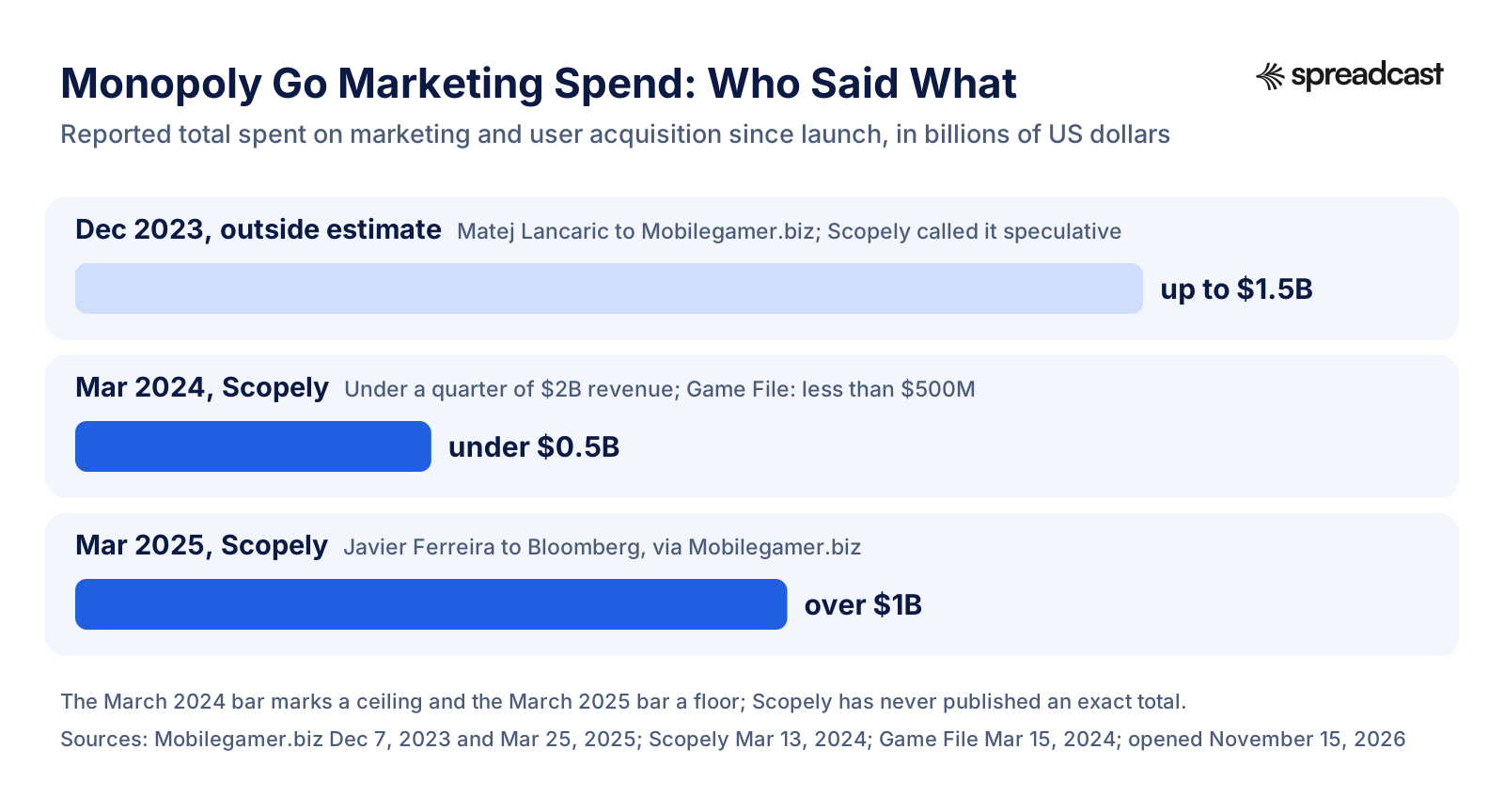
Monopoly Go's marketing budget passed $1 billion by March 2025: Scopely co chief executive Javier Ferreira told Bloomberg the studio had spent over $1 billion marketing the game. The $500 million figure you'll also see is older and was never a quote. In March 2024 Ferreira wrote that marketing was under a quarter of the game's $2 billion lifetime revenue, and Game File worked that out as less than $500 million. The strategy behind the spend is simple to state: buy ads only as fast as they pay back, while a game built around friends does much of the selling for free. The money bought localized ads in every country, a celebrity TV campaign with Will Ferrell voicing Mr. Monopoly and a constant stream of performance creative, but Scopely credits as much to friend invites, sticker trading, Facebook and Discord communities, two month seasons of events and crossovers with Marvel, Star Wars and The Simpsons. By Scopely's count the game reached $5 billion in gross bookings in 24 months, the fastest of any mobile game, and it says lifetime player spending passed $8 billion by summer 2026.
This page answers the budget question first, with who said what and when, then takes the rest of the strategy apart from Scopely's own posts, Hasbro's filings and trade press interviews. Most of it needs a nine figure budget and a famous board game. The part that doesn't, a steady rhythm of posts tied to your releases, your community and your seasons, is the part a small studio can run this week.
| Monopoly Go key facts | Figure | Source and date |
|---|---|---|
| Developer and publisher | Scopely, founded in 2011, based in Culver City, California; the game is made with Hasbro, which owns the MONOPOLY brand | Scopely newsroom, November 2024 |
| Owner | Savvy Games Group, in a deal valued at $4.9 billion that closed July 12, 2023; Savvy is backed by Saudi Arabia's Public Investment Fund | Scopely, April 2023; Savvy Games Group, November 2026 |
| Launch | Worldwide on April 12, 2023, after seven years of development | Scopely launch post; Javier Ferreira's letter, March 2024 |
| Players | 10 million+ daily players, over 8 million of them playing every day of the week; 150 million+ downloads | Ferreira's letter, March 13, 2024 |
| Marketing spend | Over $1 billion in total by March 2025; under a quarter of lifetime revenue, so less than $500 million, in March 2024 | Mobilegamer.biz on Bloomberg; Scopely; Game File |
| Revenue | $1 billion by November 2023, $2 billion by February 2024, $5 billion in gross bookings within 24 months, more than $8 billion by summer 2026; about $200 million a month in January 2026 | Scopely; Scopely, May 2025; Scopely, January 2026; Scopely, November 2026 |
| Paid to Hasbro | $112.2 million in 2024 and $168.0 million in 2025, reported as Hasbro revenue from the licensing deal | Hasbro annual report for 2025, February 2026 |
| Marketing leads | Ben Webley, named Scopely's chief marketing officer in January 2021; Jamie Berger, senior vice president of marketing for Monopoly Go | Scopely, 2021; Scopely, October 2026 |
| Main channels | Paid user acquisition, localized creative, celebrity TV and streaming spots, friend invites, sticker trading groups on Facebook and Discord, live ops seasons, brand crossovers, creators | Our reading of the sources on this page, November 2026 |
Monopoly Go's Marketing Budget: Who Said What
Monopoly Go's marketing budget has never been published as one exact number, and the two figures you see quoted, $500 million and $1 billion, come from different moments in the game's life. Scopely is a private company owned by Savvy Games Group, so there's no annual report that breaks out what it spends on one game. Everything public comes from Scopely executives talking, and from outsiders estimating. Here's the record in order.
| When | Who | What they said | Where |
|---|---|---|---|
| December 7, 2023 | Matej Lancaric, a user acquisition consultant | Spend to date could be as much as $1.5 billion, and the game was "not even close to profitability" | Mobilegamer.biz |
| December 2023 | Scopely, in a statement | Called the estimate inaccurate and said its spend was well below the figure cited | Mobilegamer.biz, update to the same story |
| March 7, 2024 | Jamie Berger, Scopely senior vice president | Monopoly Go is very profitable on an EBITDA basis every day, every month, every quarter | Mobilegamer.biz |
| March 13, 2024 | Javier Ferreira, Scopely co chief executive | Marketing investment is still less than a quarter of lifetime revenue, which had just passed $2 billion | Scopely |
| March 15, 2024 | Stephen Totilo, Game File | Under a quarter of $2 billion means less than $500 million on marketing and user acquisition | Game File |
| March 25, 2025 | Javier Ferreira, to Bloomberg | Scopely has spent over $1 billion marketing Monopoly Go | Mobilegamer.biz |
So the famous $500 million is a piece of arithmetic, not a quote. Ferreira's own letter of March 13, 2024 says the game had passed $2 billion in lifetime revenue the month before and that the marketing investment was "still less than a quarter of lifetime revenue to date." Two days later Stephen Totilo of Game File did the sum in public: under a quarter of $2 billion meant "less than $500 million (is that all??)" on marketing and user acquisition, a figure he compared with the development budgets of PlayStation blockbusters. Most of the headlines that followed trace back to that line. Kotaku's version on March 19, 2024 set "almost $500 million" against the development costs of two Sony games: about $300 million for Insomniac's 2023 Marvel sequel, a number from hacked and leaked files, and about $220 million for The Last of Us Part II, from court documents. That comparison is why people still search for Monopoly Go's budget as if it were a movie budget.
The billion dollar figure is a direct claim, but it reached most readers secondhand. Neil Long at Mobilegamer.biz reported on March 25, 2025 that Ferreira had told Bloomberg the company had spent over $1 billion marketing Monopoly Go, in an interview mostly about Scopely's $3.5 billion purchase of Niantic's games. That interview is where the billion dollar figure behind searches like "monopoly go 1 billion marketing" comes from. Both numbers are probably right for their date. The game kept advertising between March 2024 and March 2025, and lifetime revenue went from $2 billion to about $5 billion over roughly the same stretch, according to Scopely's second anniversary letter.
Total Marketing Budget Versus User Acquisition Spend
None of these numbers splits brand marketing from user acquisition, the paid installs bought through ad networks. Ferreira's letter and Totilo's sum both cover "marketing and user acquisition" together, and the Bloomberg figure as reported is simply marketing. Until November 2024 that distinction mattered less than you'd think, because Monopoly Go hadn't run a global brand campaign. Its first global brand campaign, Friendship Pays, launched on November 18, 2024, 19 months after release. So for most of the period behind the $500 million figure, the budget was mostly a performance budget: ads bought on mobile networks and judged by how fast they paid back.
How fast is the interesting part, and it's the part most write ups skip. Ferreira wrote that Scopely's goal was to optimize spend, "meaning we were only investing our net profit into incremental marketing activities." He says the company "didn't set out to create a blitz campaign, but as the game rapidly grew, so did our marketing efforts," and that for much of the first six months it recouped campaign spend within weeks. Almost a year after launch, he put the payback at under 120 days. For comparison, he says that for most of his career a 365 day payback was the standard for games of that size, and that he's seen some companies stretch it to 730 days, two years before an ad dollar comes back. So the rule came first and the total grew out of it: as long as campaigns kept paying back that fast, Scopely kept buying.
Did Monopoly Go Cost $1 Billion to Make?
No, at least not according to anything Scopely has said. Google's suggestions show people asking "how did monopoly go cost 1 billion" and "how is monopoly go the most expensive game," but the billion is marketing, not development. Scopely has said the game took seven years to develop and that by the April 2023 launch more than 150 people from over half a dozen countries worked on it; by May 2025 Massimo Maietti put the team at over 500 game makers. Scopely hasn't published a development cost. Any page that gives you one is guessing.
How Much Monopoly Go Spends on Ads per Day
Daily spend is where the guessing gets loudest. In December 2023, Mobilegamer.biz collected estimates that ran from about $300,000 a day, from Ramiz Trtovac of GameBiz Consulting, to between $3.35 million and $4.5 million a day from Lancaric, with the Deconstructor of Fun podcast's claim of over $1 million a day in between. Trtovac's version was the most specific about where the money went: 62% of impressions in the US, around 5% in other top tier countries such as Germany, Australia, Canada, the UK and France, and most impressions served on YouTube, Facebook, Unity, Smadex and Moloco. Scopely answered that its user acquisition teams spend "in magnitudes of dollar spend well below what was cited," and Berger added at a Think Games conference in Istanbul in March 2024 that "if you have an $800 million quarterly business, you can invest aggressively and still be extremely profitable," per Mobilegamer.biz.
It hasn't slowed down. In October 2026, Mobilegamer.biz's data digest reported that Monopoly Go was the biggest advertiser among US mobile games in August 2026, according to Sensor Tower estimates, and also the top earner in that top ten with $93.8 million in US in app purchase revenue. Three and a half years after launch, the game still buys more US ad space than any other.
Our read: the budget headlines miss the story. What made Monopoly Go's spending possible was a game that paid back each ad dollar in weeks, so Scopely could keep reinvesting profit at a pace no studio could fund from savings. For a small studio the useful part is the payback logic. Your marketing spend can only grow as fast as each install earns its cost back, and that speed comes from retention and word of mouth that ads can't buy. Our guides on the LTV to CAC ratio and cost per install benchmarks show how to work out your own ceiling before you buy a single install.
Whatever user acquisition budget you have, your own channels cost nothing per post and work every day, and they're where every paid install lands to check you out. Spreadcast runs your app's marketing on those accounts, with branded posts made and scheduled for you, so the free side of your marketing looks as busy as a big launch while your ad money goes on installs. Our mobile game marketing guide covers how the two fit together for a game.
How Monopoly Go Grew: Revenue Milestones From Launch to 2026
Monopoly Go grew faster than any mobile game before it, by Scopely's account: $1 billion in about seven months, $2 billion in ten and $5 billion in gross bookings within 24 months. The game didn't start that way. Scopely's first attempt, codenamed Boardwalk, was a real time player versus player game that needed a lot of skill to build wealth. Ferreira's letter says it was a good game and tested well, but the team decided it didn't serve the whole Monopoly audience; Massimo Maietti, the game's general manager, felt a midcore game would leave millions of players behind. They started over on a project codenamed Top Hat, which became Monopoly Go. Maietti told the story less politely at GDC in March 2024. "We launched it and players really did not like it," he said of the first version, per Mobilegamer.biz. In his words, "it was the wrong game." He called it the team's "biggest and most embarrassing mistake": using the Monopoly brand to make the game the team wanted, rather than the game that fit the brand.
It launched worldwide on April 12, 2023, on the App Store and Google Play, the same month Scopely signed its sale to Savvy Games Group. By November 16, 2023 Scopely announced $1 billion in revenue, more than 100 million downloads, and revenue of more than $200 million every month, calling it the fastest casual game to reach $1 billion. Hasbro's chief executive Chris Cocks said in the same release that it was "one of the only mobile titles in history to earn $1B in under a year." In March 2024 Ferreira reported $2 billion. In a September 2024 post Scopely said the game had passed $3 billion in just 15 months.
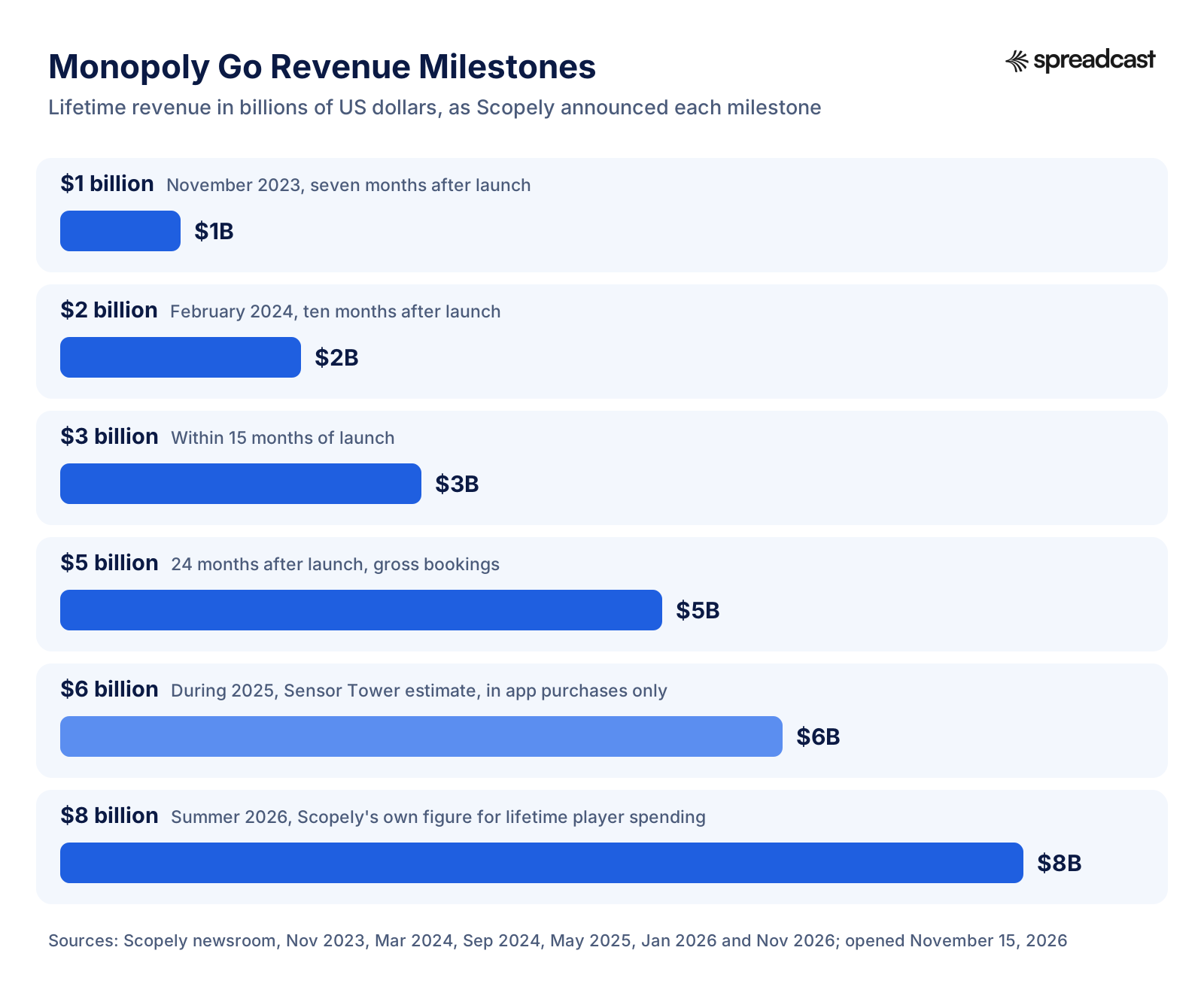
At the second anniversary in May 2025, Maietti, by then signing as President, Games at Scopely, wrote that Monopoly Go had become the fastest mobile game to pass $5 billion in gross bookings, in 24 months against a previous benchmark of 40, and compared it, lightheartedly, to the combined spending on Taylor Swift's Eras tour and the Barbenheimer box office. In January 2026 Scopely highlighted a Sensor Tower estimate that the game had passed $6 billion in lifetime in app purchase revenue during 2025, ranking it 14th on the all time mobile revenue list and the number one mobile game by 2024 in app purchase revenue. Note the fine print: Sensor Tower counts only App Store and Google Play purchases, not web shop or other revenue.
The latest figure is more than $8 billion, and it comes from Scopely. Two versions of the same interview disagree on it. PocketGamer.biz's November 10, 2026 feature says Monopoly Go has more than $6 billion in lifetime player spending, reached in time for its third anniversary that spring. Scopely's copy of the same article, credited to PocketGamer.biz, says more than $8 billion, reached over the summer. The $8 billion fits what Scopely had told the Los Angeles Times a few months earlier, that the game was expected to reach $8 billion in lifetime revenue that summer and was bringing in more than $2 billion a year. The $6 billion looks like Sensor Tower's app store only estimate for 2025 carried forward. So we use $8 billion, with the caveat that it's Scopely's own unaudited number.
One more thing in those milestones is worth seeing clearly. Scopely said the game was making more than $200 million a month in November 2023, and in January 2026 it said the game "continues to generate approx. $200 million per month." That's a game holding a very high plateau for over two years, not one still climbing. From 2024 onward the marketing job changed from winning players to keeping a giant audience busy, and you can see that shift in everything that came next: the TV campaign, the seasons, the crossovers, the chat app.

If you're making a game or an app, the timeline is a reminder that even the biggest launch of its year went quiet on brand marketing for a year and a half and let product moments carry the story. Every milestone above became a Scopely announcement, a social post and a round of trade press. Our collection of mobile app marketing examples shows smaller apps doing the same with smaller numbers, and mobile game market statistics puts these figures in context.
Your milestones are smaller, and they still deserve a post. Spreadcast watches your App Store listing and designs a rating milestone post when your app passes a round number of ratings, in your brand's colors, fonts and icon, so your 1,000th rating gets the same public moment Monopoly Go gave its first billion. It goes out at your posting times, either after you approve it or automatically.
The Hasbro License: What Monopoly Go Pays Hasbro
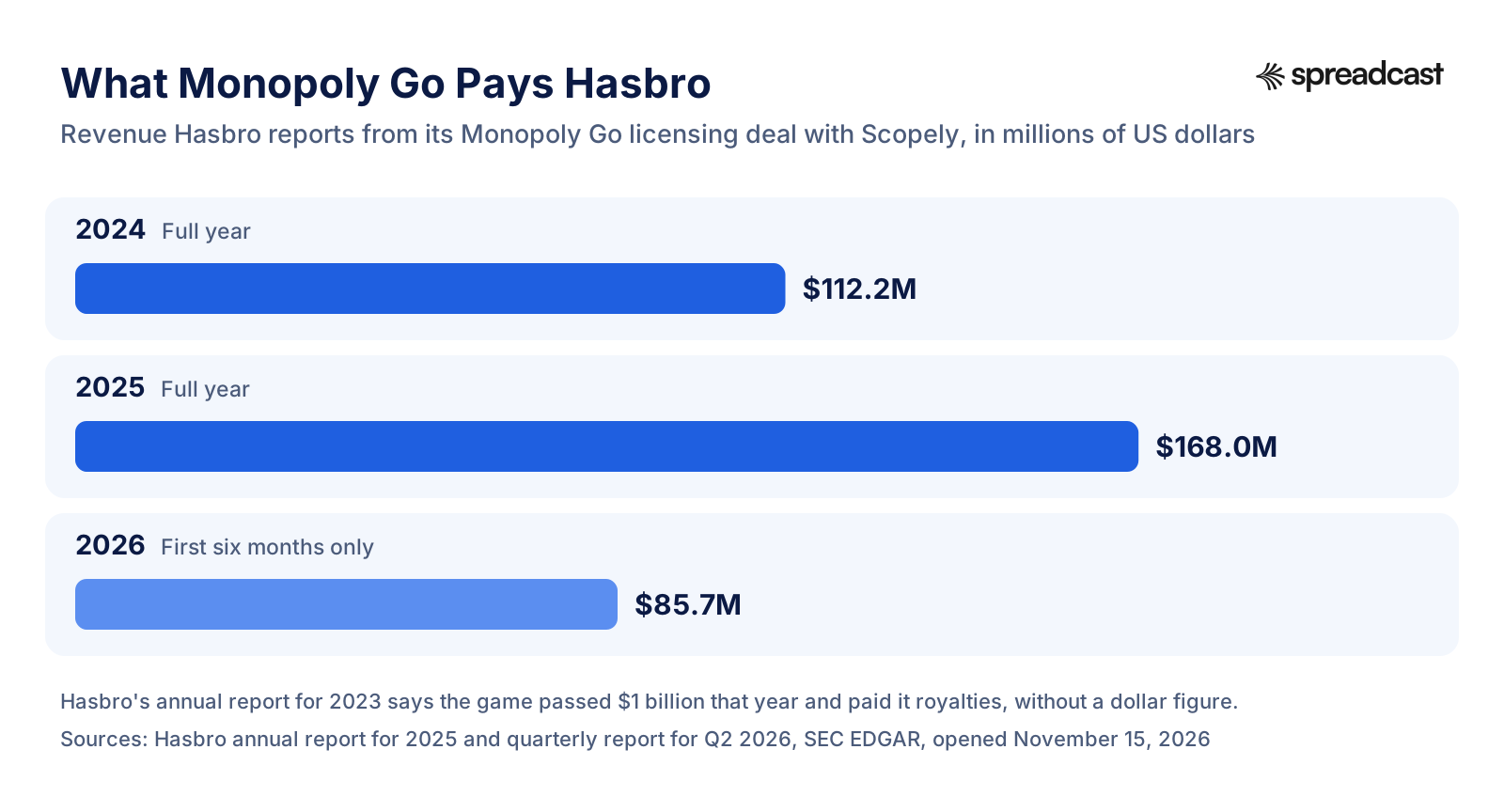
Monopoly Go is built on a license from Hasbro, which owns MONOPOLY, and Hasbro's filings are the only audited numbers anywhere in this story. Hasbro's annual report for 2023 describes Monopoly Go as a popular free to play mobile game released by Scopely, says it "surpassed $1.0 billion in revenue in 2023," and adds that Hasbro receives digital licensing royalties from it. The same report credits the game with higher revenue from MONOPOLY products overall. It doesn't give a dollar figure for the royalties that year.
From 2024 Hasbro started putting a number on it. Its fourth quarter 2024 results say Monopoly Go contributed $112 million for the full year, and the annual report for 2025 gives the precise figures: $112.2 million of revenue in 2024 and $168.0 million in 2025, from what Hasbro calls its digital licensing arrangement with Scopely. In the first six months of 2026 it was $85.7 million, $44.2 million of that in the second quarter alone, according to Hasbro's quarterly report for the period to June 28, 2026.
Neither company publishes the royalty rate, and we won't guess one: Hasbro's figure is revenue it recognizes under the deal's terms, which aren't public, so dividing it by Scopely's revenue wouldn't tell you much. What the filings do make clear is that the license is a real cost, paid on top of app store fees and ad spend. Every install Scopely buys has to earn back its share of all three, which is one more reason the payback rule mattered so much.
For Hasbro, the game is marketing too. The annual report for 2024 says digital licensing growth was led by Monopoly Go, "closing the year with a successful TV campaign and the launch of Tycoon Club," and the 2025 report ties growth in the MONOPOLY brand to both traditional games and the Scopely deal. When the $1 billion milestone landed, Chris Cocks said the game's rise "further validates our digital licensing strategy," per Scopely's release. It was Scopely's third game with Hasbro, after Yahtzee With Buddies and Scrabble GO.
Why the Monopoly Brand Did So Much of the Marketing
The license bought something no ad budget can: recognition on day one. Scopely's launch post says MONOPOLY has been part of popular culture for more than 85 years and has been played by more than one billion people. Cynthia Williams, then president of Wizards of the Coast and Hasbro Games, pointed out in the same post that the board game had already been adapted for hundreds of destinations around the world, "pioneering a localized approach," which is exactly the playbook Scopely's marketers then ran.
Maietti's version of the reason is more specific, and better. "Very few brands in the world have audiences that come into the game experience expecting, wanting, and having a predisposition to play with their friends and families," he told Brendan Sinclair of GamesIndustry.biz in 2023, in a line Scopely republished. At GDC he put it more memorably, per Mobilegamer.biz: "you get to bankrupt your dad, or your mother makes you pay rent." Monopoly isn't only famous. It's famous as a game you play with your family. Scopely built the whole product and the whole marketing around that one trait, and it's why every ad, from the first install ads to the celebrity spots, shows people playing together.
Licensing turned out to be hard work even for the licensor. At a December 2025 panel in Los Angeles, Hasbro's Barry Dorf, vice president of interactive global licensing, described a good licensing match as needing the right team, the right IP, the right project and available rights at once, "a sweet spot of a sweet spot of a sweet spot," according to Scopely's write up of the panel. The deal later spread back into the physical world: Hasbro and Scopely released a Monopoly Go board game in July 2024, a board game based on a mobile game based on a board game.
You can't license a brand a billion people know. What you can do is make sure the brand you do have shows up the same way every time, so the people who've seen you once know you the second time. Spreadcast starts there: paste your App Store or Google Play link and it reads your listing to build a brand kit from your app's colors, fonts, icon and real screenshots, then designs every post inside it. Our piece on what a brand kit actually needs explains why that consistency carries so much weight for a small app, and the free brand kit generator shows the idea on its own.
Localized Marketing: Creative Made for Every Country
Monopoly Go's launch marketing was built country by country, and Scopely calls that its most extensive and most impactful go to market strategy to date. In his March 2024 letter, Ferreira wrote that the team "knew we were facing strong headwinds" despite having the most played board game in the world, and that the marketing team pushed for a hyperlocal approach. In his words, "much of our upfront marketing investment went to developing individualized creative that reflected the language and culture of every country where the game is available."
It wasn't only creative. Ferreira says the team rebuilt its dashboards, reorganized its teams and changed how it ran analytics so that everything was measured at the country level. That's the unglamorous half of localized marketing: if your reports roll every country into one global number, you can't tell which local ads are paying back and which aren't, and you'll cut the wrong ones.
Scopely returned to the theme in January 2026, when it listed six reasons for the game's breakout alongside the Sensor Tower milestone. The sixth was what Scopely calls culturalization: going beyond translation to adapt creative assets so the game felt like "their local game" in different regions. The game itself was built the same way, by a team spread across several countries that, Ferreira says, infused it with culturally relevant ideas about how people around the world connect with Monopoly.
The money still went where the money is. Trtovac's estimate in Mobilegamer.biz put 62% of the game's ad impressions in the US in late 2023. Localization didn't mean spreading spend evenly. It meant that wherever Scopely did spend, the ad looked and sounded local.
A small studio won't make separate creative for every country, and doesn't need to. The habit that scales down is the second half of Ferreira's point: speak to each audience in its own way, and measure each place separately. On social media, the "countries" are the networks. A caption that works on TikTok reads oddly on LinkedIn. Spreadcast writes the caption for each network you've connected from the same designed post, so the picture keeps one brand look while the words fit where they land. The cross posting page shows how one post goes out to every network.
Monopoly Go's Ads: Performance Creative, TV Spots and Celebrity Campaigns
Monopoly Go's advertising runs on two tracks: a very large volume of performance ads built to win installs, and, since November 2024, celebrity brand campaigns that run on TV, streaming and social. The performance track came first and is still the bigger story.
The Performance Creative Machine
Outside analysts who studied the game's ads in 2023 found a lot of them. An analysis by the agency Liquid and Grit, quoted by Mobilegamer.biz, said that among leading casual and casino apps, Monopoly Go was second only to Royal Match in the number of ad creatives shown. The same analysis sorted the ads into three kinds: ads that highlight the Monopoly brand, ads about piling up wealth and upgrades, and ads about playing with and against other people. That makes for a wide funnel, with a different hook for each kind of player.
It also noted Scopely's "unusually frequent" use of interactive ads, the kind players can tap and try, which cost more to build but, by that analysis, have the lowest cost per install of any mobile game ad format. Trtovac, in the same article, said the top performing creatives were usually videos. Treat all of this as outside observation from ad intelligence tools, not Scopely's own data. Scopely hasn't published its creative strategy in detail.
The Monopoly Go Commercial: Friendship Pays
The first global brand campaign arrived on November 18, 2024. Scopely's announcement describes "Friendship Pays": Will Ferrell as the voice of Mr. Monopoly, with Jason Momoa, Keke Palmer and Chris Pratt playing themselves as "Momoney," "Keke GoGo" and "Extra Chrispy" in GOville, a town that mixes the real world with the game's world. The rollout was more than 20 original videos, including two 45 second TV spots, on TV, streaming, social and digital platforms. The agency was Omelet, and Henry Scholfield directed the TV ads. Scopely said "Friendship Pays" would be a long term creative concept spanning multiple campaigns, with Ferrell continuing as Mr. Monopoly.
Look at what the ads sell. Not the board, not the prizes. Jamie Berger, senior vice president of marketing for Monopoly Go, said the spots "capture the emotional rollercoaster of playing the game, where friends turn into rivals and then friends again, with just a roll of the dice." The scenes show the game's social mechanics: opening the Community Chest needs help from at least five friends, partner events have players team up, and friends knock down each other's landmarks and rob each other's banks. Marketing Dive read the timing as defensive: in its telling, Scopely was paying big stars to keep the game on top during a noisy holiday season, because popularity in mobile can be fleeting.

The campaign won a Bronze Clio Entertainment Award in the AV campaign category in November 2025, per Scopely, and Hasbro's annual report for 2024 calls the year end push "a successful TV campaign." Scopely hasn't said what it cost.
Tycoon Island and The Dice Life
The brand work since then has leaned into parody. In January 2025, Scopely launched Tycoon Island, a video series styled as a reality show, with five contestants, one mansion and plenty of drama, to promote that season of the game. In July 2025 came The Dice Life, a set of 90s sitcom spoofs made by Omelet with Jake Johnson and Sunita Mani, and Ferrell back as the voice of Mr. Monopoly, as Muse by Clio reported. Ads of the World's campaign page describes it as "a digital campaign designed for user acquisition," set in GOville, with short "channel surfing" clips meant to feel like flipping channels during a commercial break.
That last detail is the tell. The Dice Life is brand style creative used for installs. The two tracks were merging: celebrity faces and sitcom jokes, cut into short clips and bought on the same networks as the playable ads. When you can afford famous people, you still measure them like a performance ad.
Most indie games won't hire Will Ferrell, and most don't need to. What every Monopoly Go ad does that you can copy for free is show the product doing its one emotional thing, in this case friends turning into rivals and back. Your posts can do the same with your app's real screens. Spreadcast's weekly plan builds feature posts from the real features on your store listing, each shown on a real screenshot inside your brand kit, plus problem and fix posts that open with the pain your app solves. If you also run paid ads, our guide on how to advertise an app covers the paid side.
Live Ops as Retention Marketing: Events, Tournaments and Seasons
Monopoly Go keeps its audience with a nonstop calendar of in game events, and Scopely counts that live operations engine as one of the main reasons for its success. Among the six factors Scopely listed in January 2026 was live operations driven by events at scale: a steady content cadence, limited time competitions and layered events that give players consistent reasons to return. The launch post already promised daily tournaments, ever changing mini games, limited time Chance Cards and milestone events lasting days.
The results show in the engagement numbers. Ferreira's letter says players logged in more than three times a day on average, and that over 8 million people played every day of the week, more than 70% of the game's 10 million plus daily players. He calls them the best retention metrics he'd seen in any free to play mobile game in his career. For a game that spends this much on installs, that retention is what makes the ads pay back. Our app retention benchmarks page shows how unusual those numbers are.
Over time the events have been organized into seasons, most around two months long, each with its own theme, sticker album and mechanics. Here's a sample of recent seasons and events from Scopely's own announcements:
| Season or event | Dates | What it added | Source |
|---|---|---|---|
| Marvel crossover | September 26 to December 5, 2024 | First ever brand collaboration: 20 sticker sets, Avengers Racers, a Marvel partners event | Scopely |
| Star Wars | From May 1, 2025, about two months | 22 sticker sets across the Skywalker Saga and The Mandalorian; Pod and Rebel Racers | Scopely |
| Fantastic Four | From July 13, 2025 | Timed to the release of The Fantastic Four: First Steps | Scopely |
| Harry Potter | From December 10, 2025 | Hogwarts, Gringotts and chocolate frog boxes in sticker packs | Scopely |
| Pets Season | February 4 to April 7, 2026 | Charity challenge with the ASPCA and RSPCA; a sticker set based on real player pets | Scopely |
| Hello Kitty and Friends | March 10 to 29, 2026 | Themed partners, treasures and racers mini games | Scopely |
| The Simpsons | June 3 to July 29, 2026 | Springfield locations as boards; The Simpsons' first dedicated mobile game experience in 13 years | Scopely |
| Happy Harvest with Looney Tunes | From July 29, 2026 | Crops on the game board and a new use for duplicate stickers | Scopely |
| Monster Mash | September 23 to November 25, 2026 | Netflix's KPop Demon Hunters and Sony Pictures' Ghostbusters in one season | Scopely |
Christian Kurlemann, Monopoly Go's vice president of product roadmap, explained the thinking to PocketGamer.biz in November 2026. New mechanics are tied to the start of a season on purpose: "Changing things in the middle of a season can significantly affect how people play, whereas introducing features as part of a new season lets the community experience them together from the start." He also says a returning player should be able to jump straight into the latest content and connect with friends right away. A season, in other words, is a relaunch every two months, with a clean starting line that gives lapsed players a reason to come back.
This is the most copyable idea in the whole strategy, and most app makers already have the raw material. You ship updates. You have seasons in your year that matter to your users. What you probably don't do is treat each of them as a dated, public event with its own look and its own posts. Monopoly Go does that every two months, and every one of those seasons is a marketing campaign that players also pay for.
Do this for your app with Spreadcast. When a new version of your app ships on the App Store, Spreadcast designs an update post about the release in your brand colors, fonts and real screenshots and queues it at your posting times, so every update gets its launch day. The weekly plan adds seasonal posts, each tied to a real feature of your app rather than a generic holiday card. Our app update announcement examples show how other apps handle release posts, Apple's in app events give your seasons a slot on the App Store itself, and the social media content calendar helps you map the year.
Monopoly Go Partnerships and Crossovers: Marvel, Star Wars and The Simpsons
Monopoly Go's crossovers bring other brands' fans into the game, and Scopely uses them to make each season feel like an event. The first came in September 2024, when Marvel heroes including the Avengers, Wolverine and Deadpool arrived with 20 sticker sets that players could trade. Eric Wood, Scopely's senior vice president of publishing, called it "the first of its kind" for the game. Star Wars followed in May 2025, then the Fantastic Four, Harry Potter, Hello Kitty and Friends, The Simpsons, Looney Tunes and, in fall 2026, KPop Demon Hunters with Ghostbusters.
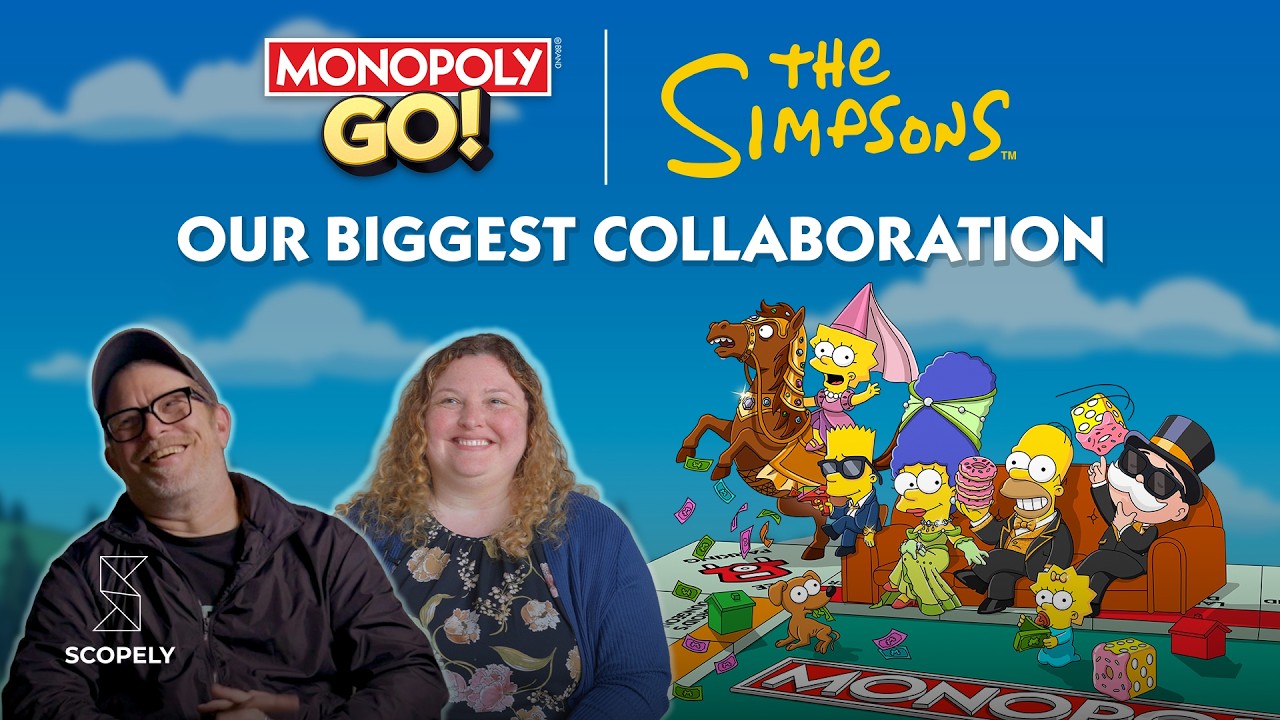
The Simpsons season shows how far this has gone. Scopely's announcement says it marked The Simpsons' first return to a dedicated mobile game experience in 13 years, with Springfield's landmarks redrawn in the game's art style and Homer, Marge, Bart, Lisa and Mr. Burns next to Mr. Monopoly. The crossover and its original animated trailer then collected most of the game's 11 MUSE Creative Awards in August 2026, in categories from social media video to brand partnerships.
Kurlemann told PocketGamer.biz that the team looks for mechanics that fit the partner's world rather than putting a brand on an existing feature. His example: in the Harry Potter season, chocolate frog boxes could appear in sticker packs with a collectible card, just like in the films, which turns a familiar Monopoly Go habit, opening a pack and hoping for something good, into something that feels native to the partner. The point, he says, is to "bring the magic of the IP into the game loop."
Real World Partnerships: Rugby, McDonald's and Dough Fest
Scopely also took the game off the phone. In February 2025 Monopoly Go became the first ever mobile games partner of Six Nations Rugby, starting at France against Wales at the Stade de France. In September 2025 it joined the US edition of the McDonald's MONOPOLY Game for the first time, with in game rewards and trips to places from the game's boards, including a prize package worth $50,000. In October 2025 came Dough Fest in London, a food festival built around a sticker album, with a doughnut created by food critic Grace Dent and Bread Ahead.
Our honest take: the crossovers are partly about installs, but they look more like retention marketing for a game that already reaches most of the people it can. Each one gives existing players a fresh album to finish and gives lapsed players a headline worth coming back for. A Star Wars season also earns press coverage the game's own update notes never would.
You won't sign Lucasfilm. You can still run a seasonal calendar where each moment connects to something your users care about that week, from tax season to back to school to the new year. Spreadcast's seasonal posts are built that way, tied to a real feature of your app, designed in your brand kit and scheduled for you. Our list of app promotion ideas includes partnership ideas that work at indie size.
Influencer and Creator Marketing: From TikTok Partnerships to the GO! Friends Creator Fund
Monopoly Go has worked with creators since its first year, and in October 2026 Scopely moved from paying for posts to funding original shows. The early signal came from outside: the Liquid and Grit analysis quoted by Mobilegamer.biz credited paid TikTok partnerships, along with localization, as instrumental, and estimated that players aged 18 to 34 made up roughly 17% of Monopoly Go's audience against 11% for Coin Master, likely helped by its success on TikTok. Webley's column describes the player run Facebook groups as discovery platforms for creator partnerships on TikTok and Instagram.
The GO! Friends Creator Fund, launched in October 2026, invites creators to pitch original series about friendship, with Monopoly Go providing the money and creative partnership. The first round, running through November, includes Leenda Dong, Symonne Harrison, Full Squad, Bianca Roth and Camille Mejia. Jamie Berger said the goal was to move past single transactional deals and build original entertainment alongside creators. Grace Hoy, director of social marketing for Monopoly Go, said: "Over the past few years, our influencer relationships have grown into real creative collaborations." The new series run on Monopoly Go's own YouTube, Instagram and TikTok accounts.
Notice where those series live. The shows are made for the brand's own channels, which means the official accounts have to be worth following in the first place. While you line up creators of your own, Spreadcast keeps your app's accounts posting branded content every week, so anyone a creator sends your way finds a feed that looks alive. If you're planning creator work for an app, our guide on how to promote an app on social media is a good place to start.
How Monopoly Go Makes Money
Monopoly Go makes its money from in app purchases inside a free game. Scopely hasn't published a breakdown of what players buy, but its statements and Sensor Tower's estimates sketch the scale. The game is the number one mobile game by 2024 in app purchase revenue, according to Sensor Tower data highlighted by Scopely, and one of the top ten apps of any kind by worldwide in app purchase revenue, ahead of Disney+, Tinder and HBO Max.
Scopely insists the money doesn't come from a tiny group of big spenders. Eric Wood told Game File it's not about "whales," the industry word for the few players who do most of the spending. The scale backs him up: in March 2024 Berger pointed to an $800 million fourth quarter, a figure he said had come out on Hasbro's investor call, per Mobilegamer.biz, and Scopely has described the game as delivering about $200 million a month since late 2023.
| Where the money goes | What we know | Source |
|---|---|---|
| Marketing and user acquisition | Under a quarter of lifetime revenue as of March 2024; over $1 billion in total by March 2025 | Scopely; Mobilegamer.biz |
| Hasbro | $112.2 million in 2024, $168.0 million in 2025, $85.7 million in the first half of 2026 | Hasbro; Hasbro |
| Development and live ops | Seven years of development; over 500 game makers by May 2025; no cost published | Scopely; Scopely |
| Profit | "Very profitable on an EBITDA basis every day, every month, every quarter," per Jamie Berger; no figure published | Mobilegamer.biz, March 2024 |
Money also flows out through the community side in ways that look like marketing spend under another name: rewards in the McDonald's game, dice giveaways, charity donations that grew when players hit a shared goal in Pets Season and a chat app with no ads or purchases at all. None of those earn directly. They keep people playing, and the people who keep playing are the ones who buy. If you're working out your own budget split, our startup marketing budget guide is a sane starting point.
What Didn't Work, and What Critics Said
Monopoly Go's marketing has drawn real criticism, mostly about whether the spending could ever pay off. The loudest version came in December 2023, when Lancaric argued that a game that had made $1 billion must have spent $1.5 billion and was "not even close to profitability." Scopely answered with a statement calling the claims inaccurate and, a few months later, with Berger's on stage line that it wanted "to put this to bed, this kind of strange debate," per Mobilegamer.biz. By Scopely's figures the critics overestimated the spend by a wide margin, but nobody outside the company can check, because Scopely doesn't publish accounts.
The product itself had a false start. Boardwalk, the first version, tested well by Ferreira's account and flopped with players by Maietti's, and it was cancelled after about three years of work, according to Mobilegamer.biz's report of his GDC talk. Ferreira admits in his letter that there were moments in the seven years when the team questioned whether it was on the right path, and plenty of times when it wasn't. No marketing budget would have rescued Boardwalk. The ads worked because the second game was built to spread through friends.
Then there's the plateau. Scopely's own words put monthly revenue at more than $200 million in November 2023 and about $200 million in January 2026. Holding that level for more than two years is remarkable, but it isn't growth, and the shift from install ads toward celebrity campaigns, crossovers, creator shows and a chat app looks like a company spending to defend an audience it already has. Hasbro's figures went up in 2025, from $112.2 million to $168.0 million, but Hasbro doesn't explain the deal's terms, so the jump can't be read as a straight measure of player spending.
And the budget numbers themselves are slippery. Two statements a year apart, under a quarter of revenue and over $1 billion, are both true and both incomplete, and most coverage quoted whichever one made the better headline. If you're comparing your own spend to Monopoly Go, compare the rule, reinvest profit and demand fast payback, not the total.
What a Small Game or App Studio Can Copy From Monopoly Go's Marketing Strategy
Monopoly Go's marketing strategy can be copied by a small studio in its habits, not its budget. If we were starting this week, this is the order we'd go in.
- Set a payback rule before a spend number. Scopely reinvested net profit and watched how fast each campaign paid back. Decide your own payback window and let it decide how much you buy.
- Build one reason to bring a friend. Not a share button, a feature that works better with three or four real people. Then point your marketing at that feature.
- Make your releases events. Every update and every season is a dated moment with its own look. Post on the day it ships, not three weeks later.
- Give your community a home and something to do there. A Discord, a group or a regular giveaway gives followers a reason to come back daily.
- Show the product's emotional moment in every ad and post. Monopoly Go shows friends turning into rivals. Find yours and put a real screen of it in front of people.
- Publish your milestones. A rating count or a download number is your version of the billion dollar announcement, and it's free.
- Keep your own channels busy while you test paid. Owned posts cost nothing per view and build the feed that every ad and creator sends people to.
What's missing from that list is everything that needs Scopely's money and Hasbro's brand: Will Ferrell, Star Wars, a billion dollars of installs. Those are real parts of the strategy and you can't buy them with an indie budget. For more tactics at small scale, read how to market an app, how to promote an app for free and, for iPhone games and apps, iOS app marketing.
This page is part of a series on how famous apps market themselves. Duolingo's marketing strategy is the case for one loud mascot posting every day, Spotify's is the case for sharing built into the product, and Netflix's is the case for treating every release as an event. Cal AI's shows creator led growth for a small team, Airbnb's the shift from search ads to brand, and Notion's templates and community. Canva's and Uber's pages cover freemium product led growth and a two sided marketplace.
Run Monopoly Go's Playbook on Autopilot With Spreadcast
Spreadcast runs your app's marketing: branded posts, made and scheduled for you. It takes the parts of Monopoly Go's playbook that don't need a nine figure budget, the event rhythm, the public milestones, the social proof and the constant presence on every network, and runs them for your app or game every week, on your own accounts, while you spend whatever user acquisition budget you have.
It starts with one link. Paste your App Store or Google Play link at Spreadcast and it reads your listing, then builds a brand kit from your app's real colors, fonts, icon and screenshots. Every post after that is designed inside the kit, so your feed looks like one brand everywhere, the way every Monopoly Go ad looks like Monopoly Go.
Then it makes your first week of posts. The weekly plan runs from one post a week up to twice a day, with choices of 1, 2, 3, 5, 7 or 14 posts a week, published at the times you pick. Here's how the plan maps to what Monopoly Go does:
| Monopoly Go tactic | What Spreadcast makes for your app |
|---|---|
| New seasons and events every few weeks | An update post designed when a new version of your app ships on the App Store |
| Seasonal themes and crossovers | Seasonal posts, each tied to a real feature of your app |
| Revenue and download milestones announced publicly | A rating milestone post when your app passes a round number of ratings |
| Friends, trading groups and player stories as social proof | Review quote posts made from your real store reviews |
| Ads that show the game's core emotional moment | Feature posts built from the real features on your listing, and problem and fix posts |
| Daily giveaways and tips in the community | Tips carousels that teach people to get more from your app |
| A constant drumbeat of branded content | A weekly plan of up to 14 designed posts, scheduled to all your networks |
You choose how hands on to be. With Approve First, every draft waits for your OK before it goes out. With Full Autopilot, posts are scheduled at your posting times automatically. The auto post to social media page explains both modes, and social media approval covers the review step if a teammate signs off on posts. Tips carousels come out of the same plan, and the Instagram carousel maker page shows the format.
Spreadcast publishes to Instagram, Facebook, LinkedIn, TikTok, YouTube, Pinterest, Threads, Bluesky, Mastodon, Telegram and Discord from one place, Discord being where Monopoly Go hosts a community of more than a million players. Analytics show followers, interactions and reach for each network as they report them. If you'd rather work from Claude or ChatGPT, Spreadcast connects through its MCP server too, covered on the Claude for social media page. The mobile apps page shows what all of this looks like for an app.
On price, Pro is $29 a month or $290 a year and includes one app with up to 10 social accounts, the brand kit, the weekly plan of designed posts, moment posts for new versions and rating milestones, publishing to your networks and the choice of approval or Full Autopilot. Studio at $79 a month covers five apps, each with its own brand and accounts, which suits a studio with a portfolio of games. Free gives you three AI posts to judge the quality before you pay anything.
Scopely spent over $1 billion on marketing and still kept its own channels busy every single day with seasons, contests and giveaways. You can have the small version of that machine today. Paste your store link at Spreadcast, look at the first week of posts it designs for your app, and decide from there.
How We Researched This
We wrote this page in November 2026, starting from primary sources. Scopely is privately owned by Savvy Games Group and publishes no financial statements, so the only audited figures are in Hasbro's filings with the US Securities and Exchange Commission: the annual reports for 2023, 2024 and 2025, the quarterly report for the second quarter of 2026 and the earnings releases for the third and fourth quarters of 2024. Everything else about revenue, players and marketing comes from Scopely's own newsroom, mainly Javier Ferreira's March 2024 letter, Massimo Maietti's second anniversary letter, the Friendship Pays release and Ben Webley's column, plus Scopely's announcements of each season and partnership.
For the budget question we went to the original reports: Stephen Totilo's Game File interview for the March 2024 figure, and Neil Long's reporting at Mobilegamer.biz on the December 2023 estimates, Scopely's profitability answer and Ferreira's Bloomberg interview. The Bloomberg article itself is paywalled, so we relied on Mobilegamer.biz's account of it. We also used Massimo Maietti's interview with GamesIndustry.biz, quoting only the lines Scopely republished, his GDC talk as reported by Mobilegamer.biz, the PocketGamer.biz interview with Christian Kurlemann and the Los Angeles Times profile of Scopely, plus campaign details from Marketing Dive, Muse by Clio and Ads of the World, and Kotaku for the budget comparisons that made the headlines. Every page linked here was opened on November 15, 2026. Revenue figures from Scopely are its own and unaudited, Sensor Tower figures are estimates, and the daily ad spend numbers are outside estimates that Scopely disputed. We left out figures we couldn't trace to a named source, including development cost, the royalty rate and follower counts. Spreadcast features described here are the ones in the product on the same date.
Frequently Asked Questions
How much did Monopoly Go spend on marketing?
Over $1 billion by March 2025, according to what Scopely co chief executive Javier Ferreira told Bloomberg. The $500 million figure is older: in March 2024 Ferreira said marketing was under a quarter of the game's $2 billion lifetime revenue, which Game File worked out as less than $500 million.
Did Monopoly Go cost $1 billion to make?
No. The $1 billion figure is marketing spend, not development. Scopely says the game took seven years to make but has never published a development cost.
How much money has Monopoly Go made?
By Scopely's figures, $1 billion by November 2023, $2 billion by February 2024, $5 billion in gross bookings within 24 months, and over $8 billion in lifetime player spending by summer 2026. Sensor Tower estimates it passed $6 billion in app store purchases alone during 2025.
Who is in the Monopoly Go commercial?
The Friendship Pays campaign from November 2024 stars Jason Momoa, Keke Palmer and Chris Pratt, with Will Ferrell as the voice of Mr. Monopoly. The Dice Life spots from July 2025 feature Jake Johnson and Sunita Mani.
How much does Hasbro make from Monopoly Go?
Hasbro reported $112.2 million of revenue from its Monopoly Go licensing deal in 2024, $168.0 million in 2025 and $85.7 million in the first half of 2026.
Can a small studio copy Monopoly Go's marketing?
The habits, yes: a payback rule for ads, a reason to bring friends, releases treated as events and milestones posted the day they happen. Spreadcast runs the posting side from your store link, with branded posts made and scheduled for you.
Where These Facts Come From
Every outside number, rule and price on this page links to the page it was taken from.
- Reflecting on the journey of Monopoly Go, a letter from Javier FerreiraScopely
- Monopoly Go launches worldwideScopely
- Monopoly Go makes history as the biggest mobile game launch of 2023Scopely
- Monopoly Go at two, a letter from Massimo MaiettiScopely
- Sensor Tower: Monopoly Go hit $6 billion revenue milestone in 2025Scopely
- Inside the seasonal mechanics that keep Monopoly Go freshScopely
- An exciting new chapter for Scopely, on joining Savvy Games GroupScopely
- Ben Webley joins Scopely as chief marketing officerScopely
- Ben Webley on social ecosystems that transcend platformsScopely
- Friendship Pays, Monopoly Go's first global brand campaignScopely
- Friendship Pays wins a Clio Entertainment AwardScopely
- Monopoly Go welcomes Tycoon Island in a new video campaignScopely
- Monopoly Go adds Marvel heroes in its first brand collaborationScopely
- Monopoly Go and Star Wars collaborationScopely
- Monopoly Go and Marvel's Fantastic FourScopely
- Monopoly Go and Harry Potter collaborationScopely
- Hello Kitty and Friends join Monopoly GoScopely
- The Simpsons arrive in Monopoly GoScopely
- Monopoly Go earns 11 MUSE awardsScopely
- Monopoly Go welcomes Looney TunesScopely
- Monopoly Go's Monster Mash season with KPop Demon Hunters and GhostbustersScopely
- Monopoly Go's first Pets Season with the ASPCA and RSPCAScopely
- Tycoons react to winning the Pet Season sticker contestScopely
- The GO! Friends Creator FundScopely
- Scopely rolls out MONOPOLY GO!ChatScopely
- MONOPOLY GO!Chat hits number one among free apps in the USScopely
- Dough Fest, Monopoly Go's first real world festivalScopely
- World Friendship Day and the connections behind Monopoly GoScopely
- Monopoly Go joins the McDonald's MONOPOLY Game in the USScopely
- Monopoly Go becomes Six Nations Rugby's first mobile games partnerScopely
- Introducing the Monopoly Go board gameScopely
- Scopely and Hasbro discuss Monopoly Go at GamesBeat's Hollywood and Games eventScopely
- GamesIndustry.biz interview: how Monopoly Go became a social sensationScopely
- About Savvy Games GroupSavvy Games Group
- Annual report for 2023 (Form 10 K)Hasbro via SEC EDGAR
- Annual report for 2024 (Form 10 K)Hasbro via SEC EDGAR
- Annual report for 2025 (Form 10 K)Hasbro via SEC EDGAR
- Quarterly report for the second quarter of 2026 (Form 10 Q)Hasbro via SEC EDGAR
- Third quarter 2024 resultsHasbro via SEC EDGAR
- Fourth quarter and full year 2024 resultsHasbro via SEC EDGAR
- Interview: the $2 billion success of Monopoly GoGame File
- Scopely has spent over $1bn marketing Monopoly GoMobilegamer.biz
- Scopely is spending big on Monopoly Go user acquisitionMobilegamer.biz
- Is Monopoly Go profitable? Scopely's answerMobilegamer.biz
- Data digest: Monopoly Go tops the US ad spend chartMobilegamer.biz
- The embarrassing mistake that birthed Monopoly GoMobilegamer.biz
- Monopoly Go spent almost $500 million on marketingKotaku
- How Culver City based Scopely built Monopoly Go into a mobile games juggernautLos Angeles Times, via The Spokesman Review
- Making the most of Monopoly Go's false startGamesIndustry.biz
- How Monopoly Go stays fresh with seasonal mechanicsPocketGamer.biz
- Monopoly Go looks to stay on top with star studded campaignMarketing Dive
- The Dice Life campaign for Monopoly GoAds of the World
- Will Ferrell returns as the voice of Mr. Monopoly, with a 90s sitcom vibeMuse by Clio
- Video: The journey of Monopoly GoScopely on YouTube
- Video: The making of the Friendship Pays campaignScopely on YouTube
- Video: How Scopely brought The Simpsons to life in Monopoly GoScopely on YouTube
Researched and written by Mark Weizer. Last checked on November 15, 2026.
Keep Reading
- Playbooks
Canva Marketing Strategy: How Templates and SEO Grew 265 Million Monthly Users
Canva's marketing strategy from its newsroom, its founders and its own sitemaps: freemium and word of mouth, 39,603 template pages built for search, 100 languages, free plans for schools, Canva Create and the TV campaigns. Then how to run the same playbook for your own app.
- Playbooks
Uber Marketing Strategy: How a Two Sided App Won 215 Million Monthly Users
Uber's marketing strategy, taken apart from its own filings: the city by city launch playbook, ice cream and kittens, referrals on both sides, the 2018 brand reset, safety, Uber One, the Uber Eats Super Bowl ads, the ads business, what it spends and how it makes money. Then how to run the copyable parts for your own app.
- Playbooks
Netflix Marketing Strategy: How 325 Million Paid Memberships Were Won
Netflix's marketing strategy, read from its own filings: originals as ads, personalized artwork, the Top 10, Tudum, live events, the ads plan and paid sharing. Then how to run the same release driven playbook for your own app.
Social Features as Marketing: Friends, Invites and Sticker Trading
Monopoly Go's cheapest and probably most powerful marketing channel is built into the game: features that only work if you bring friends. Ferreira's letter says players had sent more than 450 million friend requests by March 2024 and that much of the game's growth is driven by players sharing it with each other, and he describes the combination of marketing and a highly social, community driven game as a flywheel. Players share their wins and losses, and that pulls in more players.
The numbers grew with the game. Scopely counted 150 million friend invites by November 2023, and by the second anniversary Maietti reported over 500 million in game friend connections and 450 million player invites, plus more than 20 million players engaging with the game's community channels. Scopely's World Friendship Day post in July 2026 adds the reason it keeps pushing: players with five or more active friends in the game return most often.
Invites Built for Family, Not Strangers
The invite system works because of who it asks you to invite. Maietti's argument, in the interview Scopely highlighted from GamesIndustry.biz, was that if the game felt truly social, "so you would feel OK inviting your friends and family, the game has a chance to really scale." That's a design brief, not a marketing slogan. It meant taking skill out of the game so that anyone could keep up. At GDC he explained that progression has to include everybody, "as your brother might install the game after you, or your mother might play much more than you," per Mobilegamer.biz.
Then the rewards point at a small circle. Opening the Community Chest needs help from at least five friends, according to the Friendship Pays release, and Scopely's World Friendship Day post says players who play alongside five or more active friends return most often. Five is a family plus a couple of friends, not a contact list. You can feel the difference from the Facebook games of 2010, which rewarded you for inviting as many people as possible. Here the reward is having your sister in the game, because she's the one who'll help you open the chest tomorrow.
Maietti also wanted players to read each other. At GDC he said it mattered that you could spot character in other people's play, to be able to say "this person is generous, but demanding." We think this is the underrated part of the Monopoly Go story. The headlines are about the ad budget, but the product was designed so that playing with people you know would feel like a family game night, and that's the part that kept installs paying back in weeks.
Sticker Trading: The Feature That Built a Community Outside the Game
The sticker albums are the clearest example of a feature designed to send players somewhere else and bring them back. The launch post already pointed players to a Monopoly Go Sticker Trading Group to trade stickers and meet other players. Ben Webley, Scopely's chief marketing officer, explained the loop in a GamesBeat column Scopely republished in December 2023: sticker collecting events direct players to a Facebook group of more than 5 million players to find people with duplicates, and then send them back into the game to make the swap with their new friends.
Webley's column gives two results Scopely rarely shares. Through its in game community events, Scopely observed a 100% increase in playtime and saw new installs from friend invites rise by up to 74%. He also describes moderators dropping daily dice giveaways in Instagram stories, to get players to follow the account and give them a timely reason to go back to the game. By October 2025, sticker trading had inspired more than 3 billion exchanges worldwide, according to Scopely's post on Dough Fest, the game's first real world festival, held at London's Truman Brewery, where players who'd only met online came to trade in person.
In March 2026 Scopely turned the community into a second app. MONOPOLY GO!Chat is a free standalone chat app for players, with no ads or in app purchases, for one to one chats, group chats with up to 20 friends and team coordination during events like Tycoon Racers; Scopely said direct chat was one of the most requested features. Within weeks it reached number one among free apps on both the App Store and Google Play in the US. A companion app that tops the store charts on its own is a marketing channel in its own right.
You may not be able to build a trading economy into your app, but you can borrow the principle: give your happiest users something to share, then show the world that they're happy. The cheapest social proof you have is already sitting in your store reviews. Spreadcast turns real App Store reviews into designed review quote posts in your brand kit, and posts a rating milestone the day you pass a round number of ratings. Our guide on how to get App Store reviews helps you get more of them, and the testimonial graphic generator shows what a single quote post looks like.