Duolingo's marketing strategy is to give the product away and let people talk about it. The company tells investors it has grown mainly through word of mouth and brand buzz, with paid user acquisition only as a supplement, and in early 2023 its own blog said about 80% of users had been acquired organically, a figure its marketing chief repeated to AdExchanger that summer. Three engines feed that word of mouth: Duo the owl's "unhinged" TikTok and social accounts, the daily streak with its famous push notifications, and a handful of big stunts a year, like the five second Super Bowl ad in 2024 and the "death" of Duo in 2025. The result is an app that averaged 64.9 million daily active users in the third quarter of 2026 while spending about 12% of revenue on sales and marketing.
Most write ups about Duolingo stop at the owl. That's the fun part, and it's real, but it's the smaller half of the story. When you read Duolingo's shareholder letters, annual reports and engineering blog side by side, a different picture shows up: a company that treats retention as marketing, tests almost everything, and uses social media mostly to remind people the app exists. This page walks through all of it, with the numbers and the sources, and then shows how you can run the same playbook for your own app without a 51 person marketing team.
Every number below links to the page it came from. We opened all of them on November 15, 2026. Some figures are Duolingo's own estimates rather than audited results, like its organic share and its social impression counts, and we flag those where they come up.
Duolingo Marketing Strategy at a Glance
Duolingo is a Pittsburgh company, formed on August 18, 2011, with the app opened to the public on June 19, 2012, and these are the facts that frame its marketing as of November 2026.
| Fact | Figure | Source and date |
|---|---|---|
| Founded | Formed August 18, 2011; app public June 19, 2012; headquarters in Pittsburgh, Pennsylvania | Annual report for 2025, filed February 2026 |
| Founders | Luis von Ahn (CEO) and Severin Hacker, who met at Carnegie Mellon University | Company history in the 2025 annual report |
| Daily active users | 64.9 million in Q3 2026, up 29% on a year earlier | Q3 2026 shareholder letter, November 3, 2026 |
| Monthly active users | 153.1 million in Q3 2026, up 13% | Metrics table, Q3 2026 letter |
| Paid subscribers | 13.1 million on September 30, 2026 | Highlights page, Q3 2026 letter |
| Revenue | $1,037.6 million in 2025; $309.0 million in Q3 2026; $1,221 million guided for 2026 | Annual report for 2025 and Q3 2026 letter |
| Marketing spend | $125.7 million of sales and marketing expense in 2025, about 12% of revenue | Results of operations, 2025 annual report |
| Organic share | About 80% of users acquired organically as of early 2023; the vast majority of user growth still organic in 2026 | Duolingo Blog, February 2023; AdExchanger, August 2023; Q2 2026 letter |
| Main channels | Word of mouth, Duo's social accounts (TikTok first), push notifications and email, brand partnerships, creators, performance marketing | Sales and marketing section of the 2025 annual report; Q2 2026 letter |
| Marketing lead | Manu Orssaud, chief marketing officer, running marketing since August 2023 | Marketing Brew, January 2024 |
If you want the comparison with another subscription app that grew through a famous campaign, read our Spotify marketing strategy breakdown next. For a much smaller app with a very different budget, read the Cal AI marketing strategy page.
How Did Duolingo Become So Popular
Duolingo became popular by building a free app people liked enough to recommend, and then spending its effort on keeping those people, not on buying new ones. It's also what the company says about itself. Duolingo's 2021 IPO filing said the business grew mainly through word of mouth rather than paid user acquisition, and the annual report for 2025 still describes a company that grew for almost a decade organically, with marketing added in recent years to "supplement" that model.
The numbers behind that claim come from Duolingo itself. In February 2023, Duolingo's Erin Gustafson wrote on the Duolingo Blog that about 80% of users had been acquired organically, "maybe they followed us on social media or heard about us from a friend", and that 7% of monthly active users paid for Super Duolingo. Later that year, growth lead Sean Colombo went further: about 90% of DAU growth comes when new learners hear about the app from friends, family, teachers and coworkers. Duolingo measures this the low tech way. New users answer a "how did you hear about us" question at sign up, which Manu Orssaud told AdExchanger is the primary source for knowing where people come from, even though a survey is never going to be 100% accurate.
Here's the bit the owl roundups skip: Duolingo doesn't wait for word of mouth, its product team engineers it. Colombo's post works through the math. If 80% of your daily users come back tomorrow and one in five tells a friend who installs, your user count holds still. Lift retention by a single point and the curve starts to compound, and the gain grows every week because each extra user also tells friends. That's why Duolingo ran hundreds of experiments in the third quarter of 2026 alone, on things like notifications and streaks, and why its 2026 growth plan started with making the free app better.
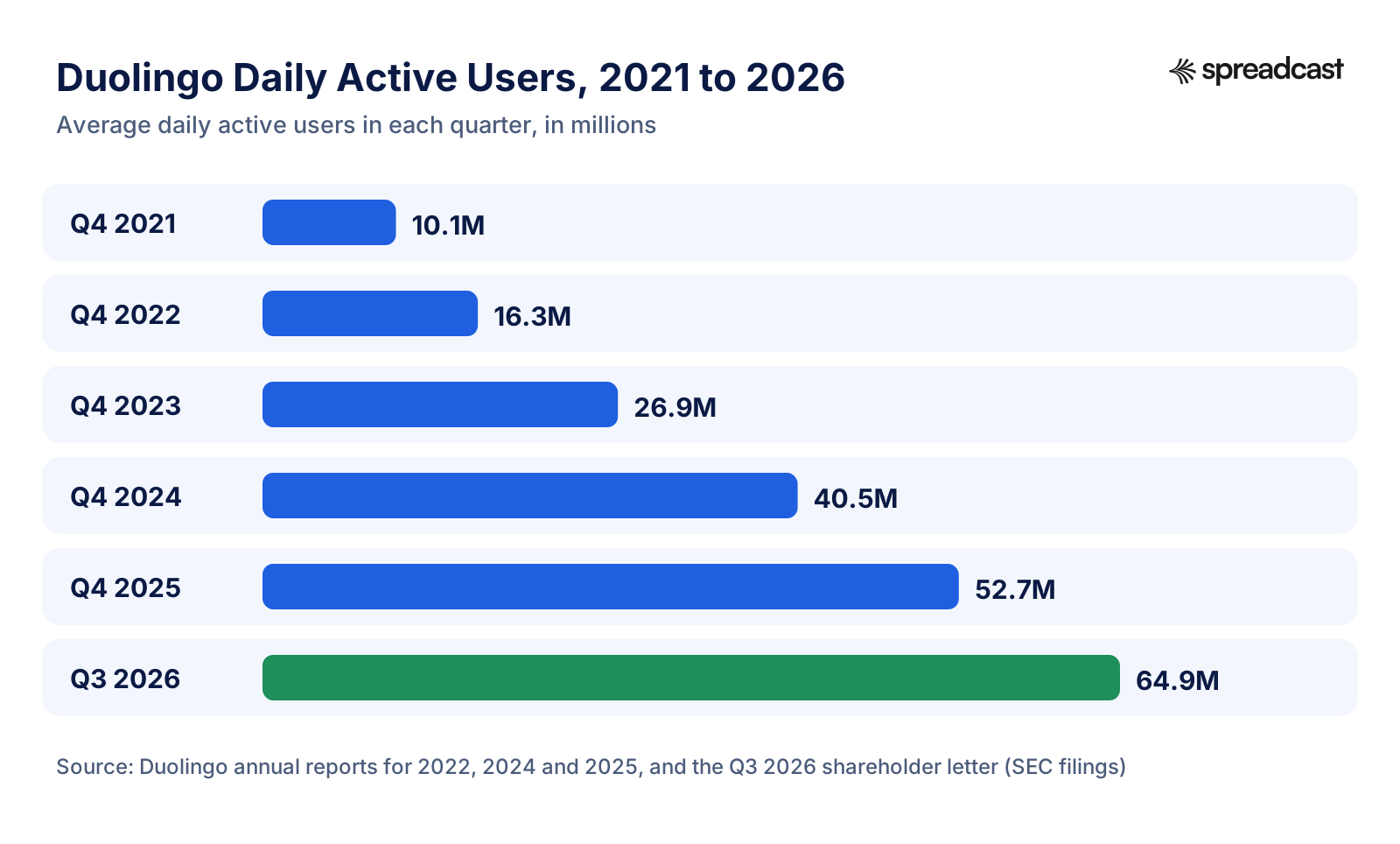
The most telling move came in early 2026. Daily user growth had slowed through 2025, and CEO Luis von Ahn wrote in the Q4 2025 shareholder letter that part of the slowdown came from Duolingo's own monetization, from small bits of friction like extra ads and upsell screens. So the company chose to give up an estimated $50 million or more of bookings, about five points of bookings growth, to make the free experience better and drive word of mouth. "Word of mouth has always been our primary growth driver," the letter says. It moved part of the monetization team onto user growth and set a goal of 100 million daily users in 2028. By the Q3 2026 letter, daily user growth had sped up two quarters in a row, to 29%.
That's a strange choice on paper. A public company with a billion dollars of revenue decided the best marketing spend available was money it didn't charge its own users. For an app maker, the lesson is uncomfortable and useful: if your free version is annoying, no amount of posting will fix your growth. Fix the thing people would recommend first, then tell the world about it every day.
Duolingo's Growth Timeline
Duolingo's marketing grew in layers over fifteen years, each one added on top of a product that was already spreading by word of mouth. This timeline puts the main moves in order, with the source for each.
| When | What happened | Source |
|---|---|---|
| 2011 to 2012 | Duolingo is formed in August 2011 and opens the app to everyone in June 2012 | Notes to the financial statements, 2025 annual report |
| 2017 | Paid subscription launches; the free app stays fully usable | Business overview, 2025 annual report |
| 2018 | Daily users stall; the team builds a growth model, focuses on current user retention and tests leaderboards | Duolingo Blog, Lenny's Newsletter |
| 2019 | Streak no longer depends on the daily goal; first Year in Review email | Duolingo Blog, Duolingo Blog |
| 2020 | Duolingo describes the bandit algorithm that picks which reminder each learner gets | Duolingo Blog |
| 2021 | IPO filing describes growth through word of mouth; Duo starts experimenting as a TikTok creator; Korean learners jump after Squid Game | IPO filing, Adweek, Duolingo Blog |
| February 2024 | Five second regional Super Bowl ad plus a push to about 4 million learners | Digiday |
| December 2024 | Learn Korean or Else campaign with Netflix for Squid Game season 2 | Marketing Dive |
| February 2025 | Duo dies, Duolingo stages a funeral, users bring him back by doing lessons | NPR, Q1 2025 letter |
| April to May 2025 | The AI first memo sets off a backlash; social posts are wiped, then restored | Entrepreneur, Marketing Interactive |
| Q3 2025 | 50 million daily users; Luckin Coffee partnership in Asia; less unhinged content for a while | Q3 2025 letter |
| Early 2026 | Strategy shift: user growth over monetization, goal of 100 million daily users in 2028 | Q4 2025 letter |
| June 2026 | Streak Revival: 15.4 million learners restore their longest ever streak | Q2 2026 letter |
| Q3 2026 | Brawl Stars and Eggy Party partnerships; 64.9 million daily users | Q3 2026 letter |
Duolingo's TikTok Strategy
Duolingo's TikTok strategy started in 2021 as an experiment by one young social media manager and turned into the most copied brand account on the platform. According to Adweek, Zaria Parvez took over the brand's dormant TikTok account after lockdown, when she was 23, and in 2021 Duolingo began treating Duo as a creator: a Squid Game parody, a crush on Dua Lipa, a "love child" with the Scrub Daddy mascot. The description of her 2023 TEDx talk says the account grew from 50,000 followers in September 2021 to 6.3 million when the talk went up. By January 2024 it had more than 8 million followers, and by April 2025 Adweek counted 16.8 million.
The tone has a name inside Duolingo: unhinged. Duo is needy, jealous, a little threatening, obsessed with Dua Lipa and permanently at war with the legal team. The joke works because it grows out of something real. Long before TikTok, Duolingo's push notifications had already made Duo a meme as the owl who guilt trips you into your lesson. TikTok gave that character a body and a voice. The content didn't invent a personality from nothing; it exaggerated the one users already knew.

It's a small team. Adweek reported that Parvez had three people supporting her in making social content, inside a marketing team of 51. Speed comes from trust more than headcount. Orssaud told Marketing Brew he rarely says no to the team's ideas, and that the brand stays away from topics that are too political or divisive. High risk posts go through a Slack chat with Orssaud and a legal and PR check, per Adweek. Everything else ships fast, because a trend is worth far less tomorrow.
The cost per post is close to nothing. Orssaud gave Marketing Brew the Barbie example: putting Duo on the pink carpet at the premiere took $300 of props and 15 minutes on site, and produced more than 150 million impressions. The cast has grown past the owl, too. Living With Lily, a YouTube Shorts series about the brand's emo character, launched in 2024 as Duolingo's first serialized show and, per Adweek, drew 10.5 million views and 100,000 new followers in its first run. The company told investors in its Q1 2024 letter that social impressions grew significantly that quarter thanks to viral content and campaigns.
Most app makers who try to copy this fail, and it isn't because they lack a mascot. Duolingo's TikTok works because tens of millions of people already have Duo in their pocket, buzzing at them every evening. The joke lands because the audience is in on it. If your app has ten thousand users, a costumed mascot dancing to a trending sound is a stranger doing a bit. Start with what your users already know about you, and build the character from there.
- Pick one voice and keep it. Duo has been the same jealous, persistent owl for years; that consistency is why fans can predict and enjoy the next bit.
- Read your comments before you plan your posts. Duolingo's team literally treats them as the brief.
- Post about the culture around your app, not only the app. Most of Duo's hits are about Dua Lipa, Barbie or Squid Game, with the app as the punchline.
- Set a short list of no go topics, then let people ship without a meeting for everything else.
For the full channel playbook, with hooks, posting times and what small apps post on TikTok, read our guide on how to promote an app on TikTok and the data on the best time to post on TikTok.
Do this for your app: while you film the skits that need a person, let the steady part of TikTok run itself. Spreadcast's TikTok scheduler sends your branded posts to your TikTok drafts on your schedule, so you add a trending sound and publish in a tap, and its TikTok slideshow maker turns your app's real screenshots and features into photo slides in your brand. Your account keeps posting on the days you're busy building, which is most days.
Duolingo Marketing Campaigns
Duolingo's marketing campaigns are few, cheap compared with the attention they get, and almost always built on the same character and the same joke: Duo really, really wants you to do your lesson. Here are the campaigns that matter, what they cost where it's known, and what Duolingo says they did.
| Campaign | When | What it was | What was reported |
|---|---|---|---|
| Year in Review | Every December since 2019 | Personal learning stats with share cards | Millions share their cards; a spike in new users after the 2021 launch (Duolingo Blog) |
| Barbie pink carpet | 2023 | Duo in pink at the movie premiere | $300 of props, more than 150 million impressions (Marketing Brew) |
| Super Bowl LVIII | February 11, 2024 | Five second regional ad, then a push to about 4 million learners | 95% of eligible learners got the push within 3.9 seconds (Duolingo Blog) |
| House of the Dragon | 2022 | HBO Max tie in; High Valyrian course updated with words from the show | More than 40% of invented language learners go on to a real language course (AdExchanger) |
| Learn Korean or Else | December 2024 | Netflix partnership for Squid Game season 2 | 40 Squid Game words added to the Korean course (Marketing Dive) |
| Dead Duo | February 2025 | Duo dies; fans revive him by doing lessons | 1.7 billion organic impressions, spend of practically nothing (Q1 2025 letter) |
| Luckin Coffee | Q3 2025 | Duolingo drinks across Asia | More than 10 million drinks sold in two weeks at over 26,000 stores (Q3 2025 letter) |
| Streak Revival | June 2026 | One time chance to restore your longest streak | 15.4 million learners revived streaks (Q2 2026 letter) |
| Brawl Stars and Eggy Party | Q3 2026 | Duo inside two mobile games, with rewards for lessons | Millions of new and returning users (Q3 2026 letter) |
The 2024 Super Bowl Ad: Five Seconds, Then a Push
Duolingo's first Super Bowl ad ran on February 11, 2024 and lasted five seconds. It aired regionally in New York, Los Angeles, San Francisco, Pittsburgh, Chicago, Miami and Detroit, showed Duo's backside, and told people to do their lesson. Orssaud's line to Digiday became the summary of Duolingo's whole approach: "it's creativity, it's not media budget."
The smart bit happened on people's phones, not on TV. Duolingo built a system to send a push notification the moment the ad aired, targeting 4 million learners in five seconds. Its previous record, according to the Duolingo Blog, was 500,000 learners in 60 seconds, and that had caused a few crashes. On the night, 95% of eligible learners got the push within 3.9 seconds and 99% within 5.7 seconds. The ad was made in house by the marketing and design teams. Three engineering teams had worked on the push since October.

So you had a tiny paid moment tied to a channel the company owns outright. The TV spot got the talk; the push turned the talk into lessons. You can't buy a Super Bowl slot, but you can copy the pairing. When you do something public, a launch, an award, a press mention, tell your own followers and your own users in the same hour.
Squid Game and Netflix: Riding What People Already Watch
Duolingo noticed the Squid Game effect before it had a deal. In October 2021 the Duolingo Blog reported roughly 40% growth in new Korean learners in the two weeks after the show premiered, compared with the week before, with no such spike the year earlier. Three years later the company turned that into a partnership. For season 2, Marketing Dive reported, Duolingo and Netflix ran Learn Korean or Else: Duo dressed as one of the show's Pink Guards, Duolingo added 40 keywords and phrases from Squid Game to its Korean course, Netflix's music lab made a remix called Korean or Get Eaten, and a TikTok filter let fans test their Korean with voice challenges.
Squid Game wasn't the first time. In 2022 Duolingo partnered with HBO Max on House of the Dragon and updated its High Valyrian course, the made up language from the show, with new words and phrases. The fan course looks like a gimmick until you see the number Duolingo gave AdExchanger: more than 40% of people who sign up to play with an invented language like High Valyrian stay to take a course in a real one. A pop culture tie in that sends fans into the core product keeps paying long after the show's finale.
The pattern is worth copying even at a small scale. Duolingo found a real behavior in its own data (people learn Korean after Korean TV) and built the campaign on it. Your app has its own version: the season when people need you most, the event your users all care about, the trend that sends new people your way. Plan posts around those moments instead of inventing reasons to post.
The Death of Duo: Duolingo's Biggest Campaign
On February 11, 2025, Duolingo announced that Duo was dead. "Tbh, he probably died waiting for you to do your lesson," the company posted, according to NPR. Over the next days the story grew into a mystery: a video showed a Tesla Cybertruck hitting the owl, Duolingo offered a reward to identify the driver, and the app ran a February challenge asking users to bring Duo back to life by doing lessons. Adweek reported that the staged TikTok funeral was watched by 66 million people, and von Ahn read a eulogy on YouTube.

Duolingo told investors in its Q1 2025 shareholder letter that Dead Duo was "one of our most successful marketing campaigns ever" and that it spent "practically nothing on it." The campaign produced 1.7 billion organic impressions and a meaningful lift in new and returning users. That quarter, daily active users reached 46.6 million, up 49% on a year earlier. We can't separate the campaign's share of that from everything else Duolingo did, and Duolingo doesn't claim to either. The same letter points out that brand moments spark growth, but the A/B tested product is the durable engine.
Killing the mascot worked because the call to action was the product. Every way to take part, from solving the mystery to bringing Duo back, ran through doing a lesson. That's the difference between a stunt that gets attention and a campaign that gets usage. Before you chase reach, decide what someone should do inside your app right after your post goes viral. If the answer is nothing, fix that first.
Do this for your app: you don't need a funeral to give people a reason to come back, you need news on a regular beat. Spreadcast watches your App Store listing and designs an update post when a new version ships, so every release gets announced in your brand the day it goes out. Its weekly plan also adds seasonal posts tied to a real feature of your app when a date is near, which is the small version of Duolingo's Squid Game timing. Start with your App Store link and see the first week of posts it plans.
The Streak and Push Notifications: Duolingo's Real Marketing Machine
The unhinged TikToks get the credit, but Duolingo's streak and its push notifications do more of the daily work of bringing people back. The streak counts the days in a row you've done a lesson, and at the end of 2025 Duolingo had about 43 million daily users on a streak of 7 days or more, and about 15 million on a streak of a year or more. That's a retention feature, a notification trigger and a social media brag, all in one number.
Duolingo has published an unusual amount of evidence on how it tuned the streak. In 2020 it found that learners who reach a 7 day streak are 2.4 times more likely to come back the next day. It also found a problem: the streak only counted if you hit your daily goal, so people with ambitious goals kept losing their streaks while using the app every day. Separating the two raised day 14 retention by 3.3% and daily active learners by 1%, and a year later just over half of daily learners had a streak of 7 days or more, up from about a third.
The tweaks kept coming. A new animation on milestone days made brand new learners 1.7% more likely to still be using the app 7 days later. Letting people equip two Streak Freezes instead of one, so a missed day doesn't wipe the streak, raised daily active learners by 0.38%. Learners who reach a 7 day streak are 3.6 times more likely to finish their course, according to the same post. Then in 2024 Duolingo made the streak social: with Friend Streak, learners who share at least one streak are 22% more likely to complete their daily lesson.
Jorge Mazal, Duolingo's former chief product officer, described the bigger picture in Lenny's Newsletter. When growth stalled in 2018, the team found that the retention rate of current users had five times the impact on daily users of the next best metric. They raised it by 21%, which he wrote cut the daily churn of the best users by over 40%. Leaderboards added 17% more learning time and tripled the number of highly engaged learners. Over four years, those efforts and others helped grow daily users 4.5 times.

How Duo Decides What to Send You
The famous passive aggressive reminders aren't written on a whim either. In 2020 Duolingo explained on its blog that it had built a bandit algorithm to pick which pre written reminder each learner gets each day, with "getting a learner to complete a lesson" as the payout. The team trained it on about 200 million practice reminders sent over 34 days. Two findings stand out. The best message varies by language: the plain "Time for" reminder, followed by the language name, worked very well for Chinese learners but usually wasn't the best option for English learners. And novelty wears off, so the algorithm deliberately avoids repeating a reminder too soon, spacing repeats with the same forgetting curve Duolingo uses for vocabulary.
Even the permission prompt gets tested. Duolingo's localization team noticed that German learners opted into notifications less often, rewrote the prompt to explain that notifications help people succeed at learning, and saw an 8% increase in opt ins. The same test in Spanish did nothing. Duolingo's lesson, in its own words, was that one size doesn't fit all, which is a decent rule for any app's copy.
The streak and the reminders count as marketing because they are how Duolingo reaches tens of millions of people every day for free, in a voice everyone recognizes. The annual report for 2025 lists "owned media marketing", meaning the personalized emails and push notifications with progress reports and lesson reminders, as one of the four parts of its sales and marketing strategy, next to brand building, paid acquisition and geographic expansion. The pushes made Duo a meme long before TikTok did, and TikTok turned that meme into a character.
Duolingo also shares the streak outward. The milestone redesign came with a share card so learners could post their 100 or 365 day streaks without leaving the app, and Year in Review turned private stats into public posts. When Duolingo made the percentile ranking the main stat on the 2021 share card, share rates went up. People share what makes them look good. Your app's milestones can do the same job, if you design them to be shown off.
For the benchmarks behind this, see our page on app retention benchmarks: most apps lose the majority of new users within days, which is why a streak style hook pays off so well.
Do this for your app: Duolingo celebrates your milestones; you can celebrate your app's. Spreadcast notices when your app passes a round number of ratings on the App Store or Google Play and designs a milestone post for it in your brand, ready to approve or already scheduled. A post that says 1,000 people have rated your app 4.8 stars is the public cousin of a streak flame. It tells new people the app is worth trying and tells your users they picked a winner. Our guide on how to get App Store reviews covers getting to those numbers in the first place, and Spreadcast handles the post when you get there.
Gamification and the Freemium Model
Duolingo's freemium model is a marketing decision as much as a pricing one: every course is free, so there's nothing stopping a friend's recommendation from turning into a new daily user. The annual report for 2025 says Duolingo intentionally doesn't put learning content behind a paywall. Anyone can use the app as long as they like and finish any course without paying. Free learners see an ad at the end of each lesson; subscribers get no ads and extra features.
Only a small share pays, and that's by design. At the end of 2025 about 9% of monthly active users were paid subscribers, up from 7% in early 2023. The other 91% aren't freeloaders in Duolingo's model. They're the audience that sees Duo, keeps streaks, shares Year in Review cards and tells friends. That's also why the company was willing to strip out friction in 2026: the free users are the marketing department.
The game mechanics sit on top of that free product. XP for every lesson, weekly leaderboards across 10 leagues that Duolingo first tested in 2018, the streak, Friend Streak, and newer collection events. The Q3 2026 letter describes Junior's Toy Hunt, where learners collected puzzle pieces to win avatar outfits, as one of the year's biggest experiment wins for getting people to complete lessons. Each mechanic gives people a reason to open the app today, and several give them something to show other people.
The tiers have changed around that core. Super Duolingo launched in 2017 and a family plan for up to six people in 2021. Duolingo Max, the higher priced AI tier, launched in 2023. In November 2026, with unlimited Video Call (its AI conversation practice) moving into Super, the company said it would stop selling new Max subscriptions and move existing individual Max subscribers to a Super family plan at the same price. Duolingo credits AI tools for a jump in how fast it makes content: it published 20,500 course units in Q1 2026 alone, up from 7,100 a quarter in 2025.
For a small app, you don't need ten leagues. You need one number your users care about and a moment where it's worth sharing. That might be days in a row, workouts logged, money saved, books finished. Then make sure the world sees those moments too, which is where your social feed comes in. Our list of app promotion ideas has more ways to turn in app moments into posts.
Do this for your app: Duolingo's gamified screens are its best ads, and yours can be too. Spreadcast's weekly plan turns your real screenshots and listed features into feature posts and tips carousels in your brand, so the parts of your app that feel like a game get shown off every week instead of once at launch. Want the carousel version on its own? The Instagram carousel maker builds multi slide posts from your app's own screens.
How Duolingo Makes Money
Duolingo makes most of its money from subscriptions: in 2025, $873.4 million of its $1,037.6 million in revenue came from Super Duolingo and Duolingo Max, about 84%. The rest came from advertising shown to free learners ($79.7 million), the Duolingo English Test ($42.0 million), in app purchases like Streak Freezes and Timer Boosts ($40.5 million), and $1.9 million of other revenue.
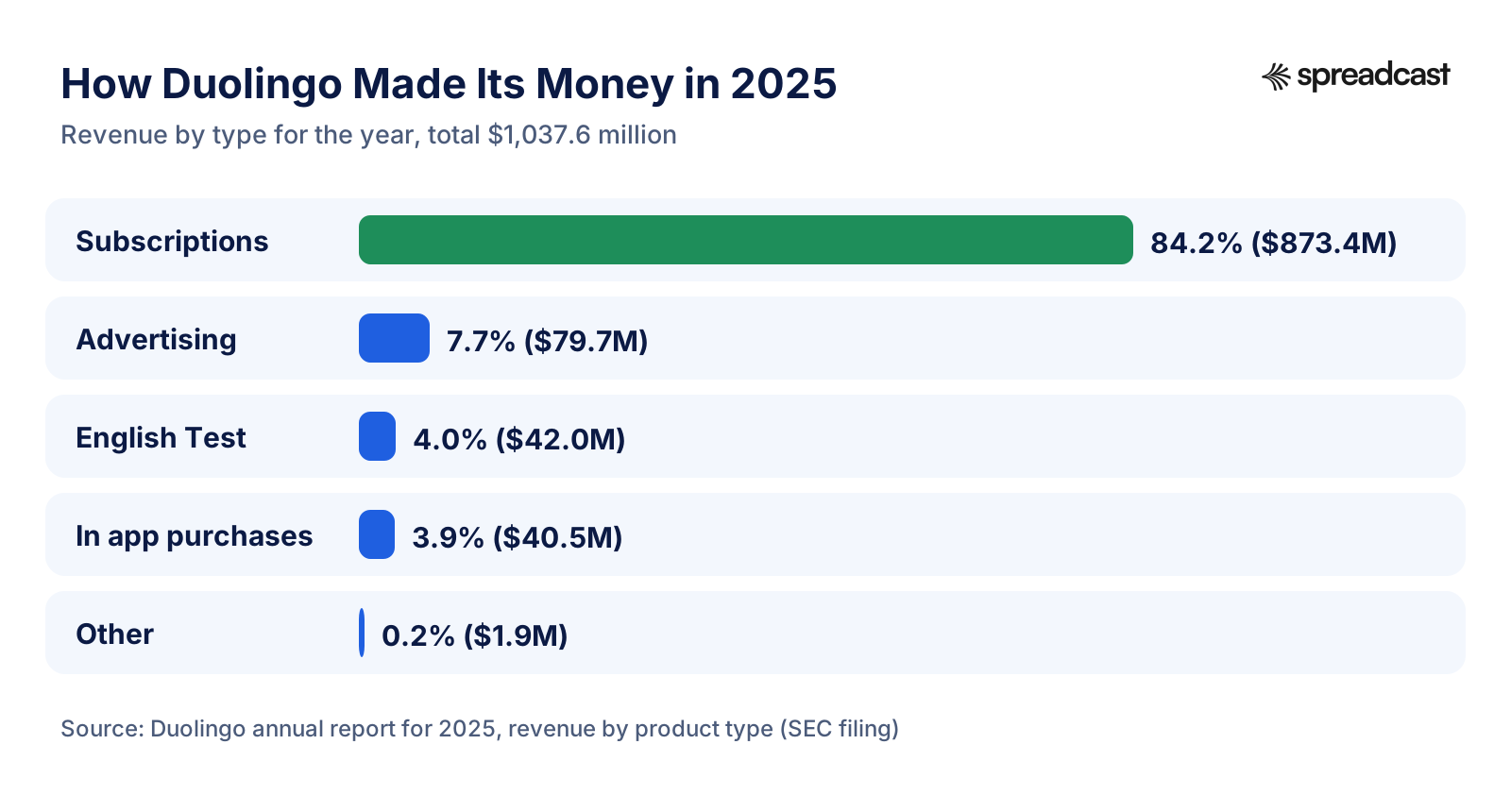
The mix is moving further toward subscriptions. In Q3 2026, subscription revenue was $270.0 million of $309.0 million, about 87%, and it grew 18% while total revenue grew 14%. Advertising was flat and in app purchases fell 38% that quarter. The Duolingo English Test, an online English exam that test takers pay for once, is a steady but small line, driven by how many universities accept it.
Note the connection to marketing. Advertising revenue depends on free users seeing ads at the end of lessons, which is exactly the friction Duolingo decided to pull back on in 2026. The company accepted lower short term bookings to grow the audience, and guided to $1,221 million of revenue for 2026, up 18%. That bet only makes sense because word of mouth, not paid ads, brings most of its new users. Each new free user costs little to acquire, so the company can afford to wait for some of them to subscribe.
How Much Duolingo Spends on Marketing
Duolingo spent $125.7 million on sales and marketing in 2025, up 39% from $90.5 million in 2024, and it stayed at about 12% of revenue for the second year running. In 2023 the figure was $75.8 million, about 14% of revenue. The annual report says most of the 2025 increase, $25.8 million, was direct marketing, with the rest in staff and technology costs.
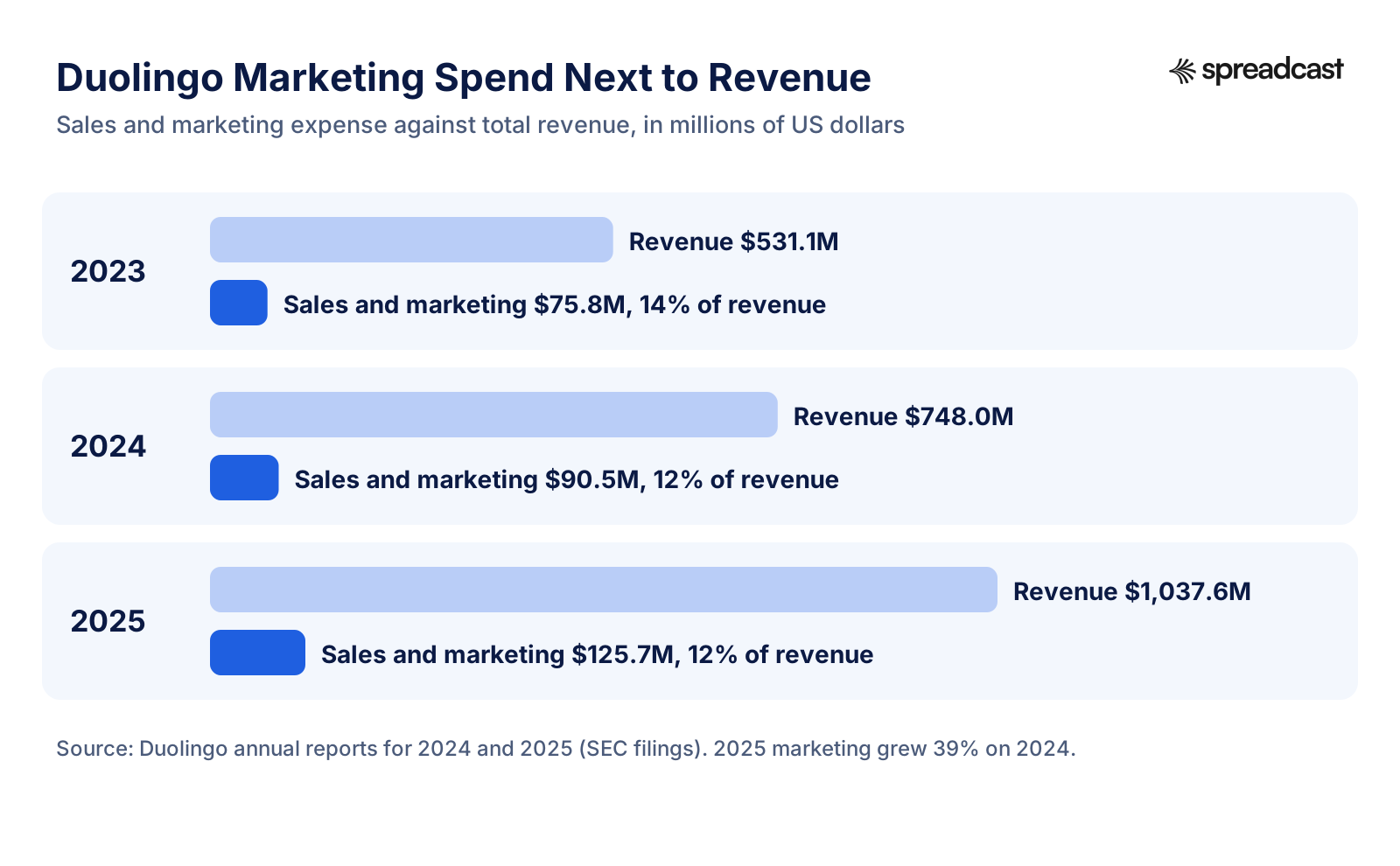
Spending is rising in 2026. Quarterly sales and marketing expense was $42.2 million in Q3 2026, up from $35.1 million a year earlier, and the Q4 2025 letter said the company expected slightly higher marketing spend as part of its user growth push. Much of the new money goes to performance marketing. In the Q2 2026 letter, Duolingo said that while the vast majority of growth is still organic, it had built a stronger performance team over the past year and tripled both the number of channels and the volume of ad creative it produces.
The $125.7 million pays for brand campaigns like the Super Bowl spot, local marketing teams and creators in growth markets, paid user acquisition aimed at users likely to stay or subscribe, and the people who make Duo's content. The annual report describes sales and marketing as mostly new user acquisition, brand marketing, digital and social media content, and staff. For context on how a smaller company might split a budget, see our page on startup marketing budgets, and for the paid side, our guide on how to advertise an app.
We think both readings of that spend matter: it's large in dollars and small as a share of revenue. The dollars mean it can do things you can't, like a Super Bowl slot or a team of 51. The share means paid media isn't what made it. Duolingo got to tens of millions of daily users first and added a real performance budget later. If you're a small app, that order is the encouraging part.
Inside Duolingo's Marketing Team
Duolingo's marketing team is bigger than its scrappy image suggests, but it's organized around making content, not buying media. Adweek counted 51 people in marketing in 2025. Within that, global senior creative director James Kuczynski leads a sub team of five focused purely on creative, and social impressions are the main measure of success for his group. Its director of marketing campaigns is known internally as the April Fools queen, and her prank work includes Love Language, a fake reality TV show pitch produced with Peacock that won at Cannes Lions.
The shift to this setup is recent. When Orssaud arrived from Spotify in 2020, Adweek reported, Duolingo's advertising was built around big TV campaigns, and they weren't driving much response. The money and attention moved to social, to the costumed Duo (originally worn by a marketing manager who happened to be the right height for the suit) and to yearly tentpoles like April Fools, which Duolingo mentions in its own letters: an April Fools brand moment in 2024 and a Duolingo themed cruise in 2025.
Forget the headcount; copy the split of attention. Duolingo puts its people on ideas and lets the steady, repeatable work run on systems: notification algorithms, experiment tooling, a content pipeline. You can make the same split with one person. Spend your own hours on the posts only you can make, like the founder video or the reply to a fan, and let software handle the daily branded posts that keep the account alive.
What an Indie App Can Copy From Duolingo, and What It Can't
Duolingo's marketing looks like a budget story from the outside, but most of what drives it costs time and discipline, not money. Here's an honest split between what a small app can realistically copy, what it can't, and the cheapest version of each.
| Duolingo tactic | Can a small app copy it | The small app version |
|---|---|---|
| Free product that people recommend | Yes, and it matters most | A useful free tier with no nagging, and a share moment built in |
| Duo, a character with one voice | Partly | A consistent voice and look on every post, even without a mascot |
| Posting every day on TikTok | Yes | Daily or near daily posts in one recognisable brand look |
| Comment section as the brief | Yes | Read replies weekly and turn the best questions into posts |
| Streak and milestone celebrations | Yes | One number users care about, plus public posts at rating milestones |
| Tested push notifications | Yes, at small scale | Two or three reminder versions, tested against each other |
| Super Bowl ad | No | A small paid push timed with a post and a push to your own users |
| Netflix and Brawl Stars partnerships | Rarely | Posts timed to the events and seasons your users care about |
| 51 person marketing team | No | Automate the steady posting and spend your hours on the creative bits |
| Performance marketing at scale | Later | Only after the free channels work; see our ads guide |
If we had to name the widest gap between Duolingo and a typical indie app, we'd pick consistency over money. Duolingo has posted as the same character, in the same tone, for years, and it reminds its users every single day. Most indie apps post in bursts around a launch, then go quiet for a month while they ship the next version. You can close that gap this week, and software can carry most of it for you. Our guide to brand consistency without a design team and our notes on what a brand kit actually needs cover the look; the rest is cadence.
If you want the wider plan around social, our guides on how to market an app and iOS app marketing cover the store, launch and channels, and mobile app marketing examples collects other apps worth studying. For founders who are the face of their app, founder led marketing is the closest thing an indie has to a Duo.
A Duolingo Style Week for a Small App
A Duolingo style week for a small app is mostly about rhythm: something every day, the same look every time, and real news when you have it. This is the routine we'd suggest to an indie developer who wants Duolingo's habits without Duolingo's budget. Adjust the days to your audience, and check the data on the best time to post on social media for your networks.
- Monday: a feature post showing one real screen of your app and the problem it solves, in your brand colors.
- Tuesday: a short video or skit in your app's voice, the closest thing you'll make to a Duo TikTok. Keep it under 20 seconds and build it on something your users already joke about.
- Wednesday: a tips carousel, five slides, each a small way to get more out of the app.
- Thursday: a review quote post from a real App Store or Google Play review, with the reviewer's words and star rating.
- Friday: whatever happened this week. A new version, a rating milestone, a press mention, a season or event your users care about.
- Weekend: read every comment and reply, then write down the questions people ask. Those are next week's posts.
Duolingo's version of this runs with dozens of people and a costumed owl. Yours can run with one person and a scheduler. The point isn't the exact days; it's that your followers see you often enough to remember you, in a look they recognize before they read the caption. That recognition is the part of Duo you can afford.
Do this for your app: Monday, Wednesday, Thursday and Friday on that list are made for you by Spreadcast from your App Store or Google Play link. Feature posts, tips carousels, review quotes, seasonal posts, update posts and rating milestones come out of the weekly plan and the moment posts, designed in your brand kit and scheduled at your times. That frees Tuesday and the weekend for the skit and the replies, which is where your own voice matters most. If you post the same thing to several networks, the cross posting page shows how one post goes everywhere at once.
Run Duolingo's Playbook on Autopilot With Spreadcast
Spreadcast runs your app's marketing: branded posts, made and scheduled for you. Take away the owl costume and the Super Bowl slot, and Duolingo's daily habit is simple to describe: post often in one look, make a fuss about milestones, and treat every release as news. That habit is exactly what Spreadcast automates for your app.
Here's how it works. You paste your App Store or Google Play link once at spreadcast.app/start. Spreadcast reads your listing and builds a brand kit from it: your app's colors, fonts, icon and real screenshots. From that kit it plans a week of branded posts. You choose how often, from one post a week up to twice a day, and the times they go out. The plan mixes post kinds the way a good social team would: feature posts from your app's real features, review quote posts from real store reviews, tips carousels, problem and fix posts, and seasonal posts tied to a real feature when a date is near.
Then it watches your app the way Duolingo's team watches its data. When a new version ships on the App Store, Spreadcast designs an update post for it. When your app passes a round number of ratings, it designs a milestone post. You never have to remember that today is a day worth posting about.
You decide how much control to keep. With approve first, drafts wait for you and nothing goes out until you tap yes; our social media approval page shows the flow. With Full Autopilot, posts are scheduled and published automatically. Either way they go to the networks you connect: Instagram, Facebook, LinkedIn, TikTok, YouTube, Pinterest, Threads, Bluesky, Mastodon, Telegram and Discord, all from one social media scheduler.
Duolingo judges its social work by impressions and the user curve. Spreadcast puts the same view in front of you from day one: social media analytics with followers, interactions and reach for each network, so you can see which posts and which networks are pulling their weight. And if you'd rather ask for posts in a chat, Spreadcast also works from Claude and ChatGPT through its MCP server.
Pricing is simple. Free gives you three AI made posts to try, so you can see your app in your own brand before paying. Pro is $29 a month, or $290 a year, and covers one app and up to ten social accounts, with clean posts, publishing to all your networks, full autopilot or one tap approval, and posting from Claude or ChatGPT. If you run several apps, Studio covers five apps with their own brands and accounts for $79 a month. Compared with hiring someone to post daily for you, it's a rounding error, and it never takes a week off. More on how it fits app teams is on our mobile apps page.
Duolingo had an owl, a 51 person marketing team and fifteen years. You have an App Store link. Paste it into Spreadcast and get your first week of branded posts, planned and ready to go out, today.
How We Researched This
We researched Duolingo's marketing strategy in November 2026 from primary sources first. On November 15, 2026 we read Duolingo's annual reports for 2022, 2024 and 2025, its 2021 IPO filing, and its shareholder letters for Q1 2024, Q1 2025, Q3 2025, Q4 2025, Q1 2026, Q2 2026 and Q3 2026, all from the SEC's EDGAR system. Every company wide user, revenue and spending figure on this page comes from those filings, and we drew the charts from them.
We then read Duolingo's own blog posts on its growth model, growth principles, notifications, streak experiments, copy tests, leaderboards, Year in Review, Friend Streak and the 2024 Super Bowl ad, plus former chief product officer Jorge Mazal's account of the 2018 growth reset. For campaigns, the TikTok team and the AI first backlash we used trade and news reporting from Adweek, Digiday, Marketing Brew, AdExchanger, Marketing Dive, NPR, Fortune, Entrepreneur and Marketing Interactive, and we watched the videos embedded above on Duolingo's, TEDx's and Lenny's Podcast's YouTube channels.
We looked for download numbers for the Super Bowl ad, Duolingo's current TikTok follower count and exact results for the Squid Game season 2 campaign, and left them out because we couldn't confirm them from a primary source or a named report. The organic share is Duolingo's own figure; Orssaud told AdExchanger that the company learns where users come from mainly through a sign up survey, which he said is never 100% accurate. The AI first sentiment numbers come from CARMA as reported by Marketing Interactive. This page was researched and written by the Spreadcast team; we're not affiliated with Duolingo.
Frequently Asked Questions
What is Duolingo's marketing strategy?
Duolingo grows mainly by word of mouth around a free app, then keeps people coming back with the streak and push notifications. On top of that, Duo the owl posts entertaining, unhinged content on TikTok and other networks, and a few low cost stunts a year, like the 2024 Super Bowl ad and the 2025 death of Duo, spread the brand further.
How much does Duolingo spend on marketing?
Duolingo spent $125.7 million on sales and marketing in 2025, about 12% of its $1,037.6 million revenue, according to its annual report. That was up from $90.5 million in 2024, and spending rose again in 2026.
Who runs Duolingo's TikTok?
Duolingo's TikTok was built by Zaria Parvez, who took over the dormant account after lockdown at 23 and turned Duo into a creator from 2021. Adweek reported in 2025 that she had three people supporting her, inside a marketing team of 51 led by CMO Manu Orssaud.
Why did Duolingo kill Duo the owl?
The death of Duo in February 2025 was a marketing campaign. Fans could only bring Duo back by doing lessons, so the stunt drove lessons, which was the point. Duolingo said it generated 1.7 billion organic impressions and cost practically nothing.
How does Duolingo make money?
Mostly from subscriptions. In 2025 subscriptions brought in about 84% of revenue, with the rest from ads shown to free learners, the Duolingo English Test and in app purchases such as Streak Freezes.
Can a small app copy Duolingo's marketing?
The expensive parts, no. The parts that matter most, yes: a free product worth recommending, one recognisable voice and look, posting on a steady schedule, and celebrating milestones in public. Spreadcast runs the steady posting for you: paste your App Store or Google Play link and it plans, designs and schedules a week of branded posts.
Where These Facts Come From
Every outside number, rule and price on this page links to the page it was taken from.
- Duolingo annual report on Form 10K for 2025Duolingo via SEC EDGAR
- Duolingo annual report on Form 10K for 2024Duolingo via SEC EDGAR
- Duolingo annual report on Form 10K for 2022Duolingo via SEC EDGAR
- Duolingo IPO registration statement (Form S1), June 2021Duolingo via SEC EDGAR
- Shareholder letter, Q3 2026Duolingo via SEC EDGAR
- Shareholder letter, Q2 2026Duolingo via SEC EDGAR
- Shareholder letter, Q1 2026Duolingo via SEC EDGAR
- Shareholder letter, Q4 and full year 2025Duolingo via SEC EDGAR
- Shareholder letter, Q3 2025Duolingo via SEC EDGAR
- Shareholder letter, Q1 2025Duolingo via SEC EDGAR
- Shareholder letter, Q1 2024Duolingo via SEC EDGAR
- Meaningful metrics: how data sharpened the focus of product teamsDuolingo Blog
- How a sense of urgency leads to growth at DuolingoDuolingo Blog
- Hi, it's Duo: meet the AI behind the memeDuolingo Blog
- The habit building research behind your Duolingo streakDuolingo Blog
- Improving the streak: forming habits one lesson at a timeDuolingo Blog
- How we brought the streak milestone to lifeDuolingo Blog
- How we adjust in app messaging for learners in different languagesDuolingo Blog
- Behind the 2024 Super Bowl commercialDuolingo Blog
- How we built a personalized Year in Review for millions of learnersDuolingo Blog
- Friend Streak: a new way to stay motivated togetherDuolingo Blog
- Squid Game could inspire a new wave of Korean language learnersDuolingo Blog
- How do Duolingo leaderboards workDuolingo Blog
- How Duolingo reignited user growth, by Jorge MazalLenny's Newsletter
- Organic marketing is Duolingo's lingua francaAdExchanger
- How Duolingo's CMO Manu Orssaud advertised around the Super BowlDigiday
- Duolingo's CMO expects the brand will be even more unhinged in 2024Marketing Brew
- The marketing strategy behind the internet's favorite green menaceAdweek
- Duolingo's owl mascot plays Squid Game with sprawling Netflix tie upMarketing Dive
- RIP Duo, the Duolingo owl. Why would the company kill its own mascotNPR
- Duolingo CEO admits controversial AI memo did not give enough contextFortune
- Duolingo's CEO clarifies AI stance after backlashEntrepreneur
- Duolingo goes rogue amid AI first backlashMarketing Interactive
- Video: Duolingo's method to the madness, Zaria Parvez at TEDxCMUTEDx Talks on YouTube
- Video: behind the product, Duolingo streaks, with Jackson ShuttleworthLenny's Podcast on YouTube
- Video: Duolingo's 2024 Super Bowl adDuolingo on YouTube
- Video: a message from Duolingo's CEO, Duo's eulogyDuolingo on YouTube
Researched and written by Mark Weizer. Last checked on November 15, 2026.
Keep Reading
- Playbooks
Canva Marketing Strategy: How Templates and SEO Grew 265 Million Monthly Users
Canva's marketing strategy from its newsroom, its founders and its own sitemaps: freemium and word of mouth, 39,603 template pages built for search, 100 languages, free plans for schools, Canva Create and the TV campaigns. Then how to run the same playbook for your own app.
- Playbooks
Uber Marketing Strategy: How a Two Sided App Won 215 Million Monthly Users
Uber's marketing strategy, taken apart from its own filings: the city by city launch playbook, ice cream and kittens, referrals on both sides, the 2018 brand reset, safety, Uber One, the Uber Eats Super Bowl ads, the ads business, what it spends and how it makes money. Then how to run the copyable parts for your own app.
- Playbooks
Monopoly Go Marketing Strategy: The Budget, the Ads and What It Bought
How much Monopoly Go spent on marketing, who said it and when, and what the money bought: localized ads, a celebrity TV campaign, friend invites, sticker trading, live ops seasons and crossovers. Then how a small studio can keep its own channels as busy as a big launch.