Uber's marketing strategy is to market two sides at once, drivers and riders, city by city, and to let the product do as much of the selling as it can through referrals, membership and the habit of opening the app. In the early years that meant hand built city launches, stunts like on demand ice cream and kittens that the press covered for free, and heavy rider discounts and driver incentives. After the scandals of 2017, new chief executive Dara Khosrowshahi reset the brand with a contrite TV campaign, a plainer black and white identity and a public safety report. Today the biggest growth levers are Uber One, which had about 55 million members in the third quarter of 2026, and Uber Eats, which brings people in who've never taken a ride. As of Uber's Q3 2026 results, 215 million people used Uber every month, up 14% in a year.
This page walks through that strategy with the numbers Uber itself filed, says which parts are worth copying if you make an app and which only work at Uber's size, and shows how to run the copyable parts for your own app without a marketing team.
| Uber key facts | Figure | Source and date |
|---|---|---|
| Founded | Launched in San Francisco on June 1, 2010 | First engineer Conrad Whelan in Fortune's oral history, June 2015 |
| Founders | Garrett Camp and Travis Kalanick; Dara Khosrowshahi chief executive since September 2017 | Uber Newsroom, June 2015, and the 2019 prospectus |
| Monthly users | 215 million monthly active platform consumers, up 14% | Q3 2026 results, November 4, 2026 |
| Drivers and couriers | 10.8 million, who took home well over $25 billion in the quarter | Q3 2026 prepared remarks, November 4, 2026 |
| Revenue | $52.0 billion in 2025, up 18%; $14.8 billion in Q3 2026, up 10% | Annual report for 2025 and Q3 2026 results |
| Gross bookings | $193.5 billion in 2025; $59.8 billion in Q3 2026, up 20% | Key metrics in the 2025 annual report and the Q3 2026 release |
| Marketing spend | $4.90 billion sales and marketing in 2025 (9% of revenue), of which $2.2 billion advertising | Annual report for 2025, filed February 2026 |
| Membership | Uber One: 46 million members at the end of 2025, about 55 million in Q3 2026 | 2025 annual report and Q3 2026 remarks |
| Main channels | City launches, referrals on both sides, discounts and incentives, Uber One, TV and Super Bowl ads, the app itself, press stunts | Our reading of the sources on this page, November 2026 |
How Uber Got Its First Users and Drivers
Uber got its first users and drivers by hand, in San Francisco. Travis Kalanick wrote on the Uber Newsroom in 2015 that the idea came from a snowy night in Paris in 2008, when he and Garrett Camp couldn't get a cab and Camp asked why you couldn't just tap a button and get a ride. Uber's first engineer, Conrad Whelan, told Fortune's Adam Lashinsky that the service officially launched on June 1, 2010, two months after he started.
The early marketing was unglamorous. Austin Geidt, who started at Uber as an intern and, in Fortune's words, became the expert on Uber's playbook for opening new markets, told the magazine she remembered handing out flyers at the Moscone Center "that no one wanted", and cold calling drivers she found on Yelp. That second detail is the part people skip. Before Uber could market a ride to anyone, it needed cars on the map, and the first cars came from a young employee phoning drivers she'd found on Yelp, one at a time.
Andrew Chen, formerly of Uber's growth team, describes how narrow the first target really was. In an excerpt from his book The Cold Start Problem, published in Lenny's Newsletter, he writes that people talk about Uber's networks as whole cities, but in the earliest days the team focused on narrow, fleeting moments like 5pm at the Caltrain station at 5th and King. Once rides happened reliably there, the team widened to the city's 7 by 7 square miles, then the East Bay and the Silicon Valley suburbs. City staff even had an internal tool, nicknamed Starcraft, for texting groups of drivers where riders were waiting.
We think this is the single most useful idea in Uber's whole history for a small app. Uber didn't try to be known everywhere. It tried to be reliable in one spot at one hour, and let the people who got a quick pickup there tell everyone else. A two sided app with thin coverage everywhere is worse than useless, because each side shows up, finds nobody and leaves.

If you're at the same stage with your own app, the lesson fits on a sticky note: pick one audience and one moment and make sure the app works there before you ask anyone else to try it. Our guides on how to get app downloads and how to market an app cover what to do once that first pocket of users exists.
Uber's City by City Launch Playbook
Uber's expansion strategy was a repeatable city launch playbook that started with drivers and then made riders aware, and the company put that order in writing in its 2019 prospectus: "When we launch our Ridesharing products in a new city, we start by onboarding Drivers and creating awareness among consumers." More drivers mean shorter waits, which attract more riders, which keep drivers busier and lets fares fall. Uber called this its liquidity network effect, and the prospectus says it's strongest in big cities and on short trips.
The playbook itself began as Geidt's notebook. She told Fortune that she took notes on everything she did while launching a city, and that she ultimately hired about 50 people, with an attitude she summed up as "ask for forgiveness". Rachel Holt, then the general manager in Washington, D.C., told the same oral history that the first ride there happened on November 18, 2011 and the official launch followed on December 15, 2011. That gap is the pattern: get supply and a few real trips running quietly, then announce.
The scale it reached is the proof the playbook worked. By June 2015, Kalanick wrote on the Uber Newsroom, Uber was available in 311 cities and 58 countries, and over 1 million drivers had given hundreds of millions of rides. By February 2016 the rebrand post put it at 400 cities in 68 countries. And by the end of 2025, the annual report says, Uber's network was moving people and food in more than 15,000 cities across more than 70 countries.
Launch Stunts: Uber Ice Cream and UberKITTENS
The launches came with stunts that turned the app into a news story. On July 13, 2012, TechCrunch reported that Uber was delivering ice cream on demand for one day in seven cities, Boston, Chicago, New York, San Francisco, Seattle, Toronto and Washington, D.C., to promote its newly diversified private rides: the week before, it had added SUVs and hybrids to its fleet of Lincoln Town Cars under the name UberX. Customers ordered and paid inside the app, and new customers got $10 gift cards. TechCrunch's headline called it brilliant marketing, and its reporter also noted the system wasn't perfect.
A year later came the kittens. Uber's own blog post from October 28, 2013 announced UberKITTENS for National Cat Day: on October 29, from 11am to 4pm, people in Seattle, New York and San Francisco could tap a KITTENS option in the app and get 15 minutes of kitten time plus cupcakes for $20, with all the money going to the local shelter. The partners were the meme site Cheezburger, the Seattle Humane Society, the ASPCA in New York and the SF SPCA, and every kitten was up for adoption. The post warned that demand would be very high and availability very limited.
Chen's excerpt in Lenny's Newsletter explains why this mattered beyond the jokes: local newspapers and social media covered the ice cream days, which helped build the rideshare network in each city. The stunts were also product demos. To get your kitten you had to open the app, see the option, request it and pay with the card on file, which is exactly what Uber wanted a first time rider to learn.
That's the bit we'd copy. The kittens weren't a random cute thing. They were a fun reason to try the exact flow the business depended on, tied to a date that already existed. Most app stunts fail because they're unrelated to what the app does, so people enjoy the joke and never touch the product.
You can run the launch side of this for your own app with Spreadcast. Every time a new version of your app ships on the App Store, Spreadcast designs an update post about it in your brand colors and fonts with your real screenshots, so each launch gets announced the day it happens instead of a week later. Its weekly plan adds seasonal posts tied to a real feature of your app, the way Uber tied kittens to National Cat Day, and they go out at the times you pick. Our collection of app launch announcement examples shows how other apps word their big days.
Marketing to Both Sides: Driver Acquisition and Rider Marketing
Uber's marketing has always had two audiences, people who drive and people who ride, and the company spends on both in different ways and in different parts of its accounts. Rider marketing looks like normal consumer marketing: TV, digital ads, promotions, referrals. Driver marketing is mostly money paid to drivers, through incentives, guarantees and referral bonuses, and it shows up partly in sales and marketing and partly as a cut to revenue.
The prospectus laid out the driver side clearly. Uber paid existing drivers to refer new ones, and it booked those payments as sales and marketing: $167 million in 2016, $199 million in 2017 and $136 million in 2018. It also paid what it called excess driver incentives, cases where the total paid to a driver ran above the revenue Uber earned from that driver. Those were $507 million in 2016, $530 million in 2017 and $837 million in 2018, and they sat in cost of revenue, not marketing. In the prospectus Uber said the 2018 jump came mainly from expanding Uber Eats.
Uber also marketed to drivers with product. After the turmoil of 2017, it ran a driver focused campaign called 180 Days of Change, starting in June 2017, which the prospectus says produced 38 new features and improvements built from driver feedback, including tipping, two minute cancellation windows, 24/7 phone support and live rider locations. In November 2018 it launched Uber Pro, a driver rewards program, in beta in eight US cities. Those are retention tools aimed at drivers, built the same way consumer apps build loyalty.
The balance between the two sides is still the main thing Uber manages. In its Q3 2026 prepared remarks, Uber said Mobility grew 1 to 2 percentage points slower than it expected because driver supply couldn't keep up with rider demand in several international markets. It blamed high fuel costs, tight local labor and competition for drivers, and named the trouble spots: driver growth lagging demand in India, Brazil still undersupplied, and Canada short of drivers after immigration slowed. Its answer was "targeted investments in driver acquisition, retention, and reactivation" where demand was outrunning supply. Sixteen years in, Uber's marketing problem is still the one Geidt had with the Yelp listings: finding enough cars.
The two sides also feed each other across products. The annual report for 2025 says that in the fourth quarter of 2025, about 58% of first time Delivery consumers were new to the Uber platform, and that people who used both rides and delivery generated more than three times the gross bookings of those who used only one. Uber says only about one in five eligible consumers was active monthly across both businesses, which tells you how much cross selling it still sees ahead.
For an app maker, the lesson is to name your two sides even if you don't think of yourself as a marketplace. A community app has posters and readers. A tutoring app has tutors and students. A booking app has businesses and customers. If you only ever market to the side that pays, the other side quietly thins out, and then the paying side leaves too.
Uber's Referral Program for Riders and Drivers
Uber's referral program pays existing users to bring in new ones on both sides of the marketplace, and Uber's own accounts treat it as customer acquisition. For riders, the annual report for 2025 describes the mechanic: a referral is earned when an existing user refers someone new who then completes a first trip or order, and it's usually paid as a credit to the person who referred them. Uber books those referrals as sales and marketing at the moment they're earned.
For drivers, the rules are on Uber's driver referrals page. A driver shares an invite code from the app and earns a reward if the friend completes a certain number of trips and meets the other conditions of the offer. Both the number of trips and the reward vary by city, and the reward follows the city where the new driver signs up. Once the friend qualifies, the money shows up on the driver's statement the following week.
The trip requirement is the clever part. Uber doesn't pay for a sign up, it pays for a driver who actually drives. That protects it from the classic referral scam where people invite fake accounts for the bonus, and it lines the reward up with the thing Uber needs, supply on the road. The prospectus shows how much Uber leaned on this early: driver referrals cost more than half a billion dollars across 2016 to 2018.
You'll find claims online that Uber's referral program returned some huge multiple of its cost, or that a precise share of riders came from referrals. We couldn't trace those numbers to anything Uber published, so we left them out. What Uber's filings do show is the shape: referral rewards are paid on a completed first trip, they're a marketing expense, and they've been part of the mix since before the listing.
For a small app, the copyable version is a referral tied to a real action, not an install. Reward the invite when the friend finishes a first workout, books a first lesson or sends a first message, and put the invite screen where people already are in the app. Our list of app promotion ideas has more ways to turn current users into promoters, and Airbnb's referral story shows what happened when a hidden program was moved into the mobile app.
Uber's Growth Strategy in Numbers
Uber's growth strategy shows up most clearly in one number it reports every quarter, monthly active platform consumers, which reached a record 215 million in the third quarter of 2026. Uber counts a person once a month if they took a ride or got a delivery, however many products they used. The chart below follows that count through the fourth quarter of each year since 2018.
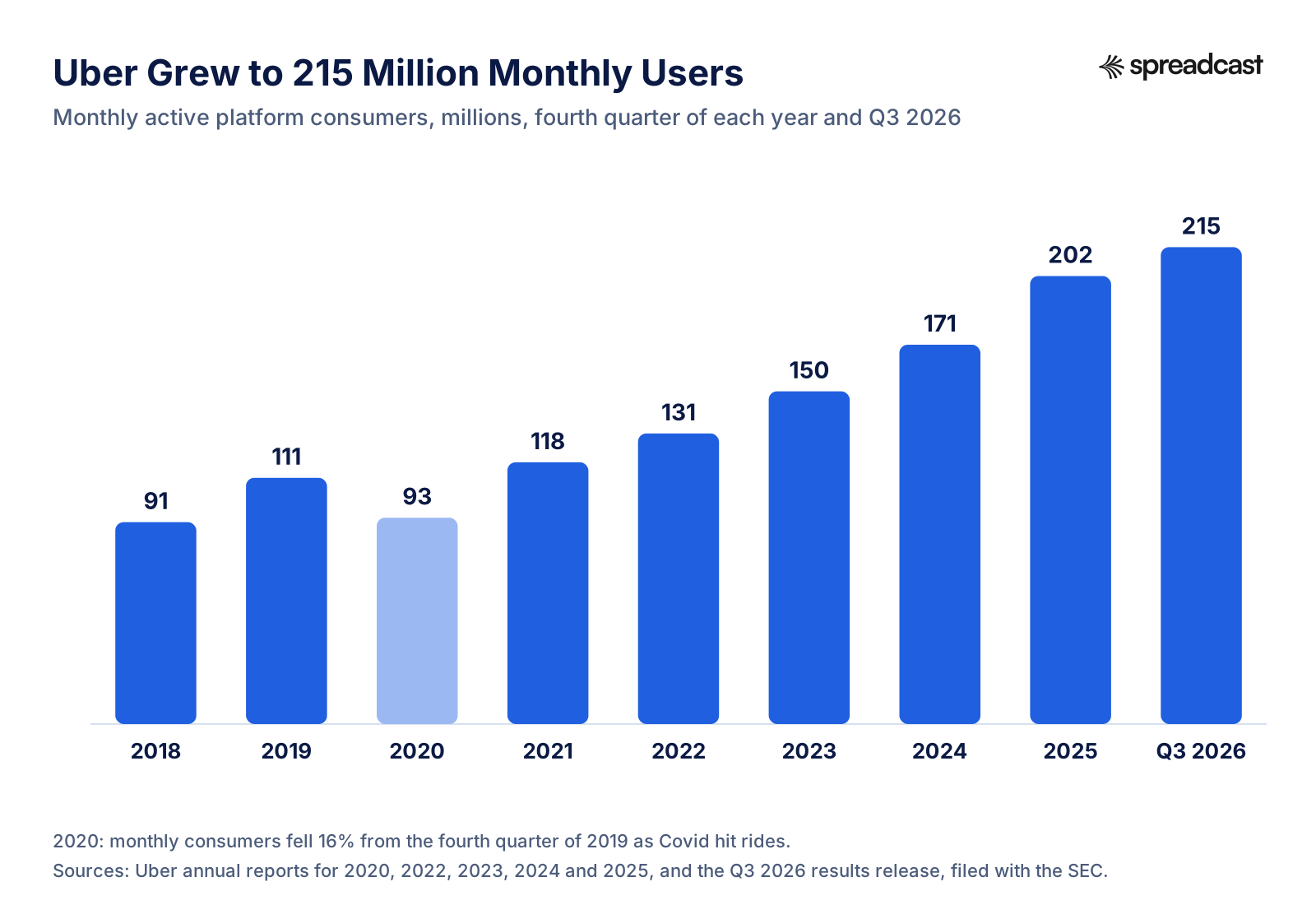
Look first at the dip. In 2020 the count fell 16% as the pandemic emptied the roads, according to the annual report for 2020. The same filing shows Mobility gross bookings down 44% that year at constant currency while Delivery gross bookings more than doubled, up 110%, so food orders kept the app open on people's phones while nobody was going anywhere. Then look at the right edge of the chart. Between the fourth quarter of 2023 and the fourth quarter of 2025 Uber added 52 million monthly users in two years, nearly as many as the 59 million it added in the five years from 2018 to 2023. That's a company at enormous scale still growing in the mid teens.
People also come back more often. The Q3 2026 prepared remarks put monthly trips per user at a record 6.3, and say the median time to book a ride is about 50 seconds and to reorder a favorite meal about 90 seconds. Speed is marketing too. Every second Uber shaves off a booking makes the app the default the next time someone needs a ride.
Notice how Uber talks about these numbers, too. The Q3 2026 remarks open with records: a record 215 million users, a record 6.3 trips each. Your app has milestones worth the same treatment, they just come in smaller sizes. When your app passes a round number of App Store or Google Play ratings, Spreadcast designs a rating milestone post in your brand kit and has it ready from its daily check of your listing, to approve with one tap or to go out on Full Autopilot. People trust an app other people are clearly using, and a milestone post says so without you having to brag.
How Much Uber Spends on Marketing
Uber spent $4.90 billion on sales and marketing in 2025, 9% of its $52.0 billion revenue, according to its annual report for 2025. Of that, $2.2 billion was advertising and $1.6 billion was discounts, loyalty programs, promotions, refunds and credits to users who aren't customers in the accounting sense. The rest is the people who work in sales and marketing, their stock based pay and a share of overhead. The filing says Uber expects the line to move with the timing of its campaigns.
| Year | Sales and marketing | Share of revenue | Advertising | Discounts, promotions and credits |
|---|---|---|---|---|
| 2016 | $1.59 billion | 41% | $693 million | $618 million |
| 2017 | $2.52 billion | 32% | $1.1 billion | $949 million |
| 2018 | $3.15 billion | 30% | $1.3 billion | $1.4 billion |
| 2019 | $4.63 billion | 36% | $1.3 billion | $2.5 billion |
| 2020 | $3.58 billion | 32% | $992 million | $2.0 billion |
| 2021 | $4.79 billion | 27% | $1.7 billion | $2.4 billion |
| 2022 | $4.76 billion | 15% | $1.7 billion | $2.2 billion |
| 2023 | $4.36 billion | 12% | $1.7 billion | $1.7 billion |
| 2024 | $4.34 billion | 10% | $1.9 billion | $1.4 billion |
| 2025 | $4.90 billion | 9% | $2.2 billion | $1.6 billion |
The figures come from the prospectus for 2016 and 2017 and the annual reports for 2020, 2022, 2024 and 2025. Each share is the percentage of revenue the filing itself reports. One caution: in its 2020 annual report Uber adjusted its 2018 and 2019 revenue to a new accounting presentation, which moved the shares. The prospectus put 2018 sales and marketing at 28% of revenue and the annual report for 2019 put 2019 at 33%; the 2020 annual report shows 30% and 36%. We used the later filing for both years. The 2016 and 2017 advertising and discount figures come from the notes to the prospectus.
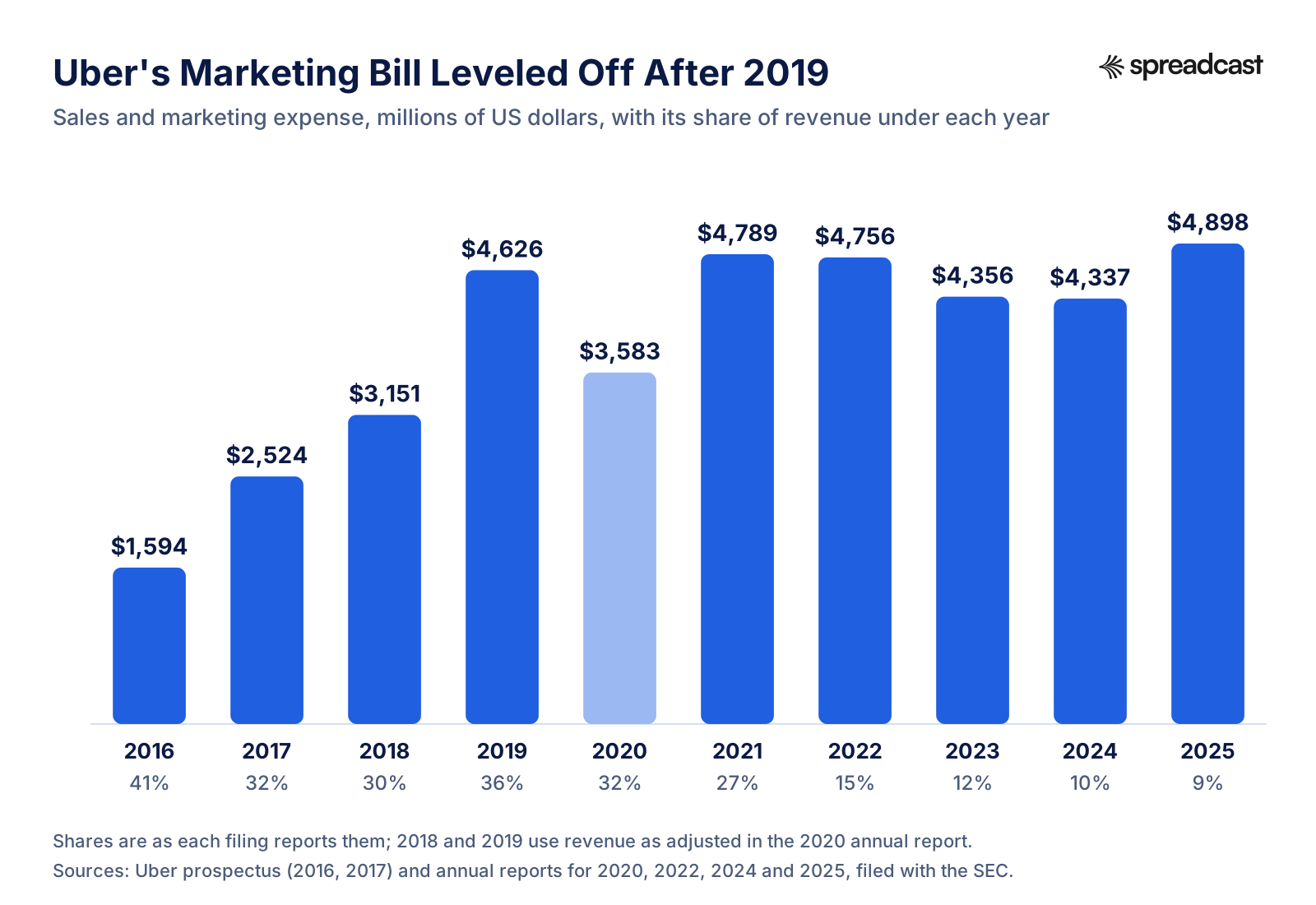
Read the chart from left to right and you see the whole story of Uber's marketing in two halves. Up to 2019, spending rose with growth, and in 2019 more than a third of revenue went to sales and marketing. After the 2020 dip, the dollar figure has sat between about $4.3 billion and $4.9 billion every year, while revenue went from $13.0 billion in 2019 to $52.0 billion in 2025. Uber didn't win by outspending everyone forever. It won by getting to a size where the same marketing bill covers four times the business.
It's rising again now. In the first nine months of 2026, sales and marketing came to $4.40 billion, up 24% from a year earlier, according to the Q3 2026 quarterly report. Uber puts most of the increase down to $389 million more in consumer discounts, promotions, credits and refunds and $279 million more in indirect advertising and marketing. Our reading: Uber is buying growth again in the markets where it's behind, and the prepared remarks say as much about driver supply.
Most app makers will never see a marketing line with a b in it. If you're setting a budget for the paid side of your app, our startup marketing budget guide and the LTV to CAC ratio explainer help you work out what a new user is worth before you pay for one, and cost per install benchmarks tell you roughly what you'll pay.
The cheaper half of Uber's marketing is the half that never stops: a recognizable brand showing up again and again until people think of it first. That needs consistency more than budget, and Spreadcast is built to supply it. Spreadcast runs your app's marketing: branded posts, made and scheduled for you. Pro is $29 a month or $290 a year and includes one app with up to 10 social accounts, a brand kit made from your store listing, a weekly plan of designed posts, update and rating milestone posts, and publishing with Full Autopilot or one tap approval. Studio, at $79 a month, covers five apps, and the Free plan lets you try three AI posts first.
Uber Rebrand: From Bits and Atoms in 2016 to the 2018 Reset
Uber has rebranded twice in three years, and the second time was a reset after the company's reputation collapsed. The first came on February 2, 2016, when Travis Kalanick introduced a new look on the Uber Newsroom built around the idea that Uber exists "where bits and atoms come together". The rider and driver app icons put a small square bit at the center, set against colors and patterns researched for each country: pink and tile patterns for Mexico, greens and Georgian architecture for Ireland, ankara fabric for Nigeria. At the time Uber was in 400 cities in 68 countries.
It didn't last. In September 2018, Uber replaced the 2016 identity with a black and white wordmark designed with the agency Wolff Olins. Dezeen reported that the 2016 circular symbol had been heavily criticized and the rebrand behind it called confusing, and that the research behind the new look boiled down to a short list: let in the light and embrace black, invest in a wordmark rather than a symbol, and bring back the U. Uber had heard from people wondering where the U went. The new identity uses a custom typeface, Uber Move, made with the Los Angeles foundry MCKL and inspired by the signs in transit hubs, with a "safety blue" saved for moments like ordering a car.
Why Uber Needed a Reset: DeleteUber and 2017
Between the two rebrands came Uber's hardest year. The prospectus describes it in unusually blunt language for a listing document. In January 2017, a backlash over accusations that Uber meant to profit from a protest against the executive order banning certain refugees and immigrants spread as #DeleteUber, a social media campaign urging people to delete the app, and "hundreds of thousands of consumers stopped using the Uber platform within days". The same filing says Uber hired Dara Khosrowshahi as chief executive in September 2017, "following many challenges regarding our culture, workplace practices, and reputation", and rebuilt its leadership team, including a new chief marketing officer, Rebecca Messina.
Moving Forward: The 2018 Campaign
In May 2018 Uber put its new boss in front of the camera. CNBC reported on May 16 that Uber was running a series of national commercials starring Khosrowshahi, a rare thing for a Silicon Valley chief executive to do. In the longer, 60 second spot he says, "Moving forward, it's time to move in a new direction." CNBC tied the campaign to the fallout from #DeleteUber and to Lyft, which said it now had more than a third of the US ride hailing market. Uber posted a version of the spot on its own YouTube channel two days before CNBC's story.

Four months later the tone flipped. On September 18, 2018, Marketing Dive reported that Uber was launching Doors Are Always Opening, made by 72andSunny in Los Angeles and, according to Ad Age, the biggest campaign in Uber's history. It debuted during NBC's Sunday night game between the New York Giants and the Dallas Cowboys, with digital banners and outdoor ads in major US cities around it. Marketing Dive noted that Uber had redesigned its app with the new logo the week before, and that the upbeat spot moved past the contrite Moving Forward ads.
Look at the order Uber did things in. First an apology from a real person, then proof of change in the product and the rules, then a new look, and only then a big, confident campaign. Uber didn't lead with the confident ad. Had it run Doors Are Always Opening in May 2018, we doubt anyone would have believed it.

For a small app, the copyable part of the 2018 reset is the plain, consistent look, not the TV money. Uber dropped a clever symbol people couldn't read for its own name in one typeface and two colors, and used it everywhere. Spreadcast gives your app the same discipline. Paste your App Store or Google Play link and it builds a brand kit from your listing, with your app's colors, fonts, icon and real screenshots, then designs every post in that kit, on every network, every week. If you want to see what a kit holds first, try the free brand kit generator, and our piece on brand consistency without a design team covers why it matters more than any single post.
Uber Safety Marketing: Trust as a Feature
Uber's safety marketing turns trust into product features and published data, because getting into a stranger's car is the objection every new rider has to get past. The prospectus lists the Safety Toolkit, launched in 2018, which put safety features on the app's home screen for both drivers and riders. Then on December 5, 2019, Uber did something most companies avoid and published a US Safety Report on the worst incidents on its platform.
Chief legal officer Tony West wrote on the Uber Newsroom that the report took 21 months and covered the most serious incidents reported in 2017 and 2018, including fatal crashes, fatal physical assaults and sexual assault. He framed it against nearly four million trips a day in the US and said more than 99.9% of trips end with no safety issue at all, while arguing that "Confronting sexual violence requires honesty". Uber made the classification system for sexual violence incidents, built with the National Sexual Violence Resource Center and the Urban Institute, open source. It committed to finding a way to share the names of drivers banned from its platform with other companies, said it was rolling out a PIN to verify your driver and a way to text 911, and planned a survivor support hotline with RAINN in 2020.
Safety has kept turning into features since. On July 23, 2025, Camiel Irving, Uber's vice president of operations for the US and Canada, announced Women Preferences in the US, with pilots in Los Angeles, San Francisco and Detroit. Women riders can request women drivers on demand, book one ahead with Reserve or set a standing preference, and women drivers can choose to get requests only from women riders. The post says Uber first launched the feature in Saudi Arabia in 2019 and has since taken it to 40 countries and over 100 million trips. On the Q3 2026 earnings call, chief financial officer Balaji Krishnamurthy named teens and women preferences among the products bringing new groups of riders to Uber in the US.
Here's what we take from Uber's safety work: the strongest trust message is a feature you can point at, backed by numbers you didn't have to publish. A safety ad saying "we care" is forgettable. A button that lets a woman choose a woman driver, and a report that admits what went wrong, are things people repeat to each other.
Most apps don't have Uber's safety problem, but every app has a trust problem with people who haven't tried it yet. The cheapest proof you own is what your current users already said about you. Spreadcast reads your real App Store and Google Play reviews and turns the best ones into review quote posts designed in your brand kit, so a stranger's first impression of your app is another user vouching for it. Need more reviews first? Our guide on how to get App Store reviews covers the asks that work, and the free testimonial graphic generator makes a single quote card by hand.
Uber One: Membership as Retention Marketing
Uber One is Uber's paid membership, and it's become the company's most important retention marketing, because a minority of users who pay for it now account for most of what's booked. Uber launched it in the US in November 2021 as a single membership across rides, delivery and grocery, according to the annual report for 2022, with discounts, special pricing, priority service and member perks. At the end of 2022 Uber had nearly 12 million members across all its membership programs, Uber One, Uber Pass, Eats Pass and Rides Pass.
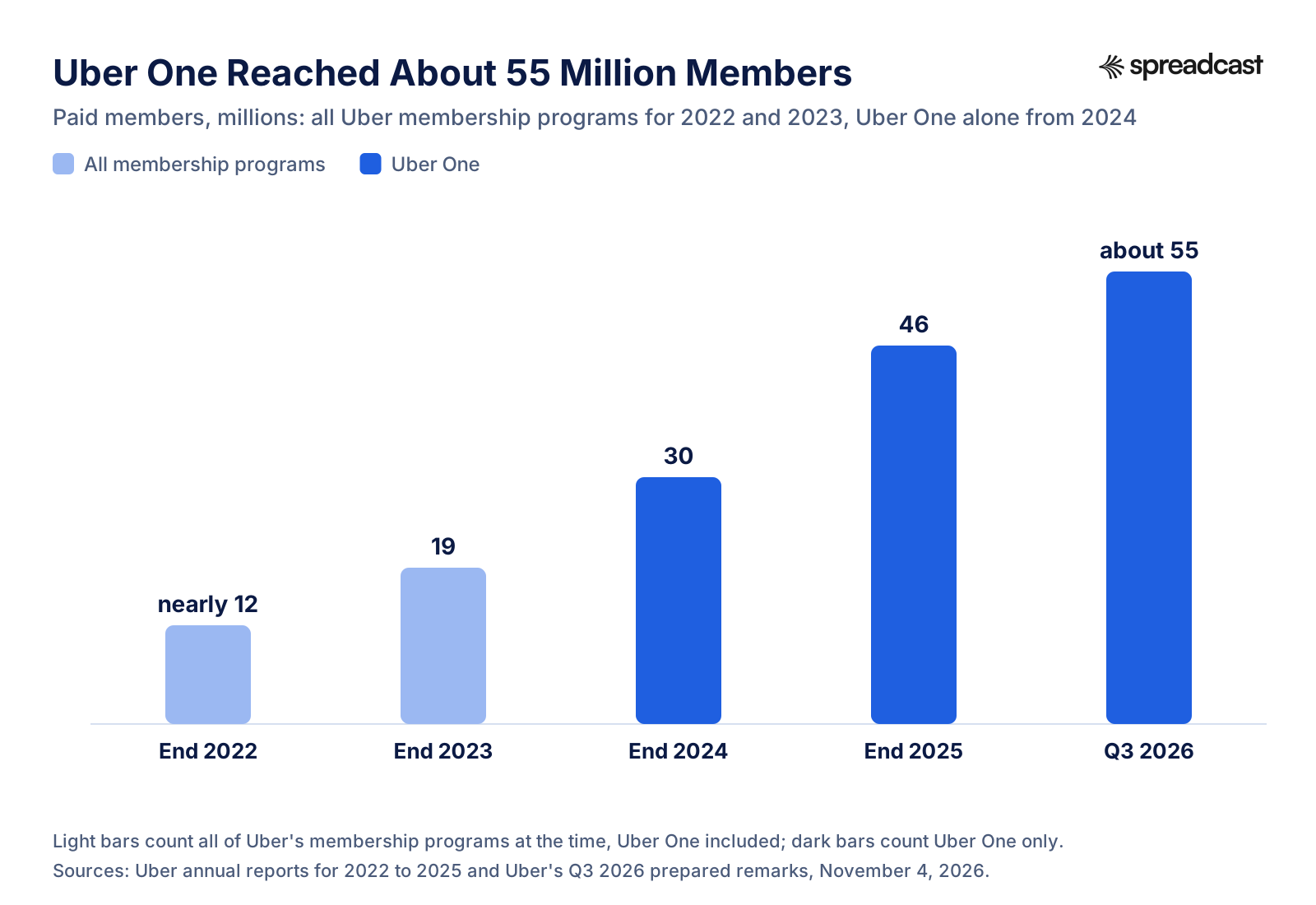
The growth since is steep. Uber exited 2023 with 19 million members across its programs, per the annual report for 2023, and the Uber One member base reached 30 million at the end of 2024, according to the annual report for 2024. In its Q4 2025 prepared remarks, Uber said Uber One grew 55% to more than 46 million members, and that more than 35% of US Mobility gross bookings now came from members. By the third quarter of 2026 it had about 55 million members, who accounted for more than half of combined Mobility and Delivery gross bookings.
Delivery is where membership bites hardest. The Q2 2026 prepared remarks say members made up more than 70% of Delivery gross bookings, up about 20 percentage points in two years, and that Uber brought back Member Days in May with exclusive offers and experiences. Uber keeps widening what membership covers: Family Sharing lets a member extend benefits to another adult and their teens at no extra cost, the Q4 2025 remarks say, and the Q3 2026 remarks promise richer rewards that grow as members ride and order more.
Membership is marketing that runs inside the product. The 2025 annual report lists what members get: discounts, cash back, special pricing, priority service and perks across rides, delivery and grocery. Each of those is a reason to open Uber instead of the rival app sitting on the same phone. We'd call it the cheapest growth Uber has, a customer who has already paid to come back.
Your app's version of Uber One is whatever makes people stay: a premium tier, a feature they'd miss, a streak. People only value those perks if they know about them, and most apps bury theirs in a settings screen. Spreadcast builds feature posts from the real features on your App Store or Google Play listing and tips carousels that teach people how to get more out of the app, both designed in your brand kit and scheduled in your weekly plan. Our guides on app retention benchmarks and how to promote an app on Instagram show where that kind of content earns its keep.
Uber Eats Marketing and the Super Bowl Ads
Uber Eats marketing runs on big celebrity TV, above all the Super Bowl, plus offers and membership perks inside the app, and it's become one of Uber's main ways to find people who've never taken a ride. The prospectus said in 2019 that Uber had launched the Uber Eats app just over three years earlier and that it was built on the same technology and regional teams as rides. By 2025, Delivery was $17.2 billion of Uber's $52.0 billion revenue, per the annual report for 2025.
| Year | Uber Eats Super Bowl campaign | What it said | Source |
|---|---|---|---|
| 2021 | Wayne's World meets Cardi B | Mike Myers and Dana Carvey as Wayne and Garth, with Cardi B, urging people to support local restaurants; the brand's first Big Game ad | Adweek |
| 2024 | Don't Forget to Remember Uber Eats | Jennifer Aniston, David Schwimmer, the Beckhams, Usher and Jelly Roll forget things so they can remember Uber Eats delivers almost, almost anything | Uber Newsroom |
| 2025 | The football conspiracy | Matthew McConaughey's theory that football was invented to make people hungry, the finale of a season long campaign | Marketing Brew |
| 2026 | McConaughey's food theory again, plus a build your own ad | McConaughey, Bradley Cooper and Parker Posey; fans could make a personalized ad in the app from over 1,000 possibilities | Tasting Table |
Uber Eats' first Super Bowl ad, in February 2021, sold the restaurants rather than the app. Adweek's David Griner wrote that it was the brand's first appearance in the Big Game, reuniting Wayne and Garth with Cardi B in an ad about local support for small business. By 2024 Uber's newsroom called it the brand's fourth year at the Super Bowl. That post, by Georgie Jeffreys, Uber's head of marketing for North America, set up the 2024 joke: you have to forget something else to remember that Uber Eats can deliver "almost, almost anything".
The 2025 campaign stretched one idea over a whole football season. Marketing Brew reported on February 4, 2025 that Matthew McConaughey anchored a season long run of ads built on the conspiracy theory that football was invented to make people hungry, capped by a 60 second Super Bowl spot with Kevin Bacon, Greta Gerwig and Sean Evans. Danielle Hawley, Uber's global head of creative and brand, called it "a love letter to football fans". The agency behind it was Special Group US.
In 2026 Uber Eats added a twist that sits closer to product marketing. Tasting Table reported on February 6, 2026 that alongside a 60 second spot in the second quarter of Super Bowl LX, with McConaughey, Bradley Cooper and Parker Posey, Uber Eats let people scan a QR code and build a personalized version of the ad inside the app, with over 1,000 possibilities and a discount code while supplies lasted. Making the ad in the app means you're in the app, which is the same trick as the kittens in 2013.
We'd flag one thing that's easy to miss under all the celebrities. Put the 2021 and 2024 ads side by side and the message has widened from your local restaurant to "almost, almost anything", grocery essentials included. The ads keep teaching people that the app does more than they assume. And the 2025 annual report shows why Uber pays for that: most first time Delivery customers in late 2025 were new to Uber altogether.
The Super Bowl is out of reach for nearly every app, but the calendar behind it isn't. Uber Eats treats the big game, the football season and the holidays as dates to show up, and you can do the same at small scale. Spreadcast puts seasonal posts in your weekly plan, each tied to a real feature of your app rather than a generic holiday graphic, and designs them in your brand kit. While you line up any creators or paid campaigns of your own, Spreadcast keeps your accounts posting on schedule. Our guide on how to promote an app on TikTok covers the video side.
Uber Advertising: The Ads Business Inside the App
Uber now sells advertising inside its own apps, which turns the attention its marketing buys into a new line of revenue. The annual report for 2025 says Uber officially launched its advertising division in October 2022 and introduced Journey Ads, which reach riders throughout a trip, alongside ads on the Uber and Uber Eats apps. Most advertising revenue comes from sponsored listings that restaurants, stores and brands pay for, charged when a user engages with the listing.
The business is growing fast. In its Q4 2025 prepared remarks, Uber said advertising was generating well over $2 billion in annualized revenue, up more than 50% in a year, and that Delivery advertising had passed 2% of Delivery gross bookings. Six months later, the Q2 2026 prepared remarks put advertising above a $2.5 billion annualized revenue run rate, still growing about 50%, with growth from big brands, grocery and retail, and ride formats such as Journey Takeovers. The Q3 2026 quarterly report shows Delivery advertising revenue up $538 million in the first nine months of 2026.
There's a wider number too. In the Q3 2026 prepared remarks, Uber said merchant spending across advertising and offers had passed a $10 billion annualized run rate. That's ads plus the offers restaurants and stores fund themselves to win orders. So a good part of the deals you see on Uber Eats is paid for by the merchants who want the customers, not by Uber's own marketing budget.
This is the end state of a two sided marketing strategy. Uber spent a decade and tens of billions of dollars building an audience on both sides, and now the businesses on one side pay Uber to reach the people on the other. You won't build an ads business into a small app, but the principle carries: once you have an audience, the partners who want to reach it can help pay for your growth.
How Uber Makes Money: The Uber Business Model
Uber makes money from fees paid by drivers and merchants for using its platform, plus freight brokerage and advertising, and it reports three segments: Mobility, Delivery and Freight. The annual report for 2025 says that in most markets Uber acts as an agent, connecting riders with drivers and eaters with restaurants, so its revenue is the fee it keeps, net of driver and merchant earnings and driver incentives. In some markets it is the provider of the ride or delivery, and there it records the full fare as revenue and the driver's pay as a cost.
| Measure | Figure | Period and source |
|---|---|---|
| Revenue | $52.0 billion, up 18% | Full year 2025, income statement in the annual report |
| Mobility revenue | $29.7 billion | 2025, segment table in the annual report |
| Delivery revenue | $17.2 billion, including advertising | 2025, Delivery segment in the 2025 annual report |
| Freight revenue | $5.1 billion | 2025, Freight segment in the annual report for 2025 |
| Gross bookings | $59.8 billion, up 20% | Third quarter of 2026, results release |
| Revenue | $14.8 billion, up 10% | Q3 2026, release; business model changes cut growth by 8 points |
| Trips | 4.1 billion, up 16% | Q3 2026 highlights in the results release |
| Income from operations | $1.4 billion, up 30% | Q3 2026 income statement, results release |
Uber spent years losing money to build this. The annual report for 2025 still shows an accumulated deficit of $10.6 billion at the end of 2025, even after two years of large reported profits. In 2025, Uber made $5.6 billion of income from operations on $52.0 billion of revenue. Our reading is that the turn came from the same flattening marketing bill you can see in the chart above, plus more trips per user and new income like advertising and membership fees.
Price is the other lever most write ups mention, usually as "surge pricing". Uber's prospectus describes dynamic pricing as a supply tool: in busy places and times it raises prices "to help restore balance between Driver supply and consumer demand", so that "a reliable ride is always within reach". It's also been one of the most fought over parts of the model. The 2025 annual report warns that its pricing models have been challenged, banned, limited in emergencies and capped, and gives two examples: legal proceedings that limited surge in major Indian cities, and Honolulu, which in 2018 became the first US city to pass a law capping it. We wouldn't copy surge into a small app. It works for Uber because a higher fare also pulls more drivers onto the road, and a subscription app has no second side to pull.
The business model explains the marketing. Uber earns a small slice of every trip, so it needs huge volume, and volume depends on both sides being there at the same time. That's why so much of its spend goes to incentives and discounts that never show up as marketing, and why Uber One matters so much: a member who comes back every week is volume Uber doesn't have to buy again.
What Didn't Work in Uber's Marketing
Uber's marketing has had expensive failures, and the biggest one was spending to grow at any cost. In 2019 sales and marketing reached 36% of revenue, per the annual report for 2020, and consumer discounts, promotions, refunds and credits hit $2.5 billion. The annual report for 2025 still warns that in competitive markets Uber has offered driver incentives so large that the driver's share of the fare plus the incentive met or exceeded the gross bookings Uber made on the trip. Paying both sides to use the app wins a city, but it doesn't make money, and the accumulated deficit is the receipt.
Reputation was the second failure, and no ad could fix it. #DeleteUber cost Uber hundreds of thousands of users within days in January 2017, by its own account in the prospectus, and that same filing lists perception of a toxic work culture among the risks to its user numbers. The Moving Forward ads worked, we'd argue, only because they came with real changes: a new chief executive, new leadership, safety features and a published safety report.
The 2016 identity is a smaller lesson. It was clever, it was built on a philosophy about bits and atoms, and it had a different palette for every country. Within three years it was gone, replaced by the company's own name in black and white, after people were left wondering where the U went. A brand that needs explaining isn't doing its job.
And some products just didn't stick. In its Q3 2026 prepared remarks, Uber said Wait & Save, the cheaper option for riders who can wait a little, had passed an $8 billion annualized gross bookings run rate, and that given its traction Uber had mostly deprioritized the UberX Share product. Uber backed the cheaper option that worked and quietly let the shared ride idea fade. That's a healthy habit for any app: stop marketing the feature people don't use.
What an App Maker Can Copy From Uber's Marketing Strategy
Uber's marketing strategy can be copied by a small app in its habits, even without its money. Here's what transfers, in the order we'd do it if we started this week.
- Name both sides of your app and market to each. Uber started every city with drivers, then riders. Work out who supplies the value in your app and who consumes it, and don't let either side go quiet.
- Win one small pocket before a whole market. Uber started at 5pm at one train station. Find the one audience and moment where your app clearly works, and make that work first.
- Tie stunts to your product's core action. UberKITTENS taught people to open the app, pick an option and pay. Any launch event you run should make people use the thing your app does.
- Reward referrals for a real action. Uber pays when a new driver completes trips, not when they sign up. Pay your referral reward after a first lesson, booking or workout.
- Turn trust into something people can see. Uber published a safety report and built women preferences. Show reviews, real numbers and features that answer the objection a newcomer has.
- Make retention visible. Uber One members get perks on rides, food and groceries. Tell your users about the perks and features they're not using yet.
- Keep one plain look everywhere. Uber traded a clever symbol for its name in black and white. Use the same colors, fonts and screenshots in every post.
What's missing from that list: Super Bowl ads, the biggest campaign in Uber's history, billions in driver incentives and a ten figure marketing line. Those are real parts of Uber's strategy, and they need Uber's money. Everything on the list needs consistency more than cash. For more channels that cost little, see how to promote an app for free and how to promote an app on social media, and the mobile apps page shows how Spreadcast fits an app team.
This page is part of a series. Duolingo's marketing strategy is the case for posting every day with one recognizable character, Spotify's marketing strategy is the case for a product that markets itself through Wrapped, and Netflix's marketing strategy shows a release driven calendar. Airbnb's marketing strategy is the closest cousin to Uber's, another two sided marketplace that learned to lean on its brand, while Notion's marketing strategy, Canva's marketing strategy and Monopoly Go's marketing strategy cover templates, freemium and mobile games. Our roundup of mobile app marketing examples puts more apps side by side.
Run Uber's Playbook on Autopilot With Spreadcast
Spreadcast runs your app's marketing: branded posts, made and scheduled for you. It takes the parts of Uber's strategy that don't need a Super Bowl budget (an announcement for every launch, seasonal moments, trust from real reviews, perks people actually hear about, one plain look) and runs them for your app every week.
It starts with one link. Paste your App Store or Google Play link at Spreadcast and it reads your listing, then builds a brand kit with your app's real colors, fonts, icon and screenshots, the way Uber applies its wordmark and Uber Move type to everything it puts out. Every post after that is designed in that kit, so your feed reads as one brand in every market you reach.
Then it makes your first week of posts. The weekly plan runs from one post a week up to twice a day, with choices of 1, 2, 3, 5, 7 or 14 posts a week, published at the times you pick. The post kinds map to Uber's playbook:
| Uber tactic | What Spreadcast makes for your app |
|---|---|
| City and market launches | Update posts when a new version ships on the App Store |
| Ice cream, kittens and the Super Bowl calendar | Seasonal posts tied to a real feature of your app |
| Safety report and trust features | Review quote posts from your real App Store and Google Play reviews |
| Uber One perks and new features | Feature posts from your listing's real features, and tips carousels |
| Showing what the app replaces | Problem and fix posts that show the pain your app removes |
| Ride and member milestones | Rating milestone posts when your app passes a round number of ratings |
| One brand look in every market | Every post designed in your brand kit and published to 11 networks |
You choose how hands on to be. With Approve First, every draft waits for your OK before it goes out. With Full Autopilot, posts are scheduled automatically at your posting times. Plenty of teams start with approval for a week or two and switch once they trust the output; the social media approval page shows how that works, and auto post to social media explains the autopilot side.
Spreadcast publishes to Instagram, Facebook, LinkedIn, TikTok, YouTube, Pinterest, Threads, Bluesky, Mastodon, Telegram and Discord, and its analytics track followers, interactions and reach as your networks report them. If you'd rather work from Claude or ChatGPT, Spreadcast also connects through its MCP server, covered on the Claude for social media page.
Uber spent years and billions learning that the cheapest growth is the product telling people about itself, again and again, in one recognizable voice. You can start that for your own app today. Paste your store link at Spreadcast, look at the first week of posts it designs, and decide from there. The Free plan gives you three AI posts to judge the quality, and Pro at $29 a month runs the whole plan.
How We Researched This
We built this page in November 2026 from Uber's own disclosures first. We opened the Q3 2026 results release for monthly users, trips, gross bookings, revenue and segments; the Q3 2026 quarterly report for sales and marketing in 2026, advertising revenue and the UK business model change; the annual report for 2025 for the full year figures, Uber One, the advertising division, the referral and discount accounting, cross product use and the accumulated deficit; the annual reports for 2020, 2022, 2023 and 2024 for the spending series, advertising costs, monthly users and membership counts; and the 2019 prospectus for the launch strategy, driver referrals and incentives, #DeleteUber, 180 Days of Change and the 2016 to 2018 spending. All are filed with the US Securities and Exchange Commission. We also read Uber's prepared remarks for Q4 2025, Q2 2026 and Q3 2026 on its investor relations site, for Uber One, advertising and driver supply.
We then read the Uber Newsroom and blog on the five year anniversary, UberKITTENS, the 2016 rebrand, the 2019 safety report, Women Preferences and the 2024 Super Bowl, plus Uber's driver referrals page, and coverage from Fortune, TechCrunch, Lenny's Newsletter, CNBC, Marketing Dive, Dezeen, Adweek, Marketing Brew and Tasting Table. Every page linked here was opened on November 15, 2026. Where sources disagreed, we said who said what: the 2018 and 2019 shares of revenue (28% and 33% in the earlier filings, 30% and 36% after Uber adjusted its revenue presentation in its 2020 annual report; we used the later one) and the membership counts (all programs for 2022 and 2023, Uber One alone from 2024). We left out figures we couldn't trace to a primary source, including return on investment claims for Uber's referral program, a precise share of riders from referrals, Uber's social media follower counts, a "Rider Zero" launch event described only in secondhand accounts, and the cost of individual campaigns. Spreadcast features described here are the ones in the product on the same date.
Frequently Asked Questions
What is Uber's marketing strategy?
Uber markets to two sides at once, drivers and riders, launching city by city with drivers first. It grows through referrals, discounts, Uber One membership, Uber Eats and big TV campaigns. In Q3 2026 it had 215 million monthly users, according to its results release.
How much does Uber spend on marketing?
Uber spent $4.90 billion on sales and marketing in 2025, 9% of its $52.0 billion revenue, including $2.2 billion of advertising, per its annual report. Some driver incentives and market wide promotions are booked as a cut to revenue instead.
How did Uber get its first users?
By hand in San Francisco after its June 2010 launch: early staff handed out flyers and cold called drivers found on Yelp. It focused on narrow pockets like one train station at 5pm, then used stunts like on demand ice cream and kittens.
How does Uber's referral program work?
Riders earn a credit when someone they refer completes a first trip or order. Drivers earn a reward when a referred driver completes a set number of trips; the trips and reward vary by city.
How many Uber One members are there?
Uber One had 46 million members at the end of 2025 and about 55 million in the third quarter of 2026, when members accounted for more than half of combined Mobility and Delivery gross bookings.
Can a small app copy Uber's marketing?
The habits, yes: market both sides, tie launches to your core feature, show reviews as proof and keep one plain look. Spreadcast runs the posting side from your store link, with branded posts made and scheduled for you.
Where These Facts Come From
Every outside number, rule and price on this page links to the page it was taken from.
- Q3 2026 results releaseUber via SEC EDGAR
- Quarterly report for Q3 2026Uber via SEC EDGAR
- Annual report for 2025Uber via SEC EDGAR
- Annual report for 2024Uber via SEC EDGAR
- Annual report for 2023Uber via SEC EDGAR
- Annual report for 2022Uber via SEC EDGAR
- Annual report for 2020Uber via SEC EDGAR
- Annual report for 2019Uber via SEC EDGAR
- Prospectus for the May 2019 listingUber via SEC EDGAR
- Q3 2026 prepared remarksUber Investor Relations
- Q3 2026 earnings call transcriptUber Investor Relations
- Q2 2026 prepared remarksUber Investor Relations
- Q4 2025 prepared remarksUber Investor Relations
- Five years and 311 cities laterUber Newsroom
- I can has UberKITTENSUber Blog
- Celebrating cities: a new look and feel for UberUber Newsroom
- Uber delivers US Safety ReportUber Newsroom
- Women PreferencesUber Newsroom
- Don't forget to remember Uber EatsUber Newsroom
- How driver referrals workUber
- Uber: an oral historyFortune
- Today in brilliant marketing strategies: Uber delivers ice creamTechCrunch
- The atomic network, an excerpt from The Cold Start Problem by Andrew ChenLenny's Newsletter
- Uber puts CEO Dara Khosrowshahi in ads to save its reputationCNBC
- Uber looks ahead with its biggest ad campaignMarketing Dive
- Uber rebrand by Wolff OlinsDezeen
- Uber Eats Super Bowl ad unites Wayne's World and Cardi BAdweek
- Uber Eats Super Bowl ad with Matthew McConaugheyMarketing Brew
- Uber Eats' 2026 Super Bowl commercial is the first of its kindTasting Table
- Video: Travis Kalanick at Startup School 2012Y Combinator on YouTube
- Video: Moving ForwardUber on YouTube
- Video: Dara Khosrowshahi at View From The TopStanford Graduate School of Business on YouTube
Researched and written by Mark Weizer. Last checked on November 15, 2026.
Keep Reading
- Playbooks
Canva Marketing Strategy: How Templates and SEO Grew 265 Million Monthly Users
Canva's marketing strategy from its newsroom, its founders and its own sitemaps: freemium and word of mouth, 39,603 template pages built for search, 100 languages, free plans for schools, Canva Create and the TV campaigns. Then how to run the same playbook for your own app.
- Playbooks
Monopoly Go Marketing Strategy: The Budget, the Ads and What It Bought
How much Monopoly Go spent on marketing, who said it and when, and what the money bought: localized ads, a celebrity TV campaign, friend invites, sticker trading, live ops seasons and crossovers. Then how a small studio can keep its own channels as busy as a big launch.
- Playbooks
Netflix Marketing Strategy: How 325 Million Paid Memberships Were Won
Netflix's marketing strategy, read from its own filings: originals as ads, personalized artwork, the Top 10, Tudum, live events, the ads plan and paid sharing. Then how to run the same release driven playbook for your own app.