Airbnb's marketing strategy is to spend on its brand and let the product, its hosts and the press bring people in, instead of buying most of its visitors through search ads. The company says so in its own filings: in the first nine months of 2020, about 91% of its traffic came through direct or unpaid channels, after it suspended substantially all of its performance marketing when travel collapsed in March 2020. Since then Airbnb has run big brand campaigns like Made Possible by Hosts and Get an Airbnb, used real guest photos and reviews as proof, and staged stunts such as the Barbie DreamHouse and the 2024 Icons that the press covers for free. It still buys search ads, and its 2025 annual report shows $1.6 billion of brand and performance marketing against $12.2 billion of revenue. The result, as of the third quarter of 2026, is a company with more than 5.5 million hosts, over 2.5 billion guest arrivals since 2007 and revenue up 19% on a year earlier.
This page goes through that strategy with the numbers Airbnb itself filed, says which parts are worth copying if you make an app and which only work at Airbnb's size, and shows how to run the copyable parts for your own app without a marketing team.
| Airbnb key facts | Figure | Source and date |
|---|---|---|
| Founded | 2007 in San Francisco, when two hosts welcomed three guests to their apartment | Annual report for 2025, filed February 2026 |
| Founders | Brian Chesky (chief executive), Joe Gebbia and Nathan Blecharczyk, who joined in 2008 | Prospectus for the 2020 listing, December 2020 |
| Hosts and guests | Over 5.5 million hosts; over 2.5 billion guest arrivals since 2007 | Q3 2026 shareholder letter, November 5, 2026 |
| Revenue | $12.24 billion in 2025, up 10%; $4.87 billion in Q3 2026, up 19% | Income statements in the annual report for 2025 and the Q3 2026 letter |
| Bookings | $91.3 billion gross booking value in 2025; $27.7 billion in Q3 2026 | Key business metrics, 2025 annual report and Q3 2026 letter |
| Marketing spend | $2.59 billion sales and marketing in 2025 (21% of revenue), of which $1.60 billion brand and performance marketing | Sales and marketing table in the annual report for 2025 |
| Marketing approach | About 91% of traffic direct or unpaid in the first nine months of 2020, up from 77% in 2019 | Prospectus, filed December 2020 |
| Main channels | Brand campaigns, press and stunts, reviews and host stories, the app, referrals, search, event partnerships | Our reading of the sources on this page, November 2026 |
How Airbnb Got Its First Users
Airbnb got its first users by hand: the founders sold cereal to stay alive, knocked on doors in New York and photographed listings themselves. The company tells the origin in its own 2020 prospectus. In 2007 Brian Chesky and Joe Gebbia, friends from design school, couldn't cover the rent on their San Francisco apartment. A design conference was in town and the hotels were sold out, so they put up a website called AirBedandBreakfast.com and rented out airbeds. Three designers, named in the filing as Michael, Kat and Amol, became the first guests. Nathan Blecharczyk, a software engineer, joined in 2008, and the three set out to solve what the prospectus calls a design problem: how to make strangers comfortable enough to stay in each other's homes.
Their answer was trust built into the product: host and guest profiles, messaging inside the site, two way reviews and secure payments. Every one of those doubles as marketing. A review is a testimonial you didn't have to write, and a profile photo puts a face on a stranger's apartment. So Airbnb's early growth came less from ads than from making the listing itself convincing.
Obama O's and Cap'n McCain's
The most retold early story is the cereal. When AirBedandBreakfast.com was struggling to earn revenue in 2008, the founders designed and sold collectible cereal boxes during the US presidential election, Obama O's and Cap'n McCain's, and the prospectus says they earned nearly $30,000, enough to keep the company going. Airbnb liked the story enough to make it one of four values every employee has to share: "be a cereal entrepreneur", meaning bold and resourceful.
Be careful what you take from it, though. The cereal brought in cash, not users. What it does show is the founders' instinct for hooking a product to a moment everybody was already talking about, an election, and getting press for it. That instinct comes back again and again in Airbnb's marketing, from the Paris Catacombs at Halloween to the Barbie movie.
Going Door to Door in New York
Paul Graham of Y Combinator, the startup program Airbnb went through, used the founders as his main example in his 2013 essay Do Things That Don't Scale. He writes that marketplaces are so hard to start that you should expect heroic measures, and that in Airbnb's case those measures were going door to door in New York, recruiting new users and helping existing ones improve their listings. He adds that about 30 days of going out and engaging with users in person made the difference between success and failure, and that Chesky and Gebbia were taking "professional" photos of their first hosts' apartments when nobody thought they were headed anywhere big.
The photos matter more than they sound. A listing with dark phone pictures looks risky, and the same apartment shot well looks like somewhere you'd actually stay. The founders didn't touch the product here. They changed how it looked in the first second someone saw it. App makers skip this all the time, and for an app, your screenshots and the posts you share are the photos of the apartment.

The Craigslist Integration
The other famous early move was going where renters already were. Around 2012, Andrew Chen, then a writer on startup growth, picked apart a feature that let Airbnb hosts post their listing to Craigslist from inside Airbnb, and called it in his case study one of the most impressive ad hoc integrations he'd seen in years, because Craigslist had no public API to build it on. By his account, the flow had to pick the right category and region out of hundreds of local Craigslist sites, and it handled the contact link and Craigslist's limited formatting. Chen's point was that it tapped a huge, low competition channel and built marketing into the product itself.
Chen didn't put a number on it, and he said as much: nobody outside knew how much value Airbnb got from the integration. We found no figure from Airbnb either, so treat any number you see quoted elsewhere with suspicion. The idea is what transfers. Airbnb didn't wait for Craigslist users to discover it; it put its listings in front of them, in the place they were already searching. For an app, the places are social networks, Reddit threads and the communities your users already read. Our guide on how to promote an app on Reddit covers the honest version of that move.
You can run the photo lesson for your own app with Spreadcast. Paste your App Store or Google Play link once and Spreadcast reads the listing, then builds a brand kit from your app's colors, fonts, icon and real screenshots. Every post it designs after that shows your actual app, framed and on brand, the way Chesky and Gebbia's photos showed the real apartment at its best. Spreadcast then publishes those posts to Instagram, Facebook, LinkedIn, TikTok, YouTube, Pinterest, Threads, Bluesky, Mastodon, Telegram and Discord, so you're in the places people already look, like Airbnb on Craigslist. The mobile apps page shows what that looks like.
Airbnb's Shift From Performance Marketing to Brand Marketing
Airbnb's growth strategy under Brian Chesky changed in 2020, when the company cut most of its performance marketing and moved its money into brand marketing, and the filings show exactly how big the cut was. Performance marketing means paid ads bought to drive a click or a booking right away, mostly search ads on terms like "Airbnb" and "vacation rental". Brand marketing means campaigns built to make people think of Airbnb first, so they come to the app or type the name themselves.
2019: The Year Paid Ads Didn't Pay
The shift started with a disappointment. In 2019, Airbnb's sales and marketing expense rose 47% to $1.62 billion, and its brand and performance marketing went up by $473.9 million, of which $314.2 million was performance marketing, according to the annual report for 2020. The filing says much of that went into optimizing its performance marketing bidding and supporting new lines like Airbnb Experiences, Airbnb Plus, hotels and Airbnb Luxe. Sales and marketing came to 33.7% of revenue that year, as Skift reported from the listing documents, and during the roadshow in December 2020 Chesky voiced disappointment that the extra spend didn't bring the returns the company expected. Skift's summary: Airbnb tried the Booking.com performance marketing playbook in 2019, and it didn't go well.
The reason is a little embarrassing. Airbnb was paying for clicks it would partly have gotten anyway. The prospectus says the popularity of home sharing and of the brand itself had pushed up the cost of the keywords, because competitors bid on them, "including our brand name". When rivals bid on your own name, you end up paying to keep customers who were already looking for you.
2020: Cutting Performance Marketing and Watching Traffic Hold
Then the pandemic hit travel. In March 2020, the annual report for 2020 says, Airbnb paused its sales and marketing investments in new initiatives and its performance marketing spend. Brand and performance marketing fell by $661.8 million that year: $540.5 million of the drop was performance marketing and $121.2 million was brand. The Q4 2020 shareholder letter lists the "suspension of performance marketing" alongside a cut to the workforce among the changes Airbnb made.
What happened next is the reason this case gets studied. In the prospectus, Airbnb reported that about 23% of its traffic in 2019 came from paid performance marketing and 77% through direct or unpaid channels, which it says include brand marketing and search engine optimization. In the first nine months of 2020, paid fell to about 9% and direct or unpaid rose to about 91%. In the third quarter of 2020, direct and unpaid traffic made up 93% of the total and had returned to 2019 levels, even though the pandemic was still keeping much of the world at home.
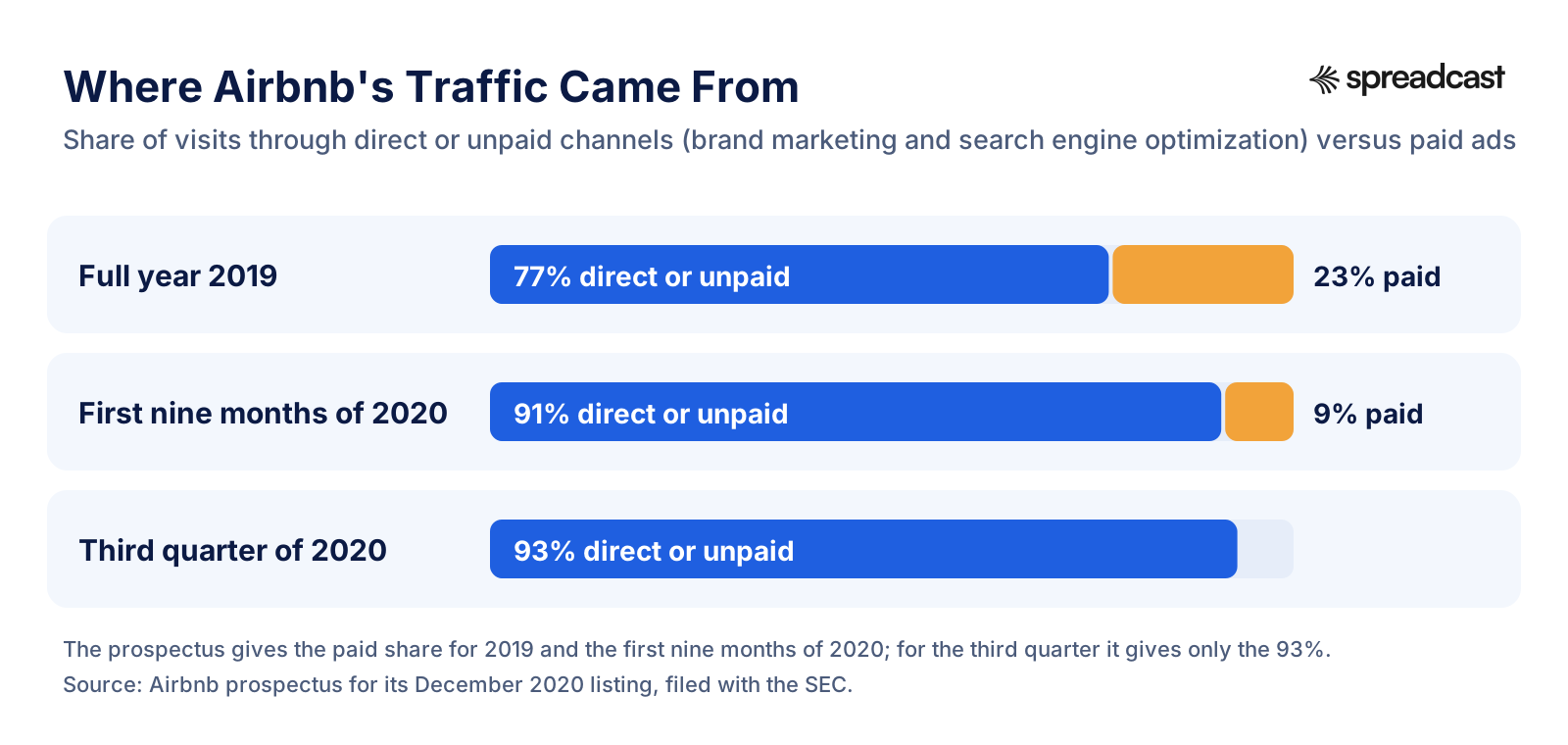
Airbnb drew its own conclusion in the same filing. Its strategy, it wrote, was to increase brand marketing, use the strength of the brand to attract more guests through direct or unpaid channels, and decrease performance marketing relative to 2019. It expected lower total sales and marketing expense in 2021 than in 2019, in dollars and as a share of revenue. The prospectus also leans on a Google Trends claim: from January 2016 through September 2020, "Airbnb" was searched worldwide more often than any other major travel brand. A name people type is a channel nobody can outbid you on.
We'd call 2020 a forced experiment most companies never get to run. Airbnb switched off paid search during a crash and found out how much of its traffic was really its own. Most of it, as it turned out. Once you know that number, renting customers from Google gets hard to justify.
The Unpaid Half: Search, Languages and Neighborhood Pages
Unpaid traffic isn't only people typing airbnb.com. The prospectus puts search engine optimization in the same bucket as brand, and while it moved money into brand, Airbnb said it would also "focus our internal resources to strengthen the infrastructure that supports our unpaid channels". Some of that infrastructure is plain localization: the same filing says the site and apps supported 62 languages and dialects in 2020, and that Superhosts, the badge for the most active and highest quality hosts, typically see higher occupancy because guests trust them.
The newest piece is in the Q3 2026 letter. Airbnb launched Neighborhood pages, starting in Paris, which pull together what guests and hosts say about an area along with experiences run by local hosts. It reported a meaningful uplift in bookings during the Paris rollout and plans to reach 1,500 neighborhoods by the end of 2026. Every one of those pages is built from material the community already wrote, which is about as cheap as content gets.
2021 to 2026: Brand First, Not Brand Only
The annual report for 2021 says brand and performance marketing rose $244.6 million that year, driven by more brand marketing and partly offset by less performance marketing, and that Airbnb had implemented a strategy that shifted its mix toward brand. The Q4 2021 letter puts it in one comparison: excluding stock based pay, sales and marketing in the fourth quarter of 2021 was 25% lower than in the same quarter of 2019, mainly because of lower performance marketing.
A lot of write ups stop there and say Airbnb quit paid ads. It didn't. The filings say so plainly, and the chart below shows the brand and performance marketing line climbing back above its 2019 level by 2023.
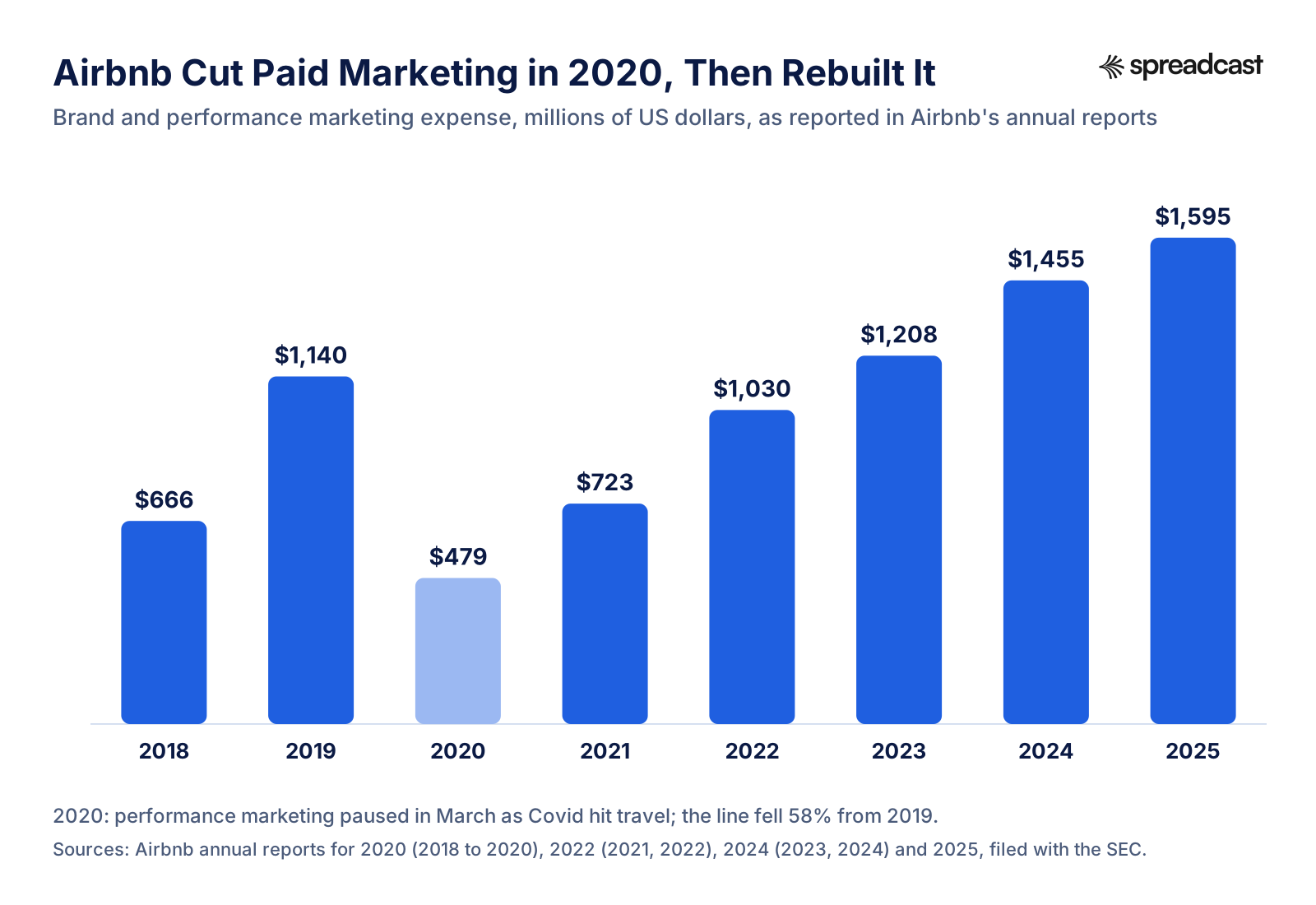
The annual report for 2022 credits a $67.9 million rise in search engine marketing and advertising that year, next to $197.8 million more for the Made Possible by Hosts, Strangers, AirCover, Categories and OMG campaigns and launches. The annual report for 2024 shows the same pattern a year later, with that year's increase coming from "ongoing marketing campaigns and search engine marketing". The annual report for 2025 describes the mix today as brand marketing, communications, performance marketing and strategic partnerships, and says that while performance marketing remains a component, the strength of the brand and the communication strategy have let Airbnb keep "lower reliance on paid marketing channels".
So the honest version of the Airbnb story is about a ratio. Nobody flipped a switch. In 2019, brand and performance marketing equaled about 24% of revenue. In 2025 it equaled about 13%. Marketing dollars grew 40% over those six years while revenue grew about 155%. That gap is the payoff of brand over performance marketing.

Your app can run the same play at small scale. Paid installs feel safe because they show up in a dashboard the next morning, but a brand people recognize keeps working after you stop paying. Spreadcast runs that brand side for your app: branded posts, made and scheduled for you. It designs every post in your brand kit, so your feed looks like one app instead of a pile of templates, and its weekly plan keeps them coming from one post a week up to twice a day, at the times you pick. That steady, recognizable presence is the small app version of what Airbnb bought when it moved money from search ads into brand.
How Much Airbnb Spends on Marketing
Airbnb spent $2.59 billion on sales and marketing in 2025, 21% of its $12.24 billion revenue, according to its annual report for 2025. Of that, $1.60 billion was brand and performance marketing, the money that buys campaigns and ads. The rest, $993 million, sits in a line Airbnb calls field operations and policy: people, local operations, policy and communications work. The filing defines sales and marketing as brand and performance marketing, staff costs including field operations, policy and communications, portions of referral incentives and coupons, and a share of facilities and IT.
| Year | Revenue | Total sales and marketing | Brand and performance marketing | Sales and marketing share of revenue |
|---|---|---|---|---|
| 2018 | $3.65 billion | $1.10 billion | $666 million | 30% |
| 2019 | $4.81 billion | $1.62 billion | $1.14 billion | 34% |
| 2020 | $3.38 billion | $1.18 billion | $479 million | 35% |
| 2021 | $5.99 billion | $1.19 billion | $723 million | 20% |
| 2022 | $8.40 billion | $1.52 billion | $1.03 billion | 18% |
| 2023 | $9.92 billion | $1.76 billion | $1.21 billion | 18% |
| 2024 | $11.10 billion | $2.15 billion | $1.46 billion | 19% |
| 2025 | $12.24 billion | $2.59 billion | $1.60 billion | 21% |
The figures come from the annual reports for 2020, 2021, 2022, 2024 and 2025; the shares are the percentage of revenue each filing reports, and our own division of the totals gives the same numbers. One caution on 2020. Total sales and marketing that year includes a jump in stock based pay that vested when Airbnb listed its shares in December, which is why the share of revenue looks high in a year when actual marketing was slashed. The brand and performance marketing column is the cleaner measure of what Airbnb chose to spend on campaigns and ads.
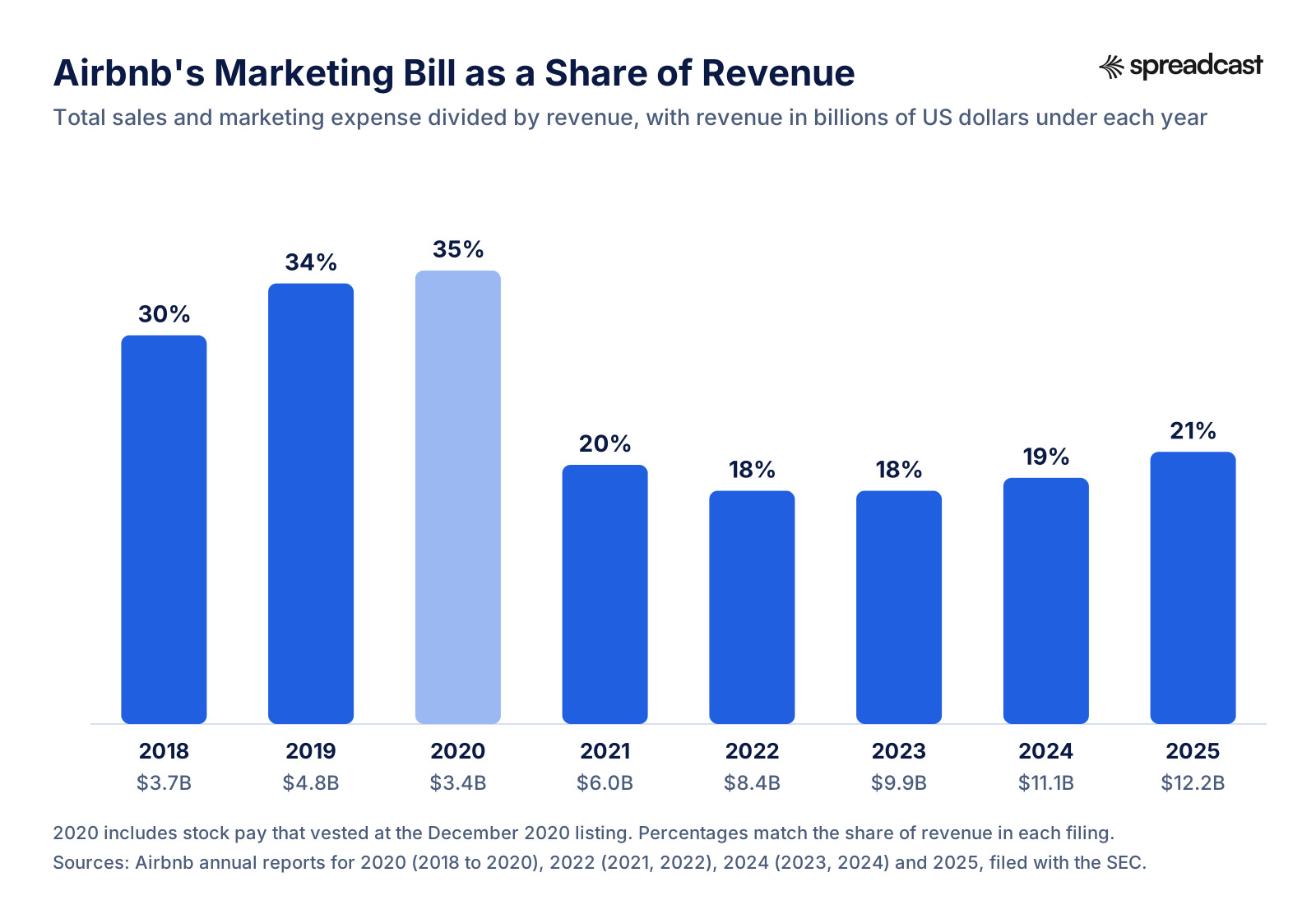
The line has been creeping back up. Sales and marketing rose 20% in 2025, which the annual report puts down to $163 million more in marketing activities, $121 million more in payroll from a larger team and $102 million more in third party services. The Q4 2025 letter said Airbnb would reinvest in 2026 "primarily in marketing, product, and technology". And in the third quarter of 2026, sales and marketing came to $762 million against $639 million a year earlier, according to the Q3 2026 letter; for the first nine months it was $2.39 billion, up from $1.89 billion.
We don't think Airbnb has given up on brand first. It's pointing the money at new things now, like services and experiences, countries where it's still small, and event partnerships. That's still brand marketing, only aimed at new categories instead of the core homes business.
For perspective, Airbnb's quarterly marketing bill is bigger than most app companies will ever raise. You don't need it. If you're setting a budget for the paid side of your app, our startup marketing budget guide and the LTV to CAC ratio explainer help you work out what a new user is worth before you buy one.
Brand work gets cheaper per customer the longer you keep it up, and that's the catch: someone has to keep it up, every week, for years. Spreadcast is built to be that someone. Its Pro plan is $29 a month or $290 a year, and it includes one app with up to 10 social accounts, the brand kit, the weekly plan of designed posts, moment posts for new versions and rating milestones, publishing to your networks, and Full Autopilot or one tap approval. Studio, at $79 a month, covers five apps. You can start free with three AI posts and judge the quality before you pay anything.
Belong Anywhere: The 2014 Airbnb Rebrand and the Bélo
Airbnb's branding rests on one idea, belonging, which it made official with a rebrand and a new logo called the Bélo in July 2014. Dezeen reported on July 16, 2014 that London agency DesignStudio had overhauled Airbnb's identity around the principle "belong anywhere". The symbol was built to be read several ways at once: a person with arms raised, a location pin, an upside down heart standing for people, places and love, and the letter A. DesignStudio's executive creative director James Greenfield told Dezeen the aim was a brand anyone could draw, and an online tool let anyone make their own version of the mark.
Brian Chesky explained the thinking in an interview Entrepreneur published the next day, republished by NBC News: a house is just a space, he said, but a home is where you belong. Before that, the prospectus notes, Airbnb's early tagline had been "Travel like a human". By the time of the listing, people simply called that kind of travel "Airbnb".
What's striking is how long the idea has lasted. More than a decade later, the Q3 2025 shareholder letter describes Airbnb investing in local teams to make campaigns in the language and culture of each market, "helping us become a brand that truly belongs anywhere". The words have barely moved since 2014.
That's the part worth copying. The logo file matters less than repeating the same promise in the same look for years, until people fill in the rest themselves. Small apps usually do the opposite and change the palette with every launch and the font with every post.
Consistency is the thing Spreadcast is built to handle. The brand kit it makes from your store listing, with your colors, fonts, icon and real screenshots, is applied to every post it designs, on every network, every week. Your feed starts looking like Airbnb's: one brand people recognize before they read a word. If you want to see what a kit holds first, try the free brand kit generator, and our piece on what a brand kit actually needs covers the pieces that matter.
User Stories and Reviews: Airbnb's Most Trusted Marketing
Airbnb's most persuasive marketing is made by its users, through reviews, host stories and real guest photos, because a stranger's home only feels safe when other people vouch for it. The numbers in the prospectus show how much content that is. Over 68% of guests left reviews of their stays in 2019, and hosts and guests had written more than 430 million reviews in total by September 30, 2020. In 2019, 69% of Airbnb's revenue came from stays by repeat guests.
Reviews still carry the decision today. The Q3 2026 shareholder letter says 70% of guests read reviews before booking, over 90% browse multiple listing photos, while over 90% of stays involve direct messages between guest and host. Its Fall 2026 update leaned further in: Connections lets guests link up with friends and family to see where they've stayed and what they recommend, and a new Travel Map gathers a person's trips, reviews and recommendations in one place. Airbnb is turning word of mouth into a product screen.
Host Stories in the Prospectus
Even Airbnb's listing documents were partly a story collection. The prospectus includes illustrated pages titled "Meet the host", like the story of Soraya, an artist hosting guests in a 1750s stone house overlooking the Somerset Levels in England, and her guests' weekend there. The filing notes that Airbnb compensated the hosts and guests for documenting and sharing their stories. It's a revealing choice: when Airbnb had to explain itself to investors, it led with people, not features.
Made Possible by Hosts
The first big campaign after the 2020 shift was built from the same material. The Q4 2020 letter calls Made Possible by Hosts Airbnb's first large scale marketing campaign in five years. Its goal was to explain hosting, which the letter says was still not mainstream even though the brand was. The campaign used real guest photos from real hosted stays, and the letter's own example is a mother and daughter exploring a beach cottage in Narragansett, made possible by hosts François and Ashley.
It worked, at least by Airbnb's measure. The Q4 2021 letter says that in the fourth quarter of 2021, overall traffic rose almost 20% compared with the fourth quarter of 2019 in the seven countries where the campaign ran, well ahead of countries without it. The same quarter Airbnb launched a follow up ad called Strangers, with three shaggy, odd looking "guests" in a listing, making the point that strangers aren't so strange after all.
We think this is the most copyable thing in the whole Airbnb playbook, and the most underrated. The Super Bowl spot and the stunts get written up, but Airbnb's best marketing has always been somebody describing a stay they actually had. Every app with reviews already owns that material. Most leave it sitting on the store page where only people who've already found the app will read it.
Do this for your app with Spreadcast. It reads your real App Store and Google Play reviews and turns the best ones into review quote posts designed in your brand kit, so the words of the people who already love your app become what new people see in their feed. Those posts sit in your weekly plan next to feature posts and tips, on a schedule you set. Need more reviews to work with first? Our guide on how to get App Store reviews covers the asks that work, and the free testimonial graphic generator makes a single quote card by hand.
Airbnb's Referral Program
Airbnb's referral program rewards existing users with a coupon when someone they invite completes a first stay, and it's one of the few growth tactics the company has written about in detail. In March 2014, Jason Bosinoff of Airbnb's engineering team wrote on the Airbnb Tech Blog that the redesigned program had increased signups and bookings from referrals by over 300% per day. His starting point is a confession: the old program was barely findable on the website and didn't exist in the mobile apps. The relaunch gave both the sender and the friend $25 of travel credit once the friend completed a first trip, worked on the website, Android and iPhone, and, Bosinoff writes, raised bookings by over 25% in some markets.
The current mechanics are in the annual report for 2025. The person who refers earns a coupon when the new guest or host completes their first stay. Airbnb treats those coupons as a customer acquisition cost and books them as sales and marketing, the same way it books payments to outside marketing vendors, and it says referral coupon credits generally expire within a year. The liability for unused referral coupons was immaterial at the end of both 2024 and 2025, so the program is a steady trickle, not a big line in the accounts.
You'll also find a claim online that Airbnb's referrals drove 900% year over year growth in first time bookings. We couldn't trace it to anything Airbnb published, and the engineering post itself reports the 300% per day figure. Use that one, and be wary of the bigger number.
The most useful detail in the post is a small test. Airbnb sent two versions of the same referral email: one said you could earn $25 by inviting a friend, the other said you'd be sharing $25 with a friend. The sharing version did better globally. Bosinoff also noticed the program was astoundingly popular in South Korea, so the team started reading its test results country by country. People are happier passing on a gift than collecting a bounty, and that's worth knowing before you write your own invite screen.
The lesson for app makers is the boring one in Bosinoff's post. A referral program nobody can find does nothing, and one missing from the mobile app is invisible to most of your users. If you add a referral offer, put it where people already are inside the app, and make the reward something both sides want. Our list of app promotion ideas has more ways to turn current users into promoters.
Airbnb Marketing Campaigns: From We Accept to Get an Airbnb
Airbnb's marketing campaigns since 2015 swing between brand films, host recruitment and stunts, and for the recent ones the shareholder letters report what each did for the business. The table lists the major ones with the year and where each fact comes from.
| Year | Campaign | What it did | Source |
|---|---|---|---|
| 2015 | Halloween night in the Paris Catacombs | A contest winner slept among the bones under Paris | PBS NewsHour |
| 2017 | We Accept, Super Bowl LI | A spot showing faces of many nationalities, read as a reply to the US travel ban | Fortune |
| 2017 | Airbnbmag with Hearst | A print travel magazine whose stories came from Airbnb searches | Fortune |
| 2021 | Made Possible by Hosts | First large scale campaign in five years, built on real guest photos | Q4 2020 letter |
| 2021 | Strangers | Shaggy guests show strangers aren't that strange | Q4 2021 letter |
| 2022 | Airbnb It | Host recruitment; visits to the host landing page doubled | Q4 2022 letter |
| 2023 | Get an Airbnb | Animated ads comparing Airbnb with hotel rooms | Skift |
| 2023 | Ken's Barbie DreamHouse | Two free nights tied to the Barbie film | Airbnb Newsroom |
| 2024 | Icons | Eleven pop culture stays, from the Up house to Prince's Purple Rain house | Airbnb Newsroom |
| 2025 | The Grand Adventure | A 60 second spot for the relaunch of Experiences and Services | Marketing Dive |
| 2026 | Milano Cortina Winter Olympics | Around 1 billion impressions from global and local campaigns | Q1 2026 letter |
| 2026 | FIFA World Cup 2026 | Over 150,000 homes in host cities listed for the first time | Q2 2026 letter |
We Accept and Airbnbmag
Two 2017 campaigns show Airbnb using its brand to stand for something and to own a medium. During Super Bowl LI, Airbnb aired We Accept, a montage of faces of different nationalities with a line about inclusion. Fortune reported that many viewers saw it as an implicit rebuke of President Trump's immigration ban, that a spokesperson said the decision came about spontaneously the week before, and that the footage came from an earlier campaign. Fortune also noted Airbnb had recently pledged $4 million to help displaced people. Love it or not, it was the Belong Anywhere promise turned into a 30 second position.
A few months later Airbnb went to print. Fortune's Adam Lashinsky wrote in May 2017 that Airbnbmag, made with Hearst, was selling at airports for $4 an issue, and that its editors picked stories using what people searched for on Airbnb; rising searches for Cuba helped them decide to cover the country. Chesky told him print "isn't ephemeral" the way content on a feed is. The method holds up for any brand: let what your users search for decide what you write about.
Airbnb It: Marketing to Hosts
Airbnb has two audiences, and it markets to hosts as hard as to guests, since every new home is new inventory. The Airbnb It campaign launched with the November 2022 Winter Release. The Q4 2022 letter says that after the release and the campaign, visits to the host landing page doubled, and new active hosts recruited with help from Superhosts rose more than 20% compared with before the launch. Digiday reported in October 2024 that Airbnb It was still running, with a spot called Rodeo promoting the new co host network, mainly on paid social through YouTube and Instagram. Airbnb's marketing chief Hiroki Asai told Digiday that steady brand campaigns build a moat around Airbnb, including against public criticism, though he declined to share budgets.
Get an Airbnb: Picking a Fight With Hotels
In late August 2023, Airbnb launched Get an Airbnb, a series of short animated ads that Skift described as comparing Airbnb with hotels on space, amenities, privacy and value; one asks why you'd pay for four hotel rooms to stay apart from your friends. Marketing Dive notes the animation was made by Buck. Airbnb kept the line running for years: the Q1 2025 shareholder letter shows a newer Get an Airbnb commercial built on the idea that in a hotel, the world beyond your room is limited to the lobby.
The hotel comparison works because it names the alternative people are really weighing. Instead of calling Airbnb great, each ad points at one thing a hotel room can't give you. Any app can borrow that format by showing one thing it does that the usual workaround doesn't.
The Airbnb Ad Campaign in 2026: Events and Local Markets
Airbnb's 2026 marketing has leaned on big events. As an official Olympic and Paralympic partner at the Milano Cortina 2026 Winter Games, Airbnb hosted nearly 200,000 guests, supply in the host markets grew about 30%, and its global and local marketing campaigns generated around 1 billion impressions, according to the Q1 2026 letter. At the FIFA World Cup 2026, the Q2 2026 letter says, Airbnb was an official Tournament Supporter, hosted millions of guest arrivals including many first time users, and saw more than 150,000 homes in host cities listed for the first time. The same letter lists partners including the International Olympic Committee, the Tour de France, Art Basel, Lollapalooza, La Liga and NASCAR.
Alongside the events, Airbnb has been running local campaigns country by country. The Q1 2025 letter describes a brand campaign about domestic travel launched in Japan late in 2024, followed by double digit growth in first time bookers and domestic nights booked there. By the Q3 2026 letter, Airbnb said its push to improve fit and build brand preference in expansion markets was paying off, with first time bookers up 13% year on year across the company and origin nights in India up more than 60%.
Events and seasons are moments your app can use too, without a sponsorship deal. Spreadcast builds seasonal posts into its weekly plan, each tied to a real feature of your app rather than a generic holiday graphic: the packing list feature before summer travel, the budget view in January, the study timer at back to school. They're designed in your brand kit and go out at your posting times. The social media approval page shows how drafts wait for your go ahead before anything is published.
Airbnb's Experiential Stunts: Paris Catacombs, Barbie's DreamHouse and Icons
Airbnb's stunts turn a listing into a news story, a single unforgettable stay that the press covers for free, and they've become a regular part of its marketing calendar. Each one is technically a product: you can request to book it in the app. But almost nobody books it. The point is everyone else hearing about it.
A Night in the Paris Catacombs, 2015
For Halloween 2015, Airbnb ran a contest for a night in the Paris Catacombs. PBS NewsHour reported that the winner, a 27 year old Brazilian named Pedro Arruda, wrote an essay on why he was brave enough to sleep 65 feet underground, and spent the night in a candlelit stone chamber with dinner, a violin concert and a storyteller; he brought his mother. The report says Airbnb reportedly paid Paris City Hall about $331,000 for access. Asked about sleeping among the remains of millions of people, Arruda told the Associated Press he'd be much more scared if they were alive.
Ken's Barbie DreamHouse, 2023
In June 2023, Airbnb announced on its newsroom that Barbie's Malibu DreamHouse was back on Airbnb, this time hosted by Ken. There were two one night stays, on July 21 and July 22, for up to two guests each, requests opened July 17, and the stays were free, with guests paying their own travel to Malibu. The timing matched the Barbie film opening in theaters on July 21, and Airbnb made a one time donation to Save the Children. Four guests at most, and coverage far beyond that.
Airbnb hasn't published a coverage number. On the Skift Travel Podcast in May 2024, Skift's Sarah Kopit said Chesky had told her the Barbie house got about 2.5 times the organic coverage clicks of Airbnb's IPO. That's a figure passed on secondhand in a conversation, so treat it as a sign of how Airbnb sees the stunt, not an audited result.
Icons, 2024
On May 1, 2024, Airbnb turned the stunt into a category. Its 2024 Summer Release introduced Icons, eleven stays and experiences drawn from music, film, television, art and sports, including a night in the house from Pixar's Up, a stay in Prince's Purple Rain house, a night in the Ferrari Museum, waking up in the Musée d'Orsay, and sessions with Kevin Hart, Doja Cat and Khaby Lame. Most were free and every one cost under $100 per guest. Guests requested to book in the app and the chosen ones got a "digital golden ticket"; Airbnb planned more than 4,000 tickets for the year.

The trade press split on whether Icons was clever or a gimmick. On the same Skift podcast, Seth Borko argued that Icons are earned media, and that attention like this is part of why so much of Airbnb's traffic is direct, which lowers its need for paid search. Kopit was more cautious: whether it works, she said, depends on whether people want to share the photos. Both have a point. With most Icons free, bookings were never where the money was. Borko's rough math on the show was that the houses cost a couple of million dollars, while a rival like Expedia spends around $2 billion a year on Google. Airbnb got its name in front of millions of people right when it wanted them to think of it for more than a place to sleep.
A small app can't build the Up house. The shape of it, though, a single dated event with a story attached, is exactly what a good launch is. Your version is a big update, a feature people asked for, a round number of ratings, announced with the care Airbnb gives a stunt instead of a line in the release notes. Our collection of app launch announcement examples shows how other apps do it.
This is where Spreadcast earns its keep. When a new version of your app ships on the App Store, Spreadcast notices and designs an update post about it, in your brand colors and fonts with your real screenshots, ready for you to approve. When your app passes a round number of ratings, it designs a milestone post. Between launches, the weekly plan keeps feature posts coming, each built from a real feature on your listing, so a launch keeps getting seen for weeks instead of one afternoon. The free release notes generator helps with the store text.
The 2025 Relaunch: Services, Experiences and Airbnb More Than an Airbnb
Airbnb relaunched itself on May 13, 2025, adding services and rebuilt experiences to its app and backing them with its first major brand campaign since Get an Airbnb. The 2025 Summer Release launched Airbnb Services with ten categories in 260 cities and Airbnb Experiences in 650 cities, plus Airbnb Originals, experiences made only for Airbnb with names like Megan Thee Stallion, Sabrina Carpenter and Patrick Mahomes. The app was rebuilt from the ground up so guests could book homes, services and experiences in one place. Chesky's line for the day was "Now you can Airbnb more than an Airbnb."
The campaign was a 60 second film called The Grand Adventure, made by Airbnb's own team and run on TV, streaming and online in twelve countries through the summer, Marketing Dive reported. The interesting part was the social plan around it. Airbnb made more than a dozen social only videos for cities including Florence, Lisbon, London, Paris, Seoul and Tokyo, served when people searched for those cities on Instagram, TikTok and YouTube, with a link straight to booking. Marketing Dive says the bet is that travel searches on social media will overtake searches on Google. Asai told Adweek the launch was about "replanting the flag of the brand".
Early numbers suggest the new lines bring in new people. The Q4 2025 letter says almost half of experience bookings in the fourth quarter weren't attached to a stay. The Q1 2026 letter adds that nearly a quarter of guests who are new to Airbnb and book an experience go on to book a stay or a service. Then the 2026 Summer Release on May 20, 2026 added car rentals, grocery delivery and airport pickups, World Cup experiences and boutique hotels in 20 top destinations.
Look at the rhythm here. Airbnb ships a Summer Release in May and a Winter or Fall release later in the year, each with a name and a press release, and the big ones with a keynote and a campaign. The product calendar is the marketing calendar. That's a habit that costs nothing to copy, and most app teams never adopt it. They ship features one by one, quietly, and wonder why nobody noticed. Our collection of app update announcement examples shows apps that get this right.
With Spreadcast, your releases get that treatment without a keynote. Every new App Store version gets an update post designed in your brand kit, and the weekly plan follows up with feature posts drawn from your listing's real features and problem and fix posts that show the pain your app removes. You approve the drafts, or switch on Full Autopilot and they go out at your posting times. The auto post to social media page explains both modes.
How Airbnb Makes Money: The Airbnb Business Model
Airbnb makes money from service fees on bookings, and substantially all of its revenue comes from stays, according to its annual report for 2025. It doesn't own the homes. Revenue is the service fees it charges, net of incentives and refunds, and it's recognized when the guest checks in. Experiences and services earn only a host fee. In 2025, Airbnb had $91.3 billion of gross booking value, the total value of bookings including host earnings, fees, cleaning and taxes, and $12.24 billion of revenue, so revenue was about 13% of everything booked.
The fee structure is changing. Historically Airbnb split its fee between host and guest. In October 2025 it started moving to a single fee charged only to the host. The Q3 2026 letter says Airbnb first moved most hosts who use property management software from the split model, where the host paid 3%, to a single fee of 15.5%, and that nearly all remaining hosts have now been moved too. Hosts can raise prices to keep the same earnings, and guests see the full price up front.
| Measure | Figure | Period and source |
|---|---|---|
| Revenue | $12.24 billion, up 10% | Full year 2025, annual report |
| Gross booking value | $91.3 billion, up 12% | Full year 2025, key metrics in the 2025 annual report |
| Revenue | $4.87 billion, up 19% | Third quarter of 2026, shareholder letter |
| Net income | $1.89 billion, a 39% margin | Q3 2026, income statement in the letter |
| Nights and seats booked | 155.0 million, up 16% | Q3 2026, key metrics in the letter |
| Average daily rate | $179, up 4% | Q3 2026, business performance section |
| Implied take rate | 17.6% of gross booking value | Q3 2026, monetization section |
New income lines are growing too. The Q3 2026 letter says revenue from guest travel insurance rose nearly 70% year on year, and that thousands of boutique and independent hotels across more than 60 destinations are now on Airbnb, still a single digit share of nights. About 35% of guests whose first Airbnb booking was a hotel came back to book a home, by the letter's measure.
The business model explains the marketing. Airbnb earns a fee on every booking, so a guest who comes back on their own is almost pure profit, and a guest bought through a search ad costs part of that fee before the trip even starts. That's why the 2020 traffic numbers mattered so much to investors, and why Airbnb keeps putting money into brand, reviews and the app instead of bidding for every click.
What Didn't Work in Airbnb's Marketing
Airbnb's marketing has had misfires, and the filings are candid about the biggest one. The 2019 push into performance marketing raised sales and marketing to about a third of revenue, and Chesky later told investors the extra spend didn't deliver the returns Airbnb expected, as Skift reported from the December 2020 roadshow. Buying traffic you'd mostly get anyway is the costliest kind of marketing there is.
The stunts have limits too. A night in the Catacombs or Ken's DreamHouse reaches millions through the press, but serves a handful of guests, and the coverage fades in days. On the Skift podcast, Borko, playing devil's advocate before he came around, pointed out that a platform with hundreds of thousands of listings had launched "just 11 homes". A program built on spectacle needs a new spectacle every season. Airbnb's own direction since then says something: in 2025 it relaunched Experiences in 650 cities, plus Originals, a product meant to be booked at scale.
And the cost line is rising again. Sales and marketing went from 18% of revenue in 2022 and 2023 to 21% in 2025, per the annual report for 2025, as Airbnb spent more on marketing activities, a bigger team and outside service providers. Some of that is simply what new businesses cost. Still, it's a reminder that brand first marketing doesn't make the bill go away; it changes what the bill buys.
One more, on brand safety. Fortune's coverage of We Accept read it first as a rebuke of a president's policy, not as a travel ad. A brand built on a value will be judged on that value, by people on both sides of it. For a small app, the cheaper lesson is to pick a promise you can keep in every post, every week, and never break it.
What an App Maker Can Copy From Airbnb's Marketing Strategy
Airbnb's marketing strategy can be copied by a small app in its habits, even without its budget. Here's what transfers, in the order we'd do it if we started this week.
- Fix how your app looks in the first second. Chesky and Gebbia photographed apartments; you need screenshots and posts that show the real app at its best, in one consistent look.
- Turn reviews into marketing. Airbnb built its trust on two way reviews and real guest photos. Pick your best store reviews and put them in front of people who haven't installed yet.
- Make your releases events. Airbnb names every release, gives it a keynote and a campaign. Announce each version of your app with a post that says what changed and why it matters.
- Keep a steady brand presence before you buy ads. Airbnb's traffic held when paid ads stopped because people already knew the name. A feed that posts in the same look every week builds that recognition.
- Name the alternative. Get an Airbnb compares itself with the hotel room. Show the specific thing your app does that the usual workaround can't.
- Use seasons and events. Airbnb rides the Olympics and the World Cup. You can ride New Year, summer travel and back to school with a post tied to a real feature.
- Make referrals visible. Airbnb's program took off once it was easy to find in the mobile app. Put your invite offer where users already are.
What's missing from that list: Super Bowl ads, a floating Up house, Olympic sponsorships and a $1.6 billion marketing line. Those are real parts of Airbnb's strategy, and they need Airbnb's money. Everything on the list needs consistency more than cash. For more channels that cost little, see how to promote an app for free, and for the full plan, how to market an app.
This page is part of a series. Duolingo's marketing strategy is the case for posting every day with one recognizable character, Spotify's marketing strategy is the case for a product that markets itself through Wrapped, and Cal AI's marketing strategy is the case for growing through creators and short video. Netflix's marketing strategy and Notion's marketing strategy show a release driven calendar and a community built on templates. Airbnb sits in the middle: a brand built on users' stories, spent carefully. Our roundup of mobile app marketing examples puts more apps side by side.
Run Airbnb's Playbook on Autopilot With Spreadcast
Spreadcast runs your app's marketing: branded posts, made and scheduled for you. It takes the parts of Airbnb's strategy that don't need a billion dollars (reviews people trust, one consistent look, a post for every launch, seasonal moments) and runs them for your app every week.
It starts with one link. Paste your App Store or Google Play link at /start and Spreadcast reads your listing. From it, Spreadcast builds a brand kit with your app's real colors, fonts, icon and screenshots, the way Airbnb applies the Bélo and its look to everything it puts out. Every post after that is designed in that kit, so your feed reads as one brand. Our guide to brand consistency without a design team explains why that matters more than any single post.
Then it makes your first week of posts. The weekly plan runs from one post a week up to twice a day, with choices of 1, 2, 3, 5, 7 or 14 posts a week, published at the times you pick. The plan mixes post kinds that map to Airbnb's playbook:
| Airbnb tactic | What Spreadcast makes for your app |
|---|---|
| Reviews and real guest stories | Review quote posts from your real App Store and Google Play reviews |
| Brand over performance marketing | Consistent branded posts from your brand kit on a weekly plan, 1 to 14 a week |
| Summer and Winter Releases | Update posts when a new version ships on the App Store, and feature posts from your listing's real features |
| Get an Airbnb's hotel comparison | Problem and fix posts that show the pain your app removes |
| Olympics, World Cup and seasonal travel | Seasonal posts tied to a real feature of your app |
| Milestones worth sharing | Rating milestone posts when your app passes a round number of ratings |
| One look everywhere | Every post published to 11 networks in the same brand kit |
You choose how hands on to be. With Approve First, every draft waits for your OK before it goes out. With Full Autopilot, posts are scheduled automatically at your posting times. Plenty of teams start with approval for a week or two and switch once they trust the output; the social media approval page shows how that works.
Spreadcast publishes to Instagram, Facebook, LinkedIn, TikTok, YouTube, Pinterest, Threads, Bluesky, Mastodon, Telegram and Discord, and shows followers, interactions and reach for each network as the network reports them. If you'd rather work from Claude or ChatGPT, Spreadcast also connects through its MCP server, covered on the Claude for social media page.
Airbnb learned in 2020 that a brand people already know keeps bringing them back after the paid ads stop. You can start building that for your own app today. Paste your store link at Spreadcast, look at the first week of posts it designs, and decide from there. The Free plan gives you three AI posts to judge the quality, and Pro at $29 a month runs the whole plan.
How We Researched This
We built this page in November 2026 from Airbnb's own disclosures first. We opened the Q3 2026 shareholder letter for current revenue, bookings, the app share, fees and marketing expense; the annual report for 2025 for full year revenue, gross booking value, the marketing strategy text, the referral program and the sales and marketing breakdown; the annual reports for 2020, 2021, 2022 and 2024 for the spending series and the explanations of each year's change; the prospectus for the December 2020 listing for the founding story, the cereal, the traffic mix and the review numbers; and the shareholder letters for Q4 2020, Q4 2021, Q4 2022, Q1 2025, Q3 2025, Q4 2025, Q1 2026 and Q2 2026 for the campaigns. All are filed with the US Securities and Exchange Commission.
We then read the Airbnb Newsroom on Icons, Ken's DreamHouse and the 2025 and 2026 releases, the Airbnb Tech Blog on referrals, Paul Graham's essay, Andrew Chen's Craigslist case study, and coverage from Dezeen, Entrepreneur, PBS NewsHour, Fortune, Skift, Digiday, Marketing Dive and Adweek. Every page linked here was opened on November 15, 2026, including the Tech Blog post on Medium, where we read the 300% figure, the $25 credit and the email test in Bosinoff's own words. Where sources disagreed, we said who said what: the 900% referral figure that circulates online (not in Airbnb's post, so we left it out), the Barbie coverage multiple (relayed secondhand on a podcast) and the share of hotel bookers who return for a home (55% in the Q1 2026 letter, about 35% on a different definition in the Q3 2026 letter; we used the later one). We left out figures we couldn't trace to a primary source, including Airbnb's social media follower counts and the cost of individual campaigns. The sales and marketing shares of revenue are the percentages Airbnb reports in each annual report; we divided the totals ourselves and got the same numbers. Spreadcast features described here are the ones in the product on the same date.
Frequently Asked Questions
What is Airbnb's marketing strategy?
Airbnb puts most of its money into brand marketing and lets its brand, reviews, hosts and press coverage bring guests in, instead of buying most traffic through search ads. In the first nine months of 2020, about 91% of its traffic came through direct or unpaid channels, according to its prospectus.
How much does Airbnb spend on marketing?
Airbnb spent $2.59 billion on sales and marketing in 2025, 21% of its $12.24 billion revenue. Of that, $1.60 billion was brand and performance marketing, according to its annual report.
Did Airbnb stop performance marketing?
It paused it in March 2020 and cut $540.5 million of performance marketing that year, then rebuilt its spending with brand first. Its 2025 annual report says performance marketing remains part of the mix, with lower reliance on paid channels.
How did Airbnb get its first users?
By hand. The founders went door to door in New York to recruit hosts, photographed listings themselves, and built a way for hosts to post their listings to Craigslist. They kept the company alive in 2008 by selling Obama O's and Cap'n McCain's cereal, which earned nearly $30,000.
How does Airbnb make money?
From service fees on bookings. In 2025 it had $91.3 billion of gross booking value and $12.24 billion of revenue. Since October 2025 it has moved nearly all hosts to a single host fee of 15.5%.
Can a small app copy Airbnb's marketing?
The habits, yes: review quote posts, a consistent brand look, a post for every release and seasonal posts tied to real features. Spreadcast runs those for an app from its store link, with branded posts made and scheduled for you.
Where These Facts Come From
Every outside number, rule and price on this page links to the page it was taken from.
- Q3 2026 shareholder letterAirbnb via SEC EDGAR
- Q2 2026 shareholder letterAirbnb via SEC EDGAR
- Q1 2026 shareholder letterAirbnb via SEC EDGAR
- Q4 2025 shareholder letterAirbnb via SEC EDGAR
- Q3 2025 shareholder letterAirbnb via SEC EDGAR
- Q1 2025 shareholder letterAirbnb via SEC EDGAR
- Q4 2022 shareholder letterAirbnb via SEC EDGAR
- Q4 2021 shareholder letterAirbnb via SEC EDGAR
- Q4 2020 shareholder letterAirbnb via SEC EDGAR
- Annual report for 2025Airbnb via SEC EDGAR
- Annual report for 2024Airbnb via SEC EDGAR
- Annual report for 2022Airbnb via SEC EDGAR
- Annual report for 2021Airbnb via SEC EDGAR
- Annual report for 2020Airbnb via SEC EDGAR
- Prospectus for the December 2020 listingAirbnb via SEC EDGAR
- 2024 Summer Release: Airbnb introduces IconsAirbnb Newsroom
- Barbie's Malibu DreamHouse is back on Airbnb, hosted by KenAirbnb Newsroom
- 2025 Summer Release: Now you can Airbnb more than an AirbnbAirbnb Newsroom
- Airbnb 2026 Summer ReleaseAirbnb Newsroom
- Hacking word of mouth: making referrals work for AirbnbAirbnb Tech Blog
- Do things that don't scalePaul Graham
- How to be a growth hacker: an Airbnb and Craigslist case studyAndrew Chen
- Airbnb rebrand by DesignStudioDezeen
- Airbnb, why the new logo?Entrepreneur via NBC News
- Airbnb contest winner spends Halloween night in Paris catacombsPBS NewsHour
- Airbnb's Super Bowl adFortune
- Airbnb and Hearst print magazineFortune
- Airbnb fell flat on a marketing plan inspired by Booking.comSkift
- Get an Airbnb campaign challenges hotelsSkift
- Airbnb's Icons: gimmick or marketing genius?Skift
- Airbnb doubles down on brand over performance to draw more hostsDigiday
- Why Airbnb booked a social first campaign for its Experiences relaunchMarketing Dive
- Airbnb's next adventure is about connectionsAdweek
- Video: Airbnb's Brian Chesky, do things that don't scaleMasters of Scale on YouTube
- Video: Brian Chesky's new playbookLenny's Podcast on YouTube
- Video: Introducing IconsAirbnb on YouTube
Researched and written by Mark Weizer. Last checked on November 15, 2026.
Keep Reading
- Playbooks
Canva Marketing Strategy: How Templates and SEO Grew 265 Million Monthly Users
Canva's marketing strategy from its newsroom, its founders and its own sitemaps: freemium and word of mouth, 39,603 template pages built for search, 100 languages, free plans for schools, Canva Create and the TV campaigns. Then how to run the same playbook for your own app.
- Playbooks
Uber Marketing Strategy: How a Two Sided App Won 215 Million Monthly Users
Uber's marketing strategy, taken apart from its own filings: the city by city launch playbook, ice cream and kittens, referrals on both sides, the 2018 brand reset, safety, Uber One, the Uber Eats Super Bowl ads, the ads business, what it spends and how it makes money. Then how to run the copyable parts for your own app.
- Playbooks
Monopoly Go Marketing Strategy: The Budget, the Ads and What It Bought
How much Monopoly Go spent on marketing, who said it and when, and what the money bought: localized ads, a celebrity TV campaign, friend invites, sticker trading, live ops seasons and crossovers. Then how a small studio can keep its own channels as busy as a big launch.