Spotify's marketing strategy is to make the product do the advertising. The free tier brings in listeners at no cost to them, personalized playlists like Discover Weekly, daylist and the AI DJ give those listeners a reason to stay and talk about it, and once a year Spotify Wrapped turns every user's listening data into a set of share cards that hundreds of millions of people post for free. In 2025 Wrapped engaged more than 300 million users and was shared 630 million times, while Spotify spent 8% of its revenue on sales and marketing, down from 14% in 2017. Paid campaigns, outdoor ads built from listening data, partnerships like FC Barcelona and tools that turn artists into promoters sit on top of that engine. The result, as of the third quarter of 2026, is 788 million monthly active users and 306 million paying subscribers.
This page takes that strategy apart with the numbers Spotify itself published, says which parts are worth copying if you make an app and which parts only work at Spotify's size, and shows how to run the copyable parts for your own app without a marketing team.
| Spotify key facts | Figure | Source and date |
|---|---|---|
| Founded | 2006, run from Stockholm, Sweden; launched to listeners in 2008 | Annual report for 2025; Daniel Ek, Audio First, February 2019 |
| Founders | Daniel Ek (now executive chairman) and Martin Lorentzon | Annual report for 2025, filed February 2026 |
| Who runs it | Alex Norström and Gustav Söderström, co chief executives since January 2026 | Named in the Q3 2026 update and the 2026 Investor Day recap |
| Monthly active users | 788 million, up 11% year on year | Q3 2026 shareholder update, October 22, 2026 |
| Paying subscribers | 306 million Premium subscribers, up 9% | Q3 2026 shareholder update, quarter ended September 30, 2026 |
| Markets | 184 countries and territories | Annual report for 2025, as of December 31, 2025 |
| Revenue | €17.19 billion in 2025; 89% Premium, 11% ads | Annual report for 2025, full year 2025 |
| Marketing spend | €1.43 billion sales and marketing in 2025, 8% of revenue | Sales and marketing line of the annual report for 2025 |
| Biggest campaign | Wrapped: 300 million+ engaged users and 630 million shares in 2025 | Q4 2025 update, February 2026 |
| Main channels | Free tier, personalized playlists, Wrapped share cards, data driven outdoor ads, artist tools, partnerships, podcasts | Our reading of the sources on this page, November 2026 |
How Spotify Grew From a Stockholm Startup to 788 Million Listeners
Spotify grew by giving music away first and selling the upgrade later, a model it has kept since Daniel Ek and Martin Lorentzon founded the company in Stockholm in 2006. Ek put the original pitch plainly in a 2019 post on the company blog: music any time, anywhere, at the right price, and along the way, he wrote, Spotify broke the grip piracy had on the industry. The service opened to listeners in 2008. By the end of 2017, when Spotify filed to list its shares in New York, it had 159 million monthly active users and 71 million Premium subscribers.
Even the free tier was rationed at first, and that was marketing too. When Spotify reached the United States on July 14, 2011, TechCrunch reported three packages: an invite only free service with ads, a $4.99 ad free plan and a $9.99 Premium plan that synced with mobile. NPR's launch guide told readers the free version needed an invitation they could request on Spotify's site, and that the invite only phase would end later with the free service opening to everyone. A waiting list for something free sounds odd today. Our read is that in 2011 it made a music app from Sweden feel like a club worth getting into, months before most Americans could try it.
The marketing history since then reads like a list of product launches, which is the point. Almost every big Spotify campaign started as a feature, and almost every feature was designed to be shared. Here is the timeline that matters for marketing, with each date taken from Spotify's own filings or newsroom, and the 2011 launch from the press coverage at the time.
| Year | What happened | Why it mattered for marketing |
|---|---|---|
| 2006 | Founded in Stockholm by Daniel Ek and Martin Lorentzon | A free, legal alternative to piracy was the whole pitch |
| 2008 | Opens to listeners with a free tier and a paid tier | The free tier becomes the funnel. Ek, 2019 |
| 2011 | Launches in the United States with an invite only free tier | Scarcity makes a free product feel exclusive. TechCrunch |
| 2015 | Discover Weekly launches; the year end recap runs as Year in Music | Personalization becomes a product people talk about. Discover Weekly; Year in Music |
| 2016 | Year in Music is renamed Wrapped; the data billboards start | Adweek calls the billboards Spotify's largest outdoor push to date |
| 2018 | Files to list its shares in New York; Instagram Stories sharing ships | Prospectus; Newsroom |
| 2019 | Gimlet and Anchor bought; Wrapped moves into the app with share cards | Audio First; Q4 2019 letter |
| 2020 | The Joe Rogan Experience signs an exclusive deal | Newsroom |
| 2022 | FC Barcelona shirt and stadium deal; Wrapped reaches 156 million | Newsroom; Q4 2022 letter |
| 2023 | AI DJ and daylist launch | DJ; daylist |
| 2025 | Wrapped passes 300 million users | Q4 2025 update |
| 2026 | Ek becomes executive chairman; 788 million listeners by Q3 | Annual report for 2025; Q3 2026 update |
Spotify rarely pays to promote a feature that wasn't built to spread on its own. You can steal that habit for free. Before you plan a single post about your app, ask which screen in your product a user would screenshot and send to a friend. If the answer is none, that's the first marketing problem to solve, and our guide on how to market an app walks through how to find that screen.
Spotify Wrapped: The Marketing Campaign That Runs on User Data
Spotify Wrapped is the company's biggest marketing campaign, and it works because the ad is made of each user's own listening data. At the end of every year, in late November or early December, Spotify shows each listener their top songs, artists, genres and minutes listened as a short story of full screen cards, and almost every card has a share button. In 2025 more than 300 million users engaged with it, according to the Q4 2025 shareholder update, and the same update lists "strong holiday and Wrapped campaigns" among the reasons for 38 million new monthly users in the quarter, a record for a fourth quarter.
It didn't start that big. Spotify's own ten year history of Wrapped says the first version in 2015 was called Year in Music and drew more than 5 million unique users. In 2016 it was renamed Wrapped and got the "Your Top Songs" playlist. In 2019 it ran inside the mobile app for the first time, and that was the year the numbers took off.
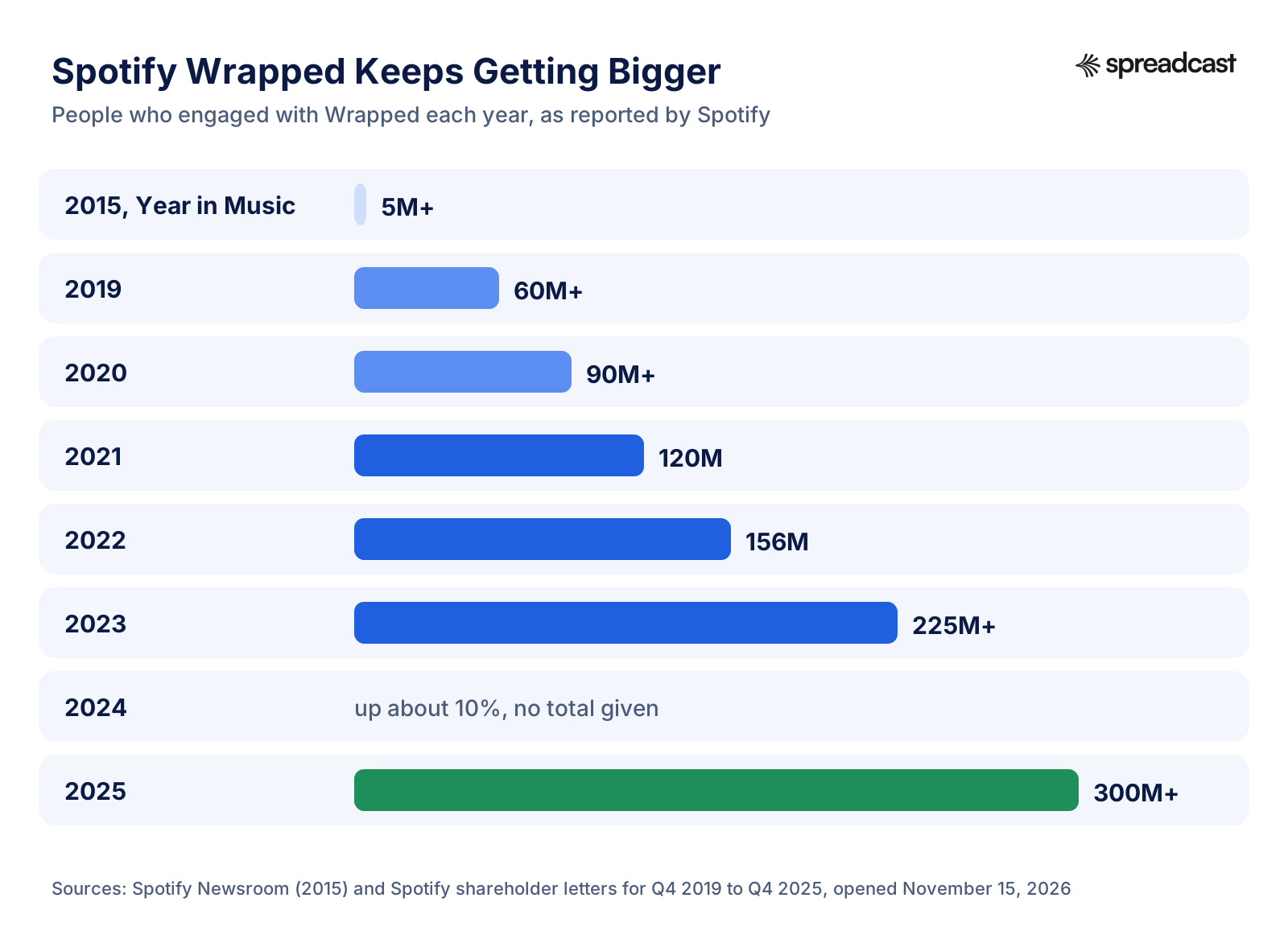
Spotify Wrapped Campaign Statistics, Year by Year
The shareholder letters are the best record of Wrapped, because Spotify reports it to investors as a growth driver, right next to revenue and subscribers. The Q4 2019 letter says more than 60 million users engaged across 21 markets, producing more than 40 million shares of stories and cards plus more than 6.5 billion streams from the Year and Decade Top Songs playlists. The Q4 2020 letter says the first 24 hours beat the whole of 2019, with more than 90 million users and over 50 million shares, and that the personalized Wrapped playlists drove 8% of all listening hours on the day after launch.
The Q4 2021 letter reports 120 million users across 103 markets and nearly 60 million shares. The Q4 2022 letter reports 156 million users across 111 markets, up 30%, plus a 2.7 times jump in visitors to artist tour pages. The Q4 2023 letter reports more than 225 million users across 170 markets, up more than 40%; a year later the newsroom's ten year history put the 2023 figure at a record 227 million. For 2024 Spotify only said engagement rose 10% across 184 markets and 53 languages, without a total. Then came 2025. The day after launch, TechCrunch reported Spotify's early numbers: more than 200 million engaged users in the first 24 hours, a level that took 62 hours the year before, with over 500 million shares already. By the Q4 2025 update the final count was more than 300 million engaged users and 630 million shares in 56 languages. (Spotify's Investor Day recap in May 2026 put the shares at "more than 620 million", so you'll see both numbers quoted.)
One comparison shows why Spotify counts Wrapped as marketing. In 2019, 60 million users made 40 million shares, roughly two shares for every three people. In 2025, 300 million users made 630 million shares, a little over two per person. Users grew five times. Shares grew more than fifteen times. So the average person now posts three times as much of their Wrapped as in 2019. Our read is that this comes from design work: more cards worth posting each year, and a share button on nearly every one.

Why Spotify Wrapped Works
Most of the pull comes from a few design choices. The biggest one: the content is about the user, not about Spotify. Nobody shares an ad. People share a card with their total minutes listened or a top genre that's oddly specific, because it says something about them. Louisa Ferguson, then Spotify's Global Head of Marketing Experience, described the 2023 theme in an interview on the company blog as "your Wrapped doesn't lie", which is the whole idea in four words.
Then there's scarcity. Wrapped arrives once a year, around the start of December, and the 2025 rules say you need at least 30 songs played for more than 30 seconds each, across at least five artists, to get one. A recap you have to qualify for feels earned. A recap that's always there would be ignored.
And every card is built to leave the app. The 2025 experience puts a share card on each data story and sends it straight to Spotify's own Messages or to "your favorite social channels", and it added Wrapped Party, a live feature for going through the year's results with friends. Marc Hazan, Spotify's Vice President of Partnerships and Marketing, called Wrapped "a global cultural phenomenon" in the ten year retrospective, and he isn't exaggerating much: the moment now comes with billboards in several cities and video thank yous from artists inside the app.
Wrapped also sells things beyond subscriptions. In 2022, when Spotify put artist merch inside the Wrapped hub and emailed fans merch from their top artists, it recorded the highest grossing week of artist merch sales in its history. And in May 2026 Spotify ran a special in app experience for its 20th birthday, built on the same idea of showing people their own history: almost 100 million people engaged in the first six days, and Spotify said it drove its single biggest day of subscriber intake ever. Remember that last part. For Spotify, a personal recap is a sales event.
What You Can Copy From Wrapped, and What You Can't
You can't copy the scale. Wrapped needs hundreds of millions of listening histories, a design that works in the 53 languages Spotify ran it in for 2024, and teams across the whole company. What you can copy is the shape: a recurring, dated moment built from real numbers about your app and its users, designed as a card someone would post.
Most apps already have these moments and never post them. Your app passes 1,000 ratings. It ships version 3.0 with the feature users begged for. A month ends and you have a real number of downloads, sessions or saved items worth showing. Each of those is a small Wrapped: a fact, a date and a reason for people who already like the app to share it.
You can run this for your own app with Spreadcast. Paste your App Store or Google Play link once, and Spreadcast watches the listing for you: when the app passes a round number of ratings, it designs a milestone post in your app's own colors, fonts and icon, and when a new version ships on the App Store, it designs an update post about it. You approve the draft, or switch on Full Autopilot and it goes out at your posting times. It's the Wrapped habit, a real number turned into a shareable card on a predictable schedule, without a design team. The mobile apps page shows what these moment posts look like.
Spotify's Data Driven Billboards and Outdoor Ad Campaigns
Spotify's outdoor ads take the Wrapped idea, listening data turned into a joke, and put it on billboards for people who may not use Spotify yet. The first big one ran at the end of 2016 under the line "Thanks 2016, it's been weird." Adweek reported that it was Spotify's largest out of home campaign to that point, made by Spotify's internal creative team, and that it opened in the US, the UK, France and Germany. The IAB in the UK gave a slightly different first wave, the UK, the US, France and Denmark on November 28, and said the campaign would reach 14 countries by Christmas, with local teams making sure each poster fit the place it hung.
The copy is the reason people still cite this campaign. Adweek quoted lines like "Dear person who played 'Sorry' 42 times on Valentine's Day, what did you do?" and "Dear 3,749 people who streamed 'It's the End of the World as We Know It' the day of the Brexit vote, hang in there." Another asked the person in the Theater District who played the Hamilton soundtrack 5,376 times that year whether they could get Spotify tickets.
Spotify ran the format again a year later as "2018 Goals", a set of New Year's resolutions built from 2017 listening habits. Adweek went inside the campaign with then CMO Seth Farbman to ask why the data ads work so well. Our short answer: they are oddly specific. A generic "Music for every mood" poster could advertise any streaming service. A poster about 3,749 people and one R.E.M. song on one specific day could only come from Spotify, because only Spotify has the data.
The idea has kept evolving. In August 2025 Spotify put up a plain orange and mint billboard in Times Square at 12:12 a.m. with no words at all, just a Spotify code. It ran in 12 locations across ten cities, from New York to São Paulo, and each code opened a playlist on Taylor Swift's profile ahead of the reveal of her album The Life of a Showgirl. Spotify's recap says fans started scanning within minutes, and photos of the boards spread across social media. The billboard's job wasn't to explain Spotify. It was to start a scavenger hunt that fans would carry to social media themselves.
Most write ups about Spotify's marketing give the billboards the credit. We think they're the smaller half of the trick. They work because Spotify had already trained people to find their own listening data funny and worth sharing. The billboard is the trailer; Wrapped is the film. If your app doesn't have the shareable product moment, a clever billboard just becomes an expensive one.
For your app, Spreadcast does the small version. You likely don't have aggregate listening data, but you do have something every app has: what your users say about you. Spreadcast reads your real store reviews and turns the best ones into designed review quote posts in your brand kit, and it builds feature posts from the real features on your listing. That's the honest small app version of the Spotify billboard: a specific line from a real person, not a slogan. Our guide on how to get App Store reviews covers getting more of them to work with.
The Spotify Business Model: Freemium as the Acquisition Channel
Spotify's free tier is its largest marketing channel, even though it never shows up as a marketing cost. In the 2018 listing prospectus, Spotify wrote that its ad supported service "serves as a funnel", and that it drove more than 60% of all gross Premium subscriber additions since it began tracking the data in February 2014. The annual report for 2025 still uses the funnel language, saying the free service drives "a significant portion" of gross Premium additions, though it no longer gives a percentage.
The logic is simple and expensive. A free listener costs Spotify royalties and servers, but pays some of that back through ads, and every free listener is a future subscriber who already has playlists, habits and a reason not to leave. At the 2026 Investor Day, Gustav Gyllenhammar, Spotify's SVP of Markets and Subscriptions, described the playbook in one line: the journey begins with Free, which drives engagement, builds habits and creates the base for conversion to Premium over time.
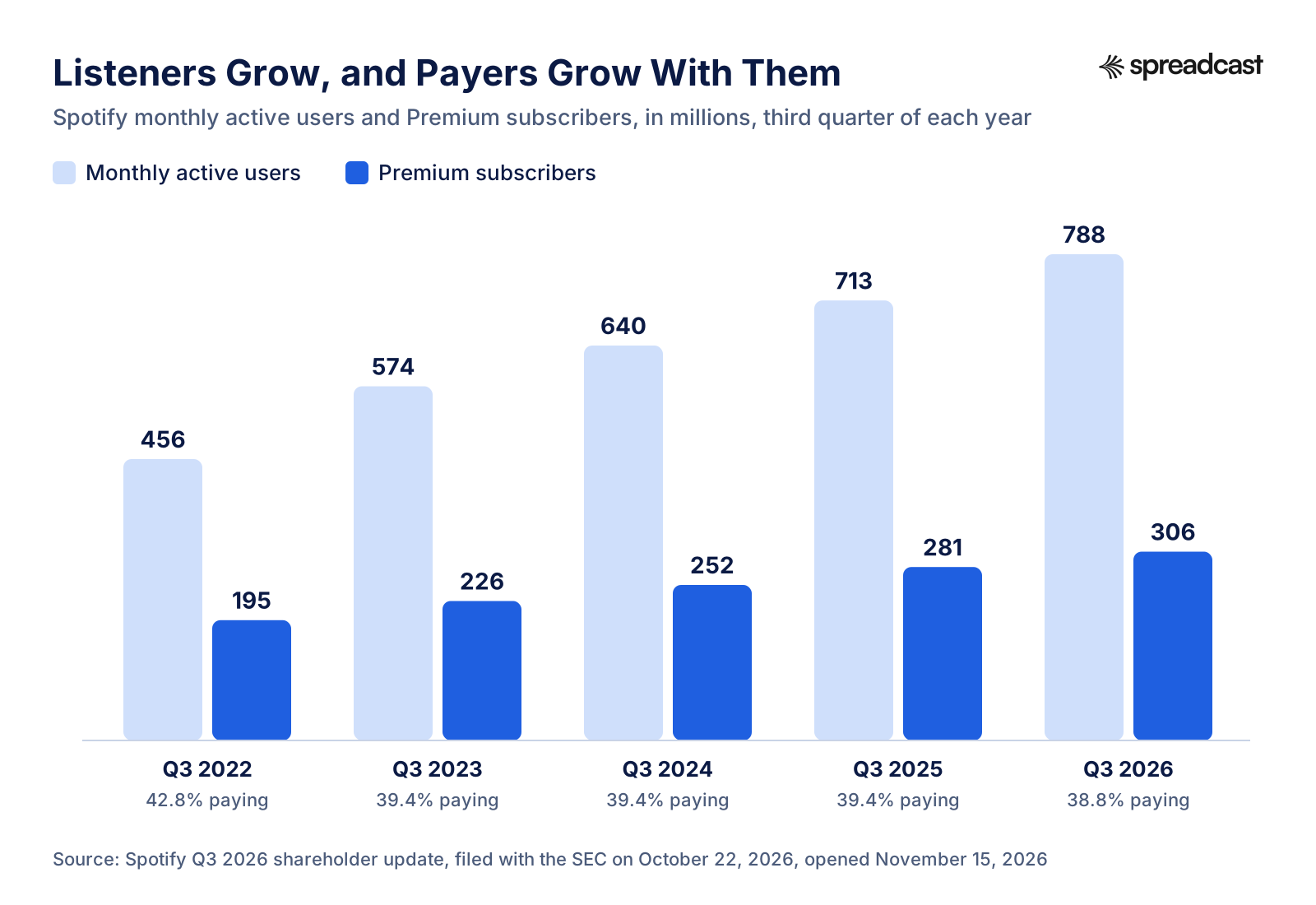
The chart shows the funnel holding up at scale. From the third quarter of 2022 to the third quarter of 2026, monthly users went from 456 million to 788 million and Premium subscribers from 195 million to 306 million. The paying share dipped from about 43% to 39% between 2022 and 2023, then held steady. Spotify's letters from that stretch, like the Q4 2023 update, point to Latin America and the Rest of World region for the user outperformance, and our read is that fast growth in those markets pulled the paying share down before it settled. The 2026 Investor Day recap gives the local picture: in Brazil the conversion rate has doubled to 44% since 2016 while the user base grew fourteen times, and in Sweden paid penetration is approaching 50% of the population.
The free tier also isn't left to work alone. The annual report for 2025 says free trial offers and global campaigns were "meaningful contributors" to gross subscriber additions, and that since 2022 Spotify has run three trial programs a year, in the second, third and fourth quarters, because subscriber growth speeds up whenever one runs. Family and Duo plans also brought in a significant share of new subscribers. The cost of those trials, the royalties paid on behalf of trial users, is booked as a sales and marketing expense.
Spotify keeps making the free tier better on purpose. In September 2025 it rolled out free tier upgrades that let free users pick and play any track, search and play, and play a song a friend just shared, and the post says Free is "where the majority of users start their Spotify journeys". It sounds backwards to give away more. But a free user who can play the exact song a friend just sent is a free user who keeps sending songs back, and every send is a small ad.

For an app maker, the lesson is about which free experience you give away, not whether to have one. Spotify's free tier is a real product people use every day, so the habit forms before the paywall shows up. A free trial that asks for a card on the first screen is a different, much weaker funnel. If your app is subscription based, read our notes on app retention benchmarks before you decide how much to give away, because a funnel only works if free users stick around long enough to convert.
Spotify's free tier sells Premium by letting people feel what they're missing. For your app, the same job on social media falls to posts that show your paid features doing something useful, and Spreadcast makes them for you. Its weekly plan includes feature posts drawn from the real features on your store listing and problem and fix posts that show the pain your app removes, each designed with your real screenshots. They give free users and people who haven't installed yet a clear picture of what the upgrade gets them.
Personalization as Marketing: Discover Weekly, Daylist and the AI DJ
Spotify treats personalization as its main marketing message, because a playlist that seems to know you is something people talk about. The company said as much in its 2018 prospectus: personalized playlists like Discover Weekly, Daily Mix and Release Radar made up about 17% of monthly listening hours at the end of 2017, and Spotify programmed about 31% of all listening across its playlists, up from less than 20% two years before. Spotify's 2025 annual report still lists the ability to give personalized content users enjoy as a key way it differs from other audio services.
Discover Weekly
Discover Weekly started as a project at Spotify's internal Hack Week and launched in July 2015 as a playlist that refreshes every Monday with 30 songs picked for you. By its fifth birthday, Spotify said users had streamed more than 2.3 billion hours of it between July 2015 and June 2020. At ten years, the anniversary post counted more than 100 billion tracks streamed and over 56 million new artist discoveries every week, 77% of them from emerging artists.
Discover Weekly matters for marketing because it gave Spotify a weekly ritual. Monday morning, new playlist, something to mention at work. It is the same thing a good newsletter or a good social account does: arrive on a known day with something new, and people start expecting you. Most app makers never set up that rhythm, and they post whenever they remember, which means nobody knows when to look.
Daylist
Daylist launched on September 12, 2023 as a playlist that changes several times a day and gives itself oddly specific names like "thrillwave monday evening" or "'90s rave rainforest late night". The names are the marketing. Spotify shipped it with three share card options built in: a ready made screenshot, a sticker for social media and a card whose background changes with the time of day. A year later, Spotify said 70% of daylist users return week after week and that, Wrapped aside, it was Spotify's most shared personalized experience, with millions of shares.
So Spotify's second most shared feature is a playlist title generator wrapped around a playlist. The music matters, but the thing people post is the funny, accurate label. That's a cheap trick to copy: if your app can describe a user to themselves in one specific, slightly surprising phrase, put that phrase on a card and give it a share button.
The AI DJ
The DJ launched in beta on February 22, 2023 for Premium users in the US and Canada. It plays a stream of songs picked for you and talks between them in a realistic voice, using Spotify's personalization, generative AI from OpenAI in the hands of Spotify's music editors, and voice technology from its Sonantic acquisition. The voice was modeled on Xavier "X" Jernigan, Spotify's Head of Cultural Partnerships. By August 2023 it was in 50 markets, and Spotify said it had become the most discussed Spotify feature on social media among users since launch. In May 2025 Spotify added voice requests and said DJ listener engagement had nearly doubled over the past year.
Spotify keeps shipping in this line. The 2026 Investor Day described a "Large Taste Model" fed by 3.4 trillion daily taste signals, Prompted Playlists that let Premium users steer recommendations, and Taste Profile, which the Q3 2026 update says launched to US Premium users as an editable view of how Spotify understands their taste. Each one got its own named announcement on Spotify's newsroom. Spotify treats a feature launch as a marketing event, not as a line in the release notes.
That habit is the one most worth copying, and it's the one most app makers skip. You spend weeks on a feature, ship it with "bug fixes and improvements" in the App Store notes, and never tell anyone outside the app. Spotify would have given the same feature a name, a share card and a launch post. Our collection of app update announcement examples shows how other apps announce releases, and the free release notes generator helps with the store text.
With Spreadcast, your releases get the launch treatment too. When a new version of your app ships on the App Store, Spreadcast notices and designs an update post about it, in your brand colors and fonts with your real screenshots, ready for you to approve. Between releases, the weekly plan keeps feature posts coming, each built from a real feature on your listing, so a launch like Spotify's DJ isn't a one day story. It's a feature your followers keep seeing for weeks.
Playlists, Culture and Spotify for Artists: Turning Artists Into Marketers
Spotify gets millions of artists to market Spotify for it, by giving them tools, data and share cards that point fans back to the app. The 2018 prospectus is candid about why: playlists had become "one of the primary tools" that labels, artists and managers use to boost artists and measure success. Its example is Lauv, whose song "The Other" climbed to about 750,000 streams a day after editorial playlist placement, with about 70% of those streams coming from Spotify's programmed playlists.
Picture an artist's marketing plan under those conditions. If most of your streams come from Spotify's playlists, your release week posts say "out now on Spotify", your Instagram bio links to your Spotify profile and your fans get sent to Spotify. Every artist becomes a small Spotify marketer, posting to their own audience, without Spotify paying for the post.
Spotify for Artists turns that into a product. At its Stream On event in March 2023, Spotify said one third of new artist discoveries on Spotify come from personalized recommendations, and it opened Discovery Mode to independent artists. Songs in Discovery Mode were saved 50% more often, added to playlists 44% more and drove 37% more artist follows in their first month, by Spotify's own count. It also expanded Marquee, a full screen sponsored recommendation of a new release, and said a study with eight labels and distributors found Marquee delivered ten times more Spotify listeners per dollar than similar social ads. That last figure is Spotify grading its own product, so read it as a claim, not an audit.
Wrapped extends to artists too. For the ninth year in 2025, Spotify gave artists, songwriters, podcasters, authors and advertisers their own Wrapped microsites, with "unique, shareable data stories to post across their social channels". Every data story comes with a share card. When artists post their own Wrapped cards to thank fans in early December, each post carries Spotify's design and a reason for fans to go look at their own Wrapped.
Money keeps the arrangement working. Spotify's Loud & Clear report for 2026 says it paid the music industry more than $11 billion in 2025 and nearly $70 billion in total, that more than 13,800 artists earned at least $100,000 from Spotify alone, and that more than 1,500 earned over $1 million. Artists promote the platform that pays them. Our read is that publishing those payout numbers every year is part of the marketing too: it gives artists a reason to keep sending fans to Spotify.
Your version of this is your happiest users and partners. The people who leave five star reviews, the creators who already mention your app, the communities where it comes up. Give them something to post: a badge, a milestone, a quote card with their words on it. Our list of app promotion ideas has more ways to turn fans into promoters, and founder led marketing covers the version where the most visible fan is you.
Do this for your app with Spreadcast: it turns your best real store reviews into review quote posts designed in your brand kit, so the words of the users who already love your app become the posts other people see. Add them to the weekly plan next to feature posts and tips carousels, and your feed starts to sound like Spotify's artist posts: other people vouching for you, on a schedule.
Spotify Marketing Campaigns and Brand Partnerships
Spotify's partnerships put the app inside things people already pay for or care about, which is cheaper than winning attention from scratch. A few of them show the range. In April 2018, Spotify and Hulu launched Spotify Premium, now with Hulu, a single $12.99 a month bundle of ad free music and Hulu's ad supported TV library, a year after launching a version of the bundle for students. A bundle like that turns another company's subscribers into your subscribers at the checkout.
In March 2022 Spotify and FC Barcelona announced a long term partnership that put Spotify's logo on the front of the men's and women's team shirts from the 2022 to 2023 season and renamed the stadium Spotify Camp Nou. Alex Norström, then Chief Freemium Business Officer and now a co chief executive, framed it around artists: Spotify had always used its marketing as a platform for them, and this added "literally a stadium". The plan was to use the famous shirt as a space to celebrate artists from around the world. Few apps can buy a stadium. The underlying move, attaching your brand to a culture your users already belong to, works at any budget.
The Taylor Swift codes in 2025 were the third type: a campaign built around one artist's moment, where Spotify supplies the format and the artist's fans supply the reach. Spotify got the attention of one of the largest fan bases in music, and Swift's team got a scavenger hunt that led to her album reveal on the New Heights podcast the next day.
And then there are the seasonal pushes, which never get case studies but carry the subscriber numbers. The annual report for 2025 says Spotify has run three trial campaigns a year since 2022, in the second, third and fourth quarters, and the Q4 letters for 2024 and 2025 both credit strong holiday campaigns alongside Wrapped. These pushes have carried real weight for a long time. The 2018 prospectus says the summer and holiday campaigns alone brought in 20% of gross new Premium subscribers in 2017 and 23% in 2016, and the relaunched Family Plan added another 31% and 22%.
Spreadcast gives your app the same kind of calendar. Its weekly plan includes seasonal posts, each tied to a real feature of your app rather than a generic "Happy holidays" graphic: the budgeting feature in January, the travel mode before summer, the study timer at back to school. They come out designed in your brand kit and scheduled at your posting times, and you never have to plan the calendar yourself. The social media approval page shows how drafts wait for you before anything goes out.
Spotify's Podcast Push: The Bet on Audio Beyond Music
Spotify moved into podcasts to give people more reasons to open the app every day, and it was a marketing bet as much as a content bet. In his Audio First post of February 2019, Daniel Ek announced the purchase of the podcast studio Gimlet and the podcast creation platform Anchor, and wrote that Spotify's podcast users spent almost twice the time on the platform, and spent even more time listening to music. In other words, podcasts made the whole app stickier.
The biggest single move came in May 2020, when The Joe Rogan Experience signed a multi year exclusive licensing deal. Spotify described it as the most searched for podcast on its platform at the time. The 2026 renewal post says the show has 18 million followers and has been the most followed show on Spotify since the partnership began. Notice the wording of that October 2026 renewal: fans can keep watching or listening on Spotify "as well as across other platforms". The exclusive that started in 2020 is over, yet Spotify still signed a new multi year licensing deal to keep the show.
Not every part of the push worked. In June 2023 Spotify cut 200 jobs in its podcast division, about 2% of its workforce, and merged the Gimlet and Parcast studios into a single Spotify Studios operation. Sahar Elhabashi, then head of podcasts, called it a pivot from "a more uniform proposition". Read plainly, owning studios and paying for exclusive shows was costlier than the reach it bought. Spotify shifted toward tools and payouts for creators instead: the Q3 2026 update lists Creator Memberships in 34 markets and the Spotify Partner Program, which pays eligible creators based on engagement, expanded to more than 35 new markets.
The lesson for an app maker is about adjacent content, not podcasts specifically. Spotify found that people who used a second kind of content stayed longer and used the first kind more. Your app's version might be a tips series, a template library or a weekly guide that gives people a reason to come back between the moments they actually need your core feature. It's slower than a launch and it compounds.
Your second content line can start small. The weekly plan in Spreadcast includes tips carousels: short, swipeable how to posts drawn from what your app actually does, designed in your brand kit. They're the small app version of Spotify's second content line, a reason for people to follow you between releases. You can also make one by hand with the Instagram carousel maker.
How Much Spotify Spends on Marketing
Spotify spent €1.426 billion on sales and marketing in 2025, which was 8% of its revenue, according to its annual report for 2025. That share has fallen sharply. In 2017 it was 14%, working from the figures in the 2018 prospectus, and it held between 12% and 13% from 2018 to 2023 before dropping to 9% in 2024 and 8% in 2025, per the annual reports for 2020, 2022 and 2025.
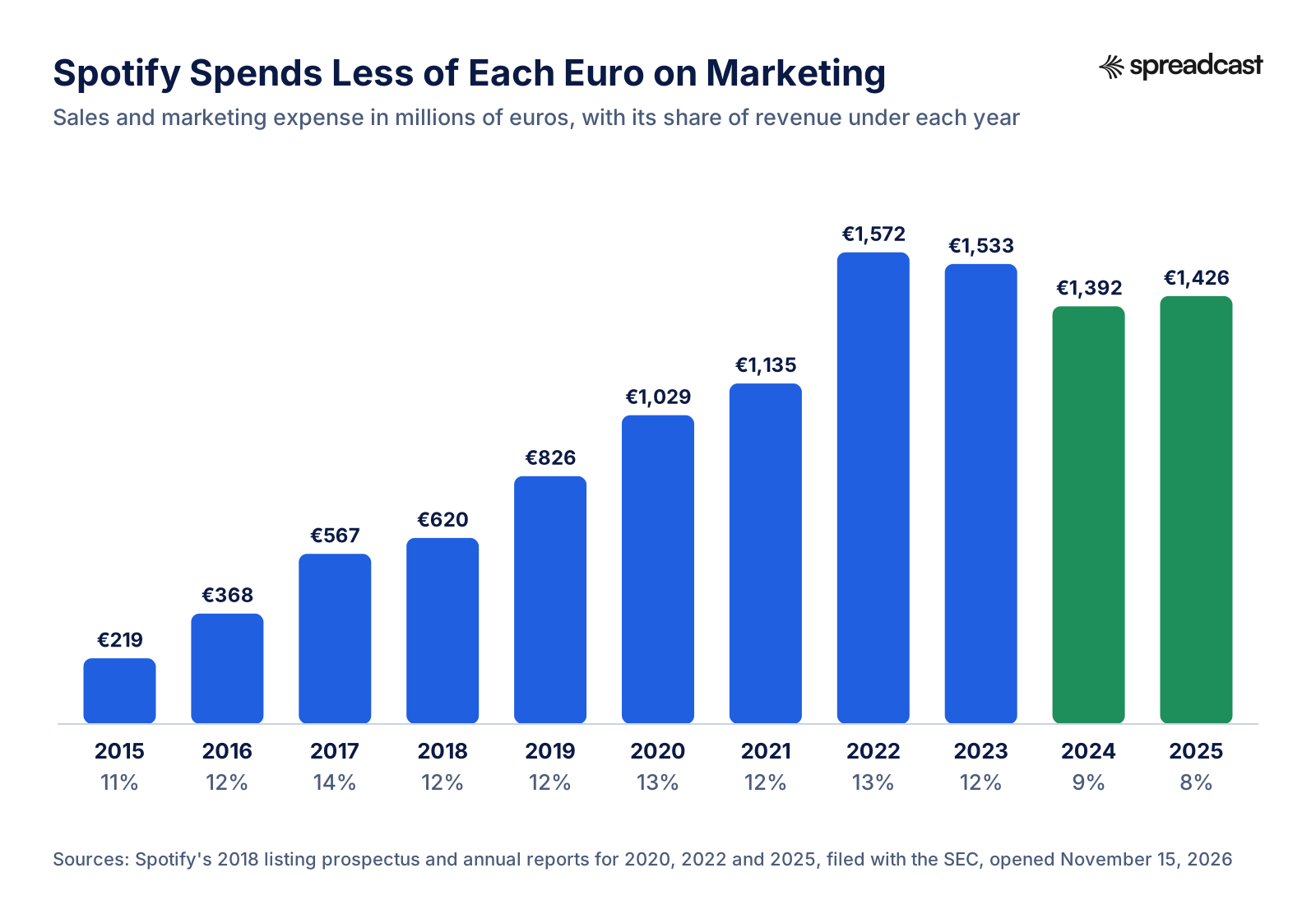
The chart tells a clearer story than any campaign. Spotify's marketing spend roughly flattened after 2022 while revenue kept climbing, so each euro of revenue needed less marketing. Some of that is cost control. But our read is that most of it is the product engine paying off. Wrapped, the free tier, artist sharing and personalization bring in users that paid ads used to buy.
It's worth knowing what's inside that number, because it's broader than ads. The annual report defines sales and marketing as staff, sponsorships, public relations, branding, advertising, events, customer acquisition costs, the cost of working with creators and rights holders to promote new releases, and the cost of free trials, which is mostly the royalties Spotify pays for trial users. The 2025 increase of €34 million was, by Spotify's account, driven by €50 million more spent on marketing campaigns, partly offset by €29 million less in social costs, the payroll taxes that move with the share price.
Spending is ticking back up in 2026. The Q3 2026 update shows €406 million of sales and marketing in the quarter, up 16% on a year earlier, and says operating expense growth was "primarily driven by an increase in marketing alongside cloud and AI spend". Even so, operating income in the quarter came in above guidance partly because marketing costs were lower than forecast.
For perspective, €406 million is one quarter of Spotify's marketing. You won't match it, and you don't need to. The useful move is to copy the parts that don't need money. A steady posting rhythm, real numbers turned into cards, reviews turned into quotes, and every release announced. If you're setting a budget for the paid side, our startup marketing budget guide and the LTV to CAC ratio explainer help you decide how much a new user is worth before you buy one.
Here's the money lesson, and where Spreadcast fits. Product driven marketing is cheaper than bought attention, but somebody still has to run it every week. Spreadcast's Pro plan is $29 a month, or $290 a year, and it includes one app with up to 10 social accounts, the brand kit, the weekly plan of designed posts, the moment posts for new versions and rating milestones, publishing to your networks, and Full Autopilot or one tap approval. That's a whole month of your app's marketing running on its own for under a dollar a day. You can start free with three AI posts to see the quality before you pay.
How Spotify Makes Money
Spotify makes almost all of its money from subscriptions. In 2025 Premium brought in €15.35 billion, or 89% of total revenue of €17.19 billion, and the ad supported service brought in €1.84 billion, or 11%, according to the annual report for 2025. Ad revenue actually fell 1% in 2025, which Spotify put down to lower fixed prices and fewer music impressions sold in its direct and podcast ad sales, partly offset by €103 million of growth in its automated ad channels.
By the third quarter of 2026 the split looked similar. The Q3 2026 update reports €4.49 billion of Premium revenue and €482 million of ad supported revenue in the quarter, a total of €4.97 billion, with Premium revenue up 17% and ad revenue up 10%. Premium average revenue per user was €4.95 a month, up 9.3% from a year earlier, mostly from price increases. Gross margin was a third quarter record of 33%, and operating income was €672 million.
| Revenue line | 2025, full year | Q3 2026 | What drives it |
|---|---|---|---|
| Premium subscriptions | €15.35 billion (89%) | €4.49 billion, up 17% | More subscribers and higher prices; Individual, Duo, Family and Student plans |
| Ad supported | €1.84 billion (11%) | €482 million, up 10% | Audio and video ads to free users, podcast sponsorships, automated ad sales |
| Total | €17.19 billion | €4.97 billion, up 16% | Annual report; Q3 2026 update |
At the 2026 Investor Day, the co chief executives described the model as a demand curve. The scaled free tier captures "the very very long tail" of listeners, supported by ads, and the paid tiers meet everyone else, from the $6.99 Student plan to the $12.99 individual Premium plan. The plan from here is more products with higher prices for the most engaged users, such as Audiobooks+, which Spotify says delivers lifetime values that are multiples of Premium only users.
This is why the marketing looks the way it does. When 89% of revenue comes from subscriptions, the job of marketing isn't to sell ads or one time purchases. It's to get people into the free tier, make them feel at home there, and give them reasons to upgrade and never leave. Wrapped, Discover Weekly and daylist all do retention work that a cheaper app would hand to email.
What Didn't Work in Spotify's Marketing
Spotify's marketing has misfires too, and they are as useful as the hits. The 2024 Wrapped, which leaned on AI features like a Wrapped AI Podcast, still grew engagement by 10% according to the Q4 2024 letter. Fans weren't impressed, though. TechCrunch's coverage of the 2025 edition called the 2024 one a flop, saying people criticized the thin detail in the stats and the focus on an AI podcast, and noted that 2025 reached 200 million users in 24 hours compared with 62 hours the year before. Our read is that users wanted their data told plainly, not generated. The 2025 edition kept the classic stories and leaned on new ones built on plain numbers, like top albums, a listening age and a top song quiz, with AI behind just one new story, the Listening Archive.
The podcast exclusives are the other lesson. Spotify bought studios and signed exclusive shows, then merged the studios and cut 200 jobs in 2023, and by 2026 its biggest podcast was available on other platforms again. Exclusive content can bring people in, but it also limits how far the content can travel as marketing. A show only on Spotify can't be clipped and shared as freely as a show everywhere.
The famous billboards point to a line every data campaign has to walk. Adweek noted the 2016 posters used aggregate data and even some individual data, and none of the lines it quoted names a person. Spotify keeps public posters anonymous and keeps the truly personal data inside Wrapped, where only you see it until you choose to share. Under the 2025 rules, streams in Private Mode don't even count toward getting a Wrapped. That's a good rule for any app using customer data in marketing: public posts use counts, private screens use names.
What an App Maker Can Copy From Spotify's Marketing Strategy
Spotify's marketing strategy can be copied by a small app in its habits, not in its budget. Here is what transfers, in the order we'd do it if we were starting this week.
- Find the shareable screen. Look for the one view in your app that says something about the user, a streak, a total, a personal label, and add a share button that makes a clean 9:16 card with your logo on it.
- Turn real numbers into dated moments. Rating milestones, version launches, year end totals. Each one is a small Wrapped, and each one gives you a reason to post that isn't "please download our app".
- Announce every feature like Spotify announced the DJ: a name, a one line reason it exists, a screenshot, and posts that keep showing it for weeks after launch.
- Set a rhythm. Discover Weekly works because it arrives every Monday. Pick a posting schedule you can keep and keep it, because a feed that posts every Tuesday and Friday beats one that posts ten times in launch week and then goes quiet.
- Give your fans something to post. Review quotes, badges, milestone cards. Spotify's artists market Spotify because it hands them share cards; your happiest users will do the same if you make it easy.
- Keep one look everywhere. Spotify's Wrapped design is recognisable on any network. Use the same colors, fonts and screenshots on every post so people know it's you before they read a word.
- Use the free tier, or a free first experience, to build the habit before the paywall. Then use posts about your paid features to show free users what they're missing.
You'll notice what's missing from that list: billboards, stadium deals and exclusive podcasts. Those are real parts of Spotify's strategy and they need Spotify's money. Everything else on the list needs consistency more than cash. For a full list of channels for small apps, see how to promote an app for free, and for iPhone specific tactics, iOS app marketing.
If you're comparing playbooks, this page is part of a series. Duolingo's marketing strategy is the case for posting every day with one recognisable character, and Cal AI's marketing strategy is the case for a young founder team growing through creators and short video. Spotify sits at the other end: the product itself is the campaign. Our roundup of mobile app marketing examples has more apps side by side.
Run Spotify's Playbook on Autopilot With Spreadcast
Spreadcast runs your app's marketing: branded posts, made and scheduled for you. It takes the parts of Spotify's strategy that don't need a billion euros, the milestone moments, the launch posts, the steady rhythm, the one consistent look, and runs them for your app every week.
It starts with one link. Paste your App Store or Google Play link at /start and Spreadcast reads your listing. From it, Spreadcast builds a brand kit with your app's real colors, fonts, icon and screenshots, the same way Spotify keeps Wrapped instantly recognisable. Every post after that is designed in that kit, so your feed looks like one brand, not a pile of templates. You can also generate a kit on its own with the brand kit generator.
Then it makes your first week of posts. The weekly plan runs from one post a week up to twice a day, with choices of 1, 2, 3, 5, 7 or 14 posts a week, published at the times you pick. The plan mixes the post kinds that map to Spotify's playbook:
| Spotify tactic | What Spreadcast makes for your app |
|---|---|
| Wrapped and milestone sharing | Rating milestone posts when your app passes a round number of ratings |
| Feature launches like the DJ and daylist | Update posts when a new version ships on the App Store, and feature posts from your listing's real features |
| Discover Weekly's steady rhythm | A weekly plan of posts at the times you pick, from 1 a week to 14 |
| Artists and fans vouching for Spotify | Review quote posts from your real store reviews |
| Seasonal trial campaigns | Seasonal posts tied to a real feature of your app |
| Tips that bring people back between releases | Tips carousels and problem and fix posts |
| One look on every network | Every post designed in your brand kit and published to 11 networks |
You choose how hands on to be. With Approve First, every draft waits for you to approve it before it goes out. With Full Autopilot, posts are scheduled automatically at your posting times. A sensible way to begin is approval for a week or two, then a switch once you trust the output; the auto post to social media page explains both modes.
Spreadcast publishes to Instagram, Facebook, LinkedIn, TikTok, YouTube, Pinterest, Threads, Bluesky, Mastodon, Telegram and Discord from one place, and the cross posting page explains how one post reaches every network at once. Analytics show followers, interactions and reach for each network, so you can see which kind of post works for your app. If you'd rather work from Claude or ChatGPT, Spreadcast also connects through its MCP server, covered on the Claude for social media page.
Spotify built a marketing machine that runs every week whether or not anyone has a new idea that morning. You can have the small version of that machine for your own app today. Paste your store link at Spreadcast, look at the first week of posts it designs, and decide from there. The Free plan gives you three AI posts to judge the quality, and Pro at $29 a month runs the whole plan.
How We Researched This
We built this page in November 2026 from Spotify's own disclosures first. We opened Spotify's Q3 2026 shareholder update for current users, subscribers, revenue and marketing expense; the annual report for 2025 for full year revenue, the funnel language, trial programs and the definition of sales and marketing; the 2018 listing prospectus and the annual reports for 2020 and 2022 for the marketing spend series; and every fourth quarter shareholder letter from 2019 to 2025 for Wrapped figures. All are filed with the US Securities and Exchange Commission.
We then read Spotify's newsroom posts on Wrapped, Discover Weekly, daylist, the DJ, sharing integrations, Spotify for Artists, Loud & Clear, the Hulu, FC Barcelona and Joe Rogan deals, the Taylor Swift billboards and the 2026 Investor Day, and trade coverage from Adweek, the IAB UK, TechCrunch, NPR and TheWrap. Every page linked here was opened on November 15, 2026. Where sources disagreed, we named who said what: the first countries for the 2016 billboards (Adweek and the IAB list different ones), the 2023 Wrapped total (225 million in the shareholder letter, 227 million in the newsroom) and 2025 Wrapped shares (500 million in the first day's report, 630 million in the Q4 2025 update, more than 620 million in the Investor Day recap). For headline numbers we used the shareholder letters. We left out figures we couldn't trace to a primary source, including the price Spotify paid for Gimlet and Anchor and follower counts for Spotify's own social accounts. Spreadcast features described here are the ones in the product on the same date.
Frequently Asked Questions
What is Spotify's marketing strategy?
Spotify markets itself mainly through its product. A free tier brings listeners in, personalized playlists keep them, and Spotify Wrapped turns each user's year of listening into share cards that more than 300 million people engaged with in 2025. Data driven billboards, partnerships and artist tools add reach on top.
How much does Spotify spend on marketing?
Spotify spent €1.426 billion on sales and marketing in 2025, about 8% of its €17.19 billion revenue, according to its annual report. That share was 14% in 2017.
Why is Spotify Wrapped so successful?
Wrapped is about the user, not Spotify, it arrives once a year, and every card has a share button. In 2025 it reached more than 300 million users and 630 million shares, according to Spotify's Q4 2025 shareholder update.
How does Spotify make money?
Mostly from subscriptions. Premium was 89% of revenue in 2025 and ads to free users were 11%. The free tier also works as a funnel that brings in a large share of new paying subscribers.
How many users does Spotify have?
Spotify reported 788 million monthly active users and 306 million Premium subscribers in its Q3 2026 shareholder update, published October 22, 2026.
Can a small app copy Spotify's marketing?
The habits, yes: milestone posts, launch posts for every feature, a steady posting rhythm and one consistent look. Spreadcast runs those for an app from its store link, with branded posts made and scheduled for you.
Where These Facts Come From
Every outside number, rule and price on this page links to the page it was taken from.
- Q3 2026 shareholder updateSpotify via SEC EDGAR
- Annual report for 2025Spotify via SEC EDGAR
- Annual report for 2022Spotify via SEC EDGAR
- Annual report for 2020Spotify via SEC EDGAR
- Registration statement for the 2018 listingSpotify via SEC EDGAR
- Q4 2025 shareholder updateSpotify via SEC EDGAR
- Q4 2024 shareholder updateSpotify via SEC EDGAR
- Q4 2023 shareholder updateSpotify via SEC EDGAR
- Q4 2022 shareholder letterSpotify via SEC EDGAR
- Q4 2021 shareholder letterSpotify via SEC EDGAR
- Q4 2020 shareholder letterSpotify via SEC EDGAR
- Q4 2019 shareholder letterSpotify via SEC EDGAR
- Ten years of Spotify WrappedSpotify Newsroom
- 2025 Wrapped is hereSpotify Newsroom
- Interview with the Global Head of Marketing Experience on 2023 WrappedSpotify Newsroom
- The 2025 Wrapped guide for artists, creators and advertisersSpotify Newsroom
- Biggest week of artist merch sales during 2022 WrappedSpotify Newsroom
- Investor Day 2026 recapSpotify Newsroom
- Investor Day 2026 remarks from the co chief executivesSpotify Newsroom
- Spotify's free experience updatesSpotify Newsroom
- Discover Weekly turns 10Spotify Newsroom
- Over 2.3 billion hours of Discover Weekly since 2015Spotify Newsroom
- Introducing daylistSpotify Newsroom
- daylist expands to new markets and languagesSpotify Newsroom
- Spotify debuts a new AI DJSpotify Newsroom
- DJ expands to 50 marketsSpotify Newsroom
- DJ now takes requestsSpotify Newsroom
- Share what you are listening to on Instagram StoriesSpotify Newsroom
- Social sharing at SpotifySpotify Newsroom
- New TikTok and Instagram integrationsSpotify Newsroom
- Campaign tools from Spotify for ArtistsSpotify Newsroom
- Loud and Clear 2026 highlightsSpotify Newsroom
- Spotify and Hulu expand partnershipSpotify Newsroom
- Spotify and FC Barcelona partnershipSpotify Newsroom
- Spotify and Taylor Swift global billboard campaignSpotify Newsroom
- Audio First, by Daniel EkSpotify Newsroom
- The Joe Rogan Experience launches exclusive partnershipSpotify Newsroom
- Spotify and Joe Rogan continue their partnershipSpotify Newsroom
- Spotify says Wrapped 2025 is its biggest yetTechCrunch
- Spotify crunches user data in fun ways for a global outdoor campaignAdweek
- How Spotify makes its data driven outdoor adsAdweek
- Thanks 2016, it's been weird: Spotify's latest campaignIAB UK
- Spotify cuts 200 jobs in its podcast divisionTheWrap
- Spotify reveals the detail behind its US launchTechCrunch
- Spotify has arrived stateside: here's what you need to knowNPR
- Video: How It's Made, WrappedSpotify on YouTube
- Video: Spotify Investor Day 2026Spotify on YouTube
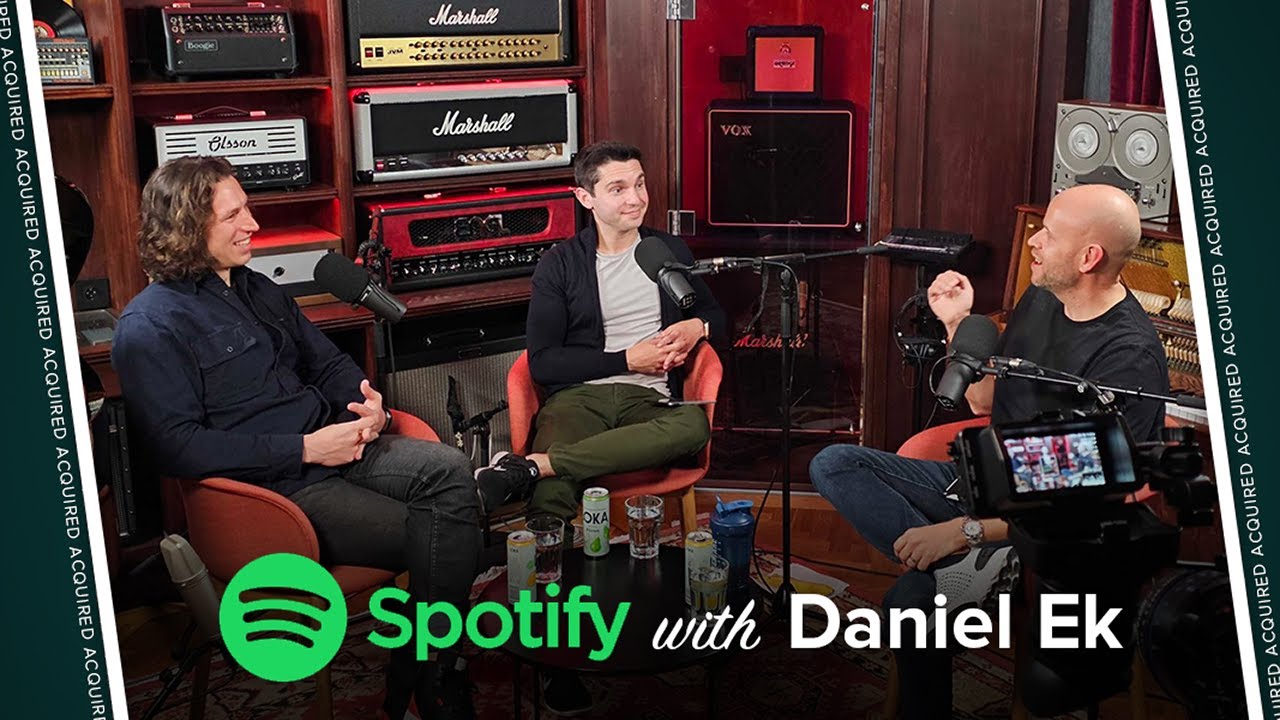
- Video: Spotify CEO Daniel EkAcquired on YouTube
Researched and written by Mark Weizer. Last checked on November 15, 2026.
Keep Reading
- Playbooks
Canva Marketing Strategy: How Templates and SEO Grew 265 Million Monthly Users
Canva's marketing strategy from its newsroom, its founders and its own sitemaps: freemium and word of mouth, 39,603 template pages built for search, 100 languages, free plans for schools, Canva Create and the TV campaigns. Then how to run the same playbook for your own app.
- Playbooks
Uber Marketing Strategy: How a Two Sided App Won 215 Million Monthly Users
Uber's marketing strategy, taken apart from its own filings: the city by city launch playbook, ice cream and kittens, referrals on both sides, the 2018 brand reset, safety, Uber One, the Uber Eats Super Bowl ads, the ads business, what it spends and how it makes money. Then how to run the copyable parts for your own app.
- Playbooks
Monopoly Go Marketing Strategy: The Budget, the Ads and What It Bought
How much Monopoly Go spent on marketing, who said it and when, and what the money bought: localized ads, a celebrity TV campaign, friend invites, sticker trading, live ops seasons and crossovers. Then how a small studio can keep its own channels as busy as a big launch.