What Is an AI Marketing Agent?
An AI marketing agent is a language model that can use your marketing tools instead of only writing text about them. You give it a goal, such as "find out why signups fell last week and draft a fix". It decides which steps that needs, reads your analytics, looks at the ad account, drafts an email and a few posts, and stops when the goal is met or when it needs a person. The tools are the whole difference. Without them you have a chatbot that hands you copy to paste. With them you have something that can move work forward while you do something else.
Anthropic's essay on building effective agents draws the line most builders now use. A workflow runs models and tools along paths someone wrote in advance. An agent directs its own process and decides which tools to use and in what order. Both are useful in marketing. Sending a weekly traffic report is a workflow: the steps never change. Working out why a campaign underperformed is agent work, because the next step depends on what the last one found.
The label is overused. In June 2025 Gartner predicted that over 40% of agentic AI projects will be canceled by the end of 2027, because of rising costs, unclear business value or weak risk controls. The same release describes "agent washing", vendors renaming chatbots, assistants and automation tools as agents, and estimates that only about 130 of the thousands of vendors claiming agentic AI are real. So when a product says it has a marketing agent, ask two plain questions: which tools can it call, and what can it do without asking you?
This page is about marketing broadly: email, paid ads, SEO, analytics, content and social. If social media is your main job, two of our guides go deeper on that one channel: what an AI agent for social media is and how to set one up, and what an AI social media manager automates for an app. Here we look at the whole marketing week and where an agent fits into it.
How We Researched This
On October 28, 2026 we opened the official documentation for every agent, connector and server named on this page and checked what each one can read, what it can change and what it costs. That means Google's own pages for the Google Analytics and Google Ads MCP servers, Meta's developer documentation and blog for its ads MCP server, HubSpot's and Semrush's developer pages, Klaviyo's announcement and pricing page, Salesforce's Agentforce pricing, Anthropic's and n8n's pricing and help pages, and the GitHub pages of the open source projects. Where a page and a third party blog disagreed, we used the vendor's own page and left the blog out.
Prices are list prices on that date, in the currency the vendor shows. We did not test enterprise tiers that need a sales call, and we say so where it matters. Spreadcast's own facts come from our product. The worked example near the end uses a made up founder called Alex and a made up app, so nothing there is a customer result.
Two things move fast here. Vendors rename features (Klaviyo's menu now lists its agent as Composer, and Claude's pricing page announced that Claude Cowork is now just Claude), and which plans get which connector changes every few months. Check the vendor page before you buy anything, and treat any number on this page as true on the date above.
What AI Agents for Marketing Can Do Today, Channel by Channel
The honest answer to "can AI agents do marketing" depends on the channel. Each row names the official connection we checked and the access it gives an agent.
| Channel | What an agent can do | Official connection we checked | What stays with a person |
|---|---|---|---|
| Analytics | Answer questions about traffic, users and conversions, build reports, spot changes week over week | Google Analytics MCP server, read only | Deciding what a drop means for the business |
| Paid search | Pull campaign metrics, budgets and status, explain what changed | Google Ads MCP server, read only in its current release | Every bid, budget and campaign change |
| Paid social | Report on campaigns, create and edit ads, ad sets and campaigns, manage catalogs | Meta ads MCP server, with rules set per ad account | Spend, targeting and the yes on anything that goes live |
| SEO | Keyword and backlink research, competitor traffic, monthly reports | Semrush MCP, read only for projects, paid in API units | Which pages to write and whether they help a reader |
| CRM | Read and update contacts, deals and engagements | HubSpot MCP server, read and write | Anything that changes what a customer receives |
| Plan, build and draft campaigns, flows and signup forms | Klaviyo Marketing Agent, built into Klaviyo | Final review, consent and the send button | |
| Social | Design branded posts and carousels, write a caption per network, schedule and publish | Spreadcast MCP server, drafts by default, publishing after approval | Replies, community and the post that needs a human voice |
| Content | Briefs, outlines, first drafts, rewrites to a style guide | Anthropic's marketing plugin and similar skill packs | Facts, sources, opinion and the final edit |
Checked on October 28, 2026 on each vendor's own documentation. "Read only" is what the vendor's page says about its current release.
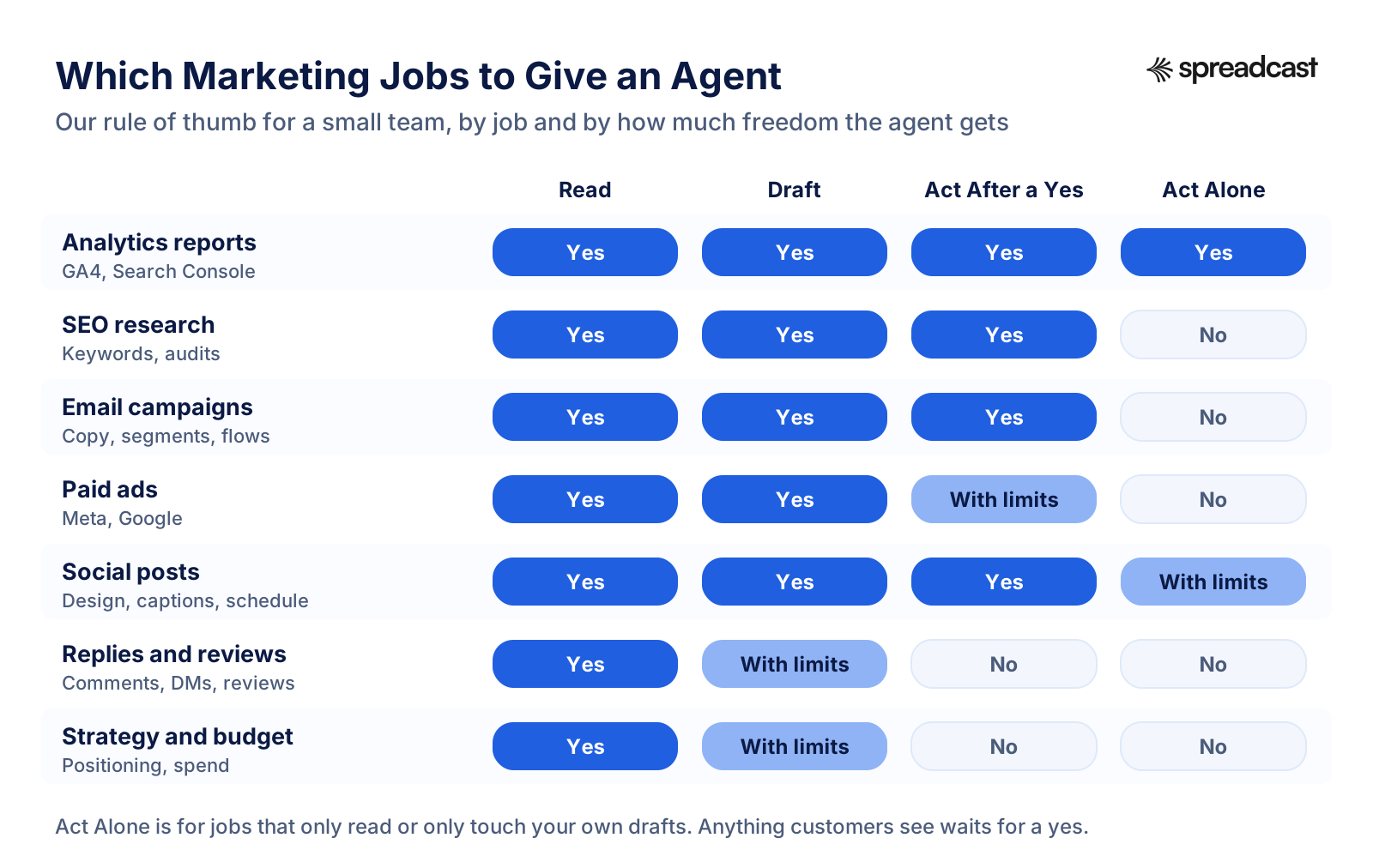
Which Marketing Jobs to Give an Agent
A useful way to decide is to split every job by how much freedom the agent gets: reading, drafting, acting after a person says yes, or acting alone.
Jobs an AI Agent for Marketing Does Well
These are the jobs where an agent saves real hours in a small team, because the work is repetitive, the inputs are data you already own and a mistake is cheap to catch.
Weekly Reports From Your Own Data
Pulling numbers from four dashboards into one summary is the job most founders skip. An agent with read access to analytics and ads can write it every Monday: sessions, signups, cost per signup, the three biggest changes and a guess at why. Google's Analytics MCP server exists for exactly this, and it cannot change your settings, so there is nothing to approve.
Turning One Idea Into Many Formats
A release note becomes an email, a changelog entry, three social posts and an ad headline. The agent keeps the facts consistent and fits each format's length. This is where most of the time savings come from, because the thinking was done once and only the shaping repeats.
Research Nobody Has Time For
Competitor traffic, keywords a page could rank for, backlinks a rival picked up last month. Semrush describes its MCP being used to scan keyword and backlink data daily, track competitor traffic and generate monthly SEO reports. An agent does this without getting bored, which is the main thing a person does when researching.
First Drafts in Your Voice
Given a style guide and three examples of your best work, an agent writes a usable first draft of a nurture email, a landing page section or a post. It will not write your best line, but it removes the blank page, and it does it at eleven at night when you finally have time to edit.
Checks Before Anything Ships
Agents are good reviewers of rules: subject line length, missing unsubscribe link, a caption over a network's limit, a broken campaign link, an image without alt text. Run every draft through a check step and you catch the boring mistakes before a customer does.
Keeping a Calendar Full
The hardest part of marketing for a small team is not any single task, it is doing the tasks every week. An agent that proposes next week's emails and posts every Friday, ready for review, keeps the rhythm going in weeks when the team is busy shipping product.
Jobs Marketing AI Agents Do Badly
Every job on this list has burned a team that handed it over too early. Keep a person on it, or keep the agent to reading and drafting.
Strategy and Positioning
An agent can summarize what competitors say. It cannot tell you which customer to ignore, which feature to stop talking about or why your best users actually stay. Those calls come from talking to customers, and the agent has never met one.
Spending Money on Its Own
Raising a budget, changing a bid strategy or launching a new campaign moves real money in minutes. Google's official Ads server only reads for now, and Meta built rules for agent access so you can grant read access to performance data while withholding the ability to change budgets, campaigns or creative. Use those rules.
Reviews and Testimonials
An agent asked to "get more reviews" may write some. That is illegal. The FTC's final rule on fake reviews, announced in August 2024, bans reviews that misrepresent that they are by someone who does not exist, such as AI generated fake reviews, and lets the agency seek civil penalties against knowing violators. Agents can ask happy customers for reviews. They cannot be the customers.
Replying to Customers in Public
Comments, DMs and review replies are where tone mistakes become screenshots. An agent can draft replies for a person to send. Letting it post them on its own also means letting strangers' text steer it, which is the prompt injection problem covered below.
Claims That Need Proof
Agents fill gaps with plausible numbers. "Used by 10,000 teams" or "cuts costs by 40%" can appear in a draft with no source behind it. Every number in an email, ad or landing page needs a person who knows where it came from.
AI Agent for Email Marketing
Email is the channel where the built in agents are furthest along, because the email platform already holds the list, the past campaigns and the results. Klaviyo introduced its K:AI Marketing Agent in September 2025 as an agent that plans, builds and launches campaigns, flows and signup forms inside Klaviyo, with the marketer keeping oversight. You paste a URL, it learns your voice and catalog, and it returns a plan with drafted campaigns. Klaviyo's own wording on review is plain: the campaigns are written, designed and ready to go live, and "you review and approve". On its pricing page the agent now sits in the menu as Composer.
If you build your own email agent instead, the law follows you. The FTC's CAN SPAM compliance guide lists what every commercial email needs: no false header information, no deceptive subject lines, a clear note that the message is an ad, your physical postal address, a working way to opt out, and opt outs honored promptly. It applies to business to business email too. Each separate email that breaks the law can cost up to $53,088. The line that matters most for agents is this one: you cannot contract away your legal responsibility, and the guide tells you to monitor what others do on your behalf. An agent is an "other". If it writes a misleading subject line, the penalty is yours.
In practice that means three rules for an email agent. It drafts and schedules, but a person approves every send to more than a test list. It never edits suppression lists or consent settings. And its subject lines get the same check as a human's: would a reader feel tricked when they open it?
A small team with a short list does not need an enterprise tool for any of this. Klaviyo's free plan covers up to 250 active profiles and 500 email sends a month, according to Klaviyo's pricing page, which is enough to test email automation on a small list before you pay. Check which agent features your plan includes before you count on them.
AI Agent for Paid Ads: Meta and Google
Ads are where agents can save the most time and lose the most money, so the vendors have been careful. Google's Google Ads MCP server is read only in its current release. Its tools list the accounts you can reach and run Google Ads Query Language requests that fetch metrics, budgets and status. That is enough for an agent to answer "which campaigns lost conversions this week and what changed", and not enough for it to touch a bid. Google also notes that developer tokens were sunset on September 9, 2026 and are no longer needed in the latest version, because API access levels now attach to the Google Cloud project.
Meta went further. Its ads MCP server overview lists tools to create and edit ads, ad sets and campaigns, pull insights, manage catalogs, check signal health, run A/B tests and conversion lift studies and read the account's change history. In July 2026 Meta opened the server to any developer with their own Meta app. The same post explains the safety layer: rules define what an agent can and cannot do on an ad account or catalog, set one asset at a time in Meta Business Suite settings or in bulk through the Marketing API.
A sensible setup for a small advertiser is to start every agent on read access, let it write a weekly performance note with suggested changes, and make the changes yourself for the first month. When its suggestions are consistently right, allow it to create new ads in a paused state you review, and keep budgets human for good. If the agent is also reading competitor ads or comments, keep it on read only access, for the reason in the prompt injection section below.
Your ad numbers also need context the ad account does not hold. If you market an app, the question is rarely the cost per click; it is what an install costs against what a customer is worth. Our pages on cost per install benchmarks and the LTV to CAC ratio give an agent the yardsticks to judge whether a campaign is worth keeping.
AI Agent for SEO and Content
SEO suits agents on the research side. Semrush's MCP documentation says the server gives AI agents access to Semrush's public APIs and lists Claude, Claude Code, ChatGPT, Cursor and other tools it works with. For your own projects it exposes the read only methods: an agent can pull data from a project but not create projects or change settings. Every request uses the same API units as the Semrush API, so a chatty agent costs more than a careful one. Ahrefs and other SEO suites offer similar servers; check each vendor's docs for the plan it needs.
Writing is where SEO agents get teams into trouble. Google's position, in its post on Google Search and AI content, is that appropriate use of AI or automation is not against its guidelines, as long as it is not used to generate content primarily to manipulate rankings. Its spam policies name the failure: scaled content abuse, many pages generated mainly to manipulate search rankings rather than help people, "no matter how it's created". An agent that turns a keyword list into two hundred thin pages is building exactly that.
The useful split is research and structure by the agent, substance by a person. Let the agent find the questions people search, outline the page, check what the top results cover and draft the plain sections. Then a person adds what only you know: your numbers, your screenshots, your opinion and the mistakes you made. That is also the part readers remember.
If your product is an app, the App Store listing is its own search engine with its own rules. Our App Store optimization guide covers the fields an agent can help you rewrite, and the App Store conversion rate benchmarks tell you whether a listing change worked.
AI Agent for Marketing Analytics
Analytics is the safest place to start, because reading cannot break anything. Google's documentation for the Google Analytics MCP server says it is available for read requests only and cannot create, modify or delete your Google Analytics configuration or settings. It authenticates with Application Default Credentials and the read only Analytics scope, and it uses the Admin API and Data API to list your accounts and properties and run reports. Google suggests it for questions like user counts and top selling products, and for data driven marketing plans.
What an agent adds over a dashboard is the follow up question. A dashboard shows that signups fell 18%. An agent can check whether the drop is one country, one device or one traffic source, compare it to last month's release date and write that up in a paragraph. It will sometimes be wrong about the cause. It is very rarely wrong about where the drop is, and that alone saves an hour.
Pick the numbers before the agent does. A report that lists forty metrics teaches nobody anything. Our list of social media KPIs with formulas and the engagement rate calculator cover the social side; for the business side, three numbers usually do: visitors to signups, signups to paying customers, and what each customer cost.
Video: Set Up the Google Analytics MCP Server
Google's own walkthrough of the read only analytics server, the safest first tool for any marketing agent.

AI Agent for Social Media Marketing
Social is the channel where most marketing agents stop short. A general agent can write a caption. It cannot design an image in your brand's fonts and colors, it does not know that Threads, LinkedIn and Bluesky want different lengths, and it has no publishing access to eleven networks. So the post goes back to a person who opens a design tool, exports the image, logs in to each network and pastes the caption four times. That is the job that never gets done in a busy week.
This is the gap Spreadcast fills inside an agent. Connect the Spreadcast MCP server to Claude or ChatGPT and the same agent that wrote your release email can design the post in your brand, write a caption for each network and schedule it to Instagram, Facebook, Threads, LinkedIn, Pinterest, TikTok, YouTube, Bluesky, Mastodon, Telegram and Discord. A new connection saves drafts only, so nothing goes out until you approve it. If you sell an app, it also reads your App Store listing every day and drafts a post when a new version goes live or the app hits a ratings milestone.
For the social channel in depth, our guide to an AI agent for social media covers the three ways to get one and the guardrails, and the AI social media manager page covers what can be automated and what each network's rules allow. If you prefer to work from a chat window, Claude for social media and ChatGPT social media automation walk through each assistant.
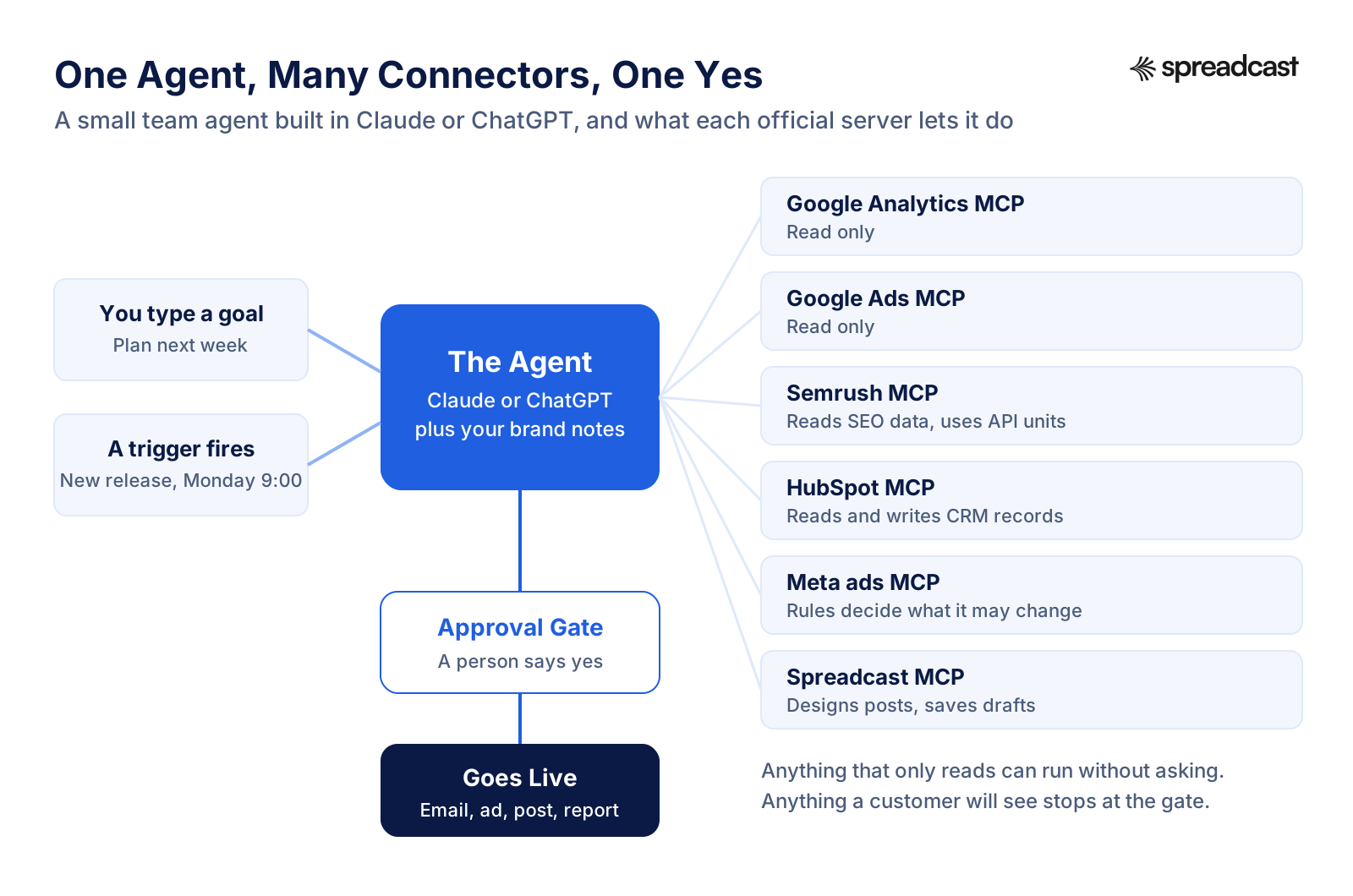
How an AI Marketing Agent Fits Together
Most small team agents in 2026 look like this: one assistant, several official servers with different powers, and one place where a person says yes.
Build vs Buy: Which AI Marketing Agent Route Fits a Small Team
There are three ways to get a marketing agent, and they trade control against effort.
The first is to buy an agent built into a tool you already use. Klaviyo's agent lives inside your email data. Salesforce sells Agentforce on consumption: its pricing page lists Flex Credits at $500 per 100,000 credits, or $2 per conversation, with a $5 per user monthly license that requires Flex Credits. Products sold as an AI CMO, such as Okara, bundle several agents for one website; Okara's pricing page lists AI CMO Lite at $129 a month and AI CMO Pro at $249 a month, with a free tier limited to analysis and strategy. Built in agents are the fastest to start and the hardest to steer outside their own walls.
The second is to assemble one from a general assistant and connectors. Claude and ChatGPT both speak the Model Context Protocol, an open standard that lets one server offer tools to any client. You add the official servers from the table above, write a page of instructions and keep the approval step. You own the brain; each vendor owns its tool. This is the route most small teams should try first, because it costs a chat subscription and an afternoon.
The third is to build a workflow agent that runs without you in the room: in n8n, Zapier Agents or code. A trigger fires on a schedule or an event, an agent step decides what to do, and approval requests arrive in Slack or email. This is where you go when the same job runs every week and you are tired of starting it by hand. It is also where most of Gartner's canceled projects live, so build it after the chat version has proved the job is worth automating.
If you sell an app, our review of Okara AI compares an AI CMO with Spreadcast for that case, and the best MCP servers for marketing roundup lists the official servers by job.
Build or Buy Compared
| Question | Buy an agent in a tool | Assemble in Claude or ChatGPT | Build a workflow in n8n or code |
|---|---|---|---|
| Time to first result | Same day | An afternoon | A week or more |
| Who decides the steps | The vendor | The assistant, guided by your instructions | You, in the workflow, plus the agent step |
| Runs while you sleep | Inside that tool only | Only scheduled tasks, on plans that offer them | Yes, on a schedule or a trigger |
| Reaches several channels | Rarely | Yes, through one connector per tool | Yes, through nodes or MCP |
| Approval step | Built in, varies by vendor | You approve in the chat or in each tool | Built in: n8n human review or Agents SDK approvals |
| Main risk | Locked to one channel | Forgetting to review before approving | Silent failures nobody reads |
| Best for | One channel that matters most | Small teams starting out | A proven job that repeats weekly |
Our summary from the vendor documentation linked on this page, checked on October 28, 2026.
How to Build an AI Marketing Agent With Claude and Connectors
The route we recommend for a team of one to five people. It takes an afternoon and you can undo every step.
- Step 1
Write the Job Down First
Pick one job that repeats and that you dislike, such as the Monday report or turning a release into an email and posts. Write the steps you do today in plain words. If you cannot write them, the agent cannot do them either.
- Step 2
Pick the Plan That Allows Connectors
Anthropic's help center says custom connectors using remote MCP work in Claude and Claude Desktop on Free, Pro, Max, Team and Enterprise plans, with Free limited to one custom connector. Pro costs $20 billed monthly or $17 a month billed yearly on Claude's pricing page. In ChatGPT, OpenAI's MCP documentation now describes remote MCP servers reaching ChatGPT as plugins; plan rules there have changed several times, so check your workspace settings.
- Step 3
Connect Read Only Tools First
Start with analytics, ads reporting and SEO research. Nothing the agent does with these can reach a customer, so you can test freely. Ask it the questions you already know the answers to and see whether it gets them right.
- Step 4
Write a Brand and Rules Page
One page: who the customer is, the voice, words you never use, claims you can prove, claims you cannot, and what needs approval. Put it in a Claude project or a skill so every conversation starts with it. This page does more for quality than any prompt trick.
- Step 5
Add Tools That Write, With a Gate
Add the CRM, email and social connections last, and only in draft mode. The agent writes the email into the email tool as a draft, saves the post as a draft, and stops. You approve in the tool where the work will go live, where you can see exactly what customers will see.
- Step 6
Give the Agent a Social Arm
If posting is part of the job, connect Spreadcast at the MCP page with OAuth, no key to copy. The agent can then design the post in your brand, write one caption per network inside each limit and save it as a draft for one tap approval. It is the step most self built agents are missing.
- Step 7
Read Twenty Runs Before You Trust It
For the first two weeks, read every output in full. Note each mistake and add a line to the rules page that would have prevented it. Most agents improve more from five good rules than from a better model.
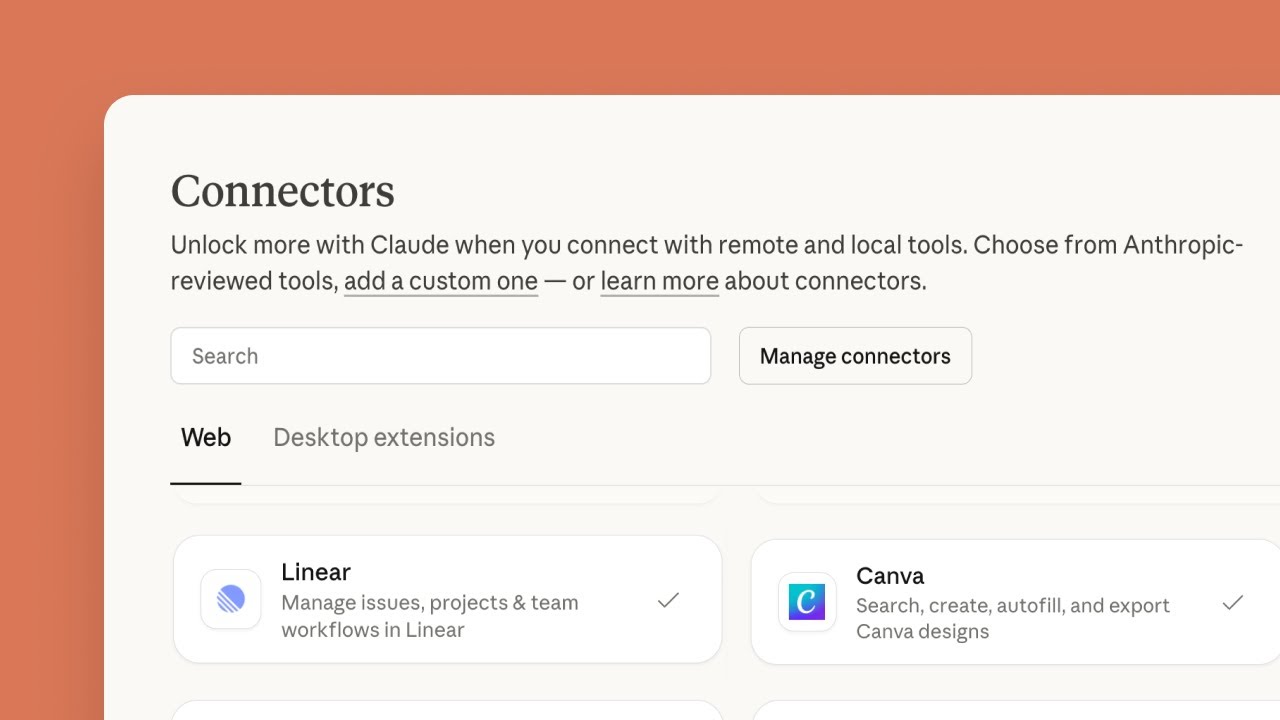
Video: Getting Started With Connectors in Claude
Every Claude marketing agent starts with this screen: adding the tools it may use.
Claude Marketing Agent: The Official Marketing Plugin and Skills
Anthropic publishes a free marketing plugin in its knowledge work plugins repository on GitHub, designed mainly for Cowork and also working in Claude Code. It installs with two commands and adds seven slash commands for the common jobs: drafting content (blog posts, social posts, newsletters, landing pages, press releases and case studies), a campaign plan with objectives, channels, a content calendar and success metrics, a brand review of copy against your voice and messaging, a competitive brief, a performance report, an SEO audit, and email sequences for nurture, onboarding and drip flows. You can store your brand voice, style guide and personas in a settings file, so the drafting and brand review commands apply them without being told each time.
The plugin's page also lists the connectors it is designed to work with, from analytics and CRM tools to SEO suites like Ahrefs and data tools like Supermetrics. That is the important point: the plugin is the playbook, the connectors are the hands. Installed alone, it writes very good plans. Installed with connectors, it can read your real numbers and fill the plan with them.
A skill is the smaller unit: a folder of instructions an agent loads when a task matches. Our page on Claude skills for social media reviews the skill packs worth installing for posting, and Claude prompts for social media has prompts to copy. For a terminal based setup, see Claude Code for social media; for scheduled hand off tasks, see Claude Cowork for social media.
AI Marketing Agent Prompt Templates to Copy
Each prompt assumes the agent has the connector named in the job. Paste it, fill the brackets, and check the last column before you approve anything.
| Job | Prompt | Check before you approve |
|---|---|---|
| Monday report | Using Google Analytics and Google Ads, compare last week with the week before for [property]. List the three biggest changes in signups or cost per signup, where each change happened (country, device, source), and one likely cause for each. Under 200 words. Do not suggest changes yet. | That each change is real in the dashboard, not a sampling artifact |
| Campaign brief | Plan a two week campaign for [launch]. Audience: [who]. Channels: email, Meta ads, social. Give the goal as one number, the message in one sentence, the assets each channel needs and how we will know it worked. Use only facts from the release notes I paste below. | That the goal number is one you can measure |
| Release email | Write a launch email for [feature] from these release notes. Subject line under 50 characters that says what changed, no tricks. One screen of text, one link to [URL]. Save it as a draft in [email tool], do not schedule. | Subject line honesty, unsubscribe link, the address in the footer |
| Ad review | Read our Meta campaigns from the last 14 days. Flag ads with frequency above 3 or a cost per result 50% above the account average. Suggest one new headline per flagged ad. Do not edit anything. | That the thresholds fit your account; change them before running |
| Keyword gap | Using Semrush, list keywords where [competitor] ranks in the top 10 and we do not rank in the top 50, with volume above 100. Group them by topic and say which existing page of ours could cover each group. | That each group matches what you actually sell |
| Content outline | Outline a page for [keyword]. List the questions people ask, what the top three results cover and what they miss. Mark which sections need our own data or screenshots. Do not write the page. | That the gaps are real and you have something to add |
| Social week | From this week's release notes, create three posts with Spreadcast: one feature post with a screenshot, one carousel of how to use it, one short update. Write captions per network. Save all as drafts for Tuesday, Wednesday and Friday at 10:00 my time. | Every fact in the captions appears in the release notes |
| CRM tidy | In HubSpot, list contacts created in the last 30 days with no lifecycle stage. Propose a stage for each with a one line reason. Do not update records until I reply yes. | A sample of ten proposals against what you know |
Prompts written and tested in Claude for this page. Thresholds are examples, not benchmarks.
How to Build an AI Marketing Agent in n8n
When a job has proved itself in chat and you want it to run on a schedule, n8n is the usual next step. n8n's AI Agent node connects a chat model and one or more tools, and the agent decides which tools to call to complete a task. n8n describes an AI agent as an autonomous system that receives data, makes rational decisions and acts within its environment to achieve specific goals. The agent uses external tools and APIs to act and to fetch information, and those tools can include MCP servers, as the video below shows.
The feature that makes n8n fit for marketing is human review for tools. You can require approval before the agent runs a specific tool. The workflow pauses and sends an approval request through Slack, Telegram or the n8n chat; a person approves, and the tool runs with the input the AI chose, or denies, and nothing happens. n8n recommends it for irreversible actions such as sending external communications, for compliance requirements and for high value decisions, and suggests starting with review on and reducing it as trust grows. Put it on every tool that sends, publishes, spends or deletes.
A typical first marketing workflow: a Monday 8:00 schedule trigger, an AI Agent node with the Google Analytics and Google Ads MCP servers as tools, a prompt like the Monday report above, and a Slack node that posts the result. No approval needed, because nothing is written. The second workflow adds the email draft tool with human review on. n8n's pricing page lists the hosted Starter plan at €20 a month billed yearly for 2,500 workflow executions, and Pro at €50 for 10,000. You can also host n8n yourself, which costs a server and your time. Our guide to n8n social media automation has three ready workflows for the posting side.
Video: The AI Agent Tool and MCP in n8n
n8n's own walkthrough of connecting MCP servers to its AI Agent node, the core of an n8n marketing agent.

AI Marketing Agent on GitHub: Open Source Options
Searching GitHub for an AI marketing agent mostly turns up two kinds of project: skill packs that teach a general agent marketing, and servers that give it tools. The best known skill pack is Marketing Skills by Corey Haines, MIT licensed, with 52 skills and about 57,000 stars when we checked. It covers SEO audits, programmatic SEO, schema, emails, cold email, ads, ad creative, copywriting, conversion work and onboarding, and it installs into Claude Code, Codex, Cursor and other agents that read the Agent Skills format.
On the server side, Google publishes the Google Analytics MCP server on GitHub under the Apache 2.0 license, and the Google Ads MCP server is listed in Google's developer toolkit with companion agent skills for Google Ads tasks. Anthropic's marketing plugin sits in an open repository too. Put together, an open source marketing agent is a general assistant, a skill pack for the know how and official servers for the data.
Open source does not mean free to run. You still pay for the model, and you take on what a hosted product does for you: updates when an API changes, token storage and security. Before installing any community server that asks for an ad account password or a long lived token, read its code or skip it. A server that runs on your machine with your credentials can do anything those credentials allow.
Guardrails for an AI Agent for Marketing Automation
Marketing automation with an agent is safe when the limits live in the tools, not only in the prompt. These six are the minimum.
The Smallest Access That Does the Job
The MCP security best practices include a section on scope minimization: ask for the narrowest access a task needs. Give the reporting agent read only access, the drafting agent draft access, and nobody publishing rights on day one. Meta's per account rules and Google's read only servers make this easy for ads.
Approval Is a Separate Step
Approving should be its own tool or button, not something the agent does as part of creating. n8n's human review and the OpenAI Agents SDK both pause a run until a person approves or rejects a sensitive tool call, and the SDK can save a paused run and resume it later.
Strangers' Text Is Data, Not Orders
OWASP lists prompt injection as the top risk for language model apps: instructions hidden in content the model reads can change what it does. Comments, reviews, competitor pages and inbound emails are all written by strangers. An agent that reads them should not also hold tools that send or spend.
One Connection per Agent
Give each agent its own connection or key, named for its job. When something odd happens you can see which agent did it and cut off one connection without stopping the others.
A Log Someone Reads
Every tool call should land somewhere a person looks each week: a Slack channel, a sheet, the tool's own activity log. Meta's server exposes the account's change history for exactly this reason. An unread log is the same as no log.
An Off Switch You Can Find
Know where to revoke each connection before you need to. In Claude and ChatGPT that is the connector settings; in most tools it is a list of connected apps. Practice once, so a bad Friday afternoon takes one minute, not one hour.
Best AI Agent for Marketing in 2026, by Job
No single agent does every marketing job well. These are the strongest option for each job that we checked, with Spreadcast first because it is the social arm most marketing agents lack.
- 1
Spreadcast
Free for 3 posts; Pro $29 a monthBest for social posts designed and published from any agent
Spreadcast designs the post in your brand, writes a caption for each network and publishes it to Instagram, Facebook, Threads, LinkedIn, Pinterest, TikTok, YouTube, Bluesky, Mastodon, Telegram and Discord, on autopilot or after one tap of approval. Its MCP server lets Claude, ChatGPT, Cursor, Claude Code and other MCP clients do the same from a chat: design posts and carousels, write captions, create, schedule and approve posts, list moments and read analytics.
It was built first for App Store apps. Paste an App Store link at the start page and it builds a brand kit from the listing: icon, colors and screenshots in an iPhone frame. It checks the listing every day and drafts a post when a new version goes live or the app reaches a ratings milestone. Businesses without an app start from a website or a short description of the brand.
Pro is $29 a month or $290 a year and includes clean posts with no cap, publishing to 10 social accounts across any mix of networks, autopilot or one tap approval and posting from Claude or ChatGPT. Studio is $79 a month for 5 apps and 50 accounts, each with its own brand. Without a subscription, a Post Pack is $19 once for 10 posts designed and published. Details are on the pricing page.
Pros
- Designs the image, not only the text
- Eleven networks, including Threads, Bluesky, Telegram and Mastodon
- Drafts by default, publishing after approval
Cons
- Social only: it does not run email, ads or SEO
- No X
- 2
Best for email marketing inside an online store
Klaviyo's agent plans, builds and launches campaigns, flows and signup forms inside Klaviyo, learning your voice and catalog from a pasted URL, with you reviewing and approving. It is strongest for ecommerce, where Klaviyo already holds the orders and the list. Free plan limits are on Klaviyo's pricing page.
Pros
- Works on your real list and order data
- Review and approve step built in
Cons
- Lives inside Klaviyo only
- 3
Meta Ads MCP Server
No separate fee listed; ad spend appliesBest for agents that manage Facebook and Instagram ads
Meta's official server gives an agent reporting, ad creation and editing, catalogs, A/B tests and change history across Meta ads, with rules that limit what each agent may change per ad account.
Pros
- Official, with per account rules
- Reads and writes
Cons
- Needs careful limits on budgets and creative
- 4
Google Analytics MCP Server
Open source, runs on your machineBest first tool for a marketing agent
Google's read only server lets an agent list properties and run reports on your Google Analytics data. It cannot change settings, which makes it the safest connector to start with.
Pros
- Read only by design
- Official and open source
Cons
- Needs Python and Google Cloud credentials to set up
- 5
Google Ads MCP Server
No separate fee listedBest for search campaign reporting
Google's server runs Google Ads Query Language reports on metrics, budgets and status. It is read only in its current release, so an agent can explain performance but not change it.
Pros
- Official
- Safe for weekly reports
Cons
- Cannot make changes yet
- 6
Semrush MCP
Uses Semrush API unitsBest for SEO and competitor research
Semrush's server gives agents its public API data from Claude, ChatGPT, Cursor and other clients, with read only access to your projects. Each request spends API units like a normal API call.
Pros
- Wide client support
- Prompt library and skills from Semrush
Cons
- Costs scale with how much the agent asks
- 7
HubSpot MCP Server
Needs a HubSpot accountBest for CRM work
HubSpot's remote server gives any MCP compatible agent read and write access to CRM data such as contacts, deals and engagements, through OAuth.
Pros
- Read and write CRM access
- Official
Cons
- Write access needs your own review rules
- 8
Okara AI
Free analysis; from $129 a monthBest for an all in one AI CMO for a website
Okara sells an AI CMO that reads your website and runs several marketing agents for it. Paid plans are AI CMO Lite at $129 and AI CMO Pro at $249 a month, with a free tier for analysis and strategy only. Our Okara AI review covers what each plan includes.
Pros
- Several agents in one product
- Free website analysis
Cons
- Priced well above a chat plan plus connectors
- 9
n8n
From €20 a month hosted, or self hostedBest for agents that run on a schedule
n8n's AI Agent node with MCP tools and human review turns a proven chat job into a workflow that runs every week and asks before anything sensitive.
Pros
- Approval per tool
- Can be self hosted
Cons
- You maintain it
How Much an AI Marketing Agent Costs
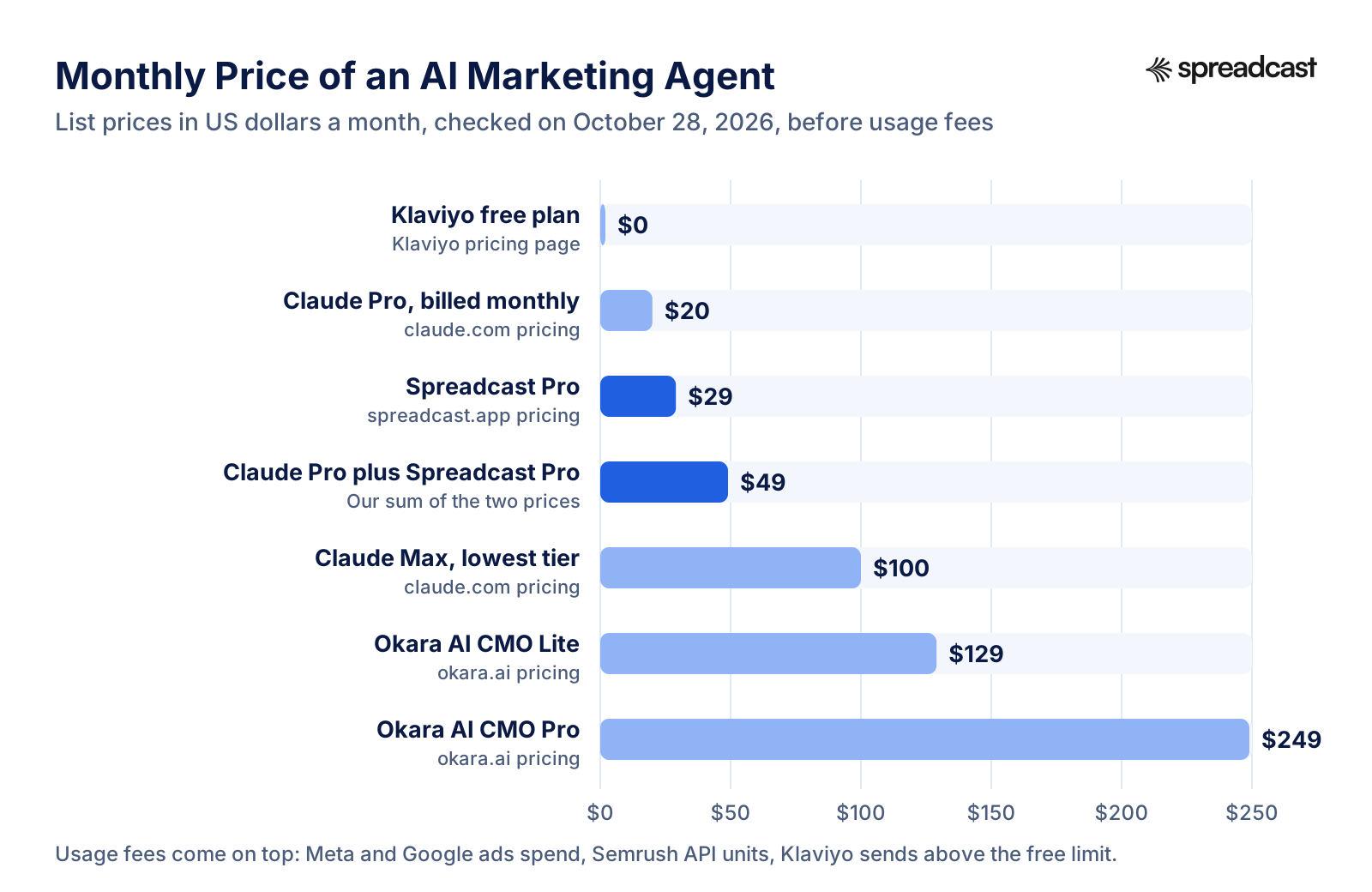
List prices on October 28, 2026. Most agents also have usage costs on top: ad spend, API units, email sends or model usage.
| Option | Price | What that buys |
|---|---|---|
| Claude Free | $0 on Claude's pricing page | Chat with apps and tools connected, one custom connector |
| Claude Pro | $20 a month, or $17 a month billed yearly | More usage, hand off and schedule tasks, Claude Code |
| Claude Max | From $100 a month | 5 or 20 times the Pro usage |
| n8n Starter | €20 a month billed yearly on n8n's pricing page | 2,500 workflow executions, hosted |
| n8n Pro | €50 a month billed yearly | 10,000 workflow executions, hosted |
| Klaviyo Free | $0 on Klaviyo's pricing page | Up to 250 active profiles and 500 email sends a month |
| Salesforce Agentforce | $500 per 100,000 Flex Credits or $2 per conversation on Salesforce's pricing page | Consumption pricing, plus licenses |
| Okara AI CMO | $129 or $249 a month on Okara's pricing page | An AI CMO for one website |
| Spreadcast Pro | $29 a month or $290 a year | Designed posts with no cap, publishing to 10 social accounts, posting from Claude or ChatGPT |
| Spreadcast Post Pack | $19 once | 10 posts designed and published, no subscription |
Euro prices are shown as n8n lists them. Usage based items like ad spend and Semrush API units are not included.
Monthly Price of an AI Marketing Agent, Compared
A chat plan plus one specialist tool costs a fraction of an all in one product. The question is whether you have time to steer it.
Is There a Free AI Marketing Agent?
Yes, if you count the pieces. Claude's free plan allows one custom connector, the Google Analytics MCP server is open source, Klaviyo's free plan covers a small list, Anthropic's marketing plugin and the Marketing Skills pack cost nothing to install, and n8n can be self hosted. A founder with a weekend can build a free agent that reads analytics and drafts emails.
What you will not get for free is volume and reliability. Free chat plans run out of usage quickly once an agent starts calling tools, because every tool result is more text for the model to read. Free tiers of products cap the parts that cost the vendor money, which is usually sending and publishing.
Spreadcast works the same way. The free plan designs 3 posts for one app that you download and post yourself, with a small Spreadcast mark. That is enough to see whether the designs fit your brand. Publishing starts with Pro at $29 a month, or a one time Post Pack at $19 for 10 posts if you only need a launch week. Paid plans have a 7 day full refund.
AI Marketing Agent for Small Business: A Worked Week
An example, not a customer story. Alex is a made up solo founder with a made up budgeting app called Pennyroot, using Claude with four connectors: Google Analytics, Google Ads, Klaviyo and Spreadcast.
- Step 1
Monday: The Report Writes Itself
At 8:00 an n8n workflow runs the Monday report prompt against Google Analytics and Google Ads and posts it to Slack. It says trial starts fell on Android in Brazil after Thursday. Alex spends ten minutes checking and finds a broken campaign link in one ad. He fixes the link himself.
- Step 2
Tuesday: Version 2.3 Ships
Pennyroot 2.3 adds shared budgets. Spreadcast sees the new version on the App Store listing and drafts a post with the new screen in an iPhone frame and captions for Instagram, Threads, LinkedIn and Bluesky. Alex approves it on his phone in one tap.
- Step 3
Tuesday Afternoon: The Release Email
In Claude, Alex pastes the release notes and runs the release email prompt. The agent saves a draft in Klaviyo. Alex rewrites the first line because it sounded like an ad, checks the footer and schedules it himself for Wednesday morning.
- Step 4
Wednesday: A Carousel for the Week
Alex asks Claude to turn the shared budgets feature into a how to carousel. Through the Spreadcast connector it designs five slides in Pennyroot's colors and saves the post as a draft for Thursday at 10:00. He swaps one slide's wording and approves.
- Step 5
Thursday: Ads, Read Only
Alex asks the agent which Google Ads campaigns lost conversions since the release. It names two and suggests new headlines. It cannot change anything, so Alex adds the headlines in Google Ads during lunch.
- Step 6
Friday: Next Week, Drafted
The agent proposes next week: one email, three posts, one ad test. Everything lands as drafts. Alex spends twenty minutes approving, editing and deleting one idea that did not fit. In this example his hands on time for the week stays around two hours, most of it reading and editing.
Where Spreadcast Fits in an AI Marketing Agent
Most marketing agents end at text. The report, the email draft and the ad headline are words, and words are what language models make well. Social media is different because a post is a picture first. That is why, in teams that have built an agent, the social channel is often the one that still gets done by hand, or not at all.
Before, the job looks like this. The agent writes a caption. You open a design tool, find the brand colors, take a screenshot, put it in a phone frame, export three sizes, open Instagram, LinkedIn, Threads and Bluesky one by one, paste the caption, shorten it where it is too long and pick a time. For one post that is half an hour. For three a week it is the reason the feed goes quiet.
After, the agent asks Spreadcast. Spreadcast designs the post from your brand kit with your real screenshots, writes a caption per network within each limit and saves a draft on the calendar. You open it, read it and approve it in one tap, or let autopilot publish the moments you trust, such as a new version or a ratings milestone. The agent never needs a Meta developer app, a Google Cloud project or tokens for eleven networks; you sign in once with OAuth from Claude or ChatGPT.
If you sell an App Store app, start at the start page with your App Store link; you will see your brand kit and the first designs in a few minutes. If you want the agent side first, the MCP page shows how to connect it, and the features page lists everything Spreadcast does. Plans are on the pricing page.
Mistakes to Avoid With Marketing AI Agents
Starting With the Hardest Job
Teams start with ad optimization because it sounds valuable. Start with reporting, which reads only, and drafting, which a person checks. Move to actions after a month of good drafts.
Trusting the Prompt to Hold the Line
"Never change budgets" in a prompt is a wish. A read only connection or a Meta rule is a fact. Put the limits in the tools, and use the prompt for tone.
Measuring Output, Not Results
An agent that writes forty posts and ten emails a week looks productive. Count signups, trials and sales from those posts and emails instead, and cut whatever does not move them.
Scaling Thin Content
Two hundred pages from a keyword list is the pattern Google's spam policy calls scaled content abuse. Fewer pages with your own data rank longer and convert better.
Forgetting the Budget Line
Agents use model credits, API units and executions. Put the agent in the startup marketing budget as its own line, and check usage weekly for the first month.
Which AI Marketing Agent Route Fits You
If you are one person with an app and no time, do not build a general agent yet. Use the built in agent of the one tool that matters most, and Spreadcast for social, so the posting happens without you. Add a chat agent for reports when you start running ads.
If you are a team of two to five with several channels, assemble an agent in Claude or ChatGPT: read only analytics and ads first, then draft access to email and social, then the Anthropic marketing plugin for plans and reviews. Move one proven job into n8n each quarter.
If you run marketing for a larger company with a CRM and a budget in six figures, the enterprise agents and consumption pricing make sense, and so does a person whose job is to watch them. Whatever the size, the rule from the start of this page holds: know which tools the agent can call, and decide what it may do without asking you.
For more on the wider plan, our guide on how to market an app puts every channel in order, and founder led marketing covers the part no agent can do for you: your own voice.
Frequently Asked Questions
What is an AI marketing agent?
It is a language model connected to marketing tools, such as analytics, an ad account, an email platform or a social scheduler, that can decide its own steps toward a goal and take actions, usually with a person approving anything customers will see.
Can AI agents do marketing on their own?
They can do parts of it on their own: reports, research, drafts and checks. Spending money, publishing, replying to customers and strategy still need a person. The official ads servers from Google are read only for that reason, and Meta lets you set rules on what an agent may change.
What is the best AI agent for marketing?
It depends on the job. For email inside a store, Klaviyo's agent. For ads, Meta's official ads MCP server and Google's read only Ads server. For analytics, Google's Analytics MCP server. For designed social posts published to eleven networks, Spreadcast. A general assistant like Claude can use all of them at once through connectors.
Is there a free AI marketing agent?
You can assemble one for free from Claude's free plan with one custom connector, open source servers such as Google's Analytics MCP, free skill packs and a self hosted n8n. Usage limits arrive quickly once the agent calls tools often, and sending or publishing is usually a paid feature.
How do I build an AI marketing agent?
Write down one repeating job, connect read only tools to Claude or ChatGPT, add a page of brand and approval rules, then add tools that write in draft mode only. Read the first twenty results in full before you let it run on a schedule in n8n.
Can Claude be a marketing agent?
Yes. With connectors Claude can read analytics, run SEO research, update a CRM and create social posts, and Anthropic's free marketing plugin adds commands for campaign plans, content drafts, brand reviews, performance reports, SEO audits and email sequences.
Will AI agents replace marketers?
They replace a lot of marketing tasks, mostly the repetitive ones like reporting, formatting and first drafts. They do not replace the judgment about who the customer is, what to say and what to stop doing, and someone still has to approve what goes out.
How much does an AI marketing agent cost?
From nothing for a self assembled free setup, to about $49 a month for Claude Pro plus Spreadcast Pro, to $129 or $249 a month for an all in one AI CMO such as Okara, to consumption pricing for enterprise agents like Salesforce Agentforce. Ad spend and API usage come on top.
Where These Facts Come From
Every outside number, rule and price on this page links to the page it was taken from.
- Building effective agentsAnthropic
- Claude plans and pricingAnthropic
- Get started with custom connectors using remote MCPClaude Help Center
- Marketing plugin in the knowledge work plugins repositoryAnthropic on GitHub
- Marketing Skills for Claude Code and AI agentsGitHub
- Building MCP servers for plugins and API integrationsOpenAI
- Human in the loop in the Agents SDKOpenAI
- AI Agent node documentationn8n
- Human in the loop for toolsn8n
- n8n plans and pricingn8n
- Host n8n yourselfn8n
- Zapier AgentsZapier
- What is the Model Context ProtocolModel Context Protocol
- MCP security best practicesModel Context Protocol
- LLM01 prompt injectionOWASP Gen AI Security Project
- Google Analytics MCP serverGoogle for Developers
- Google Ads MCP serverGoogle for Developers
- Ads MCP server overviewMeta for Developers
- Meta's ads MCP server is now available for developersMeta for Developers
- HubSpot MCP serverHubSpot Developers
- Semrush MCP overviewSemrush
- Introducing K:AI Marketing AgentKlaviyo
- Klaviyo pricingKlaviyo
- Agentforce pricingSalesforce
- Okara AI CMO pricingOkara
- Gartner predicts over 40% of agentic AI projects will be canceled by end of 2027Gartner
- CAN SPAM Act compliance guide for businessFederal Trade Commission
- Final rule banning fake reviews and testimonialsFederal Trade Commission
- Google Search's guidance about AI generated contentGoogle Search Central
- Spam policies for Google web searchGoogle Search Central
- Google Analytics MCP setup tutorialGoogle Analytics
- Getting started with connectors in ClaudeAnthropic
- Native MCP trigger and AI Agent tool walkthroughn8n
Researched and written by Spreadcast. Last checked on October 28, 2026.