Cal AI's marketing strategy was paid creator content at scale. The team paid fitness creators flat monthly fees to scan their meals with the app inside the videos they were already making for TikTok and Instagram, and by May 2025 it had 250 influencers on those deals at once, cofounder Zach Yadegari said. Around that engine sat the founder's viral posts on X, paid social ads made by creators hired for ads, and nonstop paywall testing on a deliberately cheap $29.99 a year plan. The app went from launch in May 2024 to more than 15 million downloads and over $30 million in annual revenue in under two years, by MyFitnessPal's count, and MyFitnessPal bought it in a deal that closed in December 2025.
That's the short version, and it's the version most founders copy badly. The parts that made it work were narrower and stranger: a product with a three second payoff that looks good on camera, a niche with far more creators than brands, deal math pegged to revenue per thousand views, and a team that read comment sections like sales reports. This page walks through each piece with the number and the person who said it, then shows how to run the pieces that fit your own app. One piece fits every app, and it costs the least: your app's own accounts posting real product content every day. That's the part Spreadcast runs for you.
| Cal AI key facts | Detail and source |
|---|---|
| Launched | First code around March 2024 (Latka interview), live on the App Store and Google Play in May 2024 (CNBC Make It) |
| Founders | Zach Yadegari (CEO) and Henry Langmack (CTO), high school friends from coding camp, with Blake Anderson and Jake Castillo, two people Yadegari met on X (CNBC Make It) |
| Founders' ages | Yadegari was 17 when he cofounded the app (TechCrunch), 18 and still in high school in March 2025 (TechCrunch), 19 at the sale (TechCrunch) |
| What it does | Take a photo of a meal and the app estimates calories, protein, carbs and fat; barcode and text logging too |
| Downloads | More than 5 million in eight months (founder claim to TechCrunch, March 2025), 8.3 million by July 2025 (spokesperson to CNBC Make It), more than 15 million by March 2026 (MyFitnessPal to TechCrunch) |
| App Store rating | 4.8 stars from more than 375,000 ratings on the App Store listing, checked November 15, 2026 |
| Revenue | Somewhere between $30 million and $50 million a year depending on who you ask; see the revenue section below |
| Marketing spend | Almost $770,000 a month on advertising and marketing in September 2025, per documents reviewed by CNBC Make It; 250 paid creators in May 2025 (Latka interview) |
| Main channels | Paid creators on TikTok and Instagram, ads made by creators for Meta, the founder's posts on X, App Store keywords, the brand's own short video accounts |
| Price | Free download, then $2.49 a month or $29.99 a year (Fortune, September 2025), with a three day trial (Latka interview) |
| Owner today | MyFitnessPal, deal closed December 2025 and announced March 2, 2026; the app stays separate (TechCrunch) |
Who Founded Cal AI and What the App Does
Cal AI was founded by Zach Yadegari and Henry Langmack, two high school friends, with cofounders Blake Anderson and Jake Castillo, and the app does one thing: it turns a photo of your food into a calorie and macro count. Yadegari tells the origin story the same way in every interview. He was skinny, wanted to bulk up, found that diet was most of the work, and hated logging food by hand. He told Fortune that using the most popular app at the time was "an awful experience": he was eating pre portioned meals weighed on a scale, so he couldn't sit in the cafeteria with his friends, and he skipped restaurants because he couldn't count what was on the plate.
He wasn't new to building things people used. In ninth grade he made Totally Science, a site that let students play games their schools had blocked, named so the school filters would leave it alone. He told Fortune it reached 5 million users and earned $60,000 a month from banner ads before he sold it at 16 for $100,000 to the game company FreezeNova, a sale TechCrunch and CNBC both reported. With that money he and Langmack, a friend since coding camp, went looking for the next idea on X, where Yadegari met Blake Anderson, already known for the dating advice apps RizzGPT and Umax.
Jake Castillo is the name app founders should pay most attention to. TechCrunch described him in March 2025 as the cofounder and COO running influencer marketing, and he's the person who built the creator program this whole page keeps coming back to. Yadegari and Langmack spent July 2024 in a San Francisco hacker house, interviewing their first hires there, CNBC reported, and Yadegari told TechCrunch he slept on the floor at least one night.
On the product side, Cal AI never claimed a secret model. Yadegari told TechCrunch the app uses models from Anthropic and OpenAI plus retrieval to improve accuracy, and he told Nathan Latka plainly that they did not train their own model. The app's own pitch, per TechCrunch's Disrupt preview, is that a photo plus the phone's depth sensor gives calories, protein, carbs and fat. The founders have quoted a 90% accuracy figure to TechCrunch and CNBC; the support page on Cal AI's website says about 80%. Users noticed the gap, and app reviews complain about accuracy. Yadegari told CNBC some people expect a kind of X ray vision that finds food hidden at the bottom of a bowl, and the app won't do that.
Here's why the product matters for a marketing page. Cal AI's whole strategy depended on one property of the app: you can show its value in about three seconds on camera. Point, scan, number. Without that, none of the creator math below works, and the cofounders say so themselves. Before you copy any tactic on this page, ask whether your app has a moment like that. If it doesn't, the rest still teaches you something, but your channel mix will look different.

How Did Cal AI Grow So Fast? The Timeline
Cal AI grew fast because its first paid creator post worked and the team then bought as many similar posts as it could, as quickly as it could. CNBC reported that the group spent $2,000 on a social media marketing test run once the app was built, and that the response was good enough for Yadegari and Anderson to fund six months of running and marketing costs out of pocket while the app stores' payouts caught up. The app brought in more than $28,000 in its first month and $115,000 in its second. At TechCrunch Disrupt in October 2026 Yadegari gave a slightly rounder version: about $30,000 in month one, more than $100,000 in month two, more than $300,000 in month three, $500,000 in month four and $1 million by month six, as Net Influencer reported.
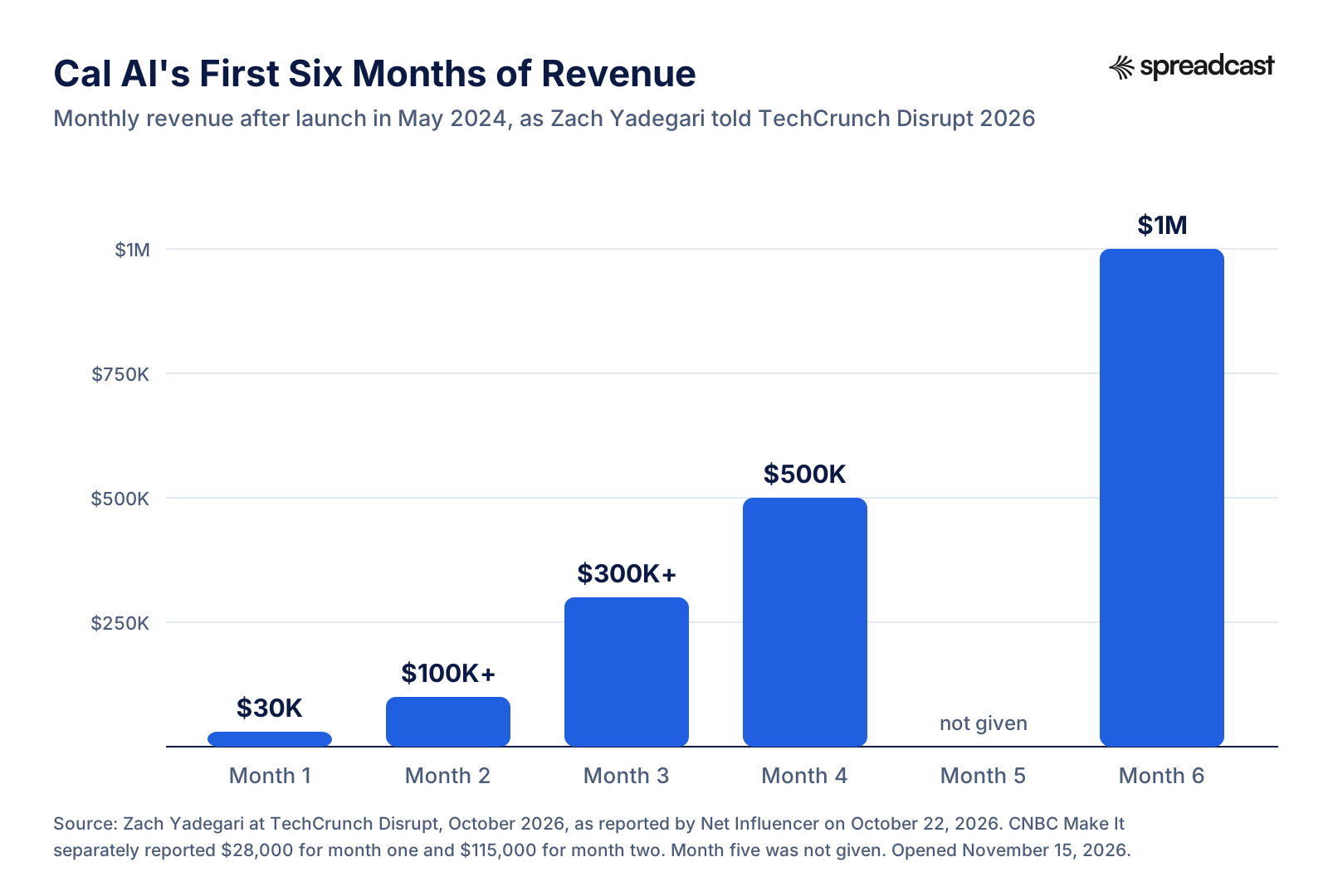
Look at the shape. It isn't a hockey stick from one viral hit. It's a staircase, each step roughly as big as the number of creators the team managed to sign that month. Yadegari described it on stage as a clear formula that was "pretty linear" but very fast. That's the most useful sentence in the whole Cal AI story for you, because linear growth is growth you can plan. Each creator post got a certain number of views, and a predictable share of those views turned into paying users.
| When | What happened | Source |
|---|---|---|
| March 2024 | First line of code, by Yadegari's recollection | Latka interview |
| May 2024 | Launch on iOS and Android, and the $2,000 social media test | CNBC Make It, September 2025 |
| July 2024 | Team moves into a San Francisco hacker house and starts hiring | CNBC Make It profile |
| September 2024 | First $1 million in sales, about five months in | Latka interview |
| March 2025 | Founder claims 5 million downloads and over $2 million in revenue the previous month; TechCrunch can't verify | TechCrunch |
| April 2025 | Yadegari's post about 15 college rejections passes 22 million views on X | TechCrunch |
| May 2025 | 250 paid creators, a $35 million run rate, 20,000 to 30,000 downloads a day | Latka interview |
| July 2025 | 8.3 million downloads | CNBC Make It, citing a spokesperson |
| December 2025 | Sale to MyFitnessPal closes | TechCrunch |
| March 2, 2026 | Sale announced; Yadegari posts that Cal AI passed $50 million in annual recurring revenue | Yadegari on X |
| June 2026 | Yadegari leaves MyFitnessPal | TechCrunch |
| October 2026 | Yadegari announces a $10 million round for Persona, then explains the growth playbook on stage at Disrupt | TechCrunch on the round, TechCrunch on the talk |
One thing the timeline hides: Cal AI wasn't the founders' first try at an app. Yadegari said at Disrupt that he and his cofounders launched about six apps in roughly a year before it, including a social fitness app, a motivational alarm clock called Grind Clock, a payment link tool and a wallpaper app. And Nathan Latka's write up of his interview notes that the founders' holding company was set up to launch several apps on the back of an influencer network posting daily. Cal AI was simply the one that grew so fast it got all the attention. If you're on your first app and nothing's working, that detail is worth more than any tactic below.
Cal AI Influencer Marketing: The Engine Behind the Growth
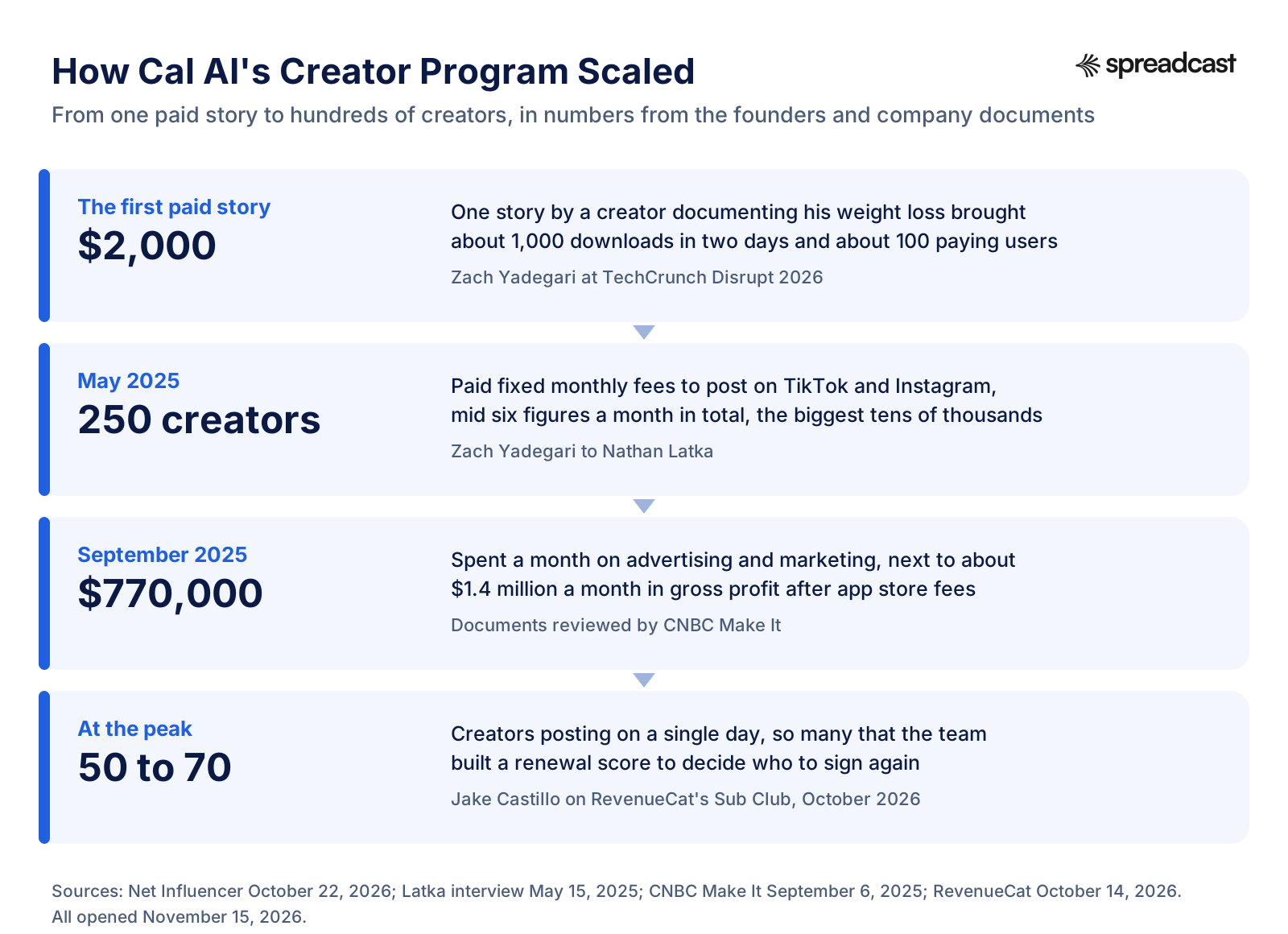
Cal AI's influencer marketing paid hundreds of fitness creators fixed fees to use the app on camera, and it was the main reason the app grew. Yadegari said as much at TechCrunch Disrupt, in a talk you can watch in full, where TechCrunch summed up his talk as a small army of influencers that paid off. It started with one post. The first paid story came from a creator documenting his own weight loss, who scanned a meal with the app. Yadegari said it cost about $2,000, brought about 1,000 downloads in two days, and turned about 100 of those people into paying customers. He credited the creator's tight, almost cult like following rather than anything clever in the video.
Do the math on that first post and you'll see why they kept going. About $2,000 for about 100 paying users is roughly $20 per payer. On a plan that costs about $30 a year, that's close to breaking even on the first year alone, before renewals, before the users who came later without a trackable link, and before the next creator turned out cheaper. Most founders run one test like this, get a messy result, and stop. Cal AI read the same messy result as a green light.
Flat Monthly Fees, Not Commissions
By May 2025 Cal AI was paying 250 influencers, mostly on TikTok and Instagram, and the total ran to mid six figures a month, Yadegari told Latka. The biggest single creator cost tens of thousands of dollars a month for four posts. Latka asked the question every founder asks: why not pay commission on installs instead? Yadegari's answer was about the market, not about preference. There's too much competition among brands, creators want a guaranteed payment, and if Cal AI wouldn't pay it, another brand would.
Castillo later gave the more interesting reason. On RevenueCat's Sub Club podcast he said flat rate deals let you keep the upside of a post that goes far beyond its usual reach. Break even is set by a creator's average views; the profit sits in the one video that goes mega viral, and with a flat fee all of that profit is yours. His example: a creator signed at around 10,000 to 12,000 views a video posted for two months, then had a video hit 7 million views in month three and never dropped under 500,000 after that.
Read that way, a commission deal gives the creator the upside of their own lucky video, and a flat fee keeps it for you. Founders used to affiliate programs tend to think of flat fees as the expensive option. Castillo treats them as the cheap one, with a catch: the math only works once you've measured what an average post earns, because that average is what you're paying for and the outlier is the bonus.
How Cal AI Priced Creator Deals
Cal AI priced every deal against one number: revenue per thousand views. Castillo told Sub Club that early on this is easy to find, because when nothing else is running a creator's post shows up as a clear spike on a flat download chart. Once you know it, the rule is simple. You can't pay a cost per thousand views higher than your revenue per thousand views, or you're guaranteed to lose money. Creators push back. Castillo's view was that there's no alternative, so you hold the line.
How do you hold the line when a creator's asking price is too high for their average views? Yadegari explained the trick at Disrupt. Instead of haggling the price down, Cal AI paid the asking price but tied it to a required view threshold or a set number of videos, so the creator kept posting until the agreed reach was delivered. TechCrunch quoted his version: many of these creators are broke college kids who want cash, so you tell them what you'll pay and how many views you need, and they keep posting until they get there.
The niche made this possible. Castillo made the same point about supply on Sub Club: health and fitness has more creators than any other niche and almost no brands to sponsor them. The prices come from a second source. FunnelFox's write up of his talk at Apps in Motion in New York, a conference FunnelFox cohosted with Adapty, says Cal AI paid CPMs between $0.50 and $3.00 because the only brands competing for those creators were apparel and supplements, and that early on the team tracked roughly 10 installs per 1,000 views. We couldn't find either number in Castillo's own interviews, so treat them as one vendor's account of one talk rather than a benchmark. Even so, the direction is clear: you won't get prices like that in a niche where every creator already has three app sponsors.
Run the same math for a smaller app. Say your app earns $25 in the first year from each paying user and 1 in 10 installs turns into a paying user. If a creator's posts average 50,000 views and you see about 5 installs per 1,000 views, that's 250 installs, about 25 payers and roughly $625 in first year revenue. That's your ceiling for the deal. If the creator wants $1,500, either you ask for a view guarantee that gets you to about 120,000 views, or you walk away. Writing this down before the first call is the single habit that separates Cal AI's program from the brands who say influencer marketing doesn't work.
How Cal AI Picked Creators
Cal AI picked creators by their communities, not their follower counts. Yadegari said at Disrupt that the team set a floor of roughly 50,000 followers but weighted views far more heavily, and looked for creators whose audiences wanted to be like them. Castillo's version is sharper: "Views can lie. Followers can lie, but comments cannot." His test, as RevenueCat wrote it up, is to read the comments. Under one leg day video it's fire emojis; under another it's someone thanking the creator because they didn't know how to train their hamstrings. The second audience is the one that downloads an app.
You can run this test from your phone tonight. Pick the ten biggest creators in your app's niche, open their last five videos, and count the comments that ask a question your app answers. That count tells you more about conversion than any media kit will. It also tells you which niche to go after in the first place.
What Flopped
Not every bet worked, and the misses are the most useful part of the story. Castillo told Sub Club that Cal AI signed UFC creators on what looked like airtight logic: fighters weigh every gram when they cut weight. The posts went out and the result was, in his words, crickets, after thousands and thousands of dollars. The reason was the audience, not the creator. People watching fights are on the couch with beer and pizza, the last people who want calorie news. Mukbang creators, who eat huge meals on camera, failed for the mirror reason. FunnelFox's write up adds that Cal AI saw videos with 100 million views that didn't convert in any meaningful way.
Fighters really do count every calorie, so on paper the UFC deal was smart. What Cal AI paid for, though, was the people watching, and they were relaxing. A fitness creator whose viewers are trying to get fit is a sales channel. A fitness creator whose viewers watch for fun is a billboard, and billboards are expensive. When you shortlist creators, picture the viewer at the moment they're watching, not the creator at the moment they're filming.
Running Hundreds of Creators
At the peak Cal AI had 50 to 70 influencers posting on a single day, Castillo said on Sub Club, which made attribution murky. His fix was a renewal score that weighs secondary signals before anyone is signed again, run from spreadsheets for a long time. FunnelFox's account of his conference talk adds the machinery: about 20 new influencers onboarded a week at the peak, contracts generated with one click, a Slack channel created automatically for each creator, briefs sent without anyone typing them. The same write up has two habits worth stealing even at a tiny scale. Get a creator on a call the moment they reply instead of trading emails, and decide on that call. And when a creator underperforms, Castillo blames the brief and the setup before the creator. Half of the 17 person team in May 2025 worked on marketing, mostly managing the creator program, Yadegari told Latka. This was an operations business wearing a consumer app's clothes.

For your own app: while you line up your first creators, keep your app's own accounts posting every day, because that's where a creator's viewers land when they go looking for you. Spreadcast reads your App Store or Google Play listing once and builds a weekly plan of branded posts from your real screenshots, in your app's colors and fonts, from one post a week up to twice a day. You approve the drafts or switch on full autopilot, and the posts go out at the times you pick. Start with your app's link and the first week is ready before your first creator call.
Cal AI's TikTok Strategy: The Magic Moment
Cal AI's TikTok strategy was built around a single three beat moment, scan, analyze, result, placed inside videos creators were already making. Castillo calls it the magic moment. On Sub Club he described it as a one, two, three punch that made viewers do a double take when a fitness creator scanned a plate in a "what I eat in a day" video. His rule: if an app doesn't have a moment like that, it can't be worked into content naturally, and if it feels like an ad, it won't go viral, and then it won't be profitable.
The team protected that moment down to small details that most copycats never saw. A streaks pop up fired after the first scan of the day and broke the rhythm, so creators were told not to film their first scan of the day. Creators whose integration was subtle got an on screen caption naming the app; creators whose integration was already obvious didn't, because the caption cost views. There was even a special build for creators with the logo on every screen. None of that is glamorous. All of it is the kind of thing you only learn by watching hundreds of videos and their download spikes.
It paid off in reach, though the biggest view counts come from a vendor's write up rather than from Cal AI. FunnelFox reports Castillo showing creator videos with 43 million, 56 million and 73 million organic views at his Apps in Motion talk, and says some of those integrations became the creators' own best performing posts, the opposite of what usually happens to sponsored content. The number Castillo gave in his own words is smaller, and it teaches you more: the creator signed at about 10,000 views a video who hit 7 million in month three, from the Sub Club episode above. If you've ever wondered how Cal AI went viral, that's the answer: not one viral video, but a few hundred creators each getting a shot at one, with the app sitting in the middle of a format their audience already liked.
Cal AI ran its own accounts too. "We started making TikToks, we started partnering with influencers, and then we had pretty explosive growth," Yadegari told Fortune, in that order. TechCrunch counted social media managers among the eight full time staff in March 2025. And the Cal AI website leans on the same content: a section headed "Used by your favorite fitness influencers" embeds creator reels and links the brand's Instagram account. The owned feed was never the headline of the Cal AI story. It was the place every creator video pointed back to, and the one channel that kept running whether or not a creator posted that day.
That's the honest trade off for an indie app. You probably can't fund 250 creators. You can make sure your own TikTok and Instagram show the magic moment over and over, with real screens, so that anyone who hears about your app finds proof of it in one scroll. Our guide on how to promote an app on TikTok covers formats and hooks, and the best times to post on TikTok covers when.
You can show your own magic moment without a creator. Spreadcast's feature posts are built from the features your listing actually names, laid over your real App Store screenshots in a phone frame, so each one shows a piece of your magic moment. Problem and fix posts open with the pain your users feel and end on the screen that solves it, the same before and after structure a creator's scan shows. The weekly plan rotates feature posts, review quotes, tips carousels and problem and fix posts so your feed never repeats itself. Posts go to your TikTok drafts, ready to publish with a tap, and straight to Instagram.
Cal AI UGC vs Influencers: Why the Team Chose Creators
Cal AI chose influencers over UGC because influencers bring an audience that already trusts them, and the team found that trust converted. Yadegari drew the line clearly at Disrupt: UGC is a "mass spray and pray strategy" that depends on volume, and influencer marketing is "a sniper approach". He said he tried making UGC himself early on, found it wasn't his strength, and moved to the product. Influencer marketing was what, in his words, "really took us off".
Castillo's version, from his Apps in Motion talk, is a handy way to compare all three paid options. The figures below are his, as FunnelFox reported them; they describe Cal AI's niche in 2025 and 2026, not a market rate.
| Channel | What you buy | Cost as Castillo put it | Risk and upside |
|---|---|---|---|
| UGC | Someone runs a dedicated brand page; every video is a hard sell to people who don't know you | About 30 videos for roughly $1,000 | Cheap and unpredictable; 100 videos can return nothing, one can take off |
| Influencers | A creator's reach plus the trust of their audience | $1,000 might buy one video | Costs more per post; if one creator converts you can find 100 like them, and you keep the viral upside |
| Paid ads | Distribution you control on Meta or another platform | Every dollar returns roughly $1.20 to $1.50 | Most predictable, scales easily, no outsized upside |
Notice where the brand's own page sits in that table: it's the UGC row. Castillo is describing a page that has to win attention from strangers, video by video, with no audience to lean on. That's hard as a paid channel. As a free channel run alongside creators, it does a different job. It's the page the creator's viewers check before they download, and a page that last posted in March loses them. Our post on why an app's feed looks like a slideshow goes into what makes a brand page look alive.
Do this for your app: treat your own accounts as the steady base under every other channel, not as a UGC experiment you have to pay for video by video. Spreadcast makes branded posts for those accounts from your listing, schedules them at your posting times, and publishes to Instagram, Facebook, LinkedIn, TikTok, YouTube, Pinterest, Threads, Bluesky, Mastodon, Telegram and Discord from one plan. Pro is $29 a month for the weekly plan and the moment posts, published to up to 10 social accounts, so your brand page keeps posting for a fraction of what Castillo said a batch of UGC videos costs. See what Spreadcast does for mobile apps.
How Cal AI Used Paid Ads
Cal AI added paid ads once the creator engine was running, and the first lesson was that viral creator videos make poor ads. Yadegari said at Disrupt that running influencer content directly as paid ads capped profitable Facebook spend at about $5,000 a day. What scaled was recruiting creators to make content specifically for ads, blunter and, in his word, "salesy" compared with their organic posts. That shift, he said, took revenue from $2 million to $4 million a month.
Castillo made the same point on Sub Club: the viral creator posts underperformed as ads until the team made dedicated creative for paid. By September 2025 the combined bill was big. CNBC reported that Cal AI spent almost $770,000 a month on advertising and marketing, against roughly $1.4 million a month in gross profit after the app stores' cut and about $274,000 in monthly net operating income. That's the real shape of the business: a consumer app spending more than half its gross profit on getting users.
If you're thinking about paid ads for your own app, the Cal AI sequence is worth copying: find what converts organically first, then pay to make ads in that style rather than boosting the organic posts. Our guides on how to advertise an app and the cost per install benchmarks give you the numbers to plan against, and the LTV to CAC ratio tells you how much you can afford per user.
How Did Cal AI Go Viral? The Founder's Own Feed
Cal AI went viral twice: once through creators, and once through Zach Yadegari himself, whose posts on X about being a teenage founder reached tens of millions of people. The biggest was about college. In April 2025 he posted that 15 of the 18 top colleges he applied to had rejected him despite a 4.0 GPA and a 34 ACT, and TechCrunch counted more than 22 million views and upwards of 3,600 comments. By his own count to Latka, the admissions post reached 28 million views and a follow up sharing his personal statement 40 million, and the attention brought calls from TV stations.
Most of those views weren't potential calorie trackers, and Yadegari didn't pretend they were. What the founder's feed did was quieter. It recruited people: he told Latka that most of Cal AI's talent came straight from X, including someone who posted an unsolicited redesign of a Cal AI screen and was interviewing for a full time job within days. It made the company newsworthy, which is why TechCrunch, CNBC and Fortune all ran profiles. And it caught the eye of the eventual buyer. MyFitnessPal's CEO Mike Fisher told TechCrunch that Cal AI got a lot of media attention because the founders were young, and that his team noticed the app early in 2025 as it climbed the store rankings.
The team also shared its numbers in public as they happened. Castillo said on Sub Club that Cal AI posted its wins and losses on Twitter, that clones followed, and that the threads about clone revenue sent traffic back to Cal AI anyway. The sale itself was announced the same way: Yadegari's post on March 2, 2026 said he and Langmack had started the company as 17 year old high school students and that it broke $50 million in annual recurring revenue along the way.
You don't need a viral college essay to borrow this. Building in public works at small numbers too, because the people who follow a founder's journey are disproportionately other builders, journalists and buyers. Our guide to founder led marketing covers how to do it without turning your feed into a highlight reel.
The founder's feed is yours to write. The app's news is a different job, and it shouldn't wait for you to find time to post. Spreadcast designs an update post when a new version of your app ships on the App Store, and a milestone post when the app passes a round number of ratings. Both arrive as finished, branded posts for your app's accounts on LinkedIn, Threads, Bluesky and the rest, so the milestones you'd share in public get shared even in the weeks you're heads down.

Cal AI Paywall and Onboarding Flow
Cal AI's paywall is hard: you can download the app and answer the setup questions for free, but scan results need a subscription, as the App Store listing says in capital letters. The listing's three steps sum up the flow. Answer lifestyle questions to build your plan, snap a photo of your meal, get your nutritional breakdown. The paywall sits between the second step and the third, right at the moment the user wants the number.
That choice came from an earlier failure. Yadegari said at Disrupt that Grind Clock, the alarm clock app the team made before Cal AI, ran on ads with a free model and made very little, and that switching it to a hard paywall multiplied revenue about tenfold. The team carried that lesson straight into Cal AI.
Onboarding Changes That Moved Conversion
In the May 2025 interview with Latka, Yadegari named two onboarding changes that raised conversion. Adding more questions and animated screens helped, which runs against the usual advice to cut onboarding short; the questions build the personal plan, so each one makes the paywall feel more earned. The biggest win by far was moving sign in to the end of onboarding, after the user had invested in the setup. At the time, 20% to 25% of new users started a trial or paid in their first session, and the app was getting 20,000 to 30,000 downloads a day.
Hundreds of Paywall Tests
Cal AI's paywalls run on Superwall, and Yadegari told Latka the conversion rate was much higher for it because it let the team run so many tests. Superwall's own case study, published in April 2026, puts numbers on that: 123 experiments across 46 trigger points, 160 paywall designs and 424 variants, with trial to paid conversion up 31% and monthly revenue more than tripled over ten months. The onboarding paywall alone went through 61 meaningful experiments. Formats included a spin wheel that lets users win a discount, video paywalls and web checkout through Stripe, with weekly, monthly, yearly and lifetime plans in the mix. Read those as the vendor's figures about its own customer.
You can see the testing from the outside. The App Store listing shows in app purchases named "Unlimited" at $29.99, $19.99, $9.99, $5.99 and $2.99, plus a $0.99 streak restore. That's what a paywall under constant test tends to look like from the store side: many price points live at the same time.
Cheap on Purpose
The price was a marketing decision as much as a revenue one. Castillo said on Sub Club that Cal AI sat among the cheapest calorie trackers at roughly $30 a year because, in cofounder Blake Anderson's framing, they were optimizing for mindshare rather than profit, and because a young audience that hasn't lived with the problem for long won't pay much to fix it. A cheap app is an easy yes for a creator's viewer who has never heard of it, and when every creator's post is selling a $30 decision instead of a $90 one, more of those views turn into money.
Retention came from the product, not from campaigns. Yadegari said at Disrupt that Cal AI didn't run retention marketing beyond email. Instead the team tracked an internal test set for the scanner's calorie and macro estimates, and retention rose in step with accuracy. In March 2025 he told TechCrunch retention was over 30%; in May he guessed the yearly renewal rate would land somewhere between 25% and 50% and called that range very broad. For context on what's normal, see our app retention benchmarks.
A big rating count is a sales asset too, and Cal AI has more than 375,000 ratings at 4.8 stars on the App Store. Spreadcast's review posts pull short quotes from your real store reviews and set them in your brand, so the praise sitting in your listing reaches the people scrolling past your feed. Pair them with a steady flow of new reviews, and the rating milestone posts take care of themselves.
One more Superwall detail is worth a pause. In January, when New Year's resolution traffic surged, Cal AI's installs nearly doubled month over month, and the tested paywall was ready for them. Calorie apps have the most obvious season in the App Store, but almost every app has one: exams, tax time, summer travel, Black Friday. Spreadcast's seasonal posts tie a date your users care about to a real feature of your app, so you show up in that week with something useful to say instead of a generic greeting.
How Cal AI Makes Money
Cal AI makes money from subscriptions: the app is free to download, food scanning needs a paid plan, and the headline price was $2.49 a month or $29.99 a year in 2025, per Fortune, with a three day trial. Around that sit the test prices above and add ons that Superwall lists in its case study: family plans, lifetime deals, body scan reports and nutrition chat. The money comes from users who decided the scan was worth paying for.
That model is why the creator math held together. A subscription with a known first year value lets you set a hard ceiling on what a view is worth, which is exactly the number Castillo priced every deal against. An ad supported app, or one where you don't know what a user is worth, can't run the same program with any confidence.
Cal AI Revenue: Every Number and Who Said It
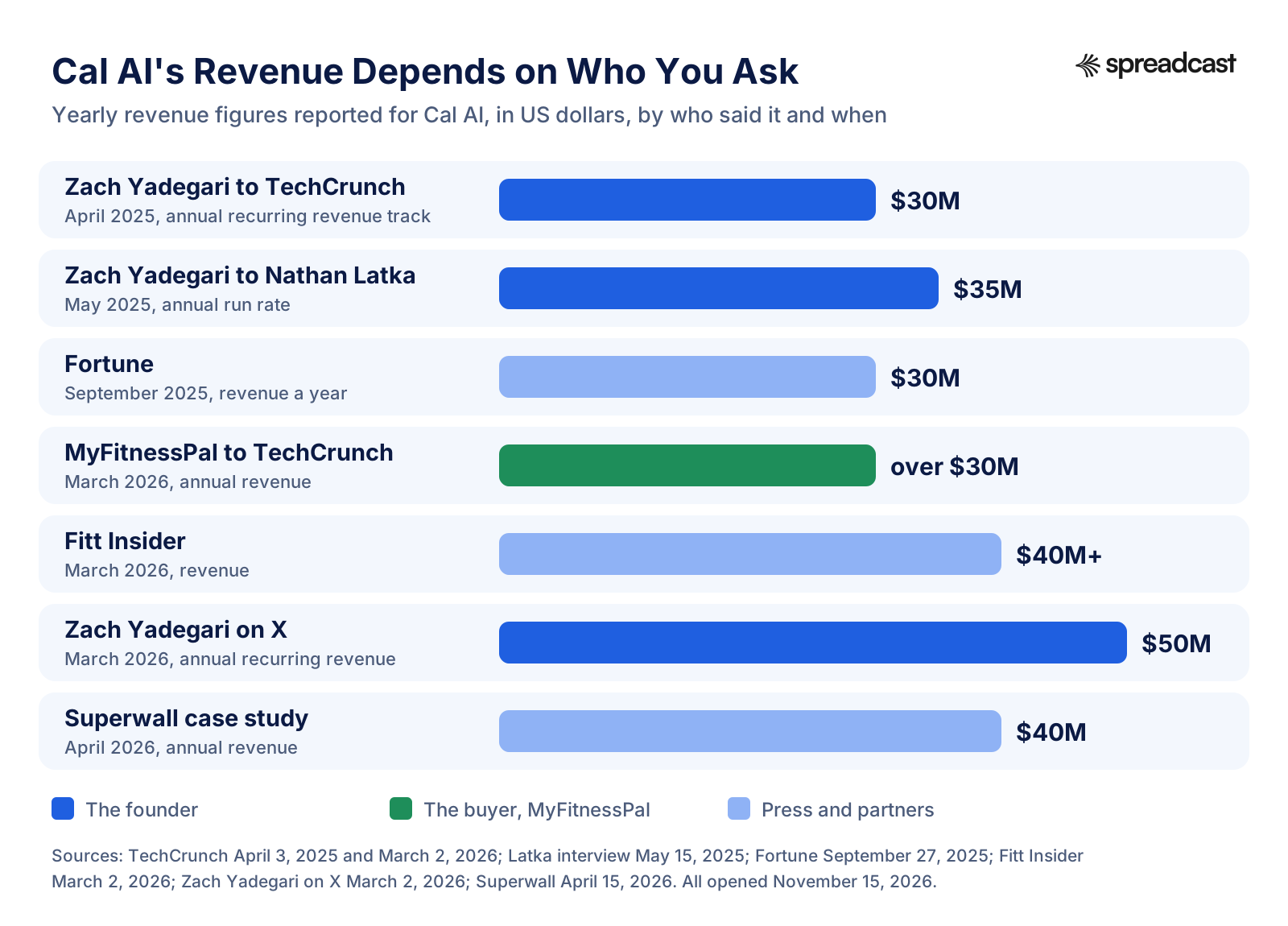
Cal AI's revenue is reported anywhere from $30 million to $50 million a year, and the spread comes from who's talking and what they're measuring. Founders quote annual recurring revenue at a peak month, the buyer quotes a safer round number, and partners pick their own. None of these are audited, and Cal AI never published financials. Here they are side by side.
| Figure | Who said it, and when | What it measures |
|---|---|---|
| About $28,000 in month one, $115,000 in month two | Documents reviewed by CNBC Make It, September 2025 | Monthly revenue right after launch |
| First $1 million | Yadegari to Latka, May 2025 | Cumulative sales, reached about five months after launch |
| Over $2 million last month | Yadegari to TechCrunch, March 2025, not verified by TechCrunch | One month's revenue, likely February 2025 |
| $30 million annual recurring revenue track | Yadegari to TechCrunch, April 2025, not verified | A projection from current subscriptions |
| $35 million run rate, a little over $10 million collected in 2025 | Yadegari to Latka, May 15, 2025 | Run rate, plus cash collected that year so far |
| $1.4 million gross profit a month, $274,000 net operating income | Documents reviewed by CNBC Make It, September 2025 | Profit after app store fees, then after costs |
| $2 million to $4 million a month | Yadegari at Disrupt, via Net Influencer, October 2026 | Monthly revenue while paid ads scaled |
| Over $30 million in annual revenue | MyFitnessPal to TechCrunch, March 2026 | The buyer's own round number |
| $40 million plus in revenue | Fitt Insider, March 2026 | A trade newsletter's figure, source not shown |
| $50 million in annual recurring revenue | Yadegari's own post on X, March 2, 2026 | Annual recurring revenue at its peak |
| $40 million in annual revenue | Superwall's case study, April 2026 | The paywall vendor's figure |
Our read: the honest range is $30 million to $50 million a year at the time of the sale, with the lower end coming from the buyer and the upper end from the founder at his best month. The sale price was never disclosed; TechCrunch reported that terms were not shared. You'll find pages online quoting a price, and we couldn't trace any of them to a primary source, so we've left it out. Analyst blogs also put far higher monthly figures on Cal AI; without a named source, treat those as estimates. If you're using Cal AI as a benchmark for your own plan, the CNBC numbers are the most useful, because they come from documents and they show the cost side too.
Cal AI Acquired by MyFitnessPal
MyFitnessPal acquired Cal AI in a deal that closed in December 2025 and was announced on March 2, 2026, after talks that ran for almost a year. TechCrunch reported that the terms weren't disclosed, that Cal AI's team of seven employees plus a small group of contractors was kept on, and that Cal AI would stay a separate app. Since the deal, Cal AI has been connected to MyFitnessPal's food database, which covers 20 million foods, 68,500 brands and meals at more than 380 restaurant chains.
Fisher's comments to TechCrunch are a quiet lesson in how big companies watch small ones. MyFitnessPal tracks about 70 competitors, he said, and Cal AI caught its eye early in 2025 as it rose in the store rankings, visible in tools like Sensor Tower, where the two were neck and neck in the category. He sees the apps serving different people: Cal AI for those who want speed, MyFitnessPal for those who want precision down to the number of pickles on a burger. Fitt Insider put MyFitnessPal itself at roughly 900,000 downloads and $13 million in revenue a month, citing Sensor Tower. That's the incumbent a two year old app was running neck and neck with. MyFitnessPal is a portfolio company of the investment firm Francisco Partners, according to Benesch, the law firm that advised it on the deal, which also put Cal AI at more than 15 million downloads and over $30 million in annual revenue.
What sold Fisher wasn't only the chart. He told TechCrunch that Cal AI's weekly stand up happened on Sunday nights, because the founders were still in school and Yadegari worked on the company all weekend, and the team showed up for it. Small details like that, he said, told him this wasn't a hobby. If you ever want a buyer to take a young company seriously, that's the kind of evidence that does it.
The headcount numbers don't line up, which is worth knowing if you're benchmarking team size. CNBC counted 30 employees in September 2025, Yadegari told Latka the team was 17 full time people in May 2025, and TechCrunch reported seven employees retained at the sale plus a small team of contractors, while Yadegari's own sale post thanked a team of more than 30 people. Nobody has spelled out how those counts relate; our guess is that contractors made up much of the 30, but no source says so outright. Yadegari kept running Cal AI as a MyFitnessPal unit while at college, then left in June 2026 to start Persona, an AI assistant that comes with a $179 wearable band. Persona raised $10 million in a round led by Vine Ventures.
What an Indie App Can Copy From Cal AI, and What It Can't
Cal AI's playbook is copyable in its habits and hard to copy in its budget, and Castillo is the first to warn you off a straight copy. "The easiest way for an app founder to blow a ton of money is to copy what I did," he told Sub Club, because his app isn't yours. His example is an astrology app: a few hundred creators in the niche, most of them probably already signed to rival apps on exclusive deals. Cal AI won because health and fitness has more creators than any other niche, almost no brands for them, and content formats that already show food. Before you copy anything, check which of those three your niche shares.
| Cal AI tactic | Can an indie app copy it? | The version that fits a small budget |
|---|---|---|
| 250 creators on monthly retainers | Not at that scale; mid six figures a month is a budget for an app already earning millions | One creator test for $1,000 to $2,000, priced against your revenue per thousand views |
| Flat fees with a view guarantee | Yes, from the first deal | Pay the asking price, tie it to a view total or a number of videos |
| Reading comments to pick creators | Yes, for free | Count purchase intent comments under the last five videos of ten creators |
| The magic moment | Only if your app has one | Find the three second result your app produces and put it in every post |
| Ads made by creators for ads | Later, once something converts organically | Ask your best creator for two direct versions of their post |
| Hundreds of paywall tests | Partly; you need traffic to read results | Test one thing a month on the paywall, starting with sign in placement |
| The founder going viral on X | Not on demand | Share real numbers and lessons every week; the reach compounds slowly |
| The brand's own accounts posting daily | Yes, and it's the cheapest piece | A weekly plan of branded posts from your listing, on autopilot |
If you want more examples of how apps split their effort, our roundup of mobile app marketing examples and the playbooks for Duolingo and Spotify show very different answers to the same question. Duolingo built a mascot people follow for its own sake; Spotify turned user data into a yearly event. Cal AI rented other people's audiences, one creator at a time. For a broader plan, start with how to market an app and our iOS app marketing guide, and set a budget with the startup marketing budget numbers.
If your app has no three second payoff, don't invent one. A budgeting app or a habit tracker usually sells on a result that shows up after weeks, not on the first tap. For apps like that, Castillo's advice points to paid ads with a hard sell, and the brand's own feed has to do more teaching: tips, real numbers from real users, answers to the questions your reviews keep asking. Find the post that converts on your own account first, then pay a creator to make a version of it.
Run Your First Creator Test for $2,000
Cal AI's first test cost about $2,000. You can run the same test for your app in a month, using what the team learned the expensive way.
- Write down your revenue per paying user for the first year and your trial to paid rate. Without these two numbers you can't price a deal, and you'll overpay.
- Pick a niche by its comments. Find ten creators your users already watch and count comments that ask for what your app does. Choose the creator whose comments show the most intent, not the most followers.
- Offer a flat fee tied to a view total or a set number of posts, the structure Yadegari described at Disrupt, so the creator keeps posting until the reach you paid for is there.
- Give each creator their own way in so you can tell them apart. Apple lets you publish up to 70 custom product pages, each with its own link and screenshots, and offer codes can carry a named code a creator says out loud. Expect most viewers to search the store by name anyway, so watch the daily download chart too.
- Ask for the disclosure the law requires. The US Federal Trade Commission's guide for influencers says the disclosure should sit with the endorsement itself and be hard to miss, and in a video that means in the video, not only in the description; build it into the brief.
- Hide anything that interrupts your magic moment on camera, the way Cal AI hid the first scan of the day, and give the creator a test account so the screen looks good.
- Read the result two ways: the download spike in the two days after the post, and the comments under it. If both are positive, sign the creator for longer before their price goes up.
While that test runs, your own accounts carry the load. Our guides on app promotion ideas and how to promote an app on Instagram cover the free channels that work alongside paid creators, and App Store optimization covers the keywords in your name and subtitle, which Yadegari said Cal AI first picked by gut feel.
Then measure your own feed the way Castillo measured creators, by what people do rather than what they say. Spreadcast's analytics put followers, interactions and reach for your connected networks in one place, so you can see which post kinds pull their weight and shift the weekly plan toward them. Read them next to your download chart and you'll know whether the days you post line up with the days people install.
Run Cal AI's Playbook on Autopilot With Spreadcast
Spreadcast runs your app's marketing: branded posts, made and scheduled for you. It covers the part of Cal AI's playbook every app can afford, the steady drumbeat of product content on your own accounts that gives every creator post, ad and press mention somewhere to land. You start with one link, and the first week of posts is made for you.
Paste your App Store or Google Play link once at /start. Spreadcast reads the listing and builds a brand kit from it: your app's icon, its colors and fonts, and the real screenshots from your store page. No design brief, no screenshots to export.
Pick how often to post, from one post a week up to twice a day, and the times your audience is around. Spreadcast fills each week with a mix of post kinds made from your real app: feature posts about the features your listing names, review posts quoting your actual store reviews, tips carousels, problem and fix posts, and seasonal posts that tie a date to a real feature. On top of the plan, moment posts arrive on their own when you ship a new version or pass a round number of ratings.
Choose how hands on to be. With approve first, each draft waits on your Dashboard for a yes; with full autopilot, posts are scheduled automatically. Either way they go out to Instagram, Facebook, LinkedIn, TikTok, YouTube, Pinterest, Threads, Bluesky, Mastodon, Telegram and Discord, and you can follow followers, interactions and reach per network in Spreadcast's analytics. If you'd rather work from Claude or ChatGPT, Spreadcast's MCP server lets you plan and approve posts from Claude or from ChatGPT.
Think about what this means next to a Cal AI style program. The cofounders had half a team managing creators and a marketing bill near $770,000 a month. You probably have an afternoon a week. Spend that afternoon on the one creator deal that could change your month, and let your own accounts post every day without you. Free gets you three AI posts to try. Pro at $29 a month, or $290 a year, publishes the full weekly plan and the moment posts for one app across up to 10 social accounts, and the $79 a month Studio plan covers five apps, each with its own brand and accounts. Paste your app's link and see your first week of posts.
How We Researched This
We opened every source on this page on November 15, 2026. That included six TechCrunch articles from March 2025 to October 2026, CNBC Make It's September 2025 profile, which drew on company documents, Fortune's September 2025 interview, Net Influencer's report of Yadegari's TechCrunch Disrupt talk, the transcript summary of Nathan Latka's May 2025 interview, RevenueCat's write up of Jake Castillo's Sub Club episode, FunnelFox's write up of Castillo's Apps in Motion talk (FunnelFox cohosted the event, so we name it wherever its figures appear), Superwall's case study, Fitt Insider's deal note, the announcement from Benesch, MyFitnessPal's law firm on the deal, Yadegari's March 2026 post on X, Cal AI's website and its current App Store listing. We checked each YouTube video through YouTube's own embed data and took upload dates from the watch pages.
Where sources disagree, we show the range and who said what. We left out claims we couldn't trace to a founder, the buyer, documents or named trade press, including a marketing blog's claim that Cal AI sponsored a MrBeast video, sale prices quoted without a source, and attribution details such as named promo codes that appear only on agency blogs. The charts are ours, drawn from the cited numbers.
Frequently Asked Questions
What is Cal AI's marketing strategy?
Paid fitness creators on TikTok and Instagram, on flat fees tied to views, showing the app's photo scan inside their normal videos. Around that: the founder's posts on X, ads made by creators for paid social, and constant paywall testing on a cheap yearly plan.
How many influencers did Cal AI pay?
Zach Yadegari said 250 at once in May 2025. Jake Castillo said 50 to 70 creators posted on a busy day, and FunnelFox's write up of his 2026 conference talk counts more than 300 partnerships in the program's first 18 months.
How much revenue does Cal AI make?
Reported figures range from over $30 million a year (MyFitnessPal, March 2026) to $50 million in annual recurring revenue (Yadegari on X, the same day). None are audited.
Who bought Cal AI?
MyFitnessPal. The deal closed in December 2025, was announced on March 2, 2026, and its terms were not disclosed. Cal AI stays a separate app.
Who founded Cal AI?
Zach Yadegari and Henry Langmack, high school friends who started it at 17, with cofounders Blake Anderson and Jake Castillo, whom Yadegari met on X.
Can a small app copy Cal AI's playbook?
Parts of it. One priced creator test, picking creators by their comments and posting product content daily on your own accounts all fit a small budget. Hundreds of retainers don't.
Where These Facts Come From
Every outside number, rule and price on this page links to the page it was taken from.
- Photo calorie app Cal AI, downloaded over a million times, was built by two teenagersTechCrunch
- Teen with a 4.0 GPA who built the viral Cal AI app was rejected by 15 top universitiesTechCrunch
- MyFitnessPal has acquired Cal AI, the viral calorie app built by teensTechCrunch
- Disrupt 2026 preview: Zach Yadegari on how to create viral growth and capitalize on itTechCrunch
- Cal AI's 19 year old founder just raised $10M for his new AI startupTechCrunch
- When it came to Cal AI's viral success, a small army of influencers paid offTechCrunch
- 18 year old CEO learned to code at age 7, now he has a $1.4 million a month AI appCNBC Make It
- This Ivy League reject built a $30m app by 18Fortune
- MyFitnessPal acquires food tracking app Cal AIFitt Insider
- Cal AI founder Zach Yadegari breaks down the influencer playbook behind his app's growthNet Influencer
- Benesch advises MyFitnessPal on acquisition of Cal AI, the viral calorie appBenesch Law
- Founder interview with Zach Yadegari, May 15, 2025Latka
- How Cal AI hit a $35M run rate in year one, then sold to MyFitnessPalLatka
- Cal AI paid UFC creators thousands of dollars to post, and got no download spike at allRevenueCat
- How Cal AI turned influencer marketing into a $50M growth engineFunnelFox
- Cal AI has been acquired by MyFitnessPal, post by Zach YadegariX
- Cal AI, Calorie Tracker on the App StoreApple App Store
- Cal AI website and support answersCal AI
- How Cal AI scaled paywall experimentation and grew monthly revenue 3x in 10 monthsSuperwall
- Custom product pagesApple Developer
- Set up offer codesApple Developer
- Disclosures 101 for social media influencersUS Federal Trade Commission
- Video: going viral is the easy part, Zach Yadegari at Disrupt 2026TechCrunch on YouTube
- Video: how Cal AI turned creators into a growth machine, with Jake CastilloSub Club by RevenueCat on YouTube
- Video: how I built a $1.4 million a month AI app at age 18CNBC Make It on YouTube
Researched and written by Mark Weizer. Last checked on November 15, 2026.
Keep Reading
- Playbooks
Canva Marketing Strategy: How Templates and SEO Grew 265 Million Monthly Users
Canva's marketing strategy from its newsroom, its founders and its own sitemaps: freemium and word of mouth, 39,603 template pages built for search, 100 languages, free plans for schools, Canva Create and the TV campaigns. Then how to run the same playbook for your own app.
- Playbooks
Uber Marketing Strategy: How a Two Sided App Won 215 Million Monthly Users
Uber's marketing strategy, taken apart from its own filings: the city by city launch playbook, ice cream and kittens, referrals on both sides, the 2018 brand reset, safety, Uber One, the Uber Eats Super Bowl ads, the ads business, what it spends and how it makes money. Then how to run the copyable parts for your own app.
- Playbooks
Monopoly Go Marketing Strategy: The Budget, the Ads and What It Bought
How much Monopoly Go spent on marketing, who said it and when, and what the money bought: localized ads, a celebrity TV campaign, friend invites, sticker trading, live ops seasons and crossovers. Then how a small studio can keep its own channels as busy as a big launch.