What a Marketing Budget for a Startup Actually Covers
A marketing budget for a startup is the amount you commit each month to finding customers, split into named lines: tools, content, paid ads, people and one off launch costs. The total matters less than the split. Two founders can both spend $2,000 a month and get very different results, because one puts it all into ads that send strangers to a page nobody trusts yet, and the other spends most of it making the product easy to find and talk about.
This page gives you four worked budgets for an app or SaaS startup: $0 a month, $500, $2,000 and $10,000. Each one is a list of line items with a price, the source of that price and the number to watch. Above them sit the benchmarks people quote when they ask how much of revenue to spend on marketing, with what each one actually measures. Below them is a startup marketing budget template you can copy into a spreadsheet, plus the checks we use to decide when a line has earned more money.
One thing up front. Most published averages describe large companies. Gartner's 2026 survey, the number you will see quoted most often, is built mostly on firms with more than $1 billion in revenue. Those numbers are useful as a ceiling and a sanity check, not as a target for a company with twelve customers. A startup's marketing budget is usually set by what it can afford to lose while it learns, and the examples below are built that way.
The short version: before revenue, budget time first and money second. Spend money on the few things that save you hours every week (making posts, scheduling, email) and on small, capped paid tests with a stop rule. After revenue, move toward a percent of revenue, and raise any channel only when its cost per customer stays under the ceiling you set from your LTV to CAC ratio.
Startup Marketing Budget Examples at a Glance
The four budgets this page builds line by line. They are examples for a small app or SaaS company, not industry averages, and every price inside them links to the seller's own page further down.
| Monthly budget | Where most of the money goes | Fits a startup that | Number to watch first |
|---|---|---|---|
| $0 a month | Founder time, about 5 to 8 hours a week, and free plans of analytics, email, CRM and scheduling tools | Has no revenue yet or is still testing whether anyone wants the product | Replies and signups per hour of founder time |
| $500 a month | A posting tool that designs and publishes, one capped paid test, a few hours of freelance design | Has a working product, a handful of users and wants a steady public presence | Cost per signup or install from the paid test |
| $2,000 a month | Paid acquisition on one or two channels, a part time freelancer, email on a paid plan, one creator test | Has early revenue and one channel that already brings customers | Cost per paying customer against your CAC ceiling |
| $10,000 a month | A first marketing hire, paid acquisition on two channels, freelance video and design, sponsorships | Has a repeatable channel and enough cash to wait for payback | CAC payback in months, by channel |
Hours and splits are our own examples for a small app or SaaS team. Tool prices and ad minimums were checked on the vendors' pages on October 28, 2026.
How We Researched This
We opened every page in the source list on October 28, 2026 and quote only what those pages say. The percent of revenue benchmarks come from the Gartner 2026 CMO Spend Survey press release, Duke's Fuqua School of Business write up of The CMO Survey 2026, which Deloitte supports together with the American Marketing Association, the Fall 2024 edition of the same survey, a small business guide on the SBA blog and Benchmarkit's public 2025 B2B SaaS benchmarks.
Tool prices come from each vendor's own pricing page as it loaded for us that day: Buffer, Hootsuite, Kit, HubSpot, Canva and Google Analytics. Ad minimums come from the help centers of Meta, LinkedIn, TikTok, Google Ads and Apple Ads. Freelance rates come from Upwork's published rate pages and wages from the US Bureau of Labor Statistics. App costs come from Apple's and Google's developer pages, SplitMetrics' Apple Ads benchmarks and RevenueCat's State of Subscription Apps 2026.
Where we did arithmetic, we show it. A monthly ad minimum is the platform's daily minimum times 30.4, the average number of days in a month that Google uses in its own budget help. The four budgets are our own worked examples for a small app or SaaS company; they show one sensible way to split each amount, and we say so wherever they appear. Prices change often, and some pages showed prices in the local currency for our location, so check the vendor's page before you copy a number into a plan. Spreadcast prices come from our own pricing page.
How Much to Spend on Marketing for a Startup
There are three honest ways to set the number, and most startups use a different one at each stage.
Before revenue, use an affordable loss. Decide how much cash you can spend on marketing every month for six months without shortening your runway in a way that scares you, and treat that as the ceiling. For many solo founders the answer is close to zero, which is fine: the $0 budget below is a real plan, not a consolation prize. What you are buying at this stage is information. Which message gets replies, which network sends people who sign up, which feature people mention when they recommend you. A small budget spent on clean tests buys more information than a big one spent everywhere at once.
After first revenue, move to a percent of revenue. The SBA blog's guide to getting the most from your marketing budget puts it plainly: many businesses use a percentage of revenues as a guide, and a startup should use its projected revenues. The same guide adds that you need to budget more when the business is just starting out, because you are still building awareness, and can reduce the share once you have a steady customer base. That is the opposite of what most early founders do. They spend the least when awareness is lowest.
Once a channel works, switch to a unit budget. Here the question is no longer a percent at all. It is how many customers you can buy at a cost per customer that pays back in time. If a paying customer is worth $300 in gross margin and you want a 3:1 ratio, you can pay up to $100 to acquire one, and the budget is simply the number of customers you want times $100. Our guide to the LTV CAC ratio shows how to set that ceiling, and the cost per install benchmarks page shows what paid installs cost in practice.
So the answer to how much to spend on marketing for a startup depends on the stage you are in. Before revenue: time plus whatever you can afford to lose for six months. With revenue: a percent you can defend, usually higher than mature companies spend. With a proven channel: as much as you can spend while each customer still pays back.
How Much of Revenue to Spend on Marketing: Benchmarks
The figures people quote most, with what each one measures and who was surveyed. Read the last column before you compare two rows: a marketing budget at a billion dollar company and sales plus marketing at a venture backed SaaS company are not the same number.
| Benchmark | Figure | Source, sample and definition |
|---|---|---|
| Marketing budget, large companies, 2026 | 7.8% of company revenue | Gartner 2026 CMO Spend Survey, May 11, 2026. 401 marketing leaders in North America, the UK and Europe, surveyed January to March 2026, most at companies with over $1 billion in annual revenue. |
| Same survey, 2025 | 7.7% of company revenue | Gartner, as reported in the 2026 release |
| Marketing teams Gartner rates as AI ready | 8.9% of company revenue | Gartner. These teams also put 21.3% of marketing budget into AI, against a 15.3% average. |
| Marketing budget, US companies, 2026 | 9.0% of revenues; 9.6% of overall company budgets | The CMO Survey 2026, Duke Fuqua with Deloitte and the AMA. 308 marketing leaders at US for profit companies, surveyed January 7 to 29, 2026. |
| Same survey, Spring 2024 to Fall 2024 | Fell from 10.1% to 7.7% of company budgets and revenues | The CMO Survey, Fall 2024, Duke Fuqua, November 12, 2024. 260 US marketing leaders. |
| Average marketing spend by business type, 2018 | 7.9% overall; B2B product 6.3%, B2B services 6.9%, B2C product 9.6%, B2C services 11.8% | SBA blog, July 9, 2019, citing a 2018 Web Strategies report |
| Average spend on advertising only | 1.08% of revenue | SBA blog, citing Small Business Trends. Retailers about 4%, restaurants 1.93%. |
| Sales and marketing, private SaaS companies | 47% of revenue if venture backed; 33% if private equity backed | Benchmarkit 2025 B2B SaaS Benchmarks, 2024 data. Includes the sales team, not marketing alone. |
All pages opened October 28, 2026. The SBA figures are older than the others; they are included because they are the only official US guidance that splits spend by business type.
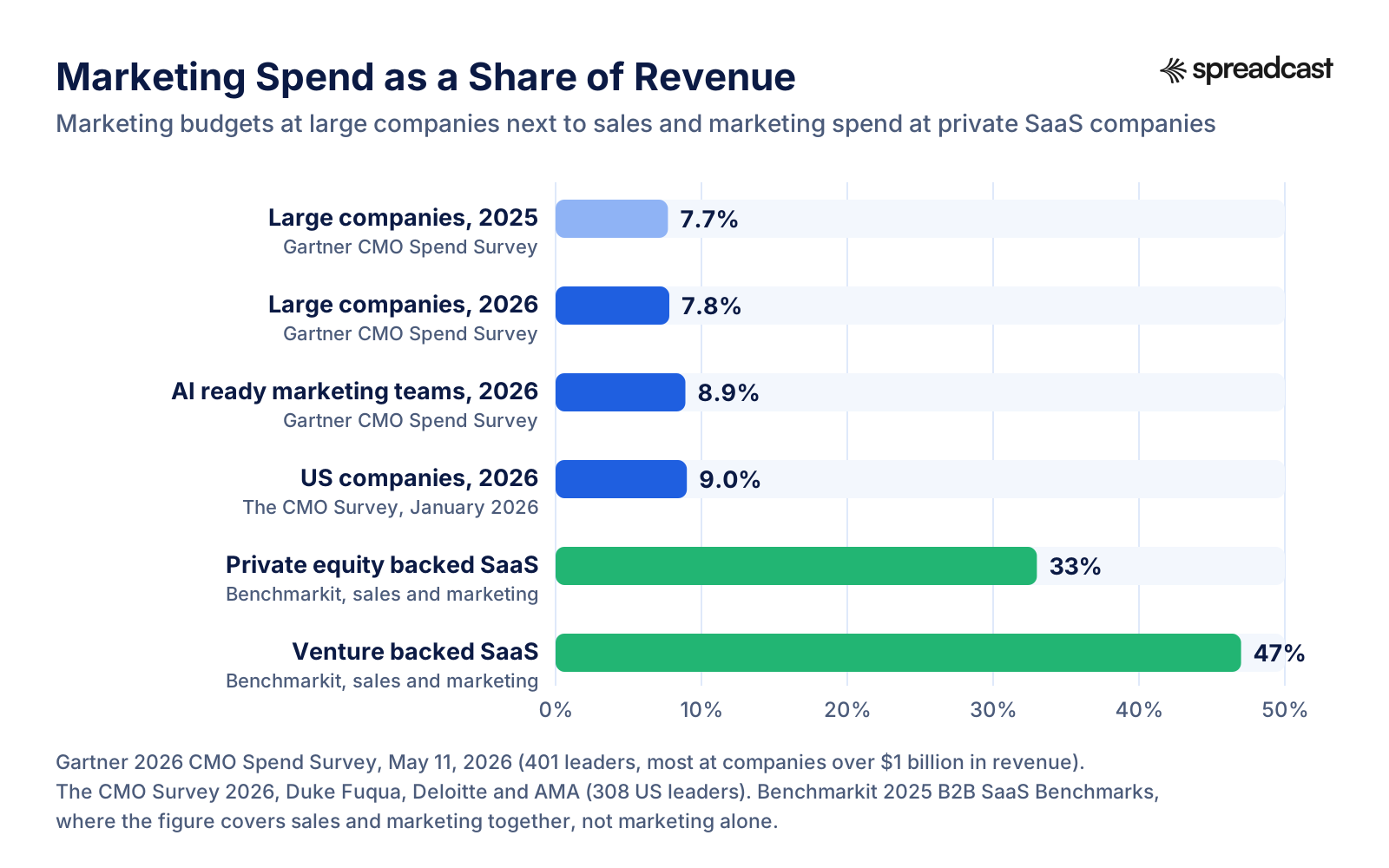
Marketing Spend as a Share of Revenue, Large Companies vs SaaS
The gap between the averages people quote and what growing software companies actually spend is wide enough to change a plan.
Average Startup Marketing Budget: Why the Usual Numbers Mislead
People who search for the average startup marketing budget usually find one of two numbers: something near 8% of revenue, or a flat dollar figure from a blog with no source. Neither fits most startups, for reasons worth knowing before you set your own.
The 8% family of numbers comes from surveys of established companies. Gartner says the vast majority of its 2026 respondents report annual revenue of over $1 billion, and found budgets effectively flat at 7.8% of revenue, up from 7.7% in 2025. Even at that scale, 56% of CMOs said their organization lacks the budget to deliver its 2026 strategy. The CMO Survey covers a broader set of US companies and found 9.0% of revenues, with overall marketing spending growing just 1.7%, the weakest rate in several years. The survey also found acquisition budgets remain 26% larger than retention budgets, even though marketers say retention matters more when the economy is uncertain. That is a useful prompt for small companies: keeping the users you have is part of the marketing budget too.
Startups that raise money spend a far larger share. Benchmarkit's 2025 report on private SaaS companies found sales and marketing at 47% of revenue for venture backed companies and 33% for private equity backed ones. That figure includes salespeople, so the marketing part alone is smaller, but the direction is clear. A company that is trying to grow fast spends several times the share a mature company does, because it is buying future revenue with today's money.
A bootstrapped startup sits in between and usually spends less in dollars but more as a share of its tiny revenue. If you make $3,000 a month and spend $500 on marketing, that is 17% of revenue, more than twice the Gartner average, and it is still a modest plan. Percentages only become a useful control once revenue is large enough that the percent pays for a real channel. Below that point, plan in dollars and hours.
So the honest average is a range, not a point. Mature companies: roughly 8% to 10% of revenue on marketing. Venture backed software: often a third to half of revenue on sales and marketing combined. Bootstrapped founders: whatever a small, fixed monthly amount works out to, plus a lot of their own time. The budgets below are written for that third group, with notes for when you move into the second.
Gartner on Where Marketing Budgets Go
Gartner's own analyst walks through the CMO Spend Survey: overall budget levels, which programs get money and which channels marketers favor. The figures are from the 2024 edition; the 2026 numbers are in the table above.

Marketing Expenses for a Startup: The Six Lines
Every startup marketing budget, at any size, fits into six lines. Naming them keeps you from spending by accident, because a cost that has no line is a cost nobody decided on.
Tools. Software that saves hours: analytics, email, a CRM, a way to design and schedule posts. For a small team this line should be the cheapest, and most of it can be free at the start. The danger is subscriptions that pile up because each one is only $30.
Content. The posts, screenshots, videos, articles and emails people actually see. This is the line most founders underfund in money and overfund in their own time. It is also where a single bad decision, such as hiring a designer for every post, can eat the whole budget.
Paid acquisition. Ads on Meta, Apple Ads, Google, LinkedIn, TikTok or Reddit, plus sponsored newsletters and creator deals. This line scales the fastest and loses money the fastest. Every paid line needs a cap, a stop rule and a target cost per customer before it starts.
People. Freelancers, agencies and eventually a hire. Early on this is a few hours of specific help a month. Later it becomes the biggest line, because people cost more than tools at every stage.
Launch and one off costs. A Product Hunt launch, App Store screenshots, a demo video, a conference ticket. These are not monthly, so give them their own line or they will quietly consume three months of the paid budget. Last, a reserve: a small amount held back for the test you did not know you would want to run next month.
Startup Marketing Cost by Line Item
What each common line costs when you buy it from the vendor directly, as listed on October 28, 2026. Use it to price your own template.
| Line item | Price on the vendor's page | Notes |
|---|---|---|
| Web and app analytics | Free (Google Analytics) | App makers also get free campaign links in App Store Connect to see which post or ad sent each download. |
| CRM | Free (HubSpot free CRM) | 100% free with no expiration date, per HubSpot, and no credit card needed. |
| Email newsletter | Free up to 10,000 subscribers; Creator from $33 a month billed yearly for 1,000 subscribers (Kit) | Paid tiers add automation; price rises with list size. |
| Post scheduling | Free for 3 channels with 10 scheduled posts each; Essentials $5 a month per channel billed yearly (Buffer) | Schedules what you bring. Design is a separate line. |
| Social suite for a team | Standard $99 per user a month for up to 10 accounts (Hootsuite) | Professional $199 and Advanced $399 per user a month. |
| Design tool | Free plan, paid Pro and Business plans (Canva) | Canva showed prices in our local currency, so check yours. |
| Freelance graphic design | $15 to $35 an hour median; $15 to $150 range, about $25 average (Upwork) | Upwork adds its own client fees on top. |
| Freelance social media manager | $14 to $35 an hour median; $400 to $2,000 a month for two channels (Upwork) | Monthly figures are Upwork's sample rates for intermediate US based specialists serving small businesses. |
| Employed graphic designer | $62,960 a year median pay, $30.27 an hour (BLS) | Before benefits, payroll taxes and equipment. |
| App Store presence | $99 a year (Apple Developer Program) | Needed to ship at all; count it as an app cost, not marketing. |
| Google Play presence | US$25 once (Play Console Help) | One time registration fee. |
| Designed posts published for you | $29 a month, or $19 once for 10 posts (Spreadcast pricing) | Covers design, captions and publishing to up to 10 social accounts on Pro. |
Prices are US dollars as shown to us on October 28, 2026. Many vendors discount yearly billing; the yearly figure is used where the page defaults to it.
The $0 a Month Marketing Budget
A $0 budget is not a budget with nothing in it. It is a budget paid in hours instead of dollars, and it works better than most people expect, because at the very start the scarce thing is not reach. It is knowing what to say to whom.
Paul Graham's essay Do Things That Don't Scale is still the best description of this stage. He calls recruiting users by hand the most common unscalable thing founders have to do at the start, and says nearly all startups have to: you can't wait for users to come to you, you have to go out and get them. That is the core of a zero dollar plan. Find the twenty people most likely to want what you built, talk to them, help them use it, and write down the words they use. Those words become your App Store subtitle, your landing page headline and your first posts.
Give the plan a fixed time budget so it does not take over your build week. We use five to eight hours a week as the example below. Split it into three blocks. Direct outreach and replies, about two hours: messages, comments and conversations with people who have the problem. Public posting, about two hours: a few posts a week on the one or two networks where your users already are. Listing and product page work, about an hour: App Store optimization or landing page copy, using the phrases you heard. The remaining time goes to a weekly email or a community where you can be useful without pitching.
The free tools are good enough for all of it. Google Analytics is free. App Store Connect gives you campaign links so you can see which post sent which download, and our App Store campaign link generator builds them in bulk. HubSpot's CRM is free with no expiry. Kit is free up to 10,000 email subscribers. Buffer's free plan schedules 10 posts per channel on 3 channels. Canva has a free plan for one off designs.
The weak spot of a $0 budget is posting. Outreach is quick and personal; posting is slow and visual. Most founders who try to post three times a week on two networks give up in the second month, not because they ran out of ideas but because each designed post takes half an hour or more and the build always feels more urgent. If that is where you get stuck, the cheapest fix is the smallest one: post less often, on one network, with plain text and real screenshots, and keep going. Our list of ways to promote an app for free ranks the free tactics by what they returned for other founders.
Spreadcast has a free plan for exactly this stage. Paste your App Store link or website at /start and it builds a brand kit from your listing, then designs three posts in your colors with your screenshots in an iPhone frame, which you can download and post yourself. It carries a small Spreadcast mark and does not publish for you; that is what the paid plans are for. Three posts will not run your marketing, but they will show you whether designed posts in your own brand get more replies than plain screenshots, at a cost of nothing.
$0 a Month Startup Marketing Budget Example
One week of a zero dollar plan for a solo founder with an app or SaaS product. Hours are our example; tools are the free plans listed above.
| Line | Tool or channel | Cost | Time per week |
|---|---|---|---|
| Direct outreach | Email, DMs, comments in communities where your users ask for help | $0 | 2 hours |
| Public posts | One or two networks, founder account and brand account | $0 | 2 hours |
| Listing and landing page | App Store optimization or homepage copy, from words users said | $0 | 1 hour |
| Kit free plan, a short weekly note to signups | $0 | 1 hour | |
| Scheduling | Buffer free plan, 10 queued posts per channel on 3 channels | $0 | Included above |
| Measurement | Google Analytics, App Store Connect campaign links, HubSpot free CRM | $0 | 30 minutes |
| Design | Canva free plan, or Spreadcast Free for 3 designed brand posts | $0 | Included above |
| Total | $0 | About 6.5 hours |
Our example split. Free plan limits checked on each vendor's pricing page on October 28, 2026.
How to Get Your First Customers Without a Budget
A Y Combinator partner who ran growth at Airbnb explains the unscalable work that a zero dollar budget is built on, for both B2B and consumer products.

The $500 a Month Marketing Budget
Five hundred dollars a month is where most bootstrapped startups land once there is a product people use. It is too little to hire anyone and too much to waste. The trick is to spend it on the two things that cost you the most hours and on one small paid test, and nothing else.
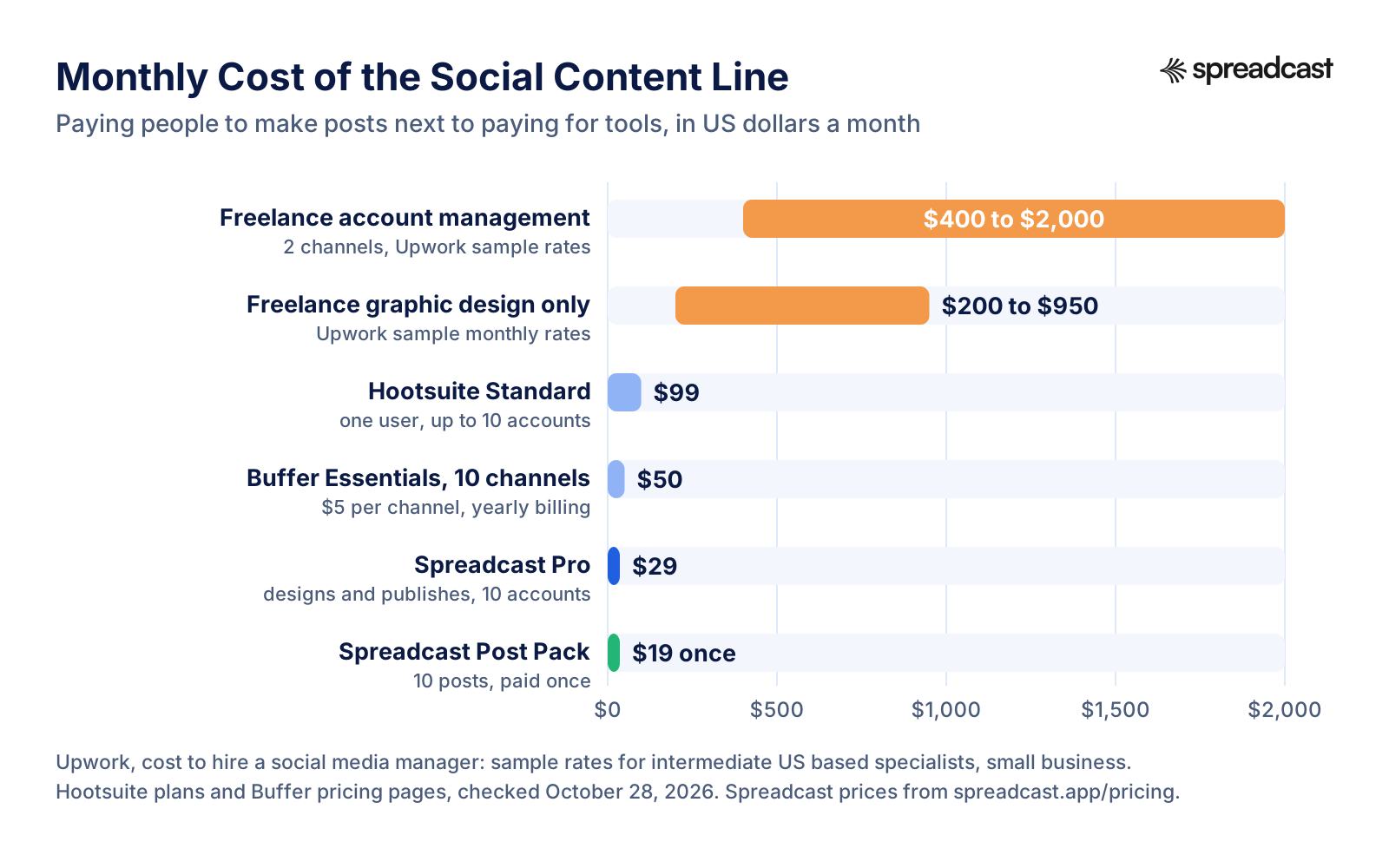
The first spend is the social content line, because that is where founder time leaks. A freelancer is the default answer, and the numbers show why it rarely fits this budget. Upwork lists graphic designers at a median of $15 to $35 an hour with an average of around $25. Its sample monthly rates for small business social media work run $200 to $950 a month for images and graphic design alone, and $400 to $2,000 a month for account management on two channels. At the bottom of those ranges you have spent most of a $500 budget on making posts, before a single person has seen them.
This is the line Spreadcast was built to replace. Pro costs $29 a month and covers what you would otherwise pay a designer and a scheduler for: it designs single image posts and carousels in your brand from one line of text, writes a caption per network and publishes to up to 10 social accounts across Instagram, Facebook, Threads, LinkedIn, Pinterest, TikTok, YouTube, Bluesky, Mastodon, Telegram and Discord. For an App Store app it also checks your listing every day and drafts a post when a new version goes live or the app reaches a ratings milestone, so release posts happen without you remembering them. If you would rather test before subscribing, the Post Pack is $19 once for 10 posts designed and published. Details are on the pricing page.
The second spend is one paid test, with a cap and a stop rule. Do not split $300 across three networks; each will get too little data to tell you anything. Pick the one where your buyers already are. For an iPhone app, Apple Ads Basic is the simplest start: you pay only for installs at a price you set, Apple suggests a maximum cost per install, and eligible new accounts get a 100 USD credit. For a SaaS product sold to professionals, a small search campaign or a Meta campaign is usually the easier first test. Meta's own advice on its ads pricing page is to start with at least $5 and run for more than six days so the delivery system can find the right people.
Set the stop rule before the money moves. Write down the most you will pay for a signup or install, run the test until it has spent at least three times that number, and stop if the cost is still above the ceiling. A $300 test with a $5 ceiling per signup tells you something within the month. A $300 test without a ceiling just spends $300.
The rest goes to a few hours of specific help and a small reserve. Four hours of a freelance designer at Upwork's average rate is about $100, enough for App Store screenshots or a landing page hero, which you only need occasionally. Keep what is left for next month's test. Before you buy any ads at all, it is worth hearing how other founders found their first customers, because the answer is rarely the paid channel.
Where 50 Founders Found Their First Customers
Before the first paid test, a reality check: Y Combinator asked 50 founders at the start of a batch how they won their very first customers.

$500 a Month Startup Marketing Budget Example
One way to split $500 for an app or SaaS startup with a working product and a few users. Our example, priced from the vendors' pages.
| Line | What it buys | Monthly cost | Stop or keep rule |
|---|---|---|---|
| Social content and publishing | Spreadcast Pro: designed posts, captions and publishing to 10 accounts | $29 | Keep while posts go out every week |
| Kit free plan up to 10,000 subscribers | $0 | Move to a paid plan only for automation you will use | |
| One paid test | Apple Ads Basic for an app, or one Meta or search campaign for SaaS | $300 | Stop if cost per signup stays above your ceiling after spending 3 times it |
| Freelance design | About 4 hours at Upwork's $25 average for screenshots or a landing page hero | $100 | Only for assets you reuse for months |
| Analytics and CRM | Google Analytics, App Store Connect, HubSpot free CRM | $0 | Always on |
| Reserve | Next month's test, a sponsored post in a small newsletter | $71 | Roll over if unused |
| Total | $500 |
Freelance cost uses Upwork's published average of about $25 an hour for graphic designers, before Upwork's client fees.
The $2,000 a Month Marketing Budget
At $2,000 a month the budget changes character. You can afford real paid acquisition on one channel, a part time freelancer and paid tools where they save time. You still cannot afford to be everywhere, and the most common way to waste this budget is to spread it across five channels at $400 each.
Start with the ad minimums, because they decide how many channels you can really test. LinkedIn's minimum daily budget is $10 for any ad format, and new campaigns need at least $100 of lifetime budget. That is about $304 a month for one campaign at the floor. TikTok's FAQ lists a minimum of $50 at the campaign level and $20 at the ad group level; one ad group at $20 a day runs about $608 a month. Google Ads works on an average daily budget and its help says to multiply by 30.4 for a monthly figure. At the floor, two channels already take half of a $2,000 budget, and floor budgets rarely give clean results. One channel funded properly beats two funded at the minimum.
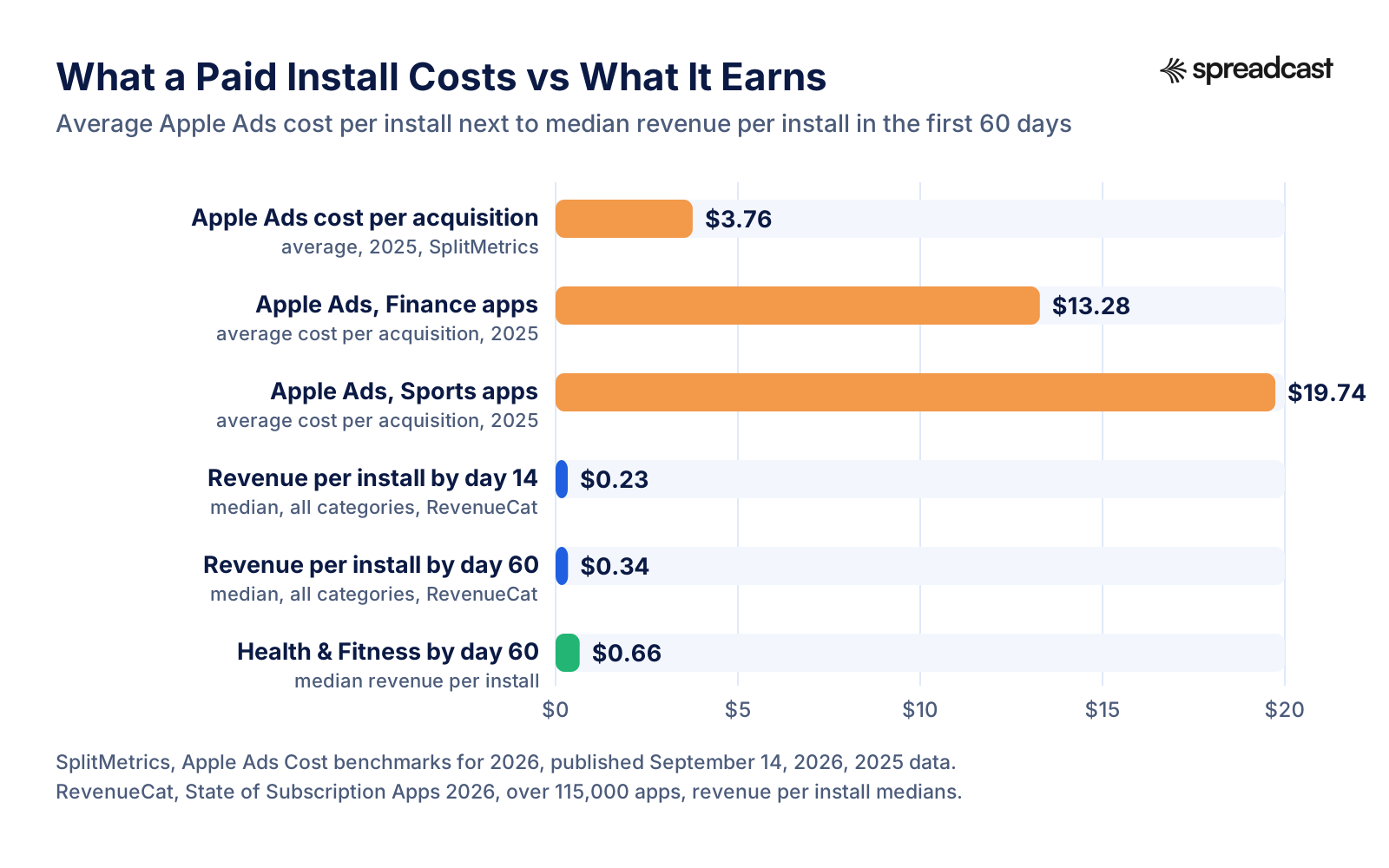
For an app, Apple Ads is usually that one channel, and the numbers explain both why it works and why it needs care. SplitMetrics' 2026 benchmarks put the average Apple Ads cost per acquisition at $3.76 in 2025, with Finance apps at $13.28 and Sports apps at $19.74. A $1,000 Apple Ads line at the average buys roughly 266 installs. Whether that is good depends on what an install earns you, which we cover in the app section below.
The people line becomes a part time freelancer. At Upwork's median range for social media managers, $14 to $35 an hour, $600 buys roughly 17 to 43 hours a month. Spend those hours on work that compounds: a library of App Store screenshots, a short demo video, a few long articles or a set of templates. Do not spend them on making single posts by hand; a tool that designs and publishes covers that line for $29.
Email moves to a paid plan if you need automation. Kit's Creator plan starts at $33 a month billed yearly for 1,000 subscribers. A welcome sequence that turns signups into active users is usually the highest return item in this budget, because it works on people you already paid to reach.
Last, one creator or sponsorship test. A sponsored issue of a niche newsletter or a paid post from a creator your users follow is a cleaner test than another ad network, because you can measure it with one campaign link and it reaches people through someone they already trust. Cap it, track it with its own link and judge it on paying customers, not clicks. If you run more than one product, Spreadcast Studio at $79 a month covers 5 apps and 50 social accounts, each with its own brand kit, so the content line does not multiply with every product.
$2,000 a Month Startup Marketing Budget Example
A split for a startup with early revenue and one channel that already brings customers. Our example, priced from the vendors' pages.
| Line | What it buys | Monthly cost | Number to watch |
|---|---|---|---|
| Paid acquisition | One main channel funded above its minimum, such as Apple Ads for an app or search for SaaS | $1,000 | Cost per paying customer against your CAC ceiling |
| Freelance help | About 17 to 43 hours at Upwork's $14 to $35 median for screenshots, video and templates | $600 | Assets delivered and reused |
| Social content and publishing | Spreadcast Pro, or Studio at $79 for several apps | $29 | Posts published per week, followers, interactions and reach |
| Kit Creator, 1,000 subscribers, billed yearly | $33 | Signup to active user rate from the welcome sequence | |
| Creator or newsletter test | One sponsored issue or creator post, tracked with its own link | $250 | Paying customers from the link |
| Reserve | Launch costs, a second channel test next quarter | $88 | Roll over if unused |
| Total | $2,000 |
LinkedIn's $10 and TikTok's $20 daily minimums, converted at 30.4 days, are why this example funds one paid channel instead of three.
Minimum Ad Budgets by Network
The least each platform lets you or advises you to spend, from its own help pages. The monthly column is our arithmetic at Google's 30.4 days per month.
| Network | Minimum or starting advice | About a month at that level | Source |
|---|---|---|---|
| Meta (Facebook and Instagram) | Start with at least $5 and a duration over six days; minimums vary by country, objective and bid strategy | Varies; Ads Manager warns when you are below the minimum | Meta ads pricing and minimum budgets |
| $10 daily minimum for any ad format; $100 lifetime minimum for new campaigns | $304 | LinkedIn budget best practices | |
| TikTok | $50 at the campaign level, $20 a day at the ad group level | $608 for one ad group | TikTok budget and bidding FAQ |
| Google Ads | No fixed minimum stated; you set an average daily budget | Daily budget × 30.4 | Google Ads Help |
| Apple Ads Basic | Pay per install at a maximum you choose; budget up to $10,000 per app per month; up to 50 apps | Your monthly budget, capped at $10,000 | Apple Ads, compare solutions |
| Apple Ads Advanced | Cost per tap with a daily budget at campaign level; no budget maximum | Daily budget × 30.4 | Apple Ads Advanced vs Basic |
Checked on each platform's help page on October 28, 2026. Minimums can differ by currency and country.
The $10,000 a Month Marketing Budget
Ten thousand dollars a month is where a startup usually makes its first marketing hire, and where the budget stops being mostly tools and tests and becomes mostly people and paid media. The questions also change. At $500 you ask whether a channel works at all. At $10,000 you ask how far each channel scales before its cost per customer climbs.
People first. A full time hire is the largest single line. As a reference point, the US Bureau of Labor Statistics puts the median pay for graphic designers at $62,960 a year, about $5,250 a month before benefits and payroll taxes. A marketing generalist who can run ads, write and analyze usually costs more. If that is out of reach, a senior freelancer for 60 to 80 hours a month buys most of the same output for less, without the commitment. Our guide to hiring a social media manager compares four options with prices.
Paid media second, split between your proven channel and one challenger. Keep about 70% on what works and 30% on the next test, and measure both on CAC payback, not clicks. Apple Ads Basic caps out at $10,000 per app per month, so a fast growing app eventually moves to Apple Ads Advanced, which has no budget maximum and gives keyword control at the cost of more setup.
Tools stay small. Even at this size, a design and publishing tool, an email platform on a paid plan and free analytics come to roughly $150 a month. If your team needs a shared social inbox and approval flows across many seats, a suite such as Hootsuite starts at $99 per user a month. Spend there only when the inbox is a real job, not because the budget can absorb it.
The new line at this size is video and sponsorship. Short video for Reels, TikTok and YouTube Shorts, and paid placements with creators or newsletters your buyers read. Both are hard to do well on a small budget and both can carry a brand further than static posts once you can fund them steadily for a quarter.
The trap at $10,000 is that the hire spends most of their time making posts by hand. A designer who makes every post is a very expensive scheduler. Give the routine posting to a tool, with approval, and point the hire at the work only a person can do: positioning, partnerships, the launch plan, the creator relationships.
$10,000 a Month Startup Marketing Budget Example
A split for a startup with a repeatable channel and enough cash to wait for payback. Our example; salary uses the BLS median as a reference point.
| Line | What it buys | Monthly cost | Number to watch |
|---|---|---|---|
| First marketing hire | One full time content and social person, salary at the BLS median for graphic designers | $5,250 | Output per month and pipeline from owned channels |
| Paid acquisition | About 70% on the proven channel, 30% on one challenger | $3,400 | CAC payback by channel |
| Freelance video and design | Short videos, App Store preview, campaign assets | $750 | Assets reused across channels |
| Creators and sponsorships | One or two placements a month with their own campaign links | $450 | Paying customers per placement |
| Tools | Spreadcast Studio $79, Kit Creator $33, analytics and link tools | About $150 | Hours saved for the hire |
| Total | $10,000 |
Salary is before benefits and payroll taxes, which add a meaningful share on top in most countries. BLS median pay checked October 28, 2026.
App Marketing Cost: What Changes for an App
An app has a few fixed costs a SaaS product does not, and one hard number that decides whether paid acquisition can work at all. The fixed costs are small. The Apple Developer Program is $99 a year and Google Play charges a US$25 one time registration fee. Neither is really marketing, but both belong in a first year plan. Our page on the Apple Developer Program covers the fee by country and the enrollment steps.
The hard number is revenue per install. RevenueCat's State of Subscription Apps 2026, built on over 115,000 apps and over $16 billion in revenue, puts the median revenue per install at $0.23 by day 14 and $0.34 by day 60 across all categories. Health & Fitness apps reach $0.66 by day 60; Gaming reaches $0.14. Set that next to SplitMetrics' average Apple Ads cost of $3.76 per acquisition and the gap is plain. A typical paid install takes many months of revenue to pay back, and in many categories it never does.
That does not mean an app should never buy installs. It means an app should buy them only after it knows its own revenue per install, from its own cohorts, and only at a cost that pays back within a time it can afford. Until then, the app marketing budget belongs mostly in the free and cheap lines: App Store optimization, a product page that converts, release posts that bring existing users back and give new ones a reason to look. When you do price a test, check the cost per install benchmarks for your category first, so the cap you set is realistic.
Two pages go deeper on the numbers. Cost per install benchmarks shows what installs cost by country and category, and App Store conversion rate shows how many product page visitors actually download, which is the other half of the equation. For the whole plan by stage, see how to market an app, and for where downloads really come from, how to get app downloads.
Social posts are one of the few channels where an app pays almost nothing per visit to its product page. A release post that reaches your followers on six networks, with a campaign link, sends people to the App Store at no media cost. The constraint is making those posts every time you ship. Spreadcast checks your App Store listing daily and, when a new version goes live, designs the release post with your real screenshots, writes a caption for each network and publishes it on autopilot or after one tap of approval. That turns the line most app makers skip into one that costs $29 a month.
What a Paid Install Costs vs What It Earns
Average Apple Ads acquisition costs next to median revenue per install. The difference is why most small apps should prove a free channel before they fund a paid one.
How Much to Spend on Social Media Marketing
Social media is usually the first marketing line a startup runs and the last one it budgets properly. The spend splits into three parts: making the posts, publishing and measuring them, and paying to boost or advertise. Most founders budget only the third and pay for the first with their evenings.
Making the posts is the expensive part, in money or in time. On Upwork's sample rates for small businesses, images and graphic design run $200 to $950 a month and full account management on two channels $400 to $2,000, with each extra channel adding $200 to $1,500. Upwork also notes the common estimate that a social media campaign costs $4,000 to $7,000 a month, which tells you what agencies charge, not what a startup needs to spend. Done by hand, a designed post takes most founders 30 minutes to an hour, and our breakdown of the real cost of designing posts by hand puts hours and rates on that work.
Publishing and measuring is cheap. Buffer schedules on 3 channels free and charges $5 per channel a month on yearly billing after that; Hootsuite's Standard plan is $99 per user a month for up to 10 accounts. For a startup the numbers that matter are followers, interactions and reach per network, and likes, comments, reach and views per post. Our social media KPIs page lists the formulas, and the engagement rate calculator does the arithmetic.
Paid social is the line to add last. Boosting a post that already did well organically is the cheapest paid test there is, because you already know people respond to it. Starting paid social before you have posts that work organically means paying to find out that your creative is weak.
A sensible split for a startup spending $500 a month on marketing: under $50 on making and publishing posts, nothing on paid social until a post earns it, and the rest on the main paid test. At $2,000, the same tools line plus a small boost budget of $100 to $200 for proven posts. If you want ideas for what to post, our content calendar for an app and the 52 post ideas cover a year without repeats.
Monthly Cost of the Social Content Line
What startups pay to have posts made and published, by route. The orange bars are people, the blue and green bars are tools.
Marketing Launch Budget
A launch is the one time a startup should spend more than its monthly budget, and it should be a separate line so it does not quietly empty three months of the paid budget. The marketing launch budget covers the assets you make once and reuse for a year, and the push in launch week.
The assets come first. App Store or landing page screenshots, a short demo video, a set of launch posts for each network, a press kit page and an email to everyone who signed up for early access. These are where a few hours of freelance design pay off, because you reuse them in every channel for months. Our app launch checklist lists 60 tasks for iOS and Google Play, and how to launch on Product Hunt covers timing, gallery images and the launch day plan.
Launch week itself is mostly time. The founder answers every comment, posts on each network the team uses, emails the list and thanks people in public. The paid part is optional: a newsletter sponsorship timed to the launch, or a small boost on the best performing launch post. Never pay for upvotes or reviews; the Product Hunt guide above explains how that backfires, and a penalty is worse than a quiet launch.
The one launch problem money solves well is volume of posts. Launch week needs a designed post every day on several networks, plus follow up posts with the first reviews and milestones. That is ten or more posts in a week, at a moment when you have no time at all. Spreadcast's Post Pack is $19 once for 10 posts designed and published, which covers a launch week across your networks without a subscription, and the 30 Day Pass at $39 once gives everything in Pro for a month if you want the launch month covered end to end.
Marketing Launch Budget Example
One off costs for a small app or SaaS launch, on top of the monthly budget. Our example; adjust the paid lines to what you can afford to lose.
| Launch line | What it covers | Example cost |
|---|---|---|
| Screenshots and hero images | About 8 hours of freelance design at Upwork's $25 average | $200 |
| Demo video | A 30 to 60 second product video, freelance or made in house | $0 to $300 |
| Launch week posts | Spreadcast Post Pack: 10 designed posts published across your networks | $19 |
| Email to early access list | Kit free plan up to 10,000 subscribers | $0 |
| Product Hunt and communities | Founder time on launch day and the week after | $0 |
| Newsletter sponsorship | One placement timed to launch week, tracked with its own link | $0 to $500 |
| Boost for the best launch post | Only after it has done well organically | $0 to $100 |
| Total | $219 to $1,419 |
Our example. Freelance cost uses Upwork's published average for graphic designers; Spreadcast prices from our pricing page.
Startup Marketing Budget Template
Copy these rows into a spreadsheet. Fill the plan column at the start of the month, the actual column at the end, and the last column in your monthly review. Every line gets an owner and one number.
| Line item | Monthly plan | Actual | Owner | Number to watch | Keep, cut or grow |
|---|---|---|---|---|---|
| Tools: analytics, CRM, email | $ | $ | Founder | Hours saved per week | |
| Social content and publishing | $ | $ | Founder or marketer | Posts published, followers, interactions, reach | |
| Paid channel 1 | $ | $ | Founder or marketer | Cost per paying customer vs ceiling | |
| Paid channel 2 (test) | $ | $ | Founder or marketer | Cost per signup after 3 times the ceiling spent | |
| Freelance help | $ | $ | Founder | Assets delivered and reused | |
| Email and retention | $ | $ | Founder or marketer | Signup to active, churn | |
| Creators and sponsorships | $ | $ | Founder or marketer | Paying customers per placement | |
| Launch and one off costs | $ | $ | Founder | Signups in launch week | |
| People (salary or retainer) | $ | $ | Founder | Output and pipeline per month | |
| Reserve | $ | $ | Founder | Rolled over or spent on a named test | |
| Total | $ | $ | Blended cost per customer, payback in months |
A blank template is more useful than a filled one: the examples above show what a reasonable plan column looks like at four sizes.
How to Build a Startup Marketing Budget
The order we use when we help a founder set the first real number. It takes an afternoon.
- Step 1
Set the Ceiling
Before revenue, decide what you can spend every month for six months without shortening your runway in a way you would regret. With revenue, start from a percent you can defend and check it against the benchmarks above. Write the number down; it is the limit, not a target.
- Step 2
List What Costs You Hours
Write down every marketing task you did last month and how long it took. The tasks that take the most hours and need the least judgment, usually designing and scheduling posts, are the first things to pay for, because each dollar there buys back founder time.
- Step 3
Pick One Paid Test
Choose the single channel where your buyers already spend time. Check its minimum budget, set a cost per customer ceiling from your LTV, and agree a stop rule before it starts. One funded test beats three starved ones.
- Step 4
Give Every Line an Owner and a Number
Use the template above. A line with no owner gets forgotten; a line with no number cannot be cut or grown on evidence. Followers, interactions and reach for social; cost per paying customer for paid; signup to active for email.
- Step 5
Review Monthly, Move Money Quarterly
Look at the numbers every month, but only move large amounts between lines every quarter, unless a channel is clearly failing its stop rule. Channels need time to show what they do, and constant shuffling teaches you nothing.
When to Spend More on Marketing
Raise a line when it has earned it, not when the bank balance looks healthy. Three signals are worth waiting for.
The first is a cost per customer that holds as you spend more. Many channels look cheap at $10 a day and get expensive at $100, because the easiest buyers are reached first. Increase spend in steps of about 20% to 30%, and check whether cost per paying customer stays under the ceiling at each step. When it stops holding, you have found that channel's useful size for now. The LTV CAC ratio page shows how to set the ceiling and the payback period that goes with it.
The second is payback inside your cash window. A channel with a fine ratio but a 15 month payback will grow revenue and empty the account at the same time. Spend more only on channels that return their cost within the months of cash you have.
The third is that your organic engine runs without you. If posts, email and your product page keep bringing signups while you work on the product, paid spend has something to amplify. If they stop the moment you stop pushing, more paid spend usually just buys more expensive versions of the same users. Our page on founder led marketing covers how founders keep their own voice in the mix as the budget grows.
Common Startup Marketing Budget Mistakes
The patterns we see most often when a small company's marketing money runs out before it learns anything.
Spreading Thin Across Every Network
Five paid channels at the minimum each produce five unclear results. Fund one channel properly, learn, then add the next. The same goes for organic: two networks done every week beat six done when you remember.
Paying a Person to Do a Tool's Job
Paying $25 an hour for someone to resize the same post for four networks is a tool's job. Pay people for judgment, writing and relationships; let software design, caption and schedule the routine posts.
No Stop Rule on Paid Tests
A test without a cost ceiling and an end date is not a test, it is a habit. Write down the most you will pay per customer and the spend at which you will decide, before the first dollar goes out.
Forgetting the Customers You Have
The CMO Survey found acquisition budgets 26% larger than retention budgets. For a startup, a welcome email and release posts that bring users back are often cheaper growth than any ad.
Copying Big Company Percentages
A billion dollar company spending 7.8% of revenue is not a guide for a company making $5,000 a month. Below a certain size, plan in dollars and hours, and use percents once revenue can fund a real channel.
Leaving Launch Costs Off the Plan
Screenshots, a demo video and a burst of launch posts are real costs. Without their own line, they eat the paid budget for the months after launch, just when you want to follow up on the attention.
Where Spreadcast Fits in a Startup Marketing Budget
Spreadcast covers one line of the budget: making social posts and getting them published, every week, on every network you use. It is the line that eats the most founder hours on a small budget and the most freelance money on a bigger one, which is why it is worth handling first.
Here is the before. A founder with an iPhone app ships a new version. To post about it, they open a design tool, find last month's template, export fresh screenshots, put them in a phone frame, check the image size for each network, write a caption for LinkedIn, a shorter one for Threads and Bluesky, another for Instagram, then open a scheduler and queue each one. That is an hour or two for one release, and it competes with the next release. Most weeks it does not happen, and the brand account goes quiet.
Here is the after. Spreadcast already has the brand kit it built from the App Store listing: icon, colors and screenshots in an iPhone frame. It checks the listing every day. When the new version goes live, it designs the release post, writes a caption per network and either publishes it on autopilot or waits for one tap of approval. For anything else, you type one line in Create, such as a feature you want to show or a review you are proud of, and it designs a single image post or a carousel in your brand. You can also upload your own pictures and video and schedule them on the same calendar. Businesses without an app start from a website or a short description instead.
It publishes to Instagram, Facebook, Threads, LinkedIn, Pinterest, TikTok, YouTube, Bluesky, Mastodon, Telegram and Discord, including the networks many schedulers skip. Analytics show followers and interactions per network and likes, comments, reach and views per post, which are the numbers the budget template above asks for. If you already work in Claude or ChatGPT, the Spreadcast MCP server lets those assistants design posts, write captions and schedule them for you.
On cost, it sits in the budget like this. Free makes 3 posts to download for one app, with a small Spreadcast mark. Pro is $29 a month or $290 a year for clean posts with no cap, publishing to 10 social accounts, autopilot or one tap approval and posting from Claude or ChatGPT. Studio is $79 a month for 5 apps and 50 accounts, each with its own brand. Without a subscription, the Post Pack is $19 once for 10 posts designed and published, and the 30 Day Pass is $39 once for everything in Pro for 30 days. Paid plans come with a 7 day full refund. Compared with the $200 to $950 a month Upwork lists for freelance graphic design alone, that is the cheapest line in any of the budgets above. See all features or start from your App Store link.
More Planning Guides for Startup Marketing
If you are building the plan around an app, start with how to market an app for the stage by stage plan and App Store optimization for the free channel that compounds. Startups planning a launch will find the strategy and timeline in app launch marketing for startups. SaaS teams can turn product updates into posts with SaaS social media marketing.
For the social line specifically, social media statistics shows how many people use each network, a social media audit template helps you see what your current accounts are doing, and how to automate social media posts compares six ways to take posting off your plate, from free to fully automatic. If you post for one brand and want a month of content ready in one sitting, try batching a month of social content in one afternoon.
Frequently Asked Questions
How much should a startup spend on marketing?
Before revenue, spend what you can afford to lose every month for six months, which for many founders is close to zero plus five to eight hours a week. With revenue, mature companies spend about 7.8% to 9.0% of revenue on marketing according to Gartner and The CMO Survey in 2026, and growing startups usually spend a larger share. Once a channel works, set the budget by how many customers you can buy at a cost that pays back in time.
What is the average startup marketing budget?
There is no reliable public average for startups specifically. Surveys of established companies land between 7.7% and 9.0% of revenue, while Benchmarkit found private SaaS companies spending 47% of revenue on sales and marketing when venture backed and 33% when private equity backed. Bootstrapped startups usually plan in fixed dollars, often $0 to $2,000 a month at the start.
How much of revenue should go to marketing?
A common guide is 7% to 10% of revenue for an established business, and a larger share while you are new. The SBA blog notes that young businesses need to budget more because they are still building awareness, and that B2C companies tend to spend a larger share than B2B. Venture backed software companies often spend a third or more of revenue on sales and marketing combined.
How much should I spend on social media marketing?
Split it into making posts, publishing and measuring them, and paid promotion. Tools for the first two cost from $0 to about $100 a month for a small team; freelancers making posts cost $200 to $2,000 a month on Upwork's sample rates. Add paid social last, starting by boosting posts that already did well organically.
What should a startup marketing budget include?
Six lines: tools, content, paid acquisition, people, launch and one off costs, and a small reserve. Each line needs an owner and one number to watch, such as cost per paying customer for paid channels or followers, interactions and reach for social.
How much does it cost to market an app?
The fixed costs are small: $99 a year for the Apple Developer Program and a $25 one time fee for Google Play. Paid installs are the expensive part. SplitMetrics put the average Apple Ads cost per acquisition at $3.76 in 2025, while RevenueCat's median revenue per install was $0.34 by day 60, so most small apps should prove free channels such as App Store optimization and social posts before buying installs.
Can you market a startup with no budget?
Yes. A $0 plan runs on founder time: direct outreach, posts on one or two networks, product page and App Store copy, and a weekly email, using free plans of Google Analytics, HubSpot CRM, Kit and Buffer. Budget the hours, about five to eight a week, so it does not take over your build time.
What is the minimum budget for ads on LinkedIn, TikTok and Meta?
LinkedIn's minimum is $10 a day for any ad format, about $304 a month. TikTok lists $50 at the campaign level and $20 a day at the ad group level. Meta advises starting with at least $5 and running for more than six days, and its minimums vary by country, objective and bid strategy.
Where These Facts Come From
Every outside number, rule and price on this page links to the page it was taken from.
- 2026 CMO Spend Survey press release (May 11, 2026)Gartner
- The CMO Survey 2026: CMOs face headwinds (March 31, 2026)Duke Fuqua School of Business
- The CMO Survey Fall 2024: marketing budgets rebound (November 12, 2024)Duke Fuqua School of Business
- 2026 CMO Survey program pageDeloitte
- How to get the most from your marketing budget (July 9, 2019)U.S. Small Business Administration
- 2025 B2B SaaS performance benchmarksBenchmarkit
- Do things that don't scalePaul Graham
- Facebook and Instagram ads pricing and costMeta for Business
- Best practices for minimum budgetsMeta Business Help Center
- Making the most of your budget: minimumsLinkedIn Marketing Solutions
- Budget and bidding FAQsTikTok Ads Manager
- Choose your bid and budgetGoogle Ads Help
- Apple Ads Basic overviewApple Ads
- Compare Apple Ads solutionsApple Ads
- Apple Ads cost: CPA, CPT, CR and TTR benchmarks for 2026 (September 14, 2026)SplitMetrics
- State of Subscription Apps 2026RevenueCat
- Apple Developer ProgramApple Developer
- Get started with Play Console: registration feePlay Console Help
- Campaign links in App Store Connect AnalyticsApple Developer
- Google AnalyticsGoogle Marketing Platform
- Free CRM softwareHubSpot
- Kit pricingKit
- Buffer pricingBuffer
- Hootsuite plansHootsuite
- Canva plans and pricingCanva
- Graphic designer hourly ratesUpwork
- Social media manager hourly ratesUpwork
- Graphic designers, Occupational Outlook HandbookU.S. Bureau of Labor Statistics
- Video: Top budget trends for CMOsGartner
- Video: How to get your first customers, Startup SchoolY Combinator
- Video: 50 founders share how they got their first customersY Combinator
Researched and written by Spreadcast. Last checked on October 28, 2026.