Notion's marketing strategy is to let its users do the selling. The company gives the product away free to individuals, hands its most excited users the tools to teach everyone else, through templates, YouTube tutorials, local meetups and an ambassador program, and only later adds brand campaigns and a sales team on top. Notion says it passed 100 million users in August 2024, and it told CNBC in September 2025 that it had reached $500 million in annualized revenue, with about 90% of the business coming from teams. Paid media came late and stayed small: the trackers quoted by Digiday put Notion's measured ad spend at more than $7 million for 2022 as of October that year. The rest came from a community and a creator economy that grew around a product people liked showing off.
Most write ups about Notion jump straight to the ambassador program and stop there. That program is real and it's clever, but it's the second chapter. The first chapter is a near death in 2015, a rebuild in a rented flat in Kyoto, and a hard lesson about what people actually want from software. The third is a company that, by 2026, had broken up its own CMO organization because, in its CEO's words, "Classic marketing can't keep up." This page walks through all of it with the sources, then shows how you can run the useful parts of the same playbook for your own app.
Notion is a private company, so there are no annual reports to read. Every number below comes from Notion's own blog and release notes, its founders and marketers speaking on the record, or named trade press, and each one links to the page it came from. We opened all of them on November 15, 2026. Where two sources disagree, we show both.
Notion Marketing Strategy at a Glance
Notion Labs is a San Francisco software company launched in 2013 by Ivan Zhao and Simon Last, and these are the facts that frame its marketing as of November 2026.
| Fact | Figure | Source and date |
|---|---|---|
| Founded | 2013, headquartered in San Francisco | Ivan Zhao on the Notion blog, September 2024; CNBC Disruptor 50, May 2026 |
| Founders | Ivan Zhao (CEO) and Simon Last; Akshay Kothari joined full time in 2018 and is credited as a cofounder | CNBC Disruptor 50; Kothari on Startup Field Guide, February 2024 |
| Users | Passed 100 million in August 2024; over 100 million in September 2025 | Notion blog, September 3, 2024; CNBC, September 18, 2025 |
| Users outside the US | Over 80% of users across 28 countries in 2021; 80% in 2024 | Notion blog, October 2021; Forbes, April 2024 |
| Revenue | $500 million annualized, confirmed to CNBC in September 2025; Forbes estimated $250 million for 2023 | CNBC, September 2025; Forbes, April 2024 |
| Valuation | $11 billion in a private share sale of about $270 million; $10 billion in October 2021 | Notion blog, January 26, 2026; CNBC |
| Outside funding | $330 million in total, none since the 2021 round | CNBC Disruptor 50, May 2026 |
| Employees | About 1,000 | CNBC, September 2025 |
| Measured ad spend | More than $7 million in 2022 as of October, up from $3.8 million in 2021, social excluded (Kantar estimate) | Digiday, October 2022 |
| Main channels | Free product and word of mouth, templates, ambassadors and local communities, creators on YouTube and TikTok, brand campaigns since 2022, sales for enterprise | First Round Review; Digiday; Sequoia Capital podcast, May 2026 |
| Marketing setup | No CMO organization in 2026: storytelling sits next to product, demand generation next to sales, community in its own group | Ivan Zhao on the Sequoia Capital podcast, May 21, 2026 |
This page is part of a series. For a consumer app that grew on a mascot and a streak, read the Duolingo marketing strategy. For a yearly campaign people wait for, read the Spotify marketing strategy. For a tiny team that grew on creators, read the Cal AI marketing strategy. And for two more companies that grew on what their users made and said, read the Netflix marketing strategy and the Airbnb marketing strategy.
How Did Notion Start
Notion started in 2013 as a tool for building your own software, and it nearly died two years later because almost nobody wanted that. Ivan Zhao put it bluntly on the Notion blog in 2024: "We had no business sense, struggled with building a horizontal tool. Notion almost died." He adds that the team rebuilt the product four times during what he calls the lost years.
The crisis came to a head in 2015. According to the Figma blog's 2019 account, the first version was built on a weak technical base and crashed constantly, and the founders had to choose between letting their small team go and starting over, or running out of money. "If you looked at the burn rate, we all would've died together," Zhao told Figma. They chose to let the team go, sublet their San Francisco office and moved to Kyoto, where, as Zhao put it, neither of them spoke Japanese, nobody around them spoke English, and all they did was code.
Zhao told the story again in May 2026 on Long Strange Trip, the Sequoia Capital podcast hosted by Brian Halligan, with a few details the earlier versions skip. He first picked Tokyo, then saw on Airbnb how small the apartments were; Kyoto's were bigger. Renting out the San Francisco office actually made the company cash flow positive. And the city itself mattered to him: he called Kyoto probably the craft capital of Asia, full of people making knives, ceramic cups and tatami seats, which he sees as tools too. That's how he thinks about Notion. Notion's own Japan launch post quotes him the same way: "The culture values such exquisite craftsmanship. It embodies all the things I wanted Notion to be."
Accounts differ on how long the rebuild took. Figma calls it the founders' year of crisis. Zhao told Halligan it took a year and a half to rebuild from scratch. First Round Review, published by Notion's seed investor First Round Capital, counts three years of designing and late night programming before the 2018 relaunch. The numbers measure different things, the crisis, the rewrite and the road to a product people wanted, and they agree on the part that matters: Notion didn't find its footing until 2018.

For marketing, the useful part of the Kyoto story is what the founders changed when they got there. Akshay Kothari, who joined in 2018, explained it on a podcast years later: people don't wake up wanting to build software, they wake up wanting to do their jobs. So the team stopped selling building blocks and started shipping finished things made of them.
Kothari described that pivot on Startup Field Guide in 2024. Around 2016 and 2017, Notion used its own blocks to build templates, so someone who needed a to do list could click a button and have one. That became Notion 1.0, a simple notes app and company wiki, and in early 2018 a general purpose database arrived on top. On Lenny's Podcast, the episode notes sum up Zhao's version of the same lesson: hide the bigger vision inside something people already understand and want. For an app maker, that's the most useful sentence in Notion's whole history. Your marketing can only work once the first thing a new user sees is something they already wanted.
How Did Notion Become Popular
Notion became popular through launches on Product Hunt, word of mouth among students, designers and startups, and later a wave of YouTube and TikTok tutorials made by its users, not by the company. Forbes reported in 2024 that Notion first went up on Product Hunt in August 2016, and Product Hunt's own page shows both launches on top: Notion 1.0 was number one of the month for August 2016, and the relaunch, Notion 2.0, was number one for March 2018. Zhao himself dates real traction to that 2018 launch in his 100 million post.
Early adopters used it in ways the founders didn't plan. Forbes describes students making class notes and to do lists, design minded founders replacing the pitch deck with a Notion page, and artists using it as a portfolio. Then "How I use Notion" tutorials flooded YouTube. In January 2021 the app went so viral on TikTok that, per Forbes, demand overwhelmed Notion's servers; it had about 20 million users at the time.
The founders were close to the users from the start. Lenny's episode notes say that early on Zhao personally replied to users' tweets and emails, so people knew there was a human behind the product. Kothari's version is even more hands on. When he joined as the ninth person in 2018, he told Startup Field Guide, the whole company was two founders, three engineers and three support people, and he spent his first six months answering about 100 to 120 Intercom support tickets a day himself. About one in five, he said, he didn't know how to answer, because users were doing things with Notion he'd never seen.
That support work became a marketing input. Every ticket was tagged, and a daily job pulled the tag counts into a Notion database, so any engineer could see which problems were growing. It's the same instinct behind the community program that came next: watch what your most active users already do, then build on it. If you're launching soon, our guide on how to launch on Product Hunt covers the launch day mechanics, and founder led marketing covers the replying to every tweet part.
Notion's Growth Timeline
Notion's growth came in layers over thirteen years: a product rebuild, a free plan, a community, creators, new languages, brand campaigns, AI and a sales team. This timeline puts the main moves in order, with the source for each.
| When | What happened | Source |
|---|---|---|
| 2013 | Ivan Zhao and Simon Last start Notion; the pitch deck already imagines a template marketplace | CNBC, Notion blog |
| 2015 | The first version fails; the founders let the team go and rebuild from Kyoto | Figma blog, Notion blog |
| August 2016 | Notion 1.0 goes up on Product Hunt and is number one of the month | Forbes, Product Hunt |
| March 2018 | Notion 2.0 is Product Hunt's number one product of the month; Akshay Kothari joins | Product Hunt, Startup Field Guide |
| September 2019 | Notion becomes free for students and teachers | TechCrunch |
| May 2020 | Personal use becomes free with unlimited content | Notion release notes |
| August 2020 | Korean becomes the first language after English | Notion release notes |
| January 2021 | Notion goes viral on TikTok with about 20 million users | Forbes, April 2024 |
| October 2021 | $275 million raised at a $10 billion valuation; Japanese launch | CNBC, Notion blog |
| August 2022 | First international brand campaign, For your life's work, in eight cities | Notion blog |
| November 2022 | Notion AI opens as a private alpha; more than 2 million join the waitlist | Notion blog |
| February 2023 | Notion AI becomes available to everyone | Notion blog |
| July 2024 | Think it. Make it., Notion's first brand tagline | Notion blog |
| August 2024 | 100 million users | Notion blog |
| September 2025 | $500 million annualized revenue; AI agents launch | CNBC |
| January 2026 | $11 billion valuation in an employee share sale | Notion blog |
| May 2026 | Number 10 on the CNBC Disruptor 50, up from 34 in 2025 | CNBC |
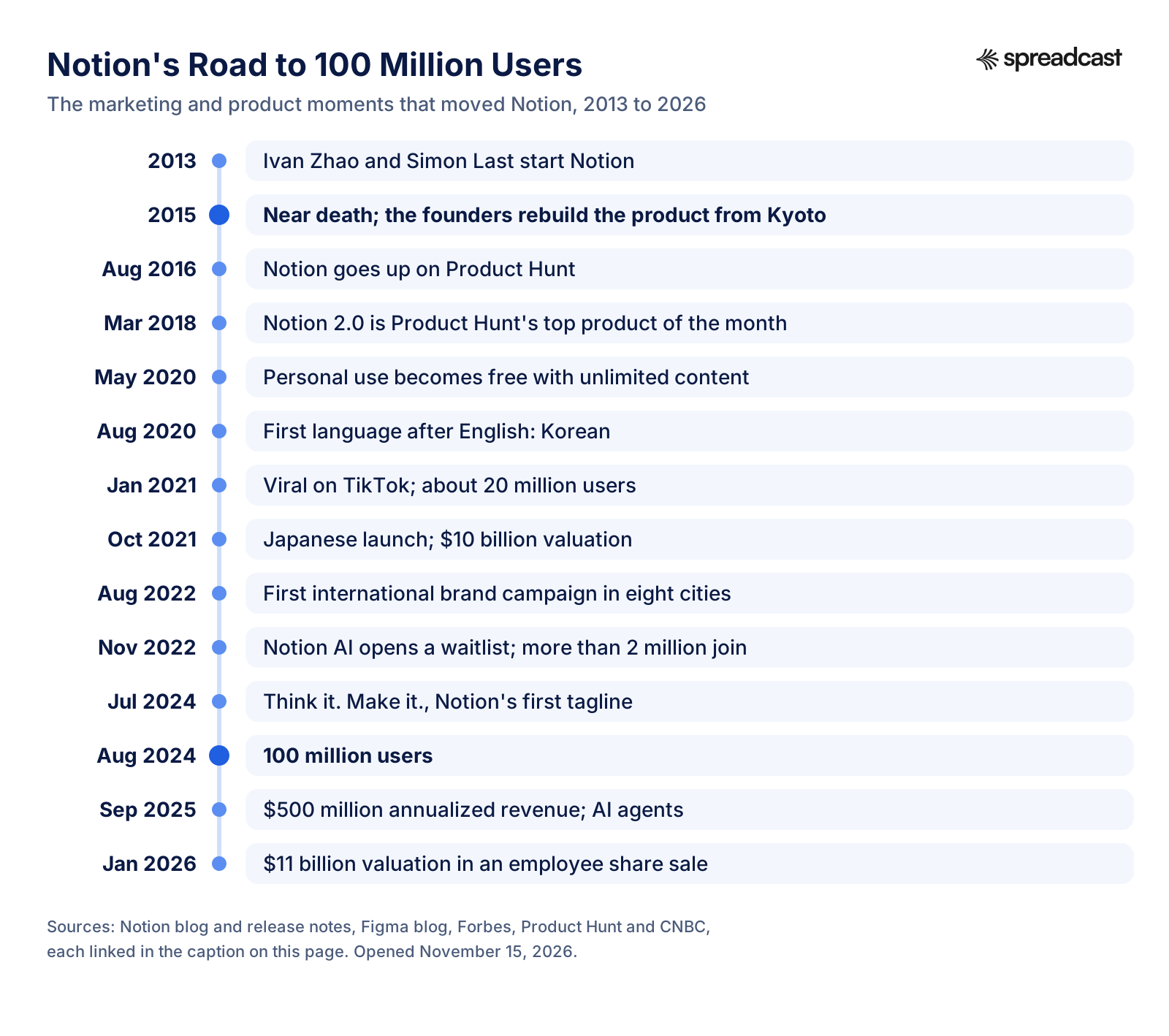
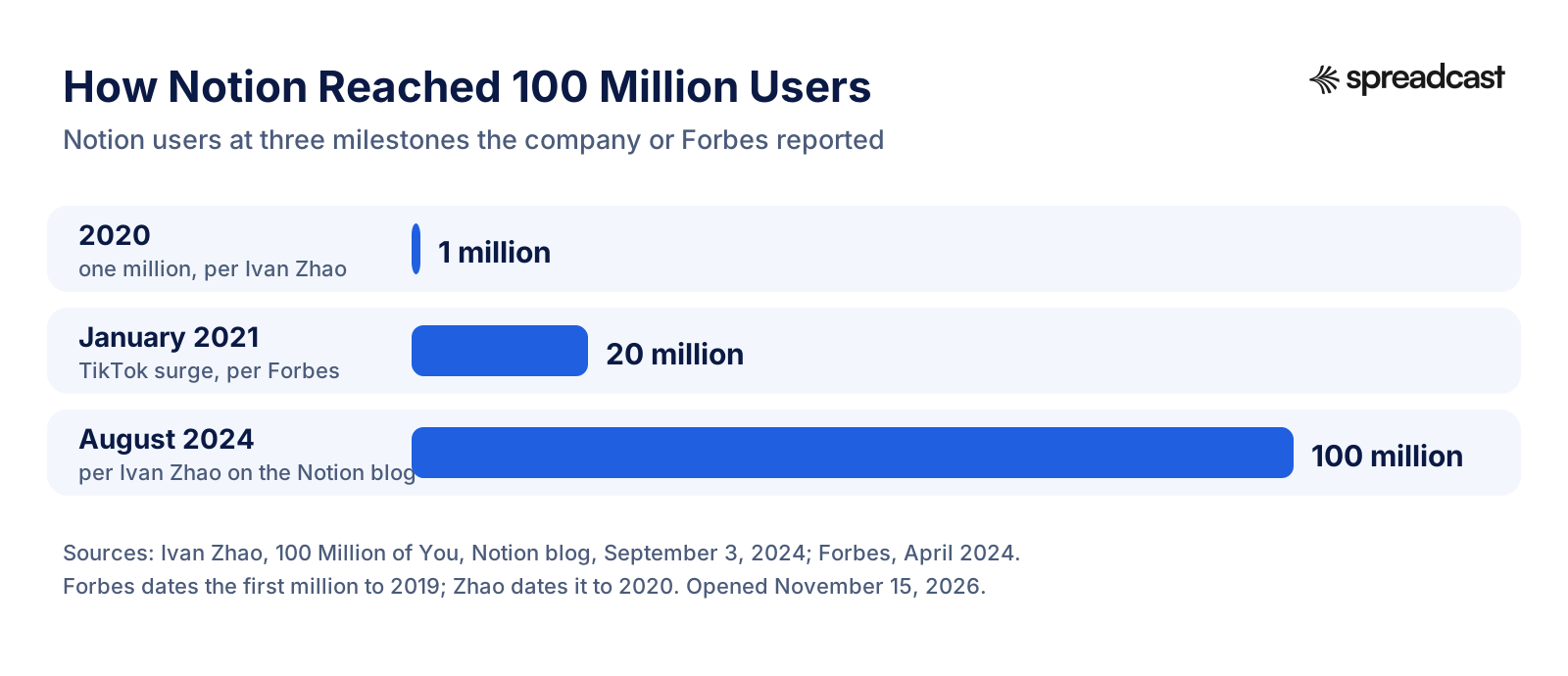
User counts are where the sources disagree a little. Zhao wrote that Notion passed one million users in 2020, right before Covid; Forbes dated the first million to 2019. Both agree on what came after: about 20 million by January 2021 and 100 million by August 2024. Notion doesn't say how many of those are active, so treat the 100 million as people who signed up, not people who use it every day.
Product Led Growth and the Free Personal Plan
Notion's growth strategy rests on a free plan generous enough that individuals never have to pay, so they bring Notion into their teams, which do. The key date is May 19, 2020, when Notion's release notes announced that personal use was now free with unlimited content. Until then, as TechCrunch reported, the free tier capped people at 1,000 blocks, Notion's unit of content, and the way to lift the cap was a $5 a month personal plan. Students and teachers had already been given Notion free in September 2019.
The release note gave a plain reason: "hitting a storage limit is the last thing you should have to worry about right now." TechCrunch read it as a long term bet on growth from the bottom up: give individuals everything, and earn the money when they bring Notion to work. Six years later the numbers back the bet. In September 2025, Kothari told CNBC that about 90% of Notion's business comes from teams, what he called multiplayer usage. Lenny's episode notes describe the thinking behind it as delaying monetization and offering generous free plans early, so goodwill turned into loyalty and word of mouth.
Kothari has a name for the motion. He calls it B2C2B: consumers first, then their companies. It also explains why a company that earns nearly all its money from businesses spent its early years marketing to students and YouTubers. Rachel Hepworth, named as Notion's CMO in First Round Review, said the community "feels like a B2C motion for a company that generates all of its revenue from companies," and that this mix was hard for anyone else to copy.
Free users only pay off if some of them convert, so Notion's growth team watches early signals rather than sign ups. Hepworth told First Round Review that her team focused on free users who became paying customers, because experiments that spike sign ups can lower the quality of users and the paid conversion rate with them. The leading indicators she named are worth copying even in a tiny app: a new user inviting a second person to work on a doc, editing a doc, creating a second doc within a day of signing up, and signing up with a work email instead of a personal one. She wanted signals people hit within a week, or even a day, because slow signals mean slow learning.
Here's our read. The free plan is Notion's biggest marketing expense, and it's the one that never shows up as ad spend. If your app has a free tier that nags people or runs out quickly, every post and ad you pay for is pushing traffic into a leaky bucket. Fix the free experience first, then pick one early action that predicts paying, and judge your marketing by how many people reach it.
Notion's Community Strategy: Ambassadors, Consultants and Local Groups
Notion's community strategy is to find the people already teaching others how to use Notion, give them support, money for events and early access, and then get out of their way. Ben Lang, Notion's founding head of community, told First Round Review that the team never ran community from the top down; it encouraged people to build things with Notion and share them.
Lang is a good example of how it started. He found Notion on Product Hunt in 2018, started tweeting his setups, got flooded with questions about how he built them, and launched a template site, Notion Pages, and a Facebook group as a side project, all for fun. When he told the founders he'd be in San Francisco, they already knew his work, and he became one of the company's earliest marketing hires, working with Notion's founding marketer, Camille Ricketts.
One of his first projects was the Ambassador program. The launch was a tweet calling for people to help by hosting events, starting a YouTube channel or making templates, and Lang told First Round that about a thousand people applied within the first few weeks. The program grew to more than 300 ambassadors worldwide, running groups like Notion Korea on Facebook and Notion for Artists on Telegram. Notion's part was small but steady: early access to features, AMAs with the team, a private Slack group, priority support, swag, and grants to pay for food or a room at local events. By the time of the interview, Lang said there was a community led Notion event almost every day somewhere in the world, and Notion wasn't running them.

A community manager told Common Room in 2023 that Notion runs its own communities on Slack but doesn't moderate or administer most of the groups people see around Notion; ambassadors do. Japan and Korea had some of the most active members, and Notion supported their local events with stickers and other goodies. The groups get big. In 2021, Notion's general manager for Asia Pacific pointed to its 50,000 strong Arabic community and 20,000 strong Taiwanese groups as examples. In India, Kothari's 2022 post on the Hyderabad office quotes a community member who hosted the first Notion meetup in Bangalore himself.
The same trick worked for services. As companies adopted Notion, some power users built side businesses setting it up for teams. Instead of building a services arm, Notion's community team listed the people already doing it, then added a certification so the directory met its standards. Lang told First Round Review that the directory went from two or three consultants to more than 60, and that Notion hired one of those consultants to help write the certification exam. First Round describes the consultants as customer success style help that costs Notion very little.
The events now have a corporate layer on top. In December 2025, Notion's head of EMEA marketing, Áine Dundas, wrote that its Make with Notion Showcase reached more than 1,300 attendees across Berlin, London, Munich and Paris, with Notion Ambassadors leading the tips sessions. And in May 2026, Zhao told the Sequoia Capital podcast that community sits in its own community ecosystem organization, which he called one of the most important for a startup: Notion fans around the world, and figuring out how to move markets through them.
A small app won't have 300 ambassadors any time soon. It can copy the order Notion did things in, though. Notion didn't invent its superfans; it noticed them in tweets and support tickets, then gave them recognition, a direct line to the team and a little money. You probably already have five people who recommend your app more than anyone else. Find them, thank them in public, and ask what would help them talk about you more.
Do this for your app: Notion's community is social proof at scale, real people saying the product works for them. The closest thing most apps have is their store reviews, and Spreadcast turns those into posts. From your App Store or Google Play link it picks real reviews and designs review quote posts in your brand colors and fonts, with the reviewer's words and star rating, as part of your weekly plan. It can also publish to Telegram and Discord, the places where app communities like Notion's tend to gather. If you want to try the format once by hand first, the free testimonial graphic generator makes a single quote card.
Notion Templates Marketing: The Gallery, the Marketplace and the Creators
Notion's templates are its onboarding, its content marketing and its creator economy at the same time. A blank Notion page is intimidating, Lang told First Round Review, because new users face a pile of building blocks with no idea where to start, so a community template gallery made sense. First Round says the gallery now holds tens of thousands of templates. Kothari called the early templates a turning point on Startup Field Guide: Notion built a few of its own, then the community took over and built all sorts of new ones, and those templates introduced other people to the platform.
What Kothari noticed next shaped Notion's marketing. Builders were proud of their templates in the way Excel macro gurus are proud of their macros: it's mine, I built it. So Notion decided to spotlight them. "Instead of us trying to be cool, we're trying to make these builders cool," he said on Startup Field Guide. A Notion template sold by a creator is a Notion ad that the creator is paid to promote.
And creators did get paid. YouTuber Thomas Frank wrote in a thread about his 2022 results that he and his team made $1 million selling Notion templates that year, led by Ultimate Brain at about $760,000. He said he never promoted the templates on his main channel; they sold through a smaller channel, Thomas Frank Explains, which grew from 43,000 to 110,000 subscribers in 2022, plus his email list and blog. A bundle outsold the other editions about three to one. Zhao's own 100 million post says some creators building on Notion made $1 million in 2023.
Zhao also shared a slide from Notion's original 2013 pitch deck that imagined a marketplace for things people build on Notion. The deck expected it in 15 months; Zhao says it took about 10 years. Today Notion runs that Marketplace itself. Its help center says Notion takes an 8% fee plus 40 cents per sale, acts as the merchant of record, offers buyers refunds within 14 days, and approves sellers from a waitlist, which can take a few months. Creators can still sell elsewhere and list the link.
Look at it from Notion's side and it's an unusually cheap content engine. The company doesn't pay for most of these templates, the creators promote them on their own channels, and every buyer has to use Notion to open what they bought. Some of the biggest names work as unofficial ambassadors. Ali Abdaal, the productivity YouTuber, says on his Notion creator profile that he's made YouTube videos since 2017 and that Notion runs his channel and his business, and he lists free templates there.
Most apps can't sell templates, but almost every app can give away the thing a template really is: a ready made way to get a result fast. A budgeting app can share a sample monthly plan. A fitness app can post a four week program. A photo app can show five presets with before and after shots. Each one teaches a stranger what your app is for in one glance, which is exactly what Notion's templates do.
Do this for your app: the social version of a template is a tips carousel, a few slides that show someone how to get a result with your app. Spreadcast's weekly plan makes these for you as tips carousels, built from your app's real features and real screenshots, in your brand kit, alongside problem and fix posts that show one common problem and how your app solves it. The Instagram carousel maker page shows the slide format, and Spreadcast puts them on a schedule so a new one goes out every week. For more formats like this, see our list of app promotion ideas.
Notion's Influencer and YouTube Strategy
Notion's influencer strategy started as a decision not to hire content marketers. Kothari explained it on Startup Field Guide: there was already a subculture of productivity YouTubers reviewing tools, stars in their own right who ran their businesses on software, and Notion asked itself what would happen if all of them used Notion as their core system. If they did, they'd make videos about it. He wanted other people to be creating content about Notion, because that has far more reach than a company blog.
At first the community team reached out to creators by hand, with contractors who knew certain markets, like European YouTubers or Spanish speaking TikTok creators, according to First Round Review. In December 2021 Notion hired Lexie Barnhorn, who had run influencer marketing at the skincare brand Curology, as head of social and influencer marketing. First Round pointed to the size of the channel: #Notion had passed 1 billion views on TikTok across more than 80,000 videos, which it put down largely to partnering with creators on the platform. So the TikTok wave wasn't all spontaneous. By then Notion was feeding it.
Barnhorn runs influencer marketing like a sales pipeline. Her process, as she laid it out for First Round, goes from defining the audience to tracking every creator in a CRM, a trial period where the creator actually uses the product, a contract, and reporting by UTM link for each partnership. Her most surprising win wasn't a video at all. Promoting Notion AI to founders, she found a career advice newsletter called Career Supplements doing unusually well, asked for an explainer section on Notion AI with GIFs, and that one newsletter converted better than any of the 150 influencer partnerships she had built for that audience. She also wrote to about 100 thought leaders on LinkedIn to ask whether they used Notion, then asked the ones who did to explain how, which she said brought in a high number of conversions.
Notion also pays its fans more formally. Hepworth told First Round Review that the affiliate program gets much of its push from community members who talk about Notion on their own channels or make templates; the community and influencer teams decide who gets links, and the marketing team handles payment and tracking. In other words, the line between fan, creator and affiliate is thin on purpose.
A small app can't recruit 150 creators, and it shouldn't try to start there. Barnhorn's newsletter result points somewhere more useful: the best partner is often a small, trusted voice whose audience matches yours exactly. One well placed mention can beat a hundred loosely matched ones. Our guides on how to promote an app on TikTok and how to promote an app on Instagram cover finding and briefing creators on a small budget.
Do this for your app: while you line up creators, keep your own channels posting so the people they send you find an active account. Spreadcast's TikTok scheduler sends your branded posts to your TikTok drafts on your schedule, so you add a sound and publish in a tap, and its YouTube scheduler puts your posts on your channel at the times you pick. The creators bring the reach; Spreadcast makes sure there's a steady stream of your own posts waiting when that reach arrives.
Notion's Social Media Strategy
Notion's social media strategy leans on other people's posts first and its own second, which is the reverse of most brands. Most of Notion's famous social moments, the TikTok surge of 2021 and the "How I use Notion" wave on YouTube that Forbes describes, came from users and creators. Kira Klaas, then Notion's global head of campaigns, told Digiday in 2022 that the company had seen "really incredible organic traction with its community and social."
Notion's own channels mostly serve that community. Notion's YouTube channel carries tutorials, launch videos and First Block, its interview series with startup founders. It also posts videos from community events, like the Seoul one below. Zhao's 100 million post includes a collage captioned "Notion creators on TikTok," which tells you who the company sees as its real social team.

This approach has a cost that's easy to miss: you don't control the message. Kothari admitted on Startup Field Guide that product led growth only goes so far, and that Notion could have started earlier on telling its own story to people who'd never heard of it. That's a striking admission from a company with 100 million users. Creators explained how to use Notion; nobody was explaining, in Notion's own voice, why a company should run on it.
For an app maker the lesson cuts both ways. User content is the best marketing there is, so make it easy and reward it. But don't wait for it. Your own accounts are the one channel you control, the place you tell your story in your words, every week, whether or not anyone made a video about you that month. Our guide on how to promote an app on social media covers which networks to start with.
Do this for your app: the steady half of a social strategy is showing up on a schedule in a look people recognize. Spreadcast does that half for you. You paste your App Store or Google Play link once, it builds a brand kit from your listing, and its weekly plan makes branded posts about your real features, real reviews, tips and the problems your app solves, from one post a week up to twice a day. It schedules them at your posting times on the social media scheduler, across Instagram, Facebook, LinkedIn, TikTok, YouTube, Pinterest, Threads, Bluesky, Mastodon, Telegram and Discord.
Notion's International Expansion: Korea, Japan and Local Communities
Notion went international by following its community: it translated the product into the languages where fans had already built groups, books and meetups in English. Its users have been overwhelmingly outside the US from the start. In October 2021 Notion said over 80% of its users were outside the US, across 28 countries, and Forbes still put the share at 80% in 2024.
Korea came first. Notion's release notes for August 10, 2020 call South Korea its "first destination" for new languages and give the reason: a huge, vibrant community of Korean users who had written four textbooks about Notion, hosted workshops and made videos while the app was English only. The launch translated the whole app, the templates and the help center.
Japan followed in October 2021, with a story that ties back to Kyoto. Notion's general manager for Asia Pacific wrote that when Zhao first asked him about Japan, the company had only 58 people, yet a large Japanese community was already using it in English, which he called very rare for Japan. Japan was by then one of Notion's leading markets, with daily users up four times in a year, according to the blog post; the press release issued in Tokyo put it as a 500% increase and said Japanese users had held meetups, started online forums and self published books about Notion before it spoke their language. Notion launched with Japanese support staff, translated help articles, local customer stories and templates, and a community party.
The pattern repeated. Kothari wrote in 2022 that Notion had grown five times in two years in India, where it opened an engineering site in Hyderabad. By 2024, Forbes reported, Notion's 650 employees worked from offices in the US, Ireland, India, South Korea and Japan. Its first brand campaign in 2022 put billboards in Tokyo and Seoul next to San Francisco and London, and Klaas told Digiday that the majority of the business was international. In 2026, Notion's head of design told Fortune that Singapore alone had over a million users.
Again, it's the order that matters. Notion didn't pick countries from a market size spreadsheet. It looked for places where people were already working around the language barrier to use the product, and translated for them. Your App Store or Google Play analytics can tell you the same thing: if a country keeps showing up in downloads or reviews even though your app isn't translated, that's your Korea.
Notion Marketing Campaigns
Notion's marketing campaigns are few, recent and built from its community's stories. The company had no brand advertising to speak of until 2022, then ran two campaigns two years apart, with paid media kept small next to its organic channels.
| Campaign | When | What it was | What was reported |
|---|---|---|---|
| Product Hunt launches | August 2016 and March 2018 | Product launches to early adopters | Notion 1.0 and Notion 2.0 were each number one of the month (Product Hunt) |
| Free personal plan | May 2020 | Unlimited content free for individuals | Earlier cap was 1,000 blocks (TechCrunch) |
| Notion in Korean and Japanese | August 2020 and October 2021 | Localized product, templates, help and community events | Japan daily users up four times in a year (Notion blog) |
| For your life's work | August 2022 | First international brand campaign: billboards in eight cities, TV and three short films | Measured spend more than $7 million in 2022 by Kantar's estimate (Digiday) |
| Notion AI waitlist | November 2022 | Private alpha announced with a launch video and a waitlist | More than 2 million joined against hopes of a couple hundred thousand (Notion blog) |
| Career Supplements newsletter | After the Notion AI launch | Notion AI explainer inside a career newsletter | Converted better than 150 other partnerships for that audience (First Round Review) |
| Think it. Make it. | July 2024 | First brand tagline, billboards in San Francisco, the London Tube and Seoul bus stops | Thousands of words tested to land on four (Notion blog) |
| 100 Million of You | September 2024 | Founder's thank you post for the milestone | 100 million users passed in August 2024 (Notion blog) |
| Make with Notion Showcase Europe | 2025 | Events in Berlin, London, Munich and Paris | More than 1,300 attendees (Notion blog) |
For Your Life's Work: Notion's First Brand Campaign
Notion's first international brand campaign, For your life's work, launched in August 2022 across the website, ads, social media and TV, with billboards in San Francisco, New York, Toronto, London, Dublin, Paris, Tokyo and Seoul. Its point was that work and life don't fit in two neat boxes. The three short films were each inspired by a member of the community: a startup founder closing a key hire while keeping healthy habits, a laid off father retraining as a web designer while raising a toddler, and a student helping run his grandparents' bakery. Notion's own post noted that the stories don't ask how many hours you can save.
Digiday's coverage adds the media plan. Klaas told Digiday that out of home advertising hadn't been part of Notion's mix before. About half the budget went to awareness, billboards and streaming video, and half to targeted media including social. Notion had also moved money from display and discovery ads to YouTube, where there's more room to explain the product, and Klaas said it might spend more on direct response later to cash in on the awareness.
Think It. Make It.: Notion's First Tagline
Two years later Notion gave itself a tagline. In July 2024, Katie Chang, head of creative strategy and operations, wrote that Think it. Make it. was meant to expand people's understanding of Notion beyond productivity software and to reflect how much the product had changed with AI. The team, working with the design studio BUCK, tested thousands of nouns, verbs and adjectives before landing on four words. It ran on a billboard in San Francisco, in a London Tube station and at bus stops in Seoul.
Neither campaign is something an indie app should copy line for line. The part worth copying is the timing. Notion ran its first brand campaign nine years after it started, once tens of millions of people already used it and word of mouth had done the heavy lifting. Paid awareness amplified a story that was already spreading. If nobody talks about your app yet, a billboard won't start the conversation.
Do this for your app: one Notion campaign any app can run is the milestone post. Zhao's 100 Million of You turned a number into a thank you to users, and people shared it. Spreadcast watches your app for the same kind of moment: when your app passes a round number of ratings on the App Store or Google Play, it designs a milestone post in your brand, ready to approve or already scheduled. Our guide on how to get App Store reviews covers getting to those numbers.
Notion's Brand and Design Language
Notion's brand is its design: quiet black and white illustrations, warm off white space and an interface that tries hard not to shout. "Design means everything here," Zhao told the Figma blog in 2019. "We're a tool that solves people's daily problems." The same piece describes designers, copywriters, engineers and the in house illustrator all making several versions of their work, and small interface icons that echo Susan Kare's original Mac icons.
The illustrations are the most recognizable piece. Roman Muradov, a long time Notion illustrator, drew the original brand illustrations when the company had only a few employees, according to Notion's post on its 2024 campaign, and the style stayed: minimal, gestural, mostly black and white. For Think it. Make it., the characters were drawn close up with their minds visible, and bold yellow, blue and red were added to the black and white.
The craft extends to things customers never see. Zhao's 100 million post mentions that the team tried 30 shades of warm white paint for an office wall, made its own work jackets because it couldn't find merch it loved, and that cofounder Akshay Kothari painted the third office himself. And in 2026, Notion's head of design, Randy Hunt, told Fortune that "You can't have every new tool screaming at you," comparing the work to tending a garden, adding features without a total redesign. He argued that the product feels good to use, and that this is why people form an emotional connection with the brand.
We think this is the most underrated part of Notion's marketing, because it compounds. Every template, screenshot and tutorial anyone makes carries Notion's look with it, so millions of user made posts all look like Notion. A small app gets the same effect from a consistent visual identity used everywhere: same colors, same fonts, same style of screenshot, every time.
Do this for your app: a look people recognize is exactly what Spreadcast builds first. Paste your App Store or Google Play link and it reads your listing and makes a brand kit from your app's real colors, fonts, icon and screenshots, then designs every post from that kit, so your feed looks like your app the way every Notion screenshot looks like Notion. Our notes on what a brand kit actually needs and brand consistency without a design team go deeper, and Spreadcast makes your kit from that one link.
Notion AI: How Notion Launched and Marketed AI
Notion AI is the best example of Notion marketing a launch, and it started with a waitlist that beat every expectation. Zhao wrote that the team built the first prototype at a company offsite after getting early access to OpenAI's next big model in the fall of 2022, launched Notion AI as a private alpha in November 2022, and hoped for a couple hundred thousand sign ups; more than 2 million joined the waitlist. CNBC notes that Notion's first AI feature arrived about two weeks before ChatGPT's public launch.
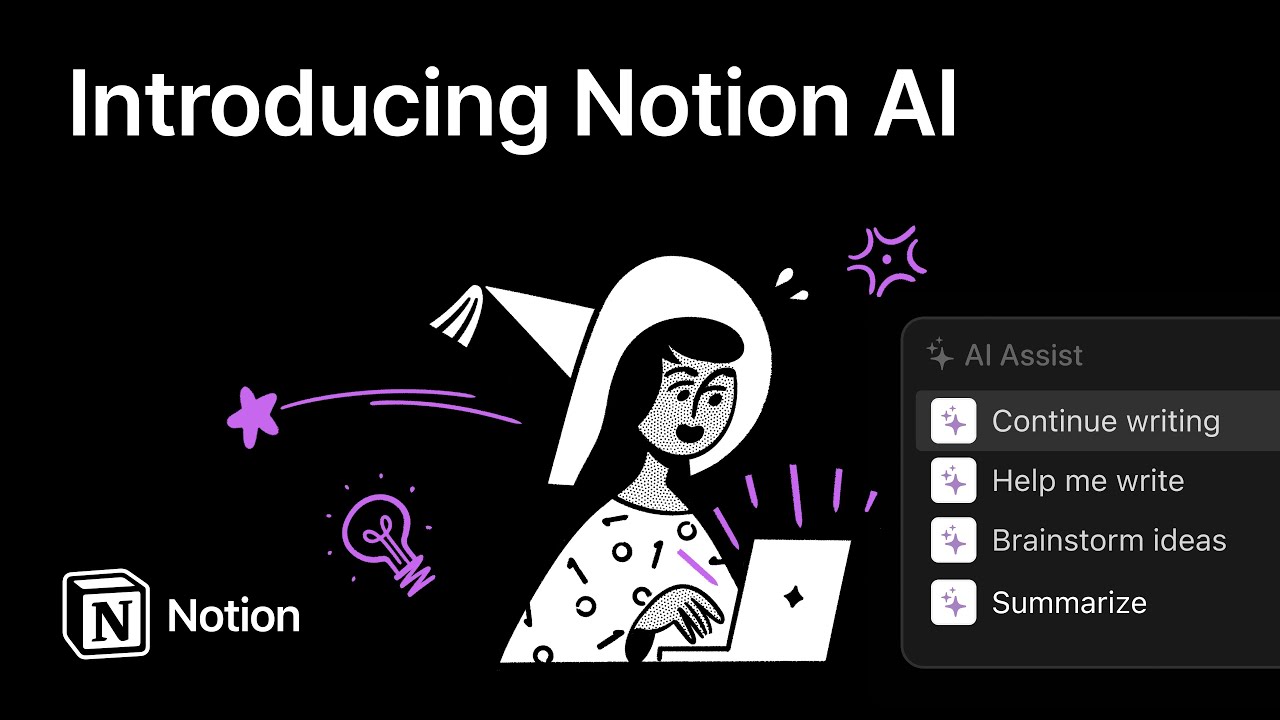
After about ten weeks of feedback, Notion AI became generally available in February 2023 to what Zhao called tens of millions of users. Kothari said on Startup Field Guide that it launched at $10 a month and became Notion's fastest growing business line. The launch prep Zhao describes is ordinary marketing done well: polishing the demo for press, doing interviews, updating the website and making sure the waitlist worked.
Notion has also been unusually open about AI uptake. Customers paying for AI were 10% to 20% in 2024, 30% to 40% in early 2025 and over half by September 2025, CNBC reported, and AI was then folded into the Business and Enterprise plans at no extra charge. Notion's CFO, Rama Katkar, wrote in January 2026 that more than half of its ARR at the end of 2025 came from customers using AI, a share that had more than doubled in a year. Agents arrived in September 2025, and Custom Agents followed in early 2026, according to Fortune.
Notice what Notion didn't do. It didn't rebrand as an AI company or run an AI only campaign at launch. It put the feature inside the product people already used every day, showed it working in a short video, and let the waitlist create the buzz. Then it changed the tagline, two years later, once AI had changed the product enough to deserve it.
Do this for your app: every release is a chance to say what's new, and most apps waste it on a line of release notes. Spreadcast watches your App Store listing and designs an update post when a new version ships, so your launch gets announced in your brand the day it goes out. Between releases, the weekly plan keeps showing the features you already have with feature posts built from your listing. For ideas on wording, see these app update announcement examples, then let Spreadcast handle the post.
Notion's Enterprise Push
Notion's enterprise push came late, and Zhao says that was a mistake. On the Sequoia Capital podcast in May 2026, he explained that Notion went a good two years without a traditional sales motion because the team wanted to design its own system from first principles. It didn't work. What turned it around, he said, was pairing chief revenue officer Erica Anderson, GitHub's former CRO and in his words a systems thinker, with a hard charging head of sales. "Perfect pairing," Zhao said, and it's when things started to work, in the past year and a half.
Kothari has made the same admission in softer terms. He's proud that Notion is one of the rare companies where you can buy the enterprise plan self serve without talking to anyone, but he also said product led growth alone won't reach every company you want to sell to. In September 2025 he told CNBC that Notion was doubling that year and would likely double its sales team the next. Named customers include Kaiser Permanente, Mitsubishi Heavy Industries, Nvidia and Volvo Cars, and by May 2026 CNBC said Notion was the tool of choice for more than half of the Fortune 500.
The marketing team adjusted too. Hepworth told First Round Review that Notion split brand, meaning community and influencers for awareness, from a revenue focused marketing team covering product marketing, growth, demand generation, content and international. She also described segmenting new users by where they sit in a company, from the first touch through sign up and onboarding, and redeploying a large team that had focused on startups once it became clear its work duplicated other functions.
For B2B apps the takeaway is simple. Bottom up adoption fills the top of the funnel, but someone still has to tell the story to the buyer who's never heard of you. That means content made for decision makers, on the network they actually read. Our pages for SaaS companies and startups cover that side of marketing.
Do this for your app: if teams buy your app, LinkedIn is where your buyers scroll. Spreadcast's LinkedIn scheduler publishes your branded feature posts and problem and fix posts there on the same weekly plan as everything else, so your story also reaches the people who sign off on budgets.
How Notion Makes Money
Notion makes money from subscriptions, sold per member to teams and companies, with AI bundled into its higher plans. Its pricing page in November 2026 lists four plans. Free costs nothing and gives individuals unlimited blocks, with a limited number of blocks for workspaces with several members, 5 MB file uploads and a trial of Notion AI. Plus costs $10 per member a month billed yearly, or $12 billed monthly. Business costs $20 per member a month billed yearly, or $24 monthly, and includes Notion Agent, AI Meeting Notes and Enterprise Search. Enterprise has custom pricing and adds security and admin controls. Custom Agents are free to try and then billed at $10 per 1,000 Notion credits, and Plus is free for students and educators. (These are the US dollar prices; visitors in Europe see euro prices on the same page.)
On revenue, Notion said it reached $500 million in annualized revenue in September 2025, and CNBC's 2026 Disruptor 50 profile describes it as $500 million in annual recurring revenue in 2025. For an earlier point, Forbes estimated that Notion made about $250 million in 2023 and said it had been profitable for a long time; that's Forbes' estimate, not a company figure. Notion has raised $330 million of outside money in total and none since 2021, and Kothari told CNBC in 2025 that the company has more cash on hand than it has raised.
Its valuation has moved slowly for a company growing this fast. Notion raised $275 million at $10 billion in October 2021, then in January 2026 its CFO announced a share sale of about $270 million, with GIC joining Sequoia and Index, at an $11 billion valuation. CNBC calls it a December tender offer, while Notion's post is dated January 26; either way, it gave employees and early investors cash without new funding. Notion also removed the one year vesting cliff on options so almost every employee could sell.
For a marketer, the telling thing in Notion's business model is the gap between who uses it and who pays. Individuals use it free and are marketed to through creators, templates and community. Teams pay, and they're reached through the individuals who bring Notion to work, then through sales. If your app has a free tier, write down which free users are most likely to bring in someone who pays, and aim your content at them.
How Much Notion Spends on Marketing
Notion doesn't publish its marketing budget, but ad trackers quoted by Digiday in October 2022 put its measured media at more than $7 million in 2022, up from $3.8 million in 2021, according to Kantar, which leaves out social. Pathmatics, which tracks digital ads, put Notion's digital spend at $6.2 million in 2022, up from $2.6 million the year before. Digiday ran those numbers on October 4, 2022, calling them "this year," so the 2022 figures cover the year up to about then, not all twelve months.
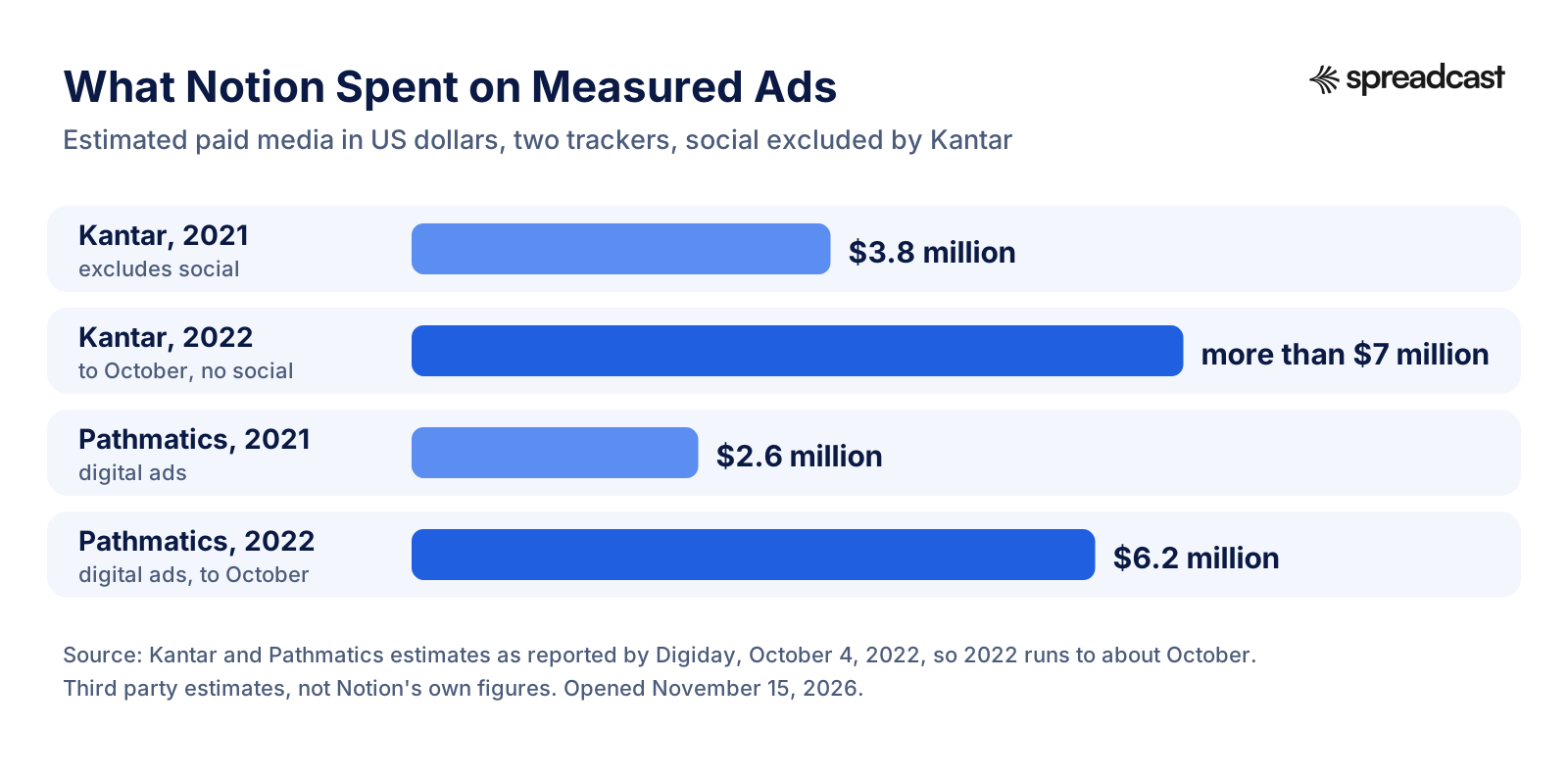
For scale, those numbers are tiny next to the business. Put the 2022 ad estimate next to Forbes' revenue estimate for the following year, about $250 million, and measured ads come to under 3% of it. That's a rough comparison across two years and two estimates, but the scale is clear. The real marketing cost sits elsewhere: the free plan, the community team and its event grants, the creator and affiliate payouts, the people who make Notion's own content, and since 2022 the brand campaigns. None of those show up in an ad tracker.
We'd treat these figures as a floor, and an old one. Notion hasn't shared newer numbers, and the trackers miss most social and creator spending. What they do show is the shape: Notion grew to tens of millions of users on almost no paid media, then added a modest budget once the brand was big enough to amplify. For how a small company might split a budget, see our page on startup marketing budgets, and for the paid side, our guide on how to advertise an app.
Inside Notion's Marketing Team
Notion's marketing team has been rebuilt more than once, and in 2026 it no longer has a CMO organization at all. That's from Zhao himself, speaking to Brian Halligan on the Sequoia Capital podcast published May 21, 2026: "We actually changed our marketing department. We no longer have a CMO organization." He said the company broke the CMO group into storytelling, which sits next to product and close to social because "Classic marketing can't keep up," and a demand generation group that serves sales. Community lives in its own group.
That's the latest of several shapes. Camille Ricketts was Notion's founding marketer and Ben Lang its founding head of community; together they built the template gallery and the global community. Lexie Barnhorn joined in December 2021 to run social and influencer marketing. Rachel Hepworth joined as head of growth and enterprise marketing and became CMO, coming from Pilot, Slack and LinkedIn. Kira Klaas led global campaigns during the first brand campaign, per Digiday, and Katie Chang led creative strategy for the 2024 tagline. Áine Dundas runs EMEA marketing.
His reasoning is about speed. The product changes so fast now that he didn't want information making a round trip to a CMO, who then decides how to serve product on one side and sales on the other. Put the storytellers next to the people building, put demand generation next to the people selling, and, as he put it, "just let both sides figure it out themselves." Lenny's notes on Zhao's episode make the same point about the whole company: Notion stayed lean on purpose, even at scale.
If you're a solo founder, you already have Notion's 2026 org chart: the person who builds the feature is the person who tells the world about it. That's actually an advantage. The hard part is the time. Notion fixed that with dedicated storytellers next to product; you can fix it by letting software handle the steady posting while you spend your hours on the stories only you can tell.
What an Indie App Can Copy From Notion, and What It Can't
Notion's marketing looks like a community story from the outside, but much of it depended on a free product good enough to show off and years of patience. Here's an honest split between what a small app can copy, what it can't, and the cheapest version of each.
| Notion tactic | Can a small app copy it | The small app version |
|---|---|---|
| Rebuild until the first experience is something people want | Yes, and it matters most | Make the first screen a finished result, not a blank tool |
| Free plan with no content limit for individuals | Partly | A free tier that never nags, plus one clear reason to upgrade |
| Ambassador program with 300 members | Not yet | Five superfans you thank in public and talk to often |
| Templates and a Marketplace | Partly | Tips posts and sample setups that show a result in one glance |
| Creators earning $1 million on templates | No | One small, trusted newsletter or creator whose audience matches yours |
| Localized launches in Korean and Japanese | Later | Translate the store listing first for the country already finding you |
| Brand campaigns in eight cities | No | A consistent brand look on every post you publish |
| Notion AI waitlist of 2 million | At small scale | A waitlist and an announcement post for your next big feature |
| Enterprise sales team | Later | LinkedIn posts aimed at the people who approve budgets |
| Measured ad spend of about $7 million | No | Organic posting first, small paid tests once it works |
Money is a smaller gap between Notion and a typical indie app than you'd think. The big one is the audience doing the marketing. Notion had millions of users making videos and templates for free. You probably don't yet, which means your own posts have to do the job that Notion's community did: show what the app is for, again and again, in a look people learn to recognize. For the wider plan, our guides on how to market an app and how to promote an app for free cover the store, the launch and the channels, and mobile app marketing examples collects other apps worth studying.
A Notion Style Week for a Small App
A Notion style week for a small app mixes your own posts with posts that celebrate your users, and keeps showing people a finished result rather than a feature list. This is the routine we'd suggest to an indie developer who wants Notion's habits without Notion's community. Shift the days to suit your audience, and check the data on the best time to post on social media.
- Monday: a feature post with one real screen of your app and the result it gets someone, in your brand colors.
- Tuesday: a tips carousel, four or five slides showing one setup or workflow from start to finish, the closest thing to a Notion template you can post.
- Wednesday: reshare or reply to something a user made with your app, and thank them by name.
- Thursday: a review quote post from a real App Store or Google Play review.
- Friday: news, if you have it. A new version, a rating milestone, a translation, an event.
- Weekend: go through the questions people asked this week, in comments, support email and reviews. Each one is a post for next week.
Notion's version of this runs on millions of fans. Yours can run on one person and a scheduler. The days don't matter much; what matters is that strangers keep seeing finished results made with your app, and your users keep seeing themselves in your feed.
Do this for your app: Monday, Tuesday, Thursday and Friday on that list come out of Spreadcast from your App Store or Google Play link. Feature posts, tips carousels, review quotes, update posts and rating milestones are designed in your brand kit and scheduled at your times, which leaves Wednesday and the weekend for the human parts: thanking users and reading their questions. If you post the same thing to several networks, the cross posting page shows how one post goes everywhere at once.
Run Notion's Playbook on Autopilot With Spreadcast
Spreadcast runs your app's marketing: branded posts, made and scheduled for you. Strip away the 100 million users and the billboards, and Notion's steady habit is simple: keep showing finished results, celebrate your users and your milestones, look the same everywhere, and announce every launch. That habit is what Spreadcast automates for your app.
Here's how it works. You paste your App Store or Google Play link once at spreadcast.app/start. Spreadcast reads your listing and builds a brand kit from it: your app's colors, fonts, icon and real screenshots. From that kit it plans a week of branded posts. You choose how often, from one post a week up to twice a day, and the times they go out. The plan mixes the post kinds a good social team would use: feature posts from your app's real features, review quote posts from real store reviews, tips carousels, problem and fix posts, and seasonal posts tied to a real feature when a date is near.
Then it watches your app for news, the way Notion's team turns launches and milestones into posts. When a new version ships on the App Store, Spreadcast designs an update post for it. When your app passes a round number of ratings, it designs a milestone post. You don't have to remember that today is worth posting about.
You decide how much control to keep. With approve first, drafts wait for you and nothing goes out until you say yes; the social media approval page shows the flow. With Full Autopilot, posts are scheduled and published automatically. Either way they go to the networks you connect: Instagram, Facebook, LinkedIn, TikTok, YouTube, Pinterest, Threads, Bluesky, Mastodon, Telegram and Discord.
Notion's growth team watches early signals instead of vanity numbers. Spreadcast gives you the same habit for social: social media analytics with followers, interactions and reach as your networks report them, for each network, so you can see what's working. And if you'd rather ask for posts in a chat, Spreadcast also works from Claude and ChatGPT through its MCP server.
Pricing is simple. Free gives you three AI made posts to try, so you can see your app in your own brand before paying. Pro is $29 a month, or $290 a year, for one app and up to ten social accounts, with publishing to all your networks, full autopilot or one tap approval, and posting from Claude or ChatGPT. If you run several apps, Studio covers five apps, each with its own brand and accounts, for $79 a month. Compared with hiring someone to post every day, it's small, and it never takes a week off. More on how it fits app teams is on our mobile apps page.
Notion had a Kyoto rebuild, a thousand ambassador applicants and ten years of patience. You have an App Store link. Paste it into Spreadcast and get your first week of branded posts, planned and ready to go out, today.
How We Researched This
We researched Notion's marketing strategy in November 2026, starting with Notion's own words. On November 15, 2026 we read Ivan Zhao's 100 Million of You and his account of building Notion AI, the CFO's post on the 2026 share sale, the posts on the 2022 and 2024 brand campaigns, the Japan, India and Europe posts, the release notes for the free plan and the Korean launch, the Tokyo press release, the current pricing page and the Marketplace seller rules.
Then we read and listened to the people who built it: Zhao on Lenny's Podcast and the Sequoia Capital podcast, Akshay Kothari on Startup Field Guide, Ben Lang, Lexie Barnhorn and Rachel Hepworth in First Round Review, Zhao in the Figma blog's 2019 profile, a Notion community manager in Common Room, and Thomas Frank on his own template sales. For revenue, users, funding and spend we used CNBC, Forbes, Digiday, TechCrunch, Fortune and Product Hunt, and we watched the videos embedded above on Notion's and Lenny's Podcast's YouTube channels.
Notion is private, so revenue and user counts are what the company chose to tell reporters, and the ad spend figures are third party estimates. Where sources disagree, like the year Notion passed one million users, the length of the Kyoto rebuild, Japan's growth rate and the date of the 2026 share sale, we show both. We looked for current numbers on the ambassador program, the template Marketplace's total payouts, Notion's TikTok and Reddit followings and its recent marketing budget, and left them out because we couldn't confirm them from Notion or a named report. This page was researched and written by the Spreadcast team; we're not affiliated with Notion.
Frequently Asked Questions
What is Notion's marketing strategy?
Notion grows mainly through its users. A free plan lets individuals use it without limits, templates make the first experience easy, and a community of ambassadors, creators and consultants teaches everyone else. Brand campaigns and a sales team came later, on top of that word of mouth.
How did Notion grow so fast?
After a near death in 2015 and a rebuild in Kyoto, Notion relaunched in 2018, made personal use free in 2020, and spread through YouTube and TikTok tutorials made by users. It went from about 20 million users in January 2021 to 100 million in August 2024.
What is the Notion Ambassador program?
It's a volunteer program for people who already teach others to use Notion. Ambassadors run local and online groups and events, and Notion gives them early access to features, a private Slack, priority support, swag and grants for events. First Round Review reported more than 300 ambassadors.
How does Notion make money?
From subscriptions sold per member. Free is for individuals; Plus, Business and Enterprise are paid team plans, with AI included in Business and Enterprise. Notion told CNBC in September 2025 that it had reached $500 million in annualized revenue.
How much does Notion spend on marketing?
Notion doesn't publish it. Kantar, quoted by Digiday in October 2022, estimated more than $7 million of measured media that year so far, up from $3.8 million in 2021, excluding social. Most of Notion's marketing cost is in its free plan, community and creators rather than ads.
Can a small app copy Notion's marketing?
The community at Notion's scale, no. The habits, yes: a free experience worth showing off, posts that show finished results, celebrating real users and milestones, and one consistent look. Spreadcast runs the posting for you from your App Store or Google Play link.
Where These Facts Come From
Every outside number, rule and price on this page links to the page it was taken from.
- 100 Million of You, by Ivan ZhaoNotion blog
- GIC, Sequoia and Index purchase Notion shares in private tender offerNotion blog
- Behind the scenes of Notion AI, by Ivan ZhaoNotion blog
- For your life's work: Notion's first brand campaignNotion blog
- The thinking behind our latest brand campaignNotion blog
- Notion is now in JapaneseNotion blog
- Notion India: scaling our Hyderabad site, by Akshay KothariNotion blog
- Highlights from Make with Notion Showcase Europe 2025Notion blog
- Release notes, May 19, 2020: unlimited content for freeNotion
- Release notes, August 10, 2020: Notion in KoreanNotion
- Notion pricingNotion
- Selling templates on MarketplaceNotion Help Center
- Ali Abdaal's creator profileNotion Marketplace
- Notion launches a localized Japanese product, press releaseNotion via Newswire
- Ivan Zhao on Notion's lost years, episode notesLenny's Newsletter
- Notion's Ivan Zhao: The RefounderSequoia Capital
- Notion's product market fit journey, with Akshay KothariUnusual Ventures, Startup Field Guide
- How Notion does marketing: community, influencers and growth playbooksFirst Round Review
- Design on a deadline: how Notion pulled itself back from the brink of failureFigma blog
- How Notion builds a world class and world spanning communityCommon Room
- Thomas Frank on $1 million in Notion template salesThomas Frank via Typefully
- Notion rides AI boom to $500 million in annual revenueCNBC
- Notion, number 10 on the 2026 Disruptor 50CNBC
- Notion wants to build your AI everything app, by Kenrick CaiForbes, republished by Forbes Australia
- Productivity app Notion goes global with OOH effortsDigiday
- Notion drops usage limit on its personal free tierTechCrunch
- Notion design head Randy Hunt on quality over noveltyFortune
- Notion launches and Notion 2.0 rankingsProduct Hunt
- Notion's YouTube channelNotion on YouTube
- Video: Ivan Zhao on Notion's lost yearsLenny's Podcast on YouTube
- Video: building a global community, Notion's cofoundersNotion on YouTube
- Video: Introducing Notion AINotion on YouTube
- Video: Notion Is Here, 2023 Seoul community eventNotion on YouTube
Researched and written by Mark Weizer. Last checked on November 15, 2026.
Keep Reading
- Playbooks
Canva Marketing Strategy: How Templates and SEO Grew 265 Million Monthly Users
Canva's marketing strategy from its newsroom, its founders and its own sitemaps: freemium and word of mouth, 39,603 template pages built for search, 100 languages, free plans for schools, Canva Create and the TV campaigns. Then how to run the same playbook for your own app.
- Playbooks
Uber Marketing Strategy: How a Two Sided App Won 215 Million Monthly Users
Uber's marketing strategy, taken apart from its own filings: the city by city launch playbook, ice cream and kittens, referrals on both sides, the 2018 brand reset, safety, Uber One, the Uber Eats Super Bowl ads, the ads business, what it spends and how it makes money. Then how to run the copyable parts for your own app.
- Playbooks
Monopoly Go Marketing Strategy: The Budget, the Ads and What It Bought
How much Monopoly Go spent on marketing, who said it and when, and what the money bought: localized ads, a celebrity TV campaign, friend invites, sticker trading, live ops seasons and crossovers. Then how a small studio can keep its own channels as busy as a big launch.