Netflix's marketing strategy is to make every release a public event and then let the product sell the next one. It spends money on ads, $3.30 billion on sales and marketing in 2025 according to its annual report, but the heavier lifting is done by things that don't look like marketing: originals built to start conversations, a homepage that picks different artwork for different people, a public Top 10 chart, the Tudum fan site, and live events like the NFL on Christmas Day, which Netflix says account for six of its ten biggest sign up days in five years, according to its Q2 2026 letter. In 2022 and 2023 it added two business moves that worked as acquisition channels too: a cheaper plan with ads and a crackdown on password sharing that turned borrowers into payers. During the fourth quarter of 2025 Netflix said it crossed the 325 million paid memberships milestone, serving an audience it puts at close to one billion people.
This page takes that strategy apart using what Netflix itself filed and published, separates what only a $45 billion company can do from what a one person app team can copy, and shows how to run the copyable parts for your own app every week.
| Netflix key facts | Figure | Source and date |
|---|---|---|
| Founded | 1997 by Reed Hastings and Marc Randolph, as a DVD rental site; streaming launched in 2007 | Fox Business, June 2020; incorporated August 29, 1997 per the annual report for 2025 |
| Who runs it | Co chief executives Ted Sarandos and Greg Peters; co founder and chairman Reed Hastings said he would not stand for reelection to the board at the June 2026 annual meeting | Annual report for 2025; Q1 2026 letter, April 2026 |
| Chief marketing officer | Marian Lee | Netflix leadership page, November 2026 |
| Paid memberships | Over 325 million, a milestone crossed in Q4 2025; quarterly counts stopped in 2025 | Q4 2025 shareholder letter, January 20, 2026 |
| Audience | Approaching one billion people | Q3 2026 shareholder letter, October 20, 2026 |
| Revenue | $45.18 billion in 2025, operating margin 29.5%; $51.1 billion forecast for 2026 | Annual report for 2025; Q3 2026 letter |
| Ad revenue | Over $1.5 billion in 2025; about $2.7 billion expected in 2026 | Q4 2025 letter; Q3 2026 letter |
| Marketing spend | $3.30 billion sales and marketing in 2025, 7% of revenue, of which $2.0 billion advertising | Annual report for 2025, full year 2025 |
| Product and technology spend | $3.39 billion technology and development in 2025, which covers the recommendations | Technology and development line, annual report for 2025 |
| Main channels | Originals and release events, personalized homepage and artwork, Top 10, Tudum, social video, live events, brand partnerships, Netflix House | Our reading of the sources on this page, November 2026 |
How Netflix Grew From DVDs by Mail to 325 Million Paid Memberships
Netflix grew in three waves, each one a different marketing problem: renting DVDs by mail, then streaming other studios' films, then making its own shows for the whole world. Reed Hastings and Marc Randolph started the company in 1997, and Fox Business's history of the founding dates the first DVD rental and sales website to 1998, the first subscription a year later and streaming to 2007. The company's own annual report for 2025 gives the paperwork version: incorporated on August 29, 1997, operating from April 14, 1998.
The membership numbers tell the modern story. At the end of 2016 Netflix had 89 million paid memberships, and four years later it had 204 million, according to the annual report for 2020. Growth then stalled. The Q4 2022 letter shows the company losing about 200,000 paid memberships in the first quarter of 2022 and about 970,000 in the second. Then growth came back hard: 260 million at the end of 2023 per the annual report for 2023, 302 million at the end of 2024 per the Q4 2024 letter, and over 325 million during the last quarter of 2025.
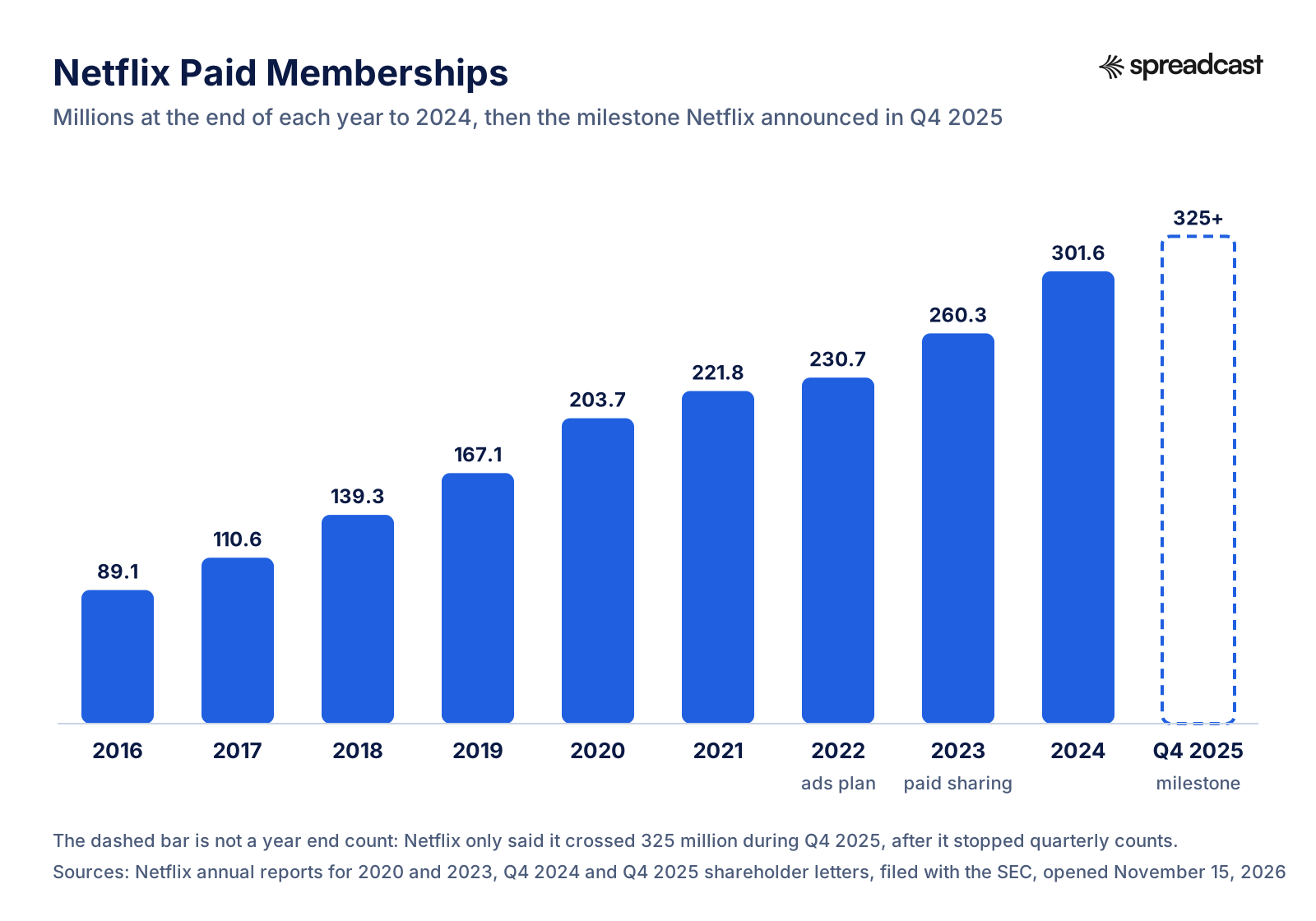
Look at where the line bends. It flattens in 2022 and climbs hard in 2023 and 2024. The marketing budget didn't explain that: it held at 8% of revenue in both 2022 and 2023, per the annual report for 2023. The price list did. A cheaper plan with ads arrived in November 2022, and paid sharing went worldwide in May 2023. Most write ups of the Netflix marketing strategy skip those two moves because they don't look like marketing. Put them next to the membership curve and they did more for growth in those two years than any campaign Netflix ran.
Netflix stopped reporting quarterly subscriber numbers in 2025. The Q4 2024 letter says that from April 2025 it would announce paid memberships only as it crossed key milestones, and it names revenue and operating margin as its primary financial metrics. So be careful with any page that gives you a precise 2026 subscriber count. Netflix hasn't published one. The last official figure is the 325 million milestone.
| Year | What happened | Why it mattered for marketing |
|---|---|---|
| 1997 to 1998 | Founded by Reed Hastings and Marc Randolph; DVD rental site goes live | The brand starts as a website, not a store. Fox Business |
| 2007 | Streaming launches | The product moves to the screen where the marketing can live too. Fox Business |
| 2016 | Netflix tests artwork against artwork and publishes what it learned | The homepage becomes an ad slot. The Power of a Picture |
| 2017 | Personalized artwork rolls out to every member | Netflix TechBlog |
| 2019 | New Coke returns for Stranger Things 3 | A partner pays for reach. Fox Business |
| 2020 | First Tudum fan festival in São Paulo; Top 10 rows appear in the app | Tudum recap; Top 10 post |
| 2021 | Squid Game; the public Top 10 website launches | Q3 2021 letter; Top 10 post |
| 2022 | Membership losses in the first half; Wednesday; ads plan launches in 12 countries | Q4 2022 letter; Q3 2022 letter |
| 2023 | Paid sharing reaches more than 100 countries; first engagement report | Q2 2023 letter; Engagement report |
| 2024 | Paul vs Tyson and NFL Christmas games stream live | Netflix newsroom; Q4 2024 letter |
| 2025 | KPop Demon Hunters, Stranger Things finale, Netflix House opens, 325 million paid memberships | Q3 2025 letter; Q4 2025 letter |
| 2026 | World Baseball Classic in Japan; ads plan heading to 15 more countries | Q1 2026 letter; Q3 2026 letter |
Netflix's Marketing Strategy in Its Own Words
Netflix describes its marketing strategy in one line of its annual report: it seeks to drive conversation around its content. The full sentence in the annual report for 2025 reads "We seek to drive conversation around our content to further enhance member joy," and it sits next to two other jobs: making content that attracts new members and improving the interface so members find what they'll enjoy. The same filing describes the competitive goal as "winning moments of truth", the moments in a free evening when someone picks Netflix over YouTube, a game or their phone. And Netflix says it is still losing most of those moments: the Q4 2025 letter puts its share of TV time below 10% in its major markets, with Nielsen's US figure at an all time high of 9.0% in December 2025 while linear TV still held over 40% of US screen time. A company with 325 million paying households still writes about itself as the challenger. That mindset explains a lot of what follows.
The shareholder letters spell out how that conversation turns into money. The Q4 2025 letter describes members who form a deep connection with a title: "they don't just watch; they engage, share, and become passionate advocates," which the letter ties to higher retention, stronger word of mouth and new sign ups. The Q3 2026 letter sums up the strategy as originals that spark conversation and bring in members, paired with licensed shows, good discovery and wide distribution.
Inside the marketing team, the work is organized around flexibility. Marian Lee, Netflix's chief marketing officer, told a Wall Street Journal editor at Cannes Lions in June 2025 that "We reserve about a quarter of our marketing budget to, as we say, chase the heat," because "None of us really can predict with a hundred percent certainty what is actually going to go viral," as The Current reported. The same report names Baby Reindeer and Adolescence as sleeper hits that got that late push. A quarter of the budget held back for surprises is a lot. It tells you Netflix plans for what audiences do after launch as much as for what the slate looked like on paper.
The other organizing idea is one creative point of view per title, translated locally. Lee told Fast Company's Jeff Beer in March 2025, as he recounts in an August 2025 piece on Wednesday, that every campaign starts with a clear overall creative strategy and point of view, which marketing teams in each country then use as a lens to decide how to express it in their market. For Wednesday Season 2 that lens was "Big outcast energy." One idea at the center, many local versions, the same look everywhere.

Strip away the budget and what's left is a simple operating rule: sound like one brand everywhere, and push harder on whatever starts working. An app maker can run that rule at any size. You don't need a quarter of a $3 billion budget to chase the heat. You need your posts to look and sound like one brand, so that when one of them takes off, people know whose it was.
That consistency is the part Spreadcast handles for you. Paste your App Store or Google Play link and Spreadcast reads your listing to build a brand kit from your app's colors, fonts, icon and real screenshots. Every post in your weekly plan is then designed inside that kit and written in one voice, so your feed on every network looks like the same app made it. If you want to see what a kit should contain before you start, read what a brand kit actually needs.
Content as Marketing: Stranger Things, Squid Game and Wednesday
Netflix's biggest marketing asset is a hit show, because a hit makes millions of people talk about Netflix without being paid to. The clearest example is Squid Game. The Q3 2021 letter says the Korean series, released on September 17, 2021, was chosen by 142 million member households in its first four weeks and ranked as the number one program in 94 countries. The letter also counts what happened off the service: a Saturday Night Live sketch and memes and clips on TikTok with more than 42 billion views. No ad budget buys 42 billion views.
What's striking is how little of that was planned. Fast Company's Jeff Beer wrote in March 2025 that back in 2021, Netflix marketing outside Asia was largely reactive to what audiences were excited about. The show broke out first and the marketing caught up. For Season 2, Lee told him the job was harder: "Convincing people to come back to watch the second season is an entirely different proposition than being surprised and having some fun with it."
Stranger Things and Wednesday show the same pattern from different angles. The Q3 2022 letter says Stranger Things 4 generated 1.35 billion hours viewed, the biggest season of an English language series Netflix had ever had. The Q4 2022 letter says both Stranger Things 4 and Wednesday passed one billion hours, and that the two shows pushed old songs back into the charts: Kate Bush's Running Up That Hill reached number one on Billboard's Global chart 37 years after its release, and Lady Gaga's Bloody Mary made the Billboard top 40 for the first time, 11 years after it came out. A Netflix show that changes what people stream on other apps is marketing that travels far outside Netflix.
By the time Wednesday Season 2 arrived, Netflix knew what it had. Fast Company reported that the first season had 350 million views, the most of any English language show on Netflix, and that the Season 2 push was Netflix's largest prelaunch social campaign ever, with more than 3 billion owned social impressions. The finale of Stranger Things followed in late 2025 with 120 million views by mid January 2026, per the Q4 2025 letter, and Netflix's own Tudum recap says just announcing the final season's dates earned 250 million impressions across Netflix channels in 96 hours, the biggest date announcement in its history.
Months before that finale, an animated film had already become Netflix's biggest ever. The Q3 2025 letter calls KPop Demon Hunters Netflix's most popular film ever, at 325 million views, and notes that its fictional girl group HUNTR/X reached number one on Billboard's Hot 100. The Q2 2026 letter adds that it was the first title to stay in the Global Top 10 for more than 52 straight weeks. That's the kind of breakout the "chase the heat" budget exists for.
Why Every Netflix Release Is a Marketing Event
Netflix releases are built to be talked about at the same time everywhere. The Q3 2022 letter makes the case for dropping whole seasons at once with Squid Game as the example: letting members watch a story from start to finish, the letter says, raises their enjoyment and their likelihood to tell their friends, so more people watch, join and stay. One date, one global conversation, and every viewer arriving at the ending within days of each other.
The releases also run on a calendar Netflix publishes far ahead. Each shareholder letter lists the coming quarter's slate in detail; the Q3 2026 letter previews the Emily in Paris finale, new seasons of The Diplomat and Lupin, three NFL games and a heavyweight fight. Fans know when the next thing lands, and so does the press. We think this is the most underrated part of the Netflix playbook. Not the shows themselves, which few companies can make, but the habit of treating every release as a dated, announced event.

App makers already have a release calendar. They just don't market it. You ship version 4.2 with the feature users asked for, write "bug fixes and performance improvements" in the store notes, and move on. Netflix would have given the same release a date, a teaser and a launch day post. Our collection of app update announcement examples shows apps that treat releases like Netflix treats premieres, and how often apps update shows how many marketing moments a normal release schedule gives you.
Do this for your app with Spreadcast. It watches your App Store listing, and when a new version ships it designs an update post about the release in your brand colors, fonts and real screenshots, then queues it at your posting times. You approve the draft or let Full Autopilot send it. Every release becomes a small premiere without you writing a launch plan, and the free release notes generator helps with the store text that goes with it.
Personalized Artwork and the Recommendation Engine as Marketing
Netflix treats the thumbnail on its homepage as an ad, and it personalizes that ad for every member. The company published how this started. In a 2016 post, The Power of a Picture, Netflix's head of product creative Nick Nelson wrote that research in early 2014 showed artwork was the biggest influence on a member's decision to watch, making up over 82% of their focus while browsing, and that members spent an average of 1.8 seconds considering each title. The companion Netflix TechBlog post adds the stakes: if Netflix doesn't capture a member's attention within 90 seconds, that member will likely lose interest and do something else.
Nelson's post lists what won in testing, and it reads like a creative brief any app maker can use:
- Faces with complex emotions beat calm or neutral expressions, because the emotion tells you the tone of the show.
- Recognizable and even villainous characters drove more engagement, especially in kids and action titles.
- An image's chance of winning dropped sharply when it showed more than three people, because ensemble shots are too busy at small sizes.
- For some titles, such as Sense8, the winning image changed from country to country.
In December 2017 Netflix went further and personalized the artwork itself. The TechBlog post on artwork personalization, by Ashok Chandrashekar, Fernando Amat, Justin Basilico and Tony Jebara, explains the Good Will Hunting example: someone who watches many romantic films might see artwork with Matt Damon and Minnie Driver, while a comedy fan might see Robin Williams. The engineers describe Netflix as having not one product but "over a 100 million different products" with one for each member. The system uses contextual bandits, a kind of algorithm that keeps testing images while it learns, and the post reports that the personalized version produced a significant lift in Netflix's core metrics in an A/B test, with the biggest gains on titles a member hadn't interacted with before. The system had to handle a peak of over 20 million image requests per second.
The engineers also wrote about a trap every marketer should recognize. They label results by the quality of viewing, the post says, so the system doesn't learn to pick clickbait images that get a play and then lose the viewer. A thumbnail that misleads wins the click and loses the member. That rule holds for your app store screenshots and your social posts too.
Around the artwork sits the rest of the recommendation system, and Netflix's help center lays out what it uses: your viewing history and how you rated titles, what similar members watch, title details like genre and cast, the time of day you watch, the languages you prefer, your devices and how long you watch. It says it doesn't use demographic information such as age or gender. Rows, the titles in them and their order are all personalized, with the strongest picks at the top of the page and on the left of each row.
Netflix pays for this machine out of a different budget line than marketing. Technology and development, which the annual report for 2025 says covers the user interface and the recommendations, cost $3.39 billion in 2025, slightly more than the $3.30 billion of sales and marketing. So Netflix spends more on technology, including the teams that build the homepage and its recommendations, than on all its advertising, partner payments and marketing staff combined.
For a small app, the takeaway is the picture, not the algorithm. You won't run contextual bandits on your Instagram grid. But the 2014 research is a free gift: people decide in under two seconds, they look at the image before the words, and a clear face or a clear screen beats a crowded collage. Most app posts fail that test because they're text on a gradient or a feature list in small type.
This is exactly what Spreadcast is built around. Your posts use your app's real screenshots, framed in a phone and set inside your brand kit, so the first thing anyone sees in their feed is your actual product, not a stock photo or a wall of text. The weekly plan's feature posts each show one real feature from your listing, which is the app version of Netflix's rule that one clear subject beats a crowd. The Instagram post maker shows the same approach for a single post.
The Netflix Top 10 and Engagement Report: Data Turned Into Marketing
Netflix turned its viewing data into a public chart, and the chart became one of its most cited marketing tools. Daily Top 10 rows appeared inside the app in 2020, and on November 16, 2021, Netflix launched the public Top 10 site, explained in a newsroom post by Pablo Perez De Rosso, then its vice president of content strategy, planning and analysis. It published weekly global lists for English and non English films and series plus rankings for more than 90 countries, based on hours viewed from Monday to Sunday of the previous week. A June 2023 update switched the ranking to views.
Publishing the chart was a marketing decision. For years Netflix was criticized for keeping its numbers secret, and opening them up turned every hit into a headline the press could write without asking Netflix: number one in 94 countries, most watched non English series ever, 52 weeks in the Top 10. The shareholder letters now link straight to the Top 10 site and use its weeks as proof of success. The Q2 2026 letter notes that Ms. Rachel had spent 27 weeks in the Global Top 10 since joining Netflix.
The chart also became an ad product. The Q2 2023 letter says brands could now target media buys on the Top 10, which updates daily, to reach audiences during Netflix's biggest viewing moments. A ranking that started as a discovery feature became a place advertisers pay to be.
In December 2023 Netflix went wider with What We Watched, a twice yearly engagement report that covered more than 18,000 titles and nearly 100 billion hours of viewing in its first edition, with non English stories making up 30% of the total. By the second half of 2025, members watched 96 billion hours in six months, up 2%, according to the Q4 2025 letter. Netflix says the report and the Top 10 together give creators and the industry deeper insight into its audience. Our read is simpler: published numbers are marketing when they're good, and Netflix publishes a lot of good ones.
Your app has a scoreboard too. It's called your rating count. When you pass 1,000 ratings, or 10,000, or a 4.8 average, that's your Top 10 moment: a public number other people can check, and proof that real users chose you. Our guide on how to get App Store reviews covers getting more of them, and App Store statistics gives you context for what your numbers mean.
Spreadcast posts that scoreboard for you. When your app passes a round number of ratings on the store, it designs a rating milestone post in your colors, fonts and icon, so the milestone reaches your followers on the day it happens, not three weeks later when you remember. It's Netflix's Top 10 habit for an app: a real, checkable number turned into a post on a schedule.
Netflix's Social Media Strategy: Tudum, Netflix2 and the Meme Machine
Netflix's social media strategy is to give fans more places to talk about its shows, and to run its own accounts like a fan would. The hub is Tudum, named after the sound at the start of every Netflix title. It began as a live festival: the first Tudum was held in January 2020 at the Bienal Pavilion in São Paulo and drew more than 50,000 fans over four days, according to Netflix's Tudum 2025 recap. Tudum is now also Netflix's editorial site for fans, and the Q4 2025 letter reports it reached a record 23.4 million visits in December 2025 and 232 million visits in the whole year, up 18%.
The 2025 Tudum event moved onto Netflix itself as a live show. The recap describes a sold out Kia Forum in Los Angeles, more than 100 stars, Sofia Carson hosting and millions of members watching live worldwide. Netflix doesn't give a viewer number for the stream. It does give a social one: the campaign before and after the show drove over 1.4 billion global impressions across Netflix's accounts and those of the talent, more than the 2023 show. That's what a fan event is for at Netflix: the event is the content, and the clips are the distribution.
Netflix's TikTok and Instagram Voice
Netflix keeps more than one voice on social. The Current's Cannes report describes a "Netflix2" Instagram account built as an outlet for more unhinged content that wouldn't fit the main page. Lee admitted she didn't get it at first, and said her team told her that was because she wasn't the audience. The same report says the content strategy is increasingly local and specific to each platform, and that her team keeps testing new formats, even hiring high school interns to advise on how younger audiences use social apps.
The memes mostly come from fans, and Netflix builds features to help them along. In October 2024 Netflix launched Moments, which Adweek described as a way to save a favorite scene on your phone and share it to social media, starting on iOS. Netflix promoted it with an ad from Wieden+Kennedy Portland in which fans and celebrities, Simone Biles among them, gush about Stranger Things, Squid Game, Wednesday, Baby Reindeer and Formula 1: Drive to Survive. The Q1 2026 letter adds a redesigned mobile app with vertical video, the format people already scroll on TikTok and Reels.
And Netflix is pulling the creators themselves onto the service. The Q2 2026 letter lists Ms. Rachel, Mark Rober, Danny Go! and Salish and Jordan Matter, with new deals for the Stokes Twins, Alan Chikin Chow, Nick DiGiovanni and Mythical. The Q4 2025 letter adds video podcasts from Spotify's The Ringer, iHeartMedia and Barstool Sports. So Netflix now books YouTube's stars as programming. If you can't beat social video, put it on your homepage.

Skip the second account and the Tudum stage. The part a small app can take is the rhythm. Netflix's channels never run short of things to post, because there's always a new release, a new clip or a new number. Most apps post in bursts around a launch and then go quiet for a month. If you're starting on a network, our guides on how to promote an app on TikTok and how to promote an app on Instagram cover what works on each, and the best time to post on social media covers when.
Spreadcast keeps that rhythm going for you. Spreadcast runs your app's marketing: branded posts, made and scheduled for you. The weekly plan runs from one post a week up to twice a day, at the times you pick, and mixes feature posts, review quote posts, tips carousels, problem and fix posts and seasonal posts. It publishes to Instagram, Facebook, LinkedIn, TikTok, YouTube, Pinterest, Threads, Bluesky, Mastodon, Telegram and Discord, and its analytics track followers, interactions and reach as your networks report them, so you can see which posts your audience actually likes.
Netflix Marketing Campaigns: Stunts, Partnerships and Fan Experiences
Netflix marketing campaigns lean on stunts and partners that turn a show into something people can touch, eat or play. The most famous partner deal came in 2019. To promote Stranger Things 3, set in the summer of 1985, Coke brought back New Coke, the 1985 formula it pulled from shelves 79 days after launch. Fox Business reported that a limited number of cans would be sold in a Stranger Things pack, that a vending machine styled after the show's Upside Down would hand out free cans in select cities, and quoted Barry Smyth, Netflix's head of global partner marketing, saying the deal let Netflix reach a massive audience "via one of the most recognizable brands in the world in a deeply authentic way." The product fit the story, which is why it worked.
Squid Game Season 2 in December 2024 got the full treatment. Adweek described a massive marketing push of real world experiences, products based on the show and billboards, with Johnnie Walker and Duolingo among the brands promoting it. Marketing Dive covered the Duolingo side: a "Learn Korean or Else" campaign that cast Duo the owl as one of the show's Pink Guards, a TikTok filter with voice challenges, a hacked billboard on Sunset Boulevard rewritten in Korean, and 40 words and phrases from the show added to Duolingo's Korean course. Magno Herran, who leads partner and brand marketing at Netflix, said "Duolingo was the perfect partner for Squid Game Season 2." We cover the owl's side of that deal in our page on Duolingo's marketing strategy.
Lee's rule for partners is short. "You can't just throw a logo on Stranger Things and call it a day," she said at Cannes, as The Current reported. "We're never going to jam an integration into something that doesn't make sense." The partners that work bring their own audience to a story that already fits them: a soda brand to a show set in the summer of its worst launch, a language app to a Korean drama.
Fan Events, Netflix House and Netflix Is a Joke
Netflix also builds places for fans to show up. From April 28 to May 8, 2022 it ran Netflix Is a Joke: The Festival across more than 25 Los Angeles venues including Dodger Stadium and the Hollywood Bowl, with over 130 artists, according to the Netflix newsroom announcement. Select shows were recorded for Netflix, so the festival filled the service while it marketed it.
The Q3 2023 letter lists the earlier experiments: Scoops Ahoy ice cream and Surfer Boy pizzas from Stranger Things, the Netflix Bites pop up restaurant, a live Bridgerton Ball and a Squid Game experience. That letter announced Netflix House, permanent sites with live experiences, food and shopping, and the Q4 2025 letter says the first two opened in Dallas and King of Prussia, Pennsylvania, drawing fans from in and out of state. The same letter credits KPop Demon Hunters with a theater sing along and fast selling merchandise. Netflix's view, stated in that letter, is that fandom is a powerful engine for the business.
Most of this is out of reach for an app team, and you shouldn't pretend otherwise. A New Coke deal needs a show that a global brand wants to stand next to. A Netflix House needs a mall lease. What scales down is the timing. Every one of these campaigns hits around a release date, a season or a cultural moment, and the planning starts from the calendar. Our list of app promotion ideas has partnership ideas that work at indie size.
Spreadcast gives your app a seasonal calendar without the planning meeting. Its weekly plan includes seasonal posts, and each one is tied to a real feature of your app rather than a generic holiday card: your budgeting feature in January, your travel mode before summer, your study timer at back to school. They're designed in your brand kit and scheduled at your posting times. The social media content calendar tool shows the same idea month by month.
Live Events as Marketing: NFL Christmas Games and Paul vs Tyson
Netflix uses live events as acquisition campaigns, and its own numbers show why. The Q2 2026 letter says live programming will be just over 5% of Netflix's content spend in 2026 and only about 1% of view hours, yet live events accounted for six of the top ten new member sign up days over the last five years, even though Netflix has only done live events since 2023. That's the clearest statement anywhere in the filings that a piece of content is bought as marketing.
The event that proved it was Jake Paul against Mike Tyson in November 2024. Netflix's newsroom says the fight drew an estimated average minute audience of 108 million live viewers worldwide and peaked at 65 million concurrent streams, 38 million of them in the US, while the Katie Taylor and Amanda Serrano undercard averaged 74 million. The figures come from TVision data in the US and Netflix's own data elsewhere. The Q4 2024 letter calls it the most streamed sporting event ever.
It wasn't smooth. CNBC's report, republished by NBC News, notes that viewers complained of buffering during the fight. The marketing still worked, which says something about live events: people forgive a glitch when everyone else is watching too.
Christmas became a Netflix fixture after that. The Q4 2024 letter says the two NFL games on Christmas Day 2024 were the two most streamed NFL games in history, and that the Beyoncé halftime show drove peak viewing that day. A year later, Netflix's newsroom reported that Lions against Vikings averaged 27.5 million US viewers, per Nielsen, making it the most streamed NFL game in US history, with Snoop Dogg's halftime show averaging 29 million. The Q3 2026 letter calls the 2026 lineup, with a Thanksgiving Eve game, a Christmas doubleheader and Tyson Fury against Anthony Joshua, Netflix's biggest quarterly live slate yet.
Live also works country by country. Netflix streamed all 47 games of the 2026 World Baseball Classic in Japan, as the Q4 2025 letter announced, and the Q1 2026 letter says it became the most watched program ever on Netflix in Japan and sparked the largest day of sign ups in the country, and that Japan was the biggest contributor to member growth that quarter. The same letter reports 18.4 million global viewers for BTS The Comeback Live.
A live event is a date everyone knows in advance. That's the copyable part. Your app's equivalent is any moment with a fixed date: a big release, a seasonal feature, a price change, the day you cross a rating milestone. The mistake most small teams make is treating those days as internal events. Netflix treats them as public ones and announces them early, then shows up on the day.
With Spreadcast, the dated moments in your app's life get posts without you watching the calendar. New versions on the App Store and rating milestones each trigger a designed moment post, and the rest of the week fills from your plan at the times you chose. Use Approve First if you want to see every draft before it goes out, or Full Autopilot if you'd rather not.
Netflix's Global Marketing Strategy: Local Hits, One Brand
Netflix's global marketing strategy is to make shows in many countries and market each one locally, under one brand. It operates in more than 190 countries, per the Q1 2026 letter, and in the same letter co founder Reed Hastings, stepping back from the board, picked January 2016, when Netflix switched its service on across nearly the entire planet, as his favorite memory of the company. A launch like that is only a marketing win if people in each new country find something made for them.
They did. The Q3 2026 letter says viewing of non English titles grew from under 10% of all viewing a decade ago to more than a third today, and lists that quarter's local records: Plastic Beauty on track to be Netflix's most viewed series ever in Japan, The Secret Woman trending to be its most viewed Danish title, The Perfect Lie on track for the most viewed series out of the Netherlands. Squid Game, a Korean show, is still the best example of where that leads, number one in 94 countries in 2021 according to the Q3 2021 letter.
The marketing is organized the same way. Netflix's leadership page lists a vice president of marketing for Europe, the Middle East, Africa and Asia Pacific, June Sauvaget, next to the global chief marketing officer, and Lee's rule of one creative point of view per title with local teams deciding how to express it, as Fast Company reported, is how a single campaign turns into dozens of local ones. The Current adds the other half: content that's increasingly specific to each region and each platform.
Most apps can't translate a campaign into 30 languages, and they don't need to. The useful part is the second half of Lee's rule. Same post, same look, but written for the place it lands. A LinkedIn caption that reads like a TikTok caption gets scrolled past on both.
That's built into Spreadcast. Every post in your weekly plan comes with a caption written for each network you've connected, from the same designed picture, so the Instagram version, the LinkedIn version and the Threads version each sound native while the image keeps your one brand look. It's Netflix's global lens at app size: one idea, adapted to every place it goes. The cross posting page shows how one post fans out.
The Netflix Ads Plan: A Cheaper Front Door That Wins Sign Ups
Netflix's ad supported plan is a pricing move that behaves like a marketing channel: it gives price sensitive people a cheaper way in. The Q3 2022 letter announced the launch for November 2022 in 12 countries, starting November 1 in Canada and Mexico, November 3 in nine more including the US and the UK, and November 10 in Spain. The plan, Basic with Ads, cost 20% to 40% less than the existing starting price, so Netflix in the US would start at $6.99 a month instead of $9.99, with about five minutes of ads an hour.
It took off slowly and then quickly. The Q1 2023 letter says the US ads plan already earned more per member, subscription plus ads, than the Standard plan. By the third quarter of 2023, about 30% of sign ups in ads countries chose it, per the Q3 2023 letter. In the fourth quarter of 2024 it was over 55%, according to the Q4 2024 letter. In the first quarter of 2026, at $8.99 a month in the US, it was over 60% of all sign ups in ads countries, per the Q1 2026 letter, which also says Netflix now works with more than 4,000 advertisers.
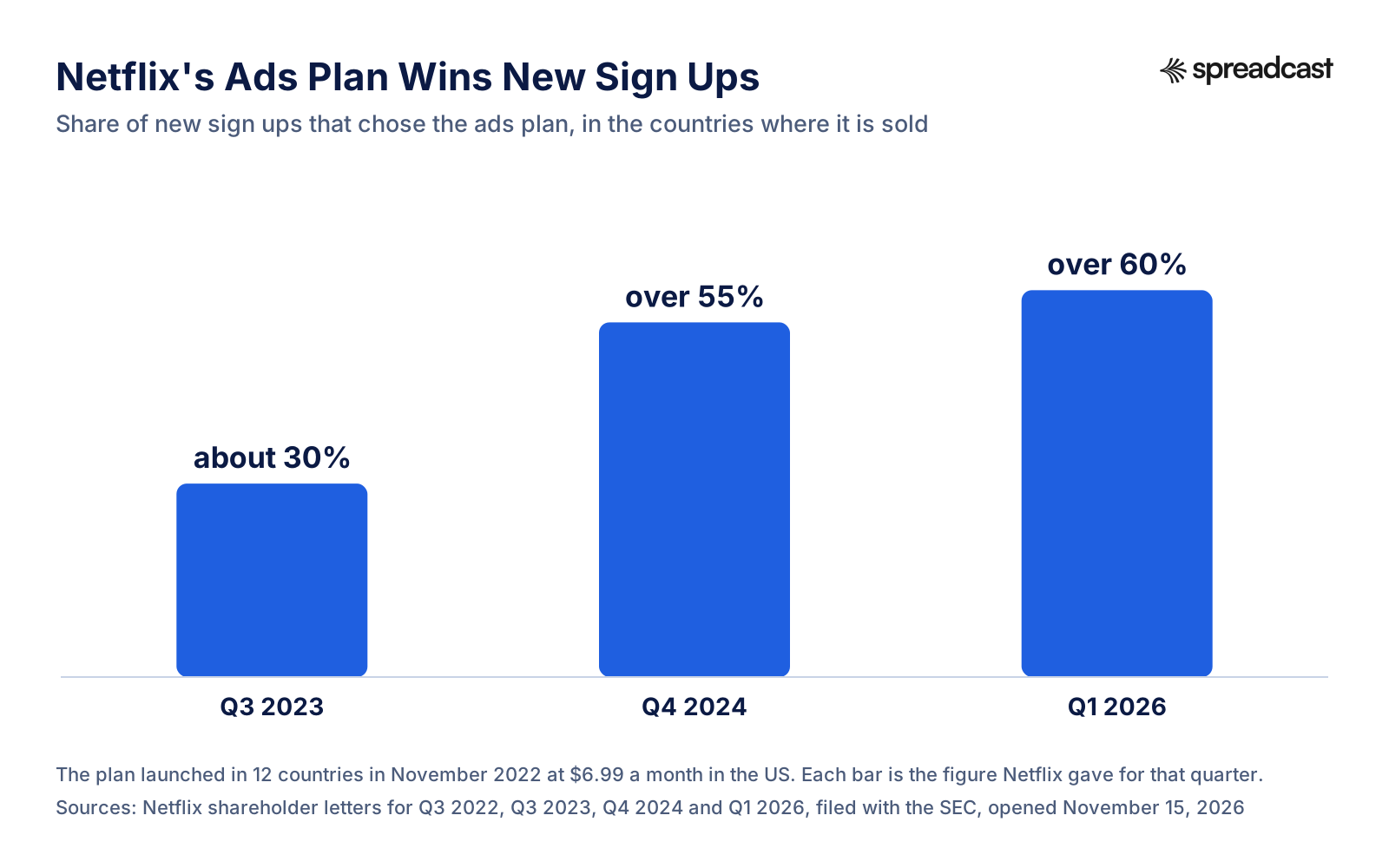
Ad revenue is growing but still small next to subscriptions. The Q4 2025 letter says ad revenue rose more than 2.5 times in 2025 to over $1.5 billion, in only Netflix's third year of selling ads. The Q3 2026 letter trimmed the 2026 forecast to about $2.7 billion from about $3 billion because some ad products rolled out slower than planned, and confirmed the plan will launch in 15 more countries in 2027, starting in March. At the May 2026 upfront, TheWrap reported that Netflix said the ad tier reaches more than 250 million monthly active viewers, a figure it builds from members who watch at least a minute of ad supported content in a month, multiplied by an estimated household size.
The ads plan sits inside a wide price ladder. As of December 31, 2025, Netflix's paid plans ranged from the US dollar equivalent of $1 to $37 a month depending on the country and plan, and an extra member for someone outside the home cost the equivalent of $2 to $9, according to the annual report for 2025. Netflix prices by market rather than with one global number, so the same service can be cheap where incomes are low and premium where they're high.
If you make an app, look hard at your entry price. Netflix found that a large share of new members want the cheapest way in, even with ads. If your app's only option is a $59.99 annual subscription behind a paywall on the first screen, you're turning away the people who would have started on the cheap plan and upgraded later. A lighter tier, a monthly option or a free core feature can do more for growth than another ad campaign.
The Password Sharing Crackdown and What It Did to Growth
Netflix's paid sharing rollout went after the more than 100 million households it said were sharing accounts, and turned many of them into paying members. In February 2023 Netflix said on its newsroom that an account is meant for one household and that over 100 million households were sharing accounts, which it said hurt its ability to invest in new TV and films. It started in Canada, New Zealand, Portugal and Spain with two options: the person borrowing could transfer their profile, with its recommendations, viewing history and My List, to a new account they pay for, or the owner could add an extra member for a fee.
The Q1 2023 letter reported that in Canada, which Netflix treated as a predictor for the US, the paid membership base was already larger than before the launch and revenue growth had sped up. In May 2023 the US got the email. CNBC reported that Netflix told members their account was for them and the people they live with, and that sharing with someone outside the home cost $7.99 a month more. The Q2 2023 letter says the May launch covered more than 100 countries and over 80% of revenue, with sign ups already exceeding cancellations, and the Q3 2023 letter reports 8.8 million paid net additions in the quarter against 2.4 million a year earlier. Netflix ended 2023 with 29.5 million more paid memberships than it started with, per the annual report for 2023, more than three times 2022's gain of 8.9 million.
The detail worth stealing is the profile transfer. It let a borrower take their whole history with them, the recommendations, the watch list, the half finished series. Netflix didn't ask borrowers to start over as new customers. It asked them to keep the version of Netflix that already knew them. That's a retention feature used as an acquisition offer. Netflix admitted in the Q1 2023 letter that every market showed a cancel reaction when the news landed, and that borrowers activating their own accounts then brought acquisition and revenue up. Letting people keep their history is a big part of why that second step happened.
You probably don't have a password sharing problem. You might have a similar one: people who use your free tier heavily and would pay if asked the right way, at the right moment, without losing their data. The Netflix version of the ask was plain, dated and gave people an easy path that kept what they'd built. That's a good template for any paywall change.
How Much Netflix Spends on Marketing
Netflix spent $3.30 billion on sales and marketing in 2025, 7% of its revenue, according to its annual report for 2025. Advertising was $2.0 billion of that. The rest covers payments to marketing partners such as TV makers, pay TV operators, mobile carriers and internet providers, plus the people who run marketing and ad sales. The 2025 increase of $384 million came from $222 million more in marketing and $149 million more in staff costs as the ad sales team grew.
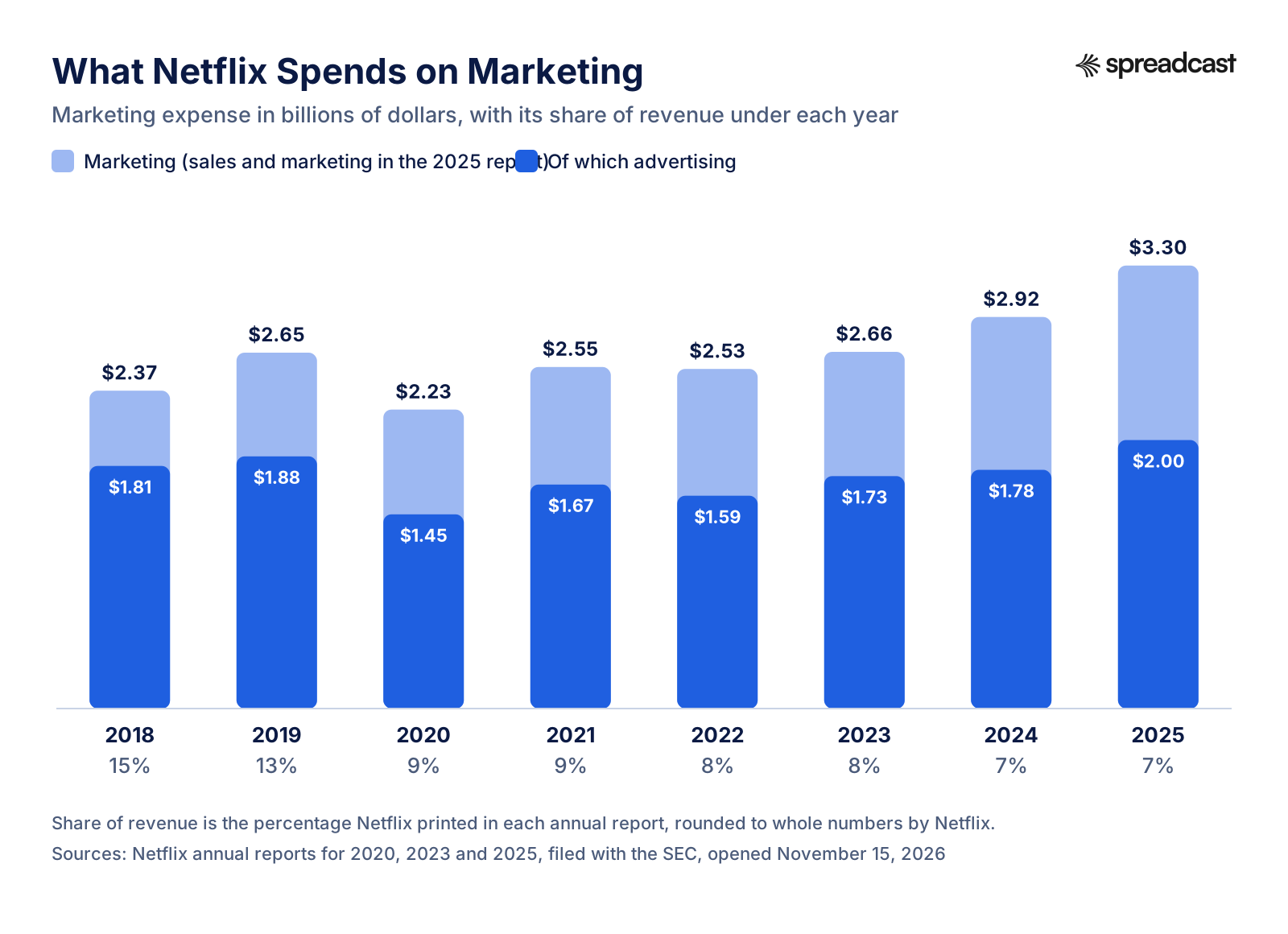
The share tells the story. Marketing was 15% of revenue in 2018 and 13% in 2019, per the annual report for 2020, when Netflix was buying growth country by country. In 2020 it fell to 9%, and the report gives the cause: advertising dropped by $432 million. It doesn't say why Netflix cut back. 2020 was the year lockdowns kept people at home, and our guess is that Netflix simply needed fewer ads to win them. The share never went back. It sat at 8% in 2022 and 2023 and 7% in 2024 and 2025, even as revenue grew from $25 billion to $45 billion.
This is the flywheel showing up in the accounts. The more members Netflix has, the more each hit spreads by itself through the homepage, the Top 10 and social, and the less each new member costs to win with paid ads. Add live events, the ads plan and paid sharing, none of which sit in the marketing line, and you get a company spending a smaller slice of revenue on marketing every year while growing faster.
The quarter of the budget Lee keeps for surprise hits, as The Current reported, fits that picture. When most of the marketing is already built into the product, the paid part can afford to be reactive. If you're working out your own split, our startup marketing budget guide and the LTV to CAC ratio explainer help you decide what a new user is worth before you pay for one.
Here's where Spreadcast fits the money side. Product driven marketing is cheap, but someone still has to show up every week with posts. Spreadcast's Pro plan is $29 a month, or $290 a year, and includes one app with up to 10 social accounts, the brand kit, the weekly plan of designed posts, moment posts for new versions and rating milestones, publishing to your networks and the choice of Full Autopilot or one tap approval. If you run several apps, Studio at $79 a month covers five, each with its own brand and accounts. You can try three AI posts free before you pay anything.
The Netflix Marketing Mix: Product, Price, Place and Promotion
Netflix's marketing mix, the classic four Ps, looks unusual because the product and the promotion are so tangled together. Business school write ups of the Netflix marketing strategy usually fill this table from memory. Here it is filled from Netflix's own filings, as of the latest reports.
| Marketing mix | What Netflix does | Source |
|---|---|---|
| Product | TV series, films, games and live programming in many genres and languages, plus video podcasts from early 2026 and a separate gaming app for kids launched in April 2026 | Annual report for 2025; Q4 2025 letter; Q1 2026 letter |
| Price | From the equivalent of $1 to $37 a month by country and plan; the US ads plan at $8.99; extra members from $2 to $9; price rises in 2026 met a member response in line with earlier ones | Annual report for 2025; Q1 2026 letter; Q3 2026 letter |
| Place | More than 190 countries, on TVs, phones and other devices, with TV makers, pay TV operators, mobile carriers and internet providers paid as marketing partners | Q1 2026 letter; annual report for 2025 |
| Promotion | Originals released as events, personalized artwork, the Top 10, Tudum, social video, live events and brand partners, backed by $3.30 billion of sales and marketing in 2025 | The sections above; annual report for 2025 |
Read across the rows and you can see why Netflix's marketing line keeps shrinking as a share of revenue. The product makes the hits people talk about, and the price ladder gives almost every wallet a way in. Distribution partners get paid out of the marketing budget to put Netflix where people already watch. By the time promotion starts, most of the selling is done, and the ads mostly amplify what's already there.
How Netflix Makes Money: The Netflix Business Model Explained
Netflix makes almost all of its money from membership fees. The annual report for 2025 says revenue comes primarily from monthly membership fees and that revenue from other sources wasn't a material part of the total. Revenue was $45.18 billion in 2025, up 16%, which the filing credits to membership growth, price increases and higher advertising revenue. Operating income passed $13.3 billion and net income was $10.98 billion.
| Region | 2025 streaming revenue | Share of total | Growth in 2025 |
|---|---|---|---|
| United States and Canada | $19.96 billion | 44% | 15% |
| Europe, Middle East and Africa | $14.51 billion | 32% | 17% |
| Latin America | $5.36 billion | 12% | 11% |
| Asia Pacific | $5.35 billion | 12% | 21% |
| Total | $45.18 billion | 100% | 16%, per the annual report for 2025 |
Advertising is the second engine, still small. Over $1.5 billion in 2025, per the Q4 2025 letter, is a little over 3% of revenue by our arithmetic. Netflix expects about $2.7 billion in 2026 according to the Q3 2026 letter, against total revenue guidance of $51.1 billion and an operating margin of 31.5%. The third quarter of 2026 alone brought in $12.87 billion, up 12%, with a 34.6% operating margin.
The business model explains the marketing. Netflix's Q3 2026 letter lists three priorities: more entertainment value for members, better technology, and better monetization through pricing, plans and ads. Those priorities, the letter says, drive acquisition and retention and let Netflix raise prices from time to time. Member response to the 2026 price changes, it adds, was in line with earlier increases. So the marketing job isn't only to win new members. It's to make the service feel worth a higher price every year, so fewer people cancel when the price goes up. That's why the strategy leans on hits, fandom and live events rather than discounts.
One more piece of the model shaped 2026. In its Q4 2025 letter, dated January 20, 2026, Netflix listed closing its acquisition of Warner Bros. among its priorities and said it had lined up a $59 billion bridge loan for the deal on December 4. By April 2026 the deal was off: the Q1 2026 letter says Warner Bros. "would have been a nice accelerant" for the strategy, but only at the right price, and records a $2.8 billion termination fee in Netflix's favor. Netflix went back to licensing instead, with new deals in the Q3 2026 letter including Disney titles and a French partnership with TF1.
What Didn't Work in Netflix's Marketing
Netflix's marketing has real misses, and the filings are honest about most of them. The biggest was 2022. The Q4 2022 letter shows paid memberships falling in both the first and second quarters, the year it called "a tough year, with a bumpy start but a brighter finish." Big hits didn't prevent it. The fix wasn't a campaign. It was pricing: the ads plan and paid sharing.
The ad business has moved slower than Netflix hoped. The Q3 2026 letter cut the 2026 ad revenue forecast from about $3 billion to about $2.7 billion because some ad products rolled out more slowly than expected. The same letter acknowledges investor concern about growth in viewing hours and says Netflix wants to speed it up. Engagement grew only 2% in the second half of 2025, per the Q4 2025 letter, as fewer licensed shows offset growth in originals.
Live events carry live risk. The Paul and Tyson stream drew complaints about buffering on what Netflix calls the most streamed sporting event ever. And the early Squid Game success was, by Fast Company's account, something the marketing outside Asia reacted to rather than planned. Netflix's answer to that last one was the reserved budget: if you can't predict the hit, keep money ready to back it when it shows up.
Our honest take: Netflix's marketing works best when the product gives it something to amplify. When the slate is thin or the price goes up without a hit to soften it, no stunt fills the gap. That's a useful reminder for app makers too. Marketing can't rescue a release nobody wanted, but it can make sure the good ones get seen.
What an App Maker Can Copy From Netflix's Marketing Strategy
Netflix's marketing strategy can be copied by a small app in its habits, not its scale. Here's the order we'd do it in if we were starting this week.
- Treat every release as a premiere. Pick the date, announce it, and post on the day with a screenshot of what's new. Your release notes are a marketing calendar you already keep.
- Make the picture do the work. People decide in under two seconds and look at the image first. Show one clear screen of your real app, not a collage and not a paragraph.
- Publish your scoreboard. Rating milestones, download milestones and review counts are your Top 10. Post them the day you hit them.
- Keep one look everywhere. Netflix runs one creative idea per title through every country. Use the same colors, fonts and screenshots on every network so people know it's you before they read a word.
- Hold some effort back for what takes off. If one post or one feature gets traction, make three more about it next week instead of sticking to the plan.
- Give people a cheap way in. A lighter plan, a free core feature or a monthly option can grow faster than any campaign, as the ads plan showed.
- When you change the deal, keep what users built. Paid sharing worked because borrowers kept their profiles. Any paywall change should let people keep their data.
What's missing from that list is everything that needs Netflix's money: the NFL, Netflix House, a New Coke partnership. Those are real parts of the strategy and you can't buy them with an app budget. The rest needs consistency more than cash. For more tactics at small scale, see how to market an app, how to promote an app for free and, if you build for iPhone, iOS app marketing.
This page is part of a series. Spotify's marketing strategy is the case for building sharing into the product, Duolingo's is the case for one loud mascot posting every day, and Cal AI's is the case for creators and short video. Netflix sits at the release driven end: every launch is an event. Airbnb's marketing strategy is the case for spending on brand over search ads, with hosts' stories and guest reviews as the proof, and Notion's on templates and its community. You can compare more apps side by side in our roundup of mobile app marketing examples.
Run Netflix's Playbook on Autopilot With Spreadcast
Spreadcast runs your app's marketing: branded posts, made and scheduled for you. It takes the parts of Netflix's playbook that don't need a studio, the release driven calendar, the public milestones, the one consistent look and the daily rhythm, and runs them for your app every week.
It starts with one link. Paste your App Store or Google Play link at Spreadcast and it reads your listing, then builds a brand kit from your app's real colors, fonts, icon and screenshots. That kit is your Netflix style creative point of view: every post afterwards is designed inside it, so your feed looks like one brand on every network. You can also try the brand kit generator on its own.
Then it makes your first week of posts. The weekly plan runs from one post a week up to twice a day, with choices of 1, 2, 3, 5, 7 or 14 posts a week, published at the times you pick. Here's how the plan maps to what Netflix does:
| Netflix tactic | What Spreadcast makes for your app |
|---|---|
| Every release is a premiere | An update post designed when a new version of your app ships on the App Store |
| The Top 10 and the engagement report | A rating milestone post when your app passes a round number of ratings |
| Originals and new seasons as content drops | Feature posts built from the real features on your store listing |
| Fans as passionate advocates | Review quote posts made from your real store reviews |
| Seasonal campaigns and holiday games | Seasonal posts, each tied to a real feature of your app |
| Content that keeps people coming back between releases | Tips carousels and problem and fix posts |
| One creative idea in every country | Every post designed in your brand kit and sent to all your networks |
You choose how hands on to be. With Approve First, every draft waits for your OK. With Full Autopilot, posts are scheduled at your posting times automatically. Many people start with approval for a week or two and switch once they trust the output; the auto post to social media page explains both modes.
Spreadcast publishes to Instagram, Facebook, LinkedIn, TikTok, YouTube, Pinterest, Threads, Bluesky, Mastodon, Telegram and Discord from one place, and the cross posting page shows how one post reaches every network. Analytics show followers, interactions and reach for each network as they report them. If you prefer to work from Claude or ChatGPT, Spreadcast connects through its MCP server too, covered on the Claude for social media page. The mobile apps page shows what all of this looks like for an app.
Netflix built a marketing machine where the product, the calendar and the scoreboard do most of the selling, and paid ads fill the gaps. You can have the small version of that machine for your app today. Paste your store link at Spreadcast, look at the first week of posts it designs, and decide from there. Free gives you three AI posts to judge the quality, and Pro at $29 a month runs the whole plan.
How We Researched This
We wrote this page in November 2026 from Netflix's own disclosures first. We opened the shareholder letters for Q3 2026, Q2 2026, Q1 2026, Q4 2025, Q3 2025, Q4 2024, Q3 2023, Q2 2023, Q1 2023, Q4 2022, Q3 2022 and Q3 2021, and the annual reports for 2025, 2023 and 2020, all filed with the US Securities and Exchange Commission. Membership counts, marketing and advertising expense, revenue by region and the ads plan figures come from those filings.
We then read Netflix's newsroom posts on artwork, the Top 10, the engagement report, Tudum, Netflix Is a Joke, paid sharing, the Paul and Tyson fight and the NFL Christmas games, two Netflix TechBlog posts on artwork, the help center page on recommendations and the leadership page. For campaigns and quotes we used Fast Company, The Current, Adweek, Marketing Dive, Fox Business, CNBC and TheWrap. Every page linked here was opened on November 15, 2026. Netflix stopped reporting quarterly membership counts in 2025, so we used only the 325 million milestone it announced and no estimates. We left out figures we couldn't trace to Netflix or a named reporter, including follower counts for Netflix's social accounts and per campaign spend. Spreadcast features described here are the ones in the product on the same date.
Frequently Asked Questions
What is Netflix's marketing strategy?
Netflix makes each release a public event and lets the product sell the next one: originals built to start conversations, personalized artwork, a public Top 10, the Tudum fan site and live events. A cheaper ads plan and paid sharing brought in new members too.
How much does Netflix spend on marketing?
Netflix spent $3.30 billion on sales and marketing in 2025, 7% of its $45.18 billion revenue, according to its annual report. About $2.0 billion of that was advertising. The share was 15% in 2018.
How many subscribers does Netflix have?
Netflix stopped reporting quarterly counts in 2025. Its Q4 2025 shareholder letter says it crossed 325 million paid memberships during that quarter, serving an audience approaching one billion people.
How does Netflix make money?
Almost entirely from monthly membership fees. Advertising on the cheaper ads plan brought in over $1.5 billion in 2025, a little over 3% of revenue, and Netflix expects about $2.7 billion in 2026.
Did the password sharing crackdown work?
Yes, by Netflix's own numbers. After paid sharing reached more than 100 countries in May 2023, Netflix added 29.5 million paid memberships that year, against 8.9 million in 2022.
Can a small app copy Netflix's marketing?
The habits, yes: treat every release as an event, post milestones the day you hit them, show real screens and keep one look everywhere. Spreadcast runs those for an app from its store link, with branded posts made and scheduled for you.
Where These Facts Come From
Every outside number, rule and price on this page links to the page it was taken from.
- Q3 2026 shareholder letterNetflix via SEC EDGAR
- Q2 2026 shareholder letterNetflix via SEC EDGAR
- Q1 2026 shareholder letterNetflix via SEC EDGAR
- Q4 2025 shareholder letterNetflix via SEC EDGAR
- Q3 2025 shareholder letterNetflix via SEC EDGAR
- Q4 2024 shareholder letterNetflix via SEC EDGAR
- Q3 2023 shareholder letterNetflix via SEC EDGAR
- Q2 2023 shareholder letterNetflix via SEC EDGAR
- Q1 2023 shareholder letterNetflix via SEC EDGAR
- Q4 2022 shareholder letterNetflix via SEC EDGAR
- Q3 2022 shareholder letterNetflix via SEC EDGAR
- Q3 2021 shareholder letterNetflix via SEC EDGAR
- Annual report for 2025Netflix via SEC EDGAR
- Annual report for 2023Netflix via SEC EDGAR
- Annual report for 2020Netflix via SEC EDGAR
- The story of the new weekly Top 10 on NetflixNetflix Newsroom
- What We Watched: a Netflix engagement reportNetflix Newsroom
- The Power of a PictureNetflix Newsroom
- Jake Paul vs Mike Tyson: over 108 million live global viewersNetflix Newsroom
- NFL Christmas Gameday on Netflix scores againNetflix Newsroom
- Tudum 2025: the live event recapNetflix Newsroom
- Netflix Is a Joke announces 2022 comedy festivalNetflix Newsroom
- An update on sharingNetflix Newsroom
- Netflix leadershipAbout Netflix
- Artwork personalization at NetflixNetflix TechBlog
- Selecting the best artwork for videos through A/B testingNetflix TechBlog
- How Netflix's recommendations system worksNetflix Help Center
- Who founded NetflixFox Business
- Coke is bringing back New Coke thanks to Stranger ThingsFox Business
- Inside Netflix's massive marketing for Squid Game Season 2Adweek
- Netflix debuts ad for its new Moments featureAdweek
- Duolingo's owl plays Squid Game with a Netflix tie upMarketing Dive
- Inside Netflix's strategy to make Wednesday an outcast iconFast Company
- What Squid Game reveals about Netflix's marketing strategyFast Company
- Netflix's CMO on holding back a quarter of the marketing budgetThe Current
- Netflix's password sharing crackdown reaches the USCNBC
- Mike Tyson and Jake Paul fight was the most streamed sporting event everNBC News
- Netflix ad tier monthly active viewers update at the 2026 upfrontTheWrap
- Video: Wednesday releases Thing in New YorkNetflix on YouTube
- Video: Fandom over funnels with Marian Lee of NetflixADWEEK on YouTube
- Video: Scalable podcast interview with Netflix CMO Marian LeeScalable on YouTube
Researched and written by Mark Weizer. Last checked on November 15, 2026.
Keep Reading
- Playbooks
Canva Marketing Strategy: How Templates and SEO Grew 265 Million Monthly Users
Canva's marketing strategy from its newsroom, its founders and its own sitemaps: freemium and word of mouth, 39,603 template pages built for search, 100 languages, free plans for schools, Canva Create and the TV campaigns. Then how to run the same playbook for your own app.
- Playbooks
Uber Marketing Strategy: How a Two Sided App Won 215 Million Monthly Users
Uber's marketing strategy, taken apart from its own filings: the city by city launch playbook, ice cream and kittens, referrals on both sides, the 2018 brand reset, safety, Uber One, the Uber Eats Super Bowl ads, the ads business, what it spends and how it makes money. Then how to run the copyable parts for your own app.
- Playbooks
Monopoly Go Marketing Strategy: The Budget, the Ads and What It Bought
How much Monopoly Go spent on marketing, who said it and when, and what the money bought: localized ads, a celebrity TV campaign, friend invites, sticker trading, live ops seasons and crossovers. Then how a small studio can keep its own channels as busy as a big launch.