Playbooks

Founder Led Marketing: Strategy and Examples for Small Startups

What founder led marketing is, seven real founders who did it with small budgets, and a weekly system for LinkedIn, Threads, Instagram, TikTok and Bluesky that fits beside building the product.

By Spreadcast · Updated October 28, 2026 · 39 min read

Founder led marketing means the founder is the main voice of the company in public: posting under their own name, telling the story of why the product exists, teaching what they know and talking to customers where everyone can see it. For a small startup it is usually the cheapest marketing that works, because the founder already has the two things a brand account lacks. People trust a person more than a logo, and the founder knows the problem better than anyone they could hire. The 37signals founders say they built their company on teaching instead of advertising, and David Heinemeier Hansson estimates they spent less than a million dollars on advertising in the company's first 15 or so years.

The catch is time. A founder who writes, films and replies every day is a founder who is not building, selling or fixing bugs. So this guide is about doing founder led marketing in a way that survives a busy week. It covers what the term means and how it differs from build in public, seven founders who did it with small budgets and what each one actually did, a strategy for picking one lane and one home network, how it works on LinkedIn, TikTok, Instagram, Threads, Bluesky, Mastodon and Telegram, a weekly system with minutes attached, the rules that trip founders up, and how to measure it.

One idea runs through all of it. The founder account and the brand account have different jobs. You speak as a person, with opinions, lessons and stories only you can tell. The brand account keeps a steady record of the product: what shipped, what it does, what customers reached. Most founders try to do both by hand and end up doing neither well. Split them and you can keep going for a year.

What Is Founder Led Marketing? A Plain Meaning

Founder led marketing is a go to market approach where the founder's own presence does most of the marketing work: their posts, videos, talks, newsletter and conversations. The company account still exists, but it plays a supporting role. Buyers meet the founder first and the product second.

It shows up in a few common forms. Founder led content is the publishing side: posts and videos under the founder's name. Founder led sales is the conversation side: the founder runs demos and closes the first customers personally. Founder led brand is the result of both over time: the company becomes known through the person who started it. Small startups tend to do all three at once, whether they planned to or not.

The phrase gets used for very different things, so it helps to say what it is not. It is not personal branding for its own sake, where the founder becomes an influencer and the product fades out of the story. It is not a founder posting the same product announcement the brand account already posted. And it is not a temporary trick for launch week. The founders below kept at it for years, and the results came slowly.

Founder Led Marketing vs Build in Public

Build in public is one style of founder led marketing, not the whole of it. Building in public means sharing the work as it happens: what shipped, what broke, revenue numbers, mistakes. It suits indie developers and developer audiences, and we cover it in depth, with rules for each community, on our page about marketing for indie developers.

Founder led marketing is wider. A founder can do it without ever sharing a revenue number. Teaching what you know about the problem counts. So does telling customer stories, explaining why you made a hard product decision, filming how your team works, or writing guest posts for someone else's audience. Several of the examples below never built in public in the usual sense. They taught, told stories or sold in person.

Question, Build in public, Founder led marketing
QuestionBuild in publicFounder led marketing
Main subjectThe work in progress: ships, numbers, setbacksThe problem, the customer and the founder's point of view
Typical audienceOther builders and early adoptersThe people who buy the product
Numbers sharedOften revenue and user countsOptional. Many founders keep them private
Best fitDeveloper tools, indie apps, products sold to makersAny product where trust or expertise decides the sale
RiskCompetitors see exactly where the money isThe company depends on one person's voice

Founder Led Marketing vs Brand Marketing

Brand marketing speaks as the company: a consistent logo, colors, product shots and announcements. It is predictable, which is its strength. A customer checking whether the app is still alive wants to see a recent release post on the brand account, not a founder's opinion about remote work. Founder led marketing is less predictable and far more personal, which is why people pay attention to it.

A small startup needs both, in different proportions. Early on the founder's voice carries most of the weight, and the brand account is the proof that the product is real and maintained. Later, as the team grows, more voices join and the brand account does more. The mistake is to treat them as the same channel and post the same thing twice.

How We Researched This

We opened every source in this guide on October 28, 2026. The founder examples come from the founder's own website or from interviews where the founder speaks for themselves: Mixergy, the REWORK podcast, the How to Win podcast and the Startup CPG podcast. Where a number is self reported, we say so, and where a detail comes from an outside writer rather than the founder, we name the writer. We left out founders whose story we could only find in anonymous recaps, and we skipped the usual billionaire examples, because what a famous CEO does with a press team tells a two person startup very little.

Platform rules come from each platform's own help pages and developer docs: LinkedIn Help and LinkedIn Marketing Solutions, Meta's Threads documentation, Bluesky's schema and blog, Mastodon's documentation, Telegram's channel FAQ, YouTube Help and Product Hunt's launch guide. Usage numbers come from Pew Research Center's 2026 survey, trust numbers from the 2024 Edelman and LinkedIn B2B Thought Leadership study, and the consistency numbers from Buffer's study of more than 100,000 of its users. The time estimates in the weekly plan are ours. Time yourself for a week and replace them.

Why Founder Led Marketing Works for Small Startups

The strongest argument is trust. In the 2024 Edelman and LinkedIn B2B Thought Leadership study, which surveyed 3,500 B2B decision makers worldwide, 73% said thought leadership is a more trustworthy basis for judging a company's competencies than traditional marketing materials. 75% said a particular piece of thought leadership had led them to research a product or service they were not previously considering. That study is about business buyers, but the logic carries to consumer apps too: people believe a specific person explaining a specific problem more than they believe a feature list.

The same study shows the bar is high. Only 15% of buyers called the quality of the thought leadership they read very good or excellent, and the content they rated highest had strong research and data, helped them understand their own challenges, and gave concrete guidance or case studies. A founder has an unfair advantage here. You talk to customers every week. You know which workaround people use and why your product exists. That is exactly the material buyers say they want and rarely get.

Then there is cost. A brand account starts at zero followers and has to earn every one. A founder starts with a network: former colleagues, investors, friends in the industry, the first users. A new company page has zero followers on its first day; the founder's profile already has every connection made over a career. LinkedIn's own rules lean the same way: any member can start a newsletter, while a company page has to meet a follower threshold first, as the LinkedIn section below explains.

And founders learn faster in public. When a founder posts a lesson and twenty people comment with their own version of the problem, that is customer research. The founders behind lemlist describe using their community this way, turning engagement into feature ideas, in the interview linked below. No brand account gets replies like that in its first year.

What the founder has, What a new brand account has, What it means for your plan
What the founder hasWhat a new brand account hasWhat it means for your plan
A face, a name and a history people can checkA logo and a bioLead with the founder for anything that needs trust
An existing network of colleagues, investors and usersZero followersThe founder's first posts reach more people than the brand's
Opinions about the problem and the marketProduct factsOpinions go on the founder account, facts on the brand account
Customer conversations every weekAnalytics, once it has postsTurn what customers say into posts, with their permission
Limited hoursNo hours at all unless someone runs itAutomate the brand account, write the founder posts by hand

When Founder Led Marketing Does Not Work

It is not right for everyone, and pretending otherwise wastes a founder's year. Here are the honest cases where it struggles.

  • The founder does not want to be public. Forced posts read as forced. A founder who hates writing should try short videos, a podcast appearance or guest posts, and if none of those fit, put the effort into the brand account and founder led sales instead.
  • The buyer is not on any network the founder can reach. Some products sell through procurement or app store search alone. Founder posts still help with hiring and investors there, but expect little direct revenue.
  • The product cannot keep up with the attention. If the founder's posts bring in users the product cannot onboard, the posts create churn. Fix onboarding first.
  • The company will be sold or the founder will step back soon. A business that depends on one person's voice is worth less to a buyer. Build the brand account and other team voices alongside.
  • There is no time at all. In a launch crunch, posting goes first. That is fine for a few weeks. It is not fine for six months, which is why the plan below is built to run on about two hours a week.

There is also a quieter risk. A founder who becomes good at posting can start optimizing for likes instead of customers. Check every few months that the people engaging with your posts are the people who buy, and change topics if they are not.

Founder Led Marketing Examples From Small Companies

Seven founders and founding teams, chosen because each did founder led marketing differently and each started small. For every one we say what they did, where, and what we could confirm from their own words. Use them as patterns to borrow, not scripts to copy.

Buffer: The Founder Who Wrote for Other People's Audiences

Buffer's cofounder Leo Widrich pitched TechCrunch when the product was new and got no reply at all. Smaller blogs did not want to write about Buffer either. In his Mixergy interview he says that was the turning point: if nobody would write about them, they could start writing themselves. He wrote guest posts with useful social media advice for other blogs, each one pointing back to Buffer. Contently's account of Buffer's early content puts it at about 150 articles for other blogs in less than a year, and around 100,000 users acquired in that time, according to Widrich.

The lesson for a small startup is that founder led marketing does not have to start on your own account. Your own followers are few at the start. Someone else's newsletter, blog or podcast already has an audience that trusts the host. A founder who teaches something useful there borrows that trust. Widrich also said, as Contently reports, that the early posts barely drove any traffic and things improved only very gradually. That is the honest part most retellings skip.

How to borrow it today: make a list of ten newsletters, podcasts and community blogs your buyers read. Offer each one a specific piece with a specific angle, not a generic pitch. For an app, that might be a teardown of how you cut onboarding from five screens to two, with the numbers, for a newsletter about product design.

37signals: Out Teach the Competition

Jason Fried and David Heinemeier Hansson built 37signals, the company behind Basecamp and HEY, on an idea from their books Getting Real and REWORK: instead of trying to outspend competitors, out teach them. In a REWORK podcast episode on the idea, published in November 2022, they describe sharing how they design, write software and run the company through books, essays, talks and now YouTube videos where the two of them discuss real decisions. Jason Fried also says they typically do not share specific revenue numbers or exact customer counts. The teaching is the point, not the numbers.

This is founder led marketing at its most patient. Most of what 37signals publishes is not about Basecamp at all. It is about how to run a calm, profitable company. People who agree with that view become customers, and people who do not were never going to be. The video below is one of their unedited decision discussions, the format they mention in the episode.

The two 37signals cofounders talk through a real pricing decision for Basecamp on camera, unedited: why they tried it, the trade offs, and why it applied to new customers only. A plain example of founders teaching in public. Video by 37signals on YouTube

What a two person startup can take from it: pick one recurring decision your customers also face and explain how you made it. A habit app founder could explain why they removed streak penalties. A B2B founder could explain why they priced per workspace instead of per seat. It costs nothing to publish and nobody else can write it.

lemlist: A Founder, Then a Team of Personal Brands on LinkedIn

Guillaume Moubeche cofounded lemlist, a cold email tool, and grew it without outside funding. In a November 2021 episode of the How to Win podcast with Peep Laja, he explains how the company went from $0 to $10 million in revenue in a few years, how it was open about its journey on social media and learned alongside its audience, how it tapped that community for feature ideas, and how it then helped employees build their own personal brands as experts in their fields.

Two parts of that are worth copying. First, the founder's openness gave people a reason to follow along, and the community that formed became a source of product ideas, not just an audience. Second, lemlist did not stop at one founder voice. It turned founder led marketing into team led marketing, so the company was not hostage to one person's calendar.

For a small team the practical version is modest: once the founder has a rhythm, invite one teammate who talks to customers to post about what they hear, in their own words. Support, sales and engineering all have stories. More on how employees should disclose that they work for the company is in the rules section below.

Justin Welsh: A Solopreneur Who Built a Business From Posts

Justin Welsh left a job as a chief revenue officer and built a one person business. His about page says it is now a $15M business with no employees and no investors, followed by an audience of more than 1.5 million people, and that more than 200,000 readers get his Saturday essay. Those are his own figures. LinkedIn is where he is best known for posting: in October 2023, newsletter writer Josh Spector put his LinkedIn following at about 471,000.

What he did there is unusually well documented by outsiders. In that October 2023 analysis, Spector observed that Welsh posted once a day, early in the morning East Coast time, with an image on every post and enough text to trigger the "see more" fold. He replied to comments soon after publishing, came back later for more, and set up a separate LinkedIn company page for his newsletter that posted daily too. That last detail is the founder account and brand account split this guide recommends, done by a solopreneur.

The lesson is not to post daily because he did. It is that his posts all served one lane, building a one person business, and every part of his profile pointed to one offer. Most founders spread across five topics and three links. Pick one.

Mid Day Squares: Founders as a Reality Show

Mid Day Squares is a chocolate company, not an app, and it is included because its founders took founder led content further than almost anyone. Its three cofounders filmed the company's ups and downs and posted them as an ongoing story. The Startup CPG podcast describes it as using social media as reality television, and in its October 2022 episode cofounder Jake Karls talks about founder conflict, working with a business therapist, and hard calls such as changing pack sizes.

Their own channel explains the idea in one line: telling the story of entrepreneurship, raw and unfiltered, built a deep connection with their community. The video below is their own account of it.

The Mid Day Squares founders explain on their own channel why they film the company's story, good days and bad, and how that storytelling built the connection with their community that sells their bars. Video by Mid Day Squares on YouTube

Few founders want to go that far, and you do not have to. The transferable part is the format: a recurring series with the same people, so viewers come back to see what happened next. A weekly two minute video called "what we changed this week and why" is a small version of the same thing, and it works on TikTok, Reels and Shorts.

Marc Lou: Shipping Solo and Showing the Results

Marc Lou is a solo founder who builds and launches small products quickly. When we checked his personal page on October 28, 2026, it said he has built 38 startups solo, listed each product with its monthly revenue, and showed a combined $90.2k a month, plus a newsletter of 50,000 readers. Those figures are his own and change over time.

He sits at the build in public end of founder led marketing: the founder's numbers and launches are the content. It works because the audience, other makers, wants exactly that. If you sell to makers too, it is worth studying. If you sell to dentists or parents, sharing revenue gives your buyers nothing, and teaching or customer stories will serve you better. Our indie developer marketing page goes through which build in public posts suit which community.

Stripe and Airbnb: Founder Led Sales Before Any Content

The oldest form of founder led marketing involves no posts at all. In Do Things That Don't Scale, written in July 2013, Paul Graham says the most common unscalable thing founders have to do at the start is recruit users manually. He describes what Y Combinator calls the Collison installation: when someone agreed to try Stripe, the Collison brothers would not wait to email a link, they set the person up on the spot. He also describes the Airbnb founders going door to door in New York, recruiting new users and helping existing ones.

Founder led content and founder led sales feed each other. A post brings in a reply; the reply becomes a call; the call becomes a customer and, later, a customer story you can post about. If your posts never turn into conversations, they are entertainment. The section on founder led sales below covers how to close the loop.

The Examples Side by Side

Founder, Main channel, What they published, What to borrow
FounderMain channelWhat they publishedWhat to borrow
Leo Widrich, BufferOther people's blogsAbout 150 guest posts of practical advice in under a yearBorrow audiences before you have one
Jason Fried and David Heinemeier Hansson, 37signalsBooks, essays, podcast, YouTubeHow they make decisions and run the companyTeach your own decisions
Guillaume Moubeche, lemlistLinkedIn and communityAn open journey, then employee expertsGrow from one voice to several
Justin WelshLinkedIn, then a newsletterOne lane, posted daily, one offerNarrow topic, one clear next step
Mid Day Squares foundersSocial video, including their YouTube channelThe company's story as a running seriesA recurring format people return to
Marc LouHis own page and newsletterLaunches and revenue per productShow results if your buyers are makers
Stripe and Airbnb foundersIn personNothing; they recruited users by handTurn attention into conversations

What the Best Founder Led Marketing Examples Have in Common

Read the seven together and four patterns stand out. None of them is about a clever hook or posting time.

  1. One lane. Each founder is known for one thing: social media advice, calm companies, cold email, solo business, unfiltered entrepreneurship, fast launches. You can describe each in five words.
  2. A home base they control. Buffer's blog, 37signals' books and site, Welsh's newsletter, Marc Lou's page. The social posts lead somewhere the founder owns.
  3. Years, not weeks. Widrich said the early posts barely drove traffic. 37signals has been teaching since the 2000s. Nobody here had a viral month that replaced steady work.
  4. A path from attention to a person. lemlist used its community for product ideas, the Stripe founders installed the product themselves, Welsh pointed every post to one offer. The content always had somewhere to go.

It is also worth noticing what the examples share with audience first founders like Arvid Kahl, whose book The Embedded Entrepreneur argues for joining communities, observing and participating before building the product. Founder led marketing works best when the founder is already part of the conversation the buyer is having, not shouting into it from outside.

Founder Led Marketing Strategy: One Lane, One Home Network, One Rhythm

A founder led marketing strategy for a small startup needs three decisions, and most founders skip all three. They start posting on every network about everything, run out of energy in week five, and conclude it does not work for them. Make the three decisions on paper first. It takes an hour.

Choose Your Topic Lane

Your lane sits where three things overlap: the problem your product solves, what you know better than most people, and what your buyer is already searching for or talking about. Write it as one sentence. "How small clinics can cut no shows without hiring" is a lane. "Healthcare, startups and productivity" is not.

Then list ten posts you could write in that lane from memory, without research. If you cannot reach ten, the lane is too narrow or not really yours. If you can reach fifty, good: that is your first quarter. Keep the list somewhere you will see it when the blank box stares back.

Choose a Home Network by Who Buys, Not by What Is Popular

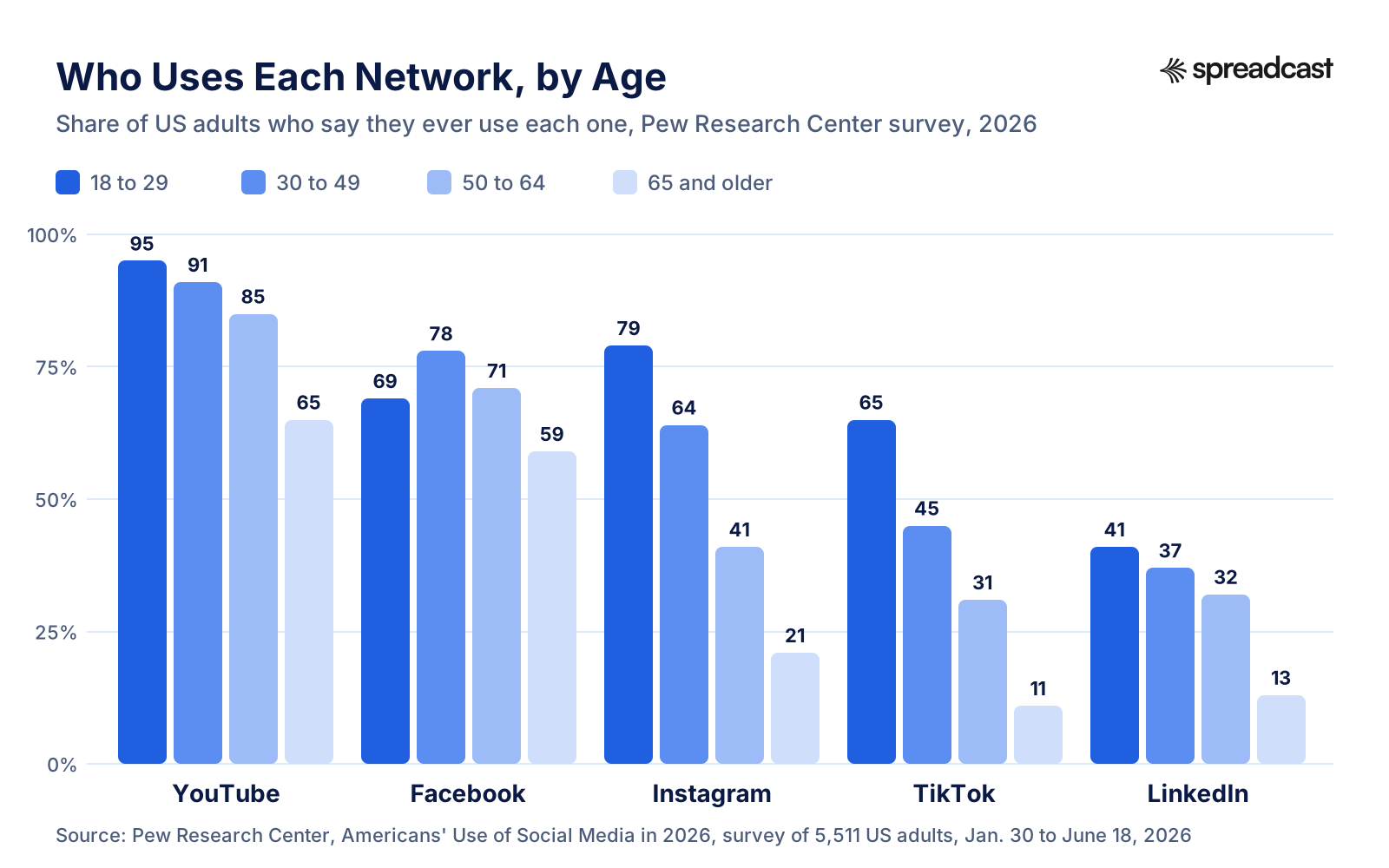
Pick one network where you post as yourself three or more times a week, and treat every other network as optional. Age is the quickest filter. In Pew Research Center's 2026 survey of US adults, 79% of 18 to 29 year olds use Instagram against 21% of those 65 and older, and 65% of 18 to 29 year olds use TikTok against 11% of the oldest group. LinkedIn is flatter: 41% of the youngest group, 37% of 30 to 49 year olds and 32% of 50 to 64 year olds. YouTube reaches most of every age group.

Grouped bar chart of the share of US adults who use YouTube, Facebook, Instagram, TikTok and LinkedIn in four age groups, from Pew Research Center's 2026 survey
Instagram and TikTok skew young, LinkedIn is spread across working ages, and YouTube reaches most adults of every age. Figures from Pew Research Center, Americans' Use of Social Media in 2026, a survey of 5,511 US adults conducted January 30 to June 18, 2026.

Then apply the buyer filter. If people buy your product at work, LinkedIn is almost always the home network, whatever the age. If they buy it for themselves on their phone, Instagram or TikTok usually is. Threads and Bluesky are good second networks for founders whose buyers are in tech, media or design, and they reward short opinions. For a deeper comparison by product type, see where to post: Instagram, Pinterest or LinkedIn, and for network sizes, our social media statistics.

Set a Rhythm You Can Keep for Six Months

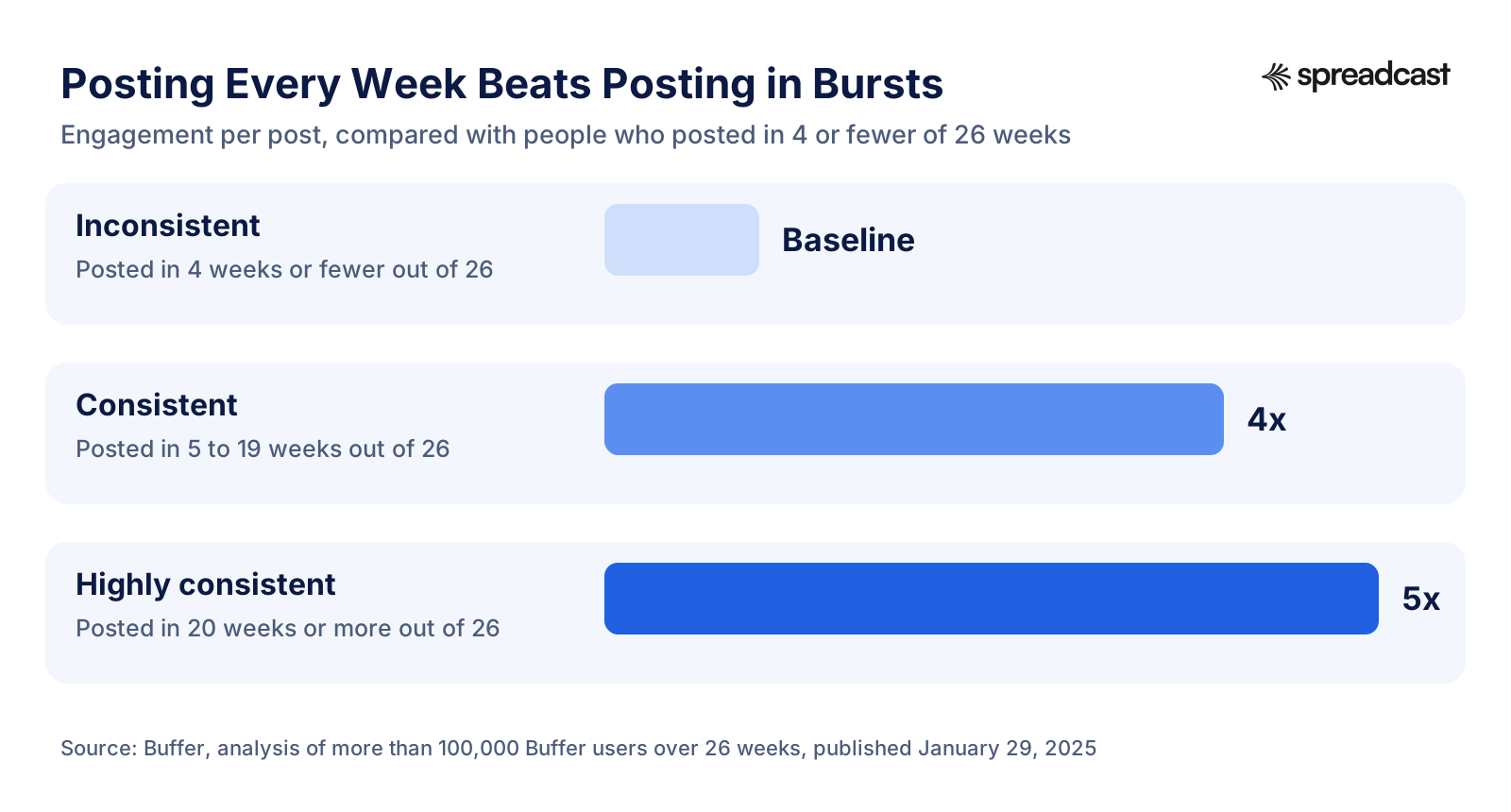
The rhythm matters more than the volume. Buffer studied more than 100,000 of its users over 26 weeks and grouped them by how many of those weeks they posted in. People who posted in 20 weeks or more got about five times the engagement per post of people who posted in 4 weeks or fewer, and people in the middle group, 5 to 19 weeks, got about four times as much. Buffer's own reading is that posting at least weekly matters, with the odd week off for holidays.

Bar chart showing that Buffer users who posted in 20 or more of 26 weeks got about five times the engagement per post of users who posted in 4 or fewer weeks, and the middle group about four times
Consistency beats bursts. Engagement per post by how many of 26 weeks people posted in, from Buffer's consistent posting study of more than 100,000 Buffer users, published January 29, 2025.

Buffer measured engagement per post, not sales, and its users are a mix of brands and people. Still, the direction matches what every founder above did. For founder led content, a good starting rhythm is two or three posts a week on your home network and one a week elsewhere. Raise it only when that feels easy for a month.

Founder Led Marketing on LinkedIn

LinkedIn is where most B2B founders should start, and where many consumer app founders find investors, hires and partners even if customers are elsewhere. It is also the network where founder accounts most clearly outperform company pages early on, so it gets the longest section here.

LinkedIn for Startup Founders: Set Up the Profile First

Before the first post, fix three things. The headline should say who you help and how, not just your title: "Founder of Alex's App, helping small clinics cut no shows" beats "CEO". The featured section should hold one link: your product, your newsletter, or a booking page, whichever is the next step you want. And the about section should tell the story of why you started, in plain words, in the first three lines, because that is all most people read.

LinkedIn gives founders two tools a new company page does not get on day one. Any member can create a LinkedIn newsletter as themselves, while a page needs more than 150 followers or connections and a record of original content before it is even evaluated, according to LinkedIn's newsletter access criteria. And posts have room: a LinkedIn post can hold up to 3,000 characters, per LinkedIn Help.

LinkedIn Content for Founders: What Actually Gets Read

The posts that work for founders on LinkedIn tend to be specific, first person and short enough to finish. A lesson from this week with a number in it. A decision and the reasoning. A customer's problem described so well that other people with the problem recognize themselves. A mistake, owned. What tends not to work is a link to your product with "excited to announce" above it, or advice so general it could have come from anyone.

Write the first two lines as if they were the whole post, because on most screens they are until someone taps to expand. Use short paragraphs. End with something a reader can answer from their own experience, not "thoughts?". And add an image when you have a real one: a screenshot of the actual dashboard, a photo from a customer visit, a chart from your own data. If you want a hand with drafts, our free LinkedIn post generator writes a first version you can rewrite in your voice, and the LinkedIn carousel examples show the document posts that do well for small companies.

LinkedIn Post Ideas for Founders

Here are post ideas that fit almost any startup. Each one comes from something the founder already has: a conversation, a decision, a mistake or a number.

  • The problem story: the moment you realized the problem was worth a company, with the specific person or situation that showed you.
  • The customer's words: a sentence a customer said on a call that changed how you think, quoted with their permission or anonymized.
  • The decision log: one product decision this month, the options you had, what you picked and why.
  • The thing you stopped doing: a feature you cut, a channel you dropped, a meeting you killed, and what happened after.
  • The honest number: one metric that moved, what you think caused it, and what you are not sure about.
  • The teardown: how you would fix a common mistake in your field, with a real (anonymized) example.
  • The hiring lesson: what you look for, what you got wrong in an early hire, written kindly.
  • The myth: a belief your buyers hold that your data or experience contradicts.
  • The behind the scenes: a photo of the whiteboard, the support inbox, the test device drawer, with one line on what it shows.
  • The thank you: a specific customer, partner or contributor and what they did, tagged if they agree.
  • The release, personally: not the announcement itself, which belongs on the brand account, but why you built it and who asked.
  • The question back: a real dilemma you have this week, asked so people with experience can answer it.

Thought Leader Ads: Paying to Boost a Founder's Post

When a founder post works organically, LinkedIn lets the company pay to show it to more of the right people. With Thought Leader Ads, an advertiser finds a member's post in Campaign Manager and requests permission; the author is notified and approves or denies. Per LinkedIn's specs page, the post itself is the ad: no headline or intro text can be added, edits must come from the original author, and there are no call to action buttons, though links in the original post stay clickable.

For a small startup this is the one paid format that fits founder led marketing cleanly. Only boost posts that already did well with your own network, target the job titles you sell to, and keep the budget small until you see replies from buyers, not just likes.

What LinkedIn Does Not Allow

LinkedIn's Professional Community Policies ask members to create original, relevant content to gain engagement and say plainly: "Don't do things to artificially increase engagement with your content." Engagement groups that agree to like each other's posts, bought followers and automated comments all fall on the wrong side of that. They also teach you nothing, because the numbers they produce are fake. A founder with 40 real comments from buyers is ahead of one with 400 from a pod.

Tip for founders who already draft in Claude or ChatGPT: keep writing your personal posts there if it helps you think, but rewrite them in your own voice before posting. For the company's side, Spreadcast's MCP server lets the same assistant design an on brand image, write a caption per network and schedule the brand post, so the AI handles the product announcement and you keep the personal one.

Founder Led Marketing on TikTok and Short Video

TikTok rewards faces and stories, which makes it a natural place for founders, especially for consumer products used by people under 50. You do not need production. A phone, decent light and something specific to say are enough. The question is format, because a founder talking about their startup in general is the one video nobody finishes.

Formats that suit founders, all of which reuse well on Instagram Reels and YouTube Shorts:

  • The series. Same opening line, new episode each week: "Day 40 of building a sleep app with my sister." Mid Day Squares built their following on a running story; a series is the small version.
  • The problem in ten seconds. Show the frustrating thing your product fixes, as your user would experience it, before you mention the product at all.
  • The decision. Thirty seconds on one call you had to make this week and what you chose. People like watching someone weigh a real trade off.
  • The reply video. Answer a real comment or a question from a customer email on camera. It shows you listen and gives you an endless list of topics.
  • The screen walk. A screen recording of one feature with your voice over it, focused on the moment it saves someone time.

Length is rarely the constraint. TikTok began letting people upload videos of up to 10 minutes in 2022, as TechCrunch reported, and YouTube Shorts can run up to three minutes for videos uploaded after October 15, 2024. Founders should still aim short. One idea per video, said in the first two seconds.

Be careful with trends. A founder dancing to a trending sound can work for a consumer brand with a playful tone, and it can make a B2B security product look unserious. Pick formats that match what you sell. Our guide on how to promote an app on TikTok covers the app side in more depth, including what to show of the product.

Founder Led Content on Instagram and Threads

Instagram is visual and personal at the same time, which suits founders of consumer products and anything with a look: food, fitness, design, travel apps. The founder's own account can carry the story, while the brand account carries the product. Instagram even has a feature built for that pairing.

Collab posts let two accounts coauthor one feed post or Reel. As TechCrunch reported when Instagram launched Collabs, you invite the other account from the tagging screen; if it accepts, both names appear in the header, the post shows on both profile grids, it goes to both sets of followers, and the two share one count of views, likes and comments. A founder and a brand account posting a launch as a Collab reach both audiences with one post and no duplicate.

Threads is the text side of the same audience. Meta's Threads documentation limits text posts to 500 characters, which forces the short, opinionated style founders are good at. Threads works well for the founder's quick takes: a reaction to industry news, a one line lesson, a question to the audience. For posting it on a schedule, see how to schedule Threads posts, and for audience size, our Threads statistics.

If you sell an app, Instagram also has its own playbook beyond the founder account, from Reels of the product to carousels of how to use it. Our guide on how to promote an app on Instagram covers the brand side, so you can keep the founder account personal.

Bluesky, Mastodon and Telegram for Founders

These three are smaller, but each has a quality that suits founder led marketing, and many schedulers skip them, which means less competition for attention.

On Bluesky, posts are capped at 300 characters in the post schema, so it rewards the same short takes as Threads. Its best feature for founders is identity. Bluesky lets you set your website as your username, so a founder can be @yourname.com and the company @yourcompany.com, which Bluesky describes as one form of verification and recommends for organizations. For a startup with no blue check anywhere, a domain handle is free proof that the account is really you. More on timing posts there in how to schedule Bluesky posts, and on its audience in our Bluesky statistics.

Mastodon has a similar idea. Its profile documentation explains that if you add a link to your profile and put a rel=me link back on that page, Mastodon confirms you own the site and shows a verification checkmark next to that link. A founder can verify both a personal site and the company site. Mastodon audiences are allergic to marketing speak, which makes it good practice: write as a person or do not bother.

Telegram works differently. A channel broadcasts to subscribers, and per Telegram's channels FAQ it can have an unlimited number of them, but a message in a channel is signed with the channel's name, not yours. So a Telegram channel is usually a brand account. Founders who want a personal voice there either run a personal channel or write in the first person in the company one. Our guide on how to grow a Telegram channel covers the rest.

A Weekly Founder Led Marketing System That Fits in Two Hours

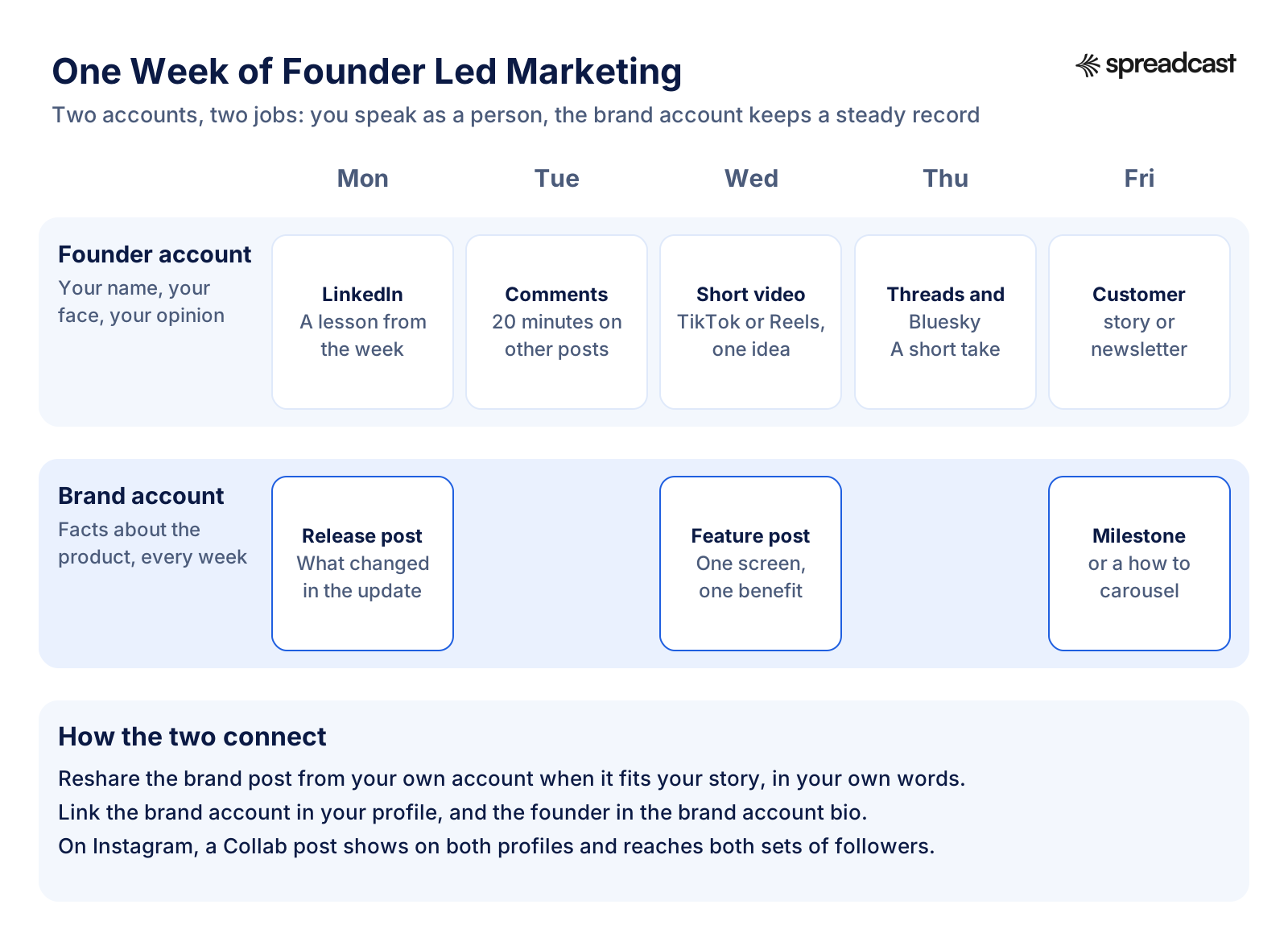
This is a week a founder with a full product workload can keep. It has two lanes. The top lane is you, posting as a person, by hand. The bottom lane is the brand account, posting product facts. The minutes are our estimates for someone who has already done the one hour strategy work above.

Weekly plan with two lanes: the founder account posts a LinkedIn lesson, comments, a short video, a Threads and Bluesky take and a customer story, while the brand account posts a release, a feature and a milestone or how to carousel
One week, two accounts. The founder lane is written by hand and carries opinion and story; the brand lane carries product facts and can be automated. The 20 minutes is our estimate, and the Collab note follows TechCrunch's report on the feature.
Day, Founder account (you), Minutes, Brand account
DayFounder account (you)MinutesBrand account
MondayOne LinkedIn post: a lesson or decision from last week, written in your lane30Release post if anything shipped: what changed, one screenshot
TuesdayComment thoughtfully on 5 to 10 posts by buyers, peers and partners20Nothing
WednesdayOne short video for TikTok or Reels, filmed on your phone, one idea30Feature post: one screen, one benefit
ThursdayOne short take on Threads and Bluesky, often a cut down version of Monday's idea10Nothing
FridayA customer story, a newsletter issue, or replies to everyone who engaged this week30A milestone post or a how to carousel
TotalFive small tasksAbout 2 hoursThree posts, ideally made without you

Notice what is missing from the founder lane: product announcements. Those go on the brand account, and you reshare them only when you have something personal to add, like why you built the feature or who asked for it. That keeps your personal feed from turning into an ad stream, which is the fastest way to lose the trust that makes founder led marketing work.

What the Brand Account Posts While You Post as Yourself

The brand lane is where most founders quietly give up. Each release post means picking a screenshot, laying out an image in the brand colors, writing a caption that fits each network and uploading it everywhere. That is about 40 minutes a post by the estimate in our cost of designing posts by hand, and it lands on the same evening as the release itself. So the brand account goes quiet, and a buyer who checks it after reading your founder post sees a feed that stopped in March.

This is the part Spreadcast was built to take off your hands. Paste your App Store link at the start page and Spreadcast builds a brand kit from the listing: icon, colors and real screenshots in an iPhone frame. It checks the listing every day, and when a new version goes live or the app reaches a ratings milestone, it designs the post, writes a caption per network and publishes it, either on full autopilot or after one tap of approval from you. For the rest of the brand lane, a feature post or a how to carousel starts from one line. No app? Start from your website or a short description of the brand.

Founder Led Sales: The Part Content Cannot Replace

Content creates conversations. Sales turns them into customers. Early on both are the founder's job, and the founders who succeed at founder led marketing usually treat their posts as the top of a sales funnel they run personally.

Y Combinator's Gustaf Alströmer, formerly head of growth at Airbnb, gives the clearest version of this in the talk below. He starts from Paul Graham's essay on doing things that don't scale, argues that founders should learn to do sales themselves, walks through the sales funnel, and explains why you should charge your first customers instead of giving the product away.

A Y Combinator partner explains why founders should do the first sales themselves, how a simple sales funnel works, why to charge the first customer, and how to work backwards from a goal. The selling half of founder led marketing. Video by Y Combinator on YouTube

Connecting your posts to that funnel does not have to feel pushy. A simple version:

  1. Reply to every thoughtful comment within a day, and when someone describes the problem your product solves, ask a follow up question in the comments.
  2. If the conversation continues, offer a call or a direct message, framed as wanting to learn, not to sell. Most people say yes to a founder who is curious about their problem.
  3. On the call, listen for twenty minutes before you mention the product. Then show it if it fits, and ask for payment if it does.
  4. After a month, write a post about what you learned from those calls, anonymized. It brings in the next round of comments.

If you sell an app to consumers, the loop is lighter: replies, a TestFlight link for the most engaged people, and a direct message asking what they think after a week. The principle is the same. Content without conversation is a hobby.

Content Marketing for Startups: Where Founder Posts Fit

Founder led content is one piece of content marketing for startups, not all of it. A complete small startup plan usually has four layers, and each has an owner.

Layer, What it is, Who owns it, How often
LayerWhat it isWho owns itHow often
Founder contentPosts, videos and a newsletter under the founder's nameThe founder, by handTwo to five times a week
Brand contentRelease, feature, milestone and how to posts on the company accountsAutomated, or a teammateTwo or three times a week
Search contentGuides and landing pages that answer what buyers search forFounder or a writerTwo to four a month
Borrowed audiencesGuest posts, podcasts, newsletters, communitiesThe founderOne or two a month

Founder content builds trust fastest; search content compounds slowest but lasts longest; brand content proves the product is alive; borrowed audiences are how you get the first thousand people to notice. A startup with limited hours should start with founder content and brand content, add one borrowed audience a month, and start search content once the product's positioning settles.

For how these layers fit into an overall budget, see our guide to a startup marketing budget. If your product is an app, the full playbook from listing to launch is in how to market an app, and the free channels are collected in how to promote an app for free. Founders at earlier stages will find the launch side covered on our page for startups, and B2B founders on the one for SaaS companies.

Marketing for Solopreneurs: The Minimum Version

If you are one person with no team, the full weekly system may still be too much. Here is the smallest version that still counts as founder led marketing. It takes about an hour a week.

  • Two posts a week on one home network, both in your lane. One lesson, one story or decision.
  • Fifteen minutes of comments on other people's posts, twice a week. This is how a small account gets seen.
  • One borrowed audience a month: a podcast, a guest post or a useful answer in a community where your buyers ask questions.
  • The brand account on autopilot, or skipped entirely until you have a product update worth announcing.

Justin Welsh's example above shows a solopreneur can build a large audience on one network with one lane, and Marc Lou's shows the build in public version of the same thing. Neither ran five networks by hand. If you want a brand account presence anyway but cannot justify a subscription, Spreadcast's Free plan makes 3 posts for one app for you to download, and the Post Pack is $19 once for 10 posts designed and published, with no subscription to cancel. The details are on the pricing page.

Rules Founders Should Know: Disclosure, Fake Engagement and Launches

Founder led marketing is mostly free of rules, which is why the few that exist catch people out.

Say It Is Your Company

When a founder talks about their own product, the relationship is usually obvious. The FTC's Endorsement Guides FAQ says that if it is obvious from an endorsement that the brand is the influencer's own, no disclosure is necessary. It is different for employees and team members posting about the company: the same FAQ says that if your employer allows it and you mention its products, you should disclose your relationship, and that listing your employer on your profile page is not enough. When lemlist style team posting starts, write a one paragraph social media policy that tells people to say "my company" in posts about the product.

No Pods, Bought Followers or Fake Reviews

LinkedIn's policies on artificial engagement are quoted above, and every other network has an equivalent. Beyond the risk of losing the account, fake engagement ruins the one signal founder led marketing gives you for free: what real buyers respond to. If a post does badly, that is information. Keep it.

Launch Platforms Want the Founder, Not the Brand

Some launch platforms are founder led by rule. Product Hunt's launch guide says company accounts are prohibited, that you cannot ask people directly to upvote your product, and that 12:01 am Pacific Time is the best time to launch if you have no other constraint. Your personal account is the launch account. Our full guide on how to launch on Product Hunt covers the assets and the week around it, and how to promote an app on Reddit covers the community rules there, where a founder with a history of helpful comments gets a much warmer reception than one who appears on launch day.

How to Measure Founder Led Marketing

Founder led marketing is hard to measure precisely, and that is not an excuse to skip it. The Edelman study cited above found that only 29% of the companies producing thought leadership could link sales leads or business wins to specific pieces, and 19% had no process for measuring it at all. You can do better than that with three simple habits.

  1. Ask every new customer how they heard about you, in the signup flow or the first email. Founder posts show up in the answers long before they show up in analytics.
  2. Use a tagged link wherever you can. For apps, Apple's campaign links add a provider token and a campaign token to your App Store link, so App Store Connect can show downloads and other metrics for each campaign.
  3. Track a handful of numbers monthly: followers and interactions on your home network, replies from buyers, calls or direct messages that started from a post, and signups that mention you.

Apple's documentation on campaign links explains both tokens and notes that a metric only appears once it reaches 5 in the selected date range, so small campaigns can look empty at first, and our App Store campaign link generator makes one per network so you can see which founder posts send people to the product page. For a fuller list of what to track and the formulas, see our guide to social media KPIs, and to check a post's engagement against your audience size, the engagement rate calculator.

Give it time before you judge. Widrich's early guest posts barely drove traffic. A founder account that has posted twice a week for three months is just getting started. Judge the trend over a quarter: are more of the people engaging buyers, and are more conversations starting from posts?

Founder Led Marketing Mistakes to Avoid

Mistake, Why it hurts, Do this instead
MistakeWhy it hurtsDo this instead
Posting product announcements from the founder accountYour feed reads like an ad, and people unfollow the person they came forPut announcements on the brand account and reshare with a personal angle
Writing about everythingNobody knows what you stand for, so nobody remembers youOne lane in one sentence, ten posts listed before you start
Five networks from week oneEnergy runs out by week five and every account goes quietOne home network, one secondary, everything else later
Copying a famous founder's styleTheir audience and context are not yoursBorrow the pattern, not the voice
Engagement pods and bought followersAgainst LinkedIn's policies, and the numbers stop meaning anythingComment on real posts by real buyers
Never turning attention into conversationsPosts become entertainment with no customers at the endReply, ask, offer a call, sell
Letting the brand account dieBuyers check it and see a product that looks abandonedAutomate the brand lane so it runs without you
Quitting after a monthBuffer's data and every example above say results come from sustained postingCommit to one quarter before judging

How to Keep the Brand Account Posting Without a Designer

Most of this guide is about the founder lane, because only you can do it. This section is about the other lane, because it is where founder led marketing usually breaks. The founder posts are going well, a buyer clicks through to the company's Instagram or LinkedIn page, and the last post is from four months ago. Your personal credibility makes the empty brand account more noticeable, not less.

Below is the brand lane done by hand next to the same lane with Spreadcast, for one app with one release a month and two other brand posts a week.

Step, By hand today, With Spreadcast
StepBy hand todayWith Spreadcast
Notice there is something to postYou remember after the release, if you rememberSpreadcast checks your App Store listing daily and spots new versions and ratings milestones
Design the imageOpen a design tool, find a screenshot, match colors, export per network sizeDesigned in your brand from the kit built off your listing, screenshots in an iPhone frame
Write captionsOne per network, each to its own length and toneA caption per network, written for you
PublishLog in to each account or a scheduler and uploadPublished to Instagram, Facebook, Threads, LinkedIn, Pinterest, TikTok, YouTube, Bluesky, Mastodon, Telegram and Discord
Your partAll of the above, usually on release nightOne tap of approval, or nothing on full autopilot

For posts that are not tied to a release, you write one line in Create, or pick one of twelve post types for apps such as a testimonial, a how to or a feature, and Spreadcast designs a single image or a carousel in your brand. You can also upload your own photos and videos, like the short founder videos from the weekly plan, and schedule them from the same calendar. The calendar, drafts, approval and analytics sit in one place, with followers and interactions per network and likes, comments, reach and views per post. The full list is on the features page.

The prices, with what each one includes. Pro is $29 a month or $290 a year: clean posts with no cap, publishing to 10 social accounts across any mix of networks, autopilot or one tap approval, and posting from Claude or ChatGPT. Studio is $79 a month for 5 apps and 50 accounts, each with its own brand. If you would rather not subscribe, the Post Pack is $19 once for 10 posts designed and published, and the 30 Day Pass is $39 once for everything in Pro for 30 days. Paid plans have a 7 day full refund. For comparison, Buffer's pricing page lists Essentials at $60 per channel a year on yearly billing, so five brand channels come to $300 a year, and you still design and write every post yourself. Our Buffer comparison goes through the rest.

What Spreadcast does not do is the founder lane. It does not write your opinions, film your face or reply to comments for you, and it should not. Those posts work because they are yours. Spreadcast keeps the brand account steady so your hours go to the posts only you can write. If you are weighing this against hiring someone to run social, our guide on whether to hire a social media manager prices every option side by side.

A 30 Day Plan to Start Founder Led Marketing

If you have read this far and have not posted yet, here is a month that gets you from nothing to a working rhythm. It assumes about two hours a week.

Week, Founder lane, Brand lane
WeekFounder laneBrand lane
Week 1Write your lane in one sentence, list ten posts, fix your profile headline, featured link and about sectionConnect the brand accounts and set up the brand kit, or decide to skip the brand account for now
Week 2Two posts on your home network from the list. Fifteen minutes of comments on three daysFirst release or feature post goes out
Week 3Two posts plus one short video. Reply to every comment. Offer one call to someone who described your problemTwo brand posts, one of them a how to
Week 4Two posts plus one short take on Threads or Bluesky. Pitch one guest post or podcastTwo brand posts. Check analytics for the first time
Day 30Count: buyer comments, conversations started, signups that mention youCount: posts published, followers and interactions per network

Then keep the same rhythm for two more months before changing anything. By day 90 you will know which topics bring buyers, which network is home, and whether your posts lead to conversations. That is enough to decide whether to add a second voice from the team, a newsletter, or paid boosts for the posts that already work.

Founder led marketing is slow, personal and cheap. Every example in this guide started with one founder posting about one thing to a small audience and doing it again next week. The founders who stopped are not in any guide. Pick your lane, keep the brand account alive in the background, and keep going. If your product is an app, paste the App Store link and the brand lane is handled from the next release on.

Questions

Frequently Asked Questions

What is founder led marketing?

Founder led marketing is when the founder is the main public voice of the company: posting under their own name, teaching what they know, telling the story of why the product exists and talking to customers in public. The brand account still exists but plays a supporting role, keeping a record of releases and product facts.

What is the difference between founder led marketing and build in public?

Build in public is one style of founder led marketing, where the founder shares the work as it happens, often with revenue numbers. Founder led marketing is wider: teaching, customer stories, decisions and guest posts all count, and many founders do it without sharing any numbers. Our indie developer page covers build in public in depth.

Is founder led marketing worth it for a small startup?

Usually yes, because it costs time rather than money and builds trust faster than a new brand account. In the 2024 Edelman and LinkedIn study, 73% of B2B decision makers said thought leadership is a more trustworthy basis for judging a company than traditional marketing materials. It is less suited to founders who do not want to be public or whose buyers are not on any social network.

How often should a founder post on LinkedIn?

Two or three times a week is a good start for most founders, raised only when it feels easy. Consistency matters more than volume: in Buffer's study of more than 100,000 users, people who posted in 20 or more of 26 weeks got about five times the engagement per post of people who posted in 4 or fewer.

What should founders post on LinkedIn?

Specific, first person posts in one topic lane: a lesson from this week with a number in it, a product decision and the reasoning, a customer problem described in their words, a mistake you owned, or a question you are genuinely stuck on. Keep product announcements on the company page and reshare them with a personal angle.

Does founder led marketing work on TikTok?

It works well for consumer products whose buyers are under 50, since TikTok's audience skews young. Founders do best with recurring series, short videos that show the problem, reply videos answering real comments and screen walks of one feature. Avoid general videos about your startup; one idea per video, said in the first two seconds.

What is founder led sales?

Founder led sales is when the founder runs the first demos and closes the first customers personally, before hiring salespeople. It pairs naturally with founder led content: posts start conversations, and the founder turns the best conversations into calls and customers.

Can I automate founder led marketing?

Automate the brand account, not the founder voice. Release posts, feature posts and milestones can be designed and published by a tool such as Spreadcast. Your personal posts, opinions and replies should stay yours, because their value comes from being written by the founder.

How do you measure founder led marketing?

Ask every new customer how they heard about you, use tagged links such as App Store campaign links per network, and track followers, interactions, buyer replies and conversations started from posts each month. Judge the trend over a quarter rather than a single post.

Sources

Where These Facts Come From

Every outside number, rule and price on this page links to the page it was taken from.

  1. 100,000 users in 9 months, interview with Leo WidrichMixergy
  2. How Buffer's blog posts get shared thousands of timesContently
  3. Out teach your competition, REWORK podcast37signals
  4. How mental availability helped Guillaume Moubeche grow lemlistHow to Win podcast with Peep Laja
  5. About Justin WelshJustin Welsh
  6. How Justin Welsh actually uses LinkedInJosh Spector
  7. Marc Lou's indie pageMarc Lou
  8. Mid Day Squares episode with Jake KarlsThe Startup CPG Podcast
  9. Do Things That Don't ScalePaul Graham
  10. The Embedded EntrepreneurArvid Kahl
  11. Thought leadership gets B2B buyers back into the game, 2024 studyEdelman
  12. Americans' use of social media in 2026Pew Research Center
  13. Consistent posting means 5x more likes, comments and sharesBuffer
  14. Character limits for postsLinkedIn Help
  15. LinkedIn Newsletter access criteriaLinkedIn Help
  16. Professional Community PoliciesLinkedIn
  17. Thought Leader AdsLinkedIn Marketing Solutions
  18. Thought Leader Ads specsLinkedIn Marketing Solutions
  19. Threads API overview and limitsMeta for Developers
  20. Bluesky post schema with the 300 character limitBluesky on GitHub
  21. How to verify your Bluesky accountBluesky
  22. Setting up your profile and verificationMastodon documentation
  23. Channels FAQTelegram
  24. Understand three minute YouTube ShortsYouTube Help
  25. TikTok expands max video length to 10 minutesTechCrunch
  26. Instagram is adding Collabs, new music features for Reels and desktop postingTechCrunch
  27. Product Hunt launch guideProduct Hunt
  28. FTC's Endorsement Guides: what people are askingFederal Trade Commission
  29. Campaign links in App Store Connect analyticsApple Developer
  30. Buffer pricingBuffer
  31. How to get your first customers, Startup School (video)Y Combinator on YouTube
  32. Discussing decisions: a Basecamp pricing experiment (video)37signals on YouTube
  33. How we used storytelling to sell 1 million bars (video)Mid Day Squares on YouTube

Researched and written by Spreadcast. Last checked on October 28, 2026.

Still on autopilot

Put Your App's Marketing on Autopilot

Paste your App Store link once. Your next update, review and rating milestone becomes a post, published for you.

Free to start · No credit card · No manual posting