An app marketing agency is a company you pay to bring your app new installs and paying users. The work usually covers App Store Optimization (ASO), paid install ads on Apple, Google, Meta and TikTok, the ad creative those campaigns need, and often social media, influencer deals and launch press. What it costs depends on the agency and the job. On Clutch, most mobile app marketing projects reviewed by clients fall between $10,000 and $49,999, and the pricing guides that agencies publish put monthly retainers at roughly $3,000 to $25,000, before a single dollar goes to ads. On November 21, 2026 we opened the websites of the 20 agencies named most often in the lists that rank for this search. Only 3 of them showed a fee for their main service.
This guide is for an app founder or developer, on the App Store or Google Play, who is wondering whether to hire an agency and what it would really cost. Most pages on this topic are lists of agencies, ranked by whoever wrote them, with "custom pricing" written next to every name. This one covers what each kind of agency actually does, how they charge, every published price we could find with a link to the agency's own page, what a realistic monthly budget buys at four levels, how to vet an agency, the red flags that can get your app removed from the store, and a plan for the jobs you can run yourself.
One note before we start. Spreadcast, the company behind this page, makes a tool that runs an app's social media marketing: branded posts made from your app, then scheduled and published for you. It is software rather than an agency, built for the social part of the work, so the paid ads and store jobs below are about agencies and your own team. We mention it where it fits, mostly in the sections on social media and on doing it yourself. Every outside number links to the page it came from, opened on November 21, 2026. Where a number is our own math, we say so and show it. The method is at the end, under How We Researched This.
What Is an App Marketing Agency?
An app marketing agency is a marketing firm that works only or mostly on mobile apps. That sounds like a small difference from a general digital agency, but it changes almost everything about the job. An app is sold through two stores that set their own rules, rank apps with their own algorithms and decide what counts as fair promotion. Installs are measured differently from website visits. Ads that send people to the App Store run through their own formats and auctions. And the money usually arrives through a trial, a subscription or an in app purchase weeks after the install, so a campaign can look cheap and still lose money.
People search for the same thing under many names: mobile app marketing agency, app growth agency, app advertising agency, user acquisition agency, app promotion agency, app marketing company. In practice the labels map to the work. An app advertising agency or user acquisition (UA) agency mostly buys paid installs and makes the ads for them. An ASO agency works on the store listing. A growth agency claims both plus the strategy around them. And an app promotion company can mean anything from a real PR shop to a seller of installs and reviews, which is the one kind you should never hire (more on that under red flags).
The lists that rank for "app marketing agency" rarely help with the money question. MarketerHire's list of 10 app marketing agencies gives every one of them the same price: custom. That matches what most of those agencies show on their own sites (one of the ten, Strataigize, does publish prices there), and it is why the sections below lean on the few agencies that do publish their prices.
What Does an App Marketing Agency Do?
Most agencies sell some mix of seven jobs. On the 20 agency sites we read, most led with one or two of them and listed the rest as extras. Knowing the jobs helps you buy only the one you need, and spot an agency that is selling you its weakest one.
App Store Optimization
ASO is the work of ranking in store search and turning store visitors into installs: the name, subtitle and keyword field, the description, the icon, screenshots and preview video, ratings, in app events and custom product pages. An ASO agency researches keywords, rewrites the metadata, designs new screenshots and runs tests. Both stores give you free testing tools for this. Apple's product page optimization lets you test up to three versions of your icon, screenshots and app previews against the original for up to 90 days. Google Play's store listing experiments let you test up to two variants against your current listing, and run up to five localized experiments at once. So most of what an ASO agency charges for is judgment and design hours, not access to tools. Our guides to App Store Optimization and Google Play ASO cover the work step by step, and the App Store conversion rate page shows how many visitors a typical listing turns into installs.
Paid User Acquisition and App Advertising
Paid user acquisition means buying installs with ads. The main places are Apple Ads in App Store search, Google App campaigns, Meta (Facebook and Instagram) and TikTok, plus ad networks that place ads inside other apps and games. Each works differently. Apple Ads has two versions: Basic charges per install at a cost you choose, with a budget of up to US$10,000 per app a month, and Advanced charges per tap with no budget maximum. Google's App campaigns show one campaign across Google Search, Google Play, YouTube, Discover and the Display Network. You provide the text, images and videos, a bid and a budget, and Google tests the combinations and chooses which ads to show where. An agency sets up tracking, structures campaigns, sets bids, watches the cost per paying user and moves money between channels. For the full channel by channel picture, read our guides on how to advertise an app, Apple Search Ads and Google App Campaigns.
Ad Creative Production
Paid ads run on creative: short videos, user generated style clips, static images and playable ads. Ads wear out fast, so a serious campaign needs new ones every month. This is where a lot of agency money goes. Admiral Media, a mobile growth agency, publishes the price of its AI creative service: €6,000 a month for 5 video concepts, €10,000 for 10 and €16,000 for 20, each concept in three variations and three sizes, with a six month initial term. RocketShip HQ sells creative and media buying together, starting at $7,500 a month. If you want to understand what makes an ad work before you pay for one, our piece on what makes a social creative convert breaks it down.
Social Media and Content
This is the organic side: an Instagram, TikTok, LinkedIn or Threads account that posts about the app every week, shows real screens and updates, and answers comments. Some app agencies sell it as a separate plan. App Masters lists a social media plan at $1,000 a month with 8 posts, 2 reels or video posts and 4 stories, posted on 2 to 3 platforms (Instagram and Facebook as standard), plus daily comment and DM replies and a monthly report. General agencies charge a wider range: DesignRush's pricing guide puts social media management retainers at $1,000 to $20,000+ a month. This is also the job that tools now do well for a small app, which we come back to near the end. Our guide on how to promote an app on social media covers the work itself.
Influencer and Creator Campaigns
Influencer agencies find creators, negotiate rates, brief them, check the posts and pay them. Their prices are almost never published. House of Marketers, one of the 20 agencies we checked, says on its influencer page that fees and programme length are tailored, with media spend shown separately in a free proposal. DesignRush lists influencer and creator fees at about $1,500 to $2,000 per collaboration as a cost that agencies often leave out of their proposals. Whoever runs it, every paid post must be disclosed: the FTC tells creators to disclose any financial, employment, personal or family relationship with a brand, in plain words such as "ad" or "sponsored", placed with the post itself where it is hard to miss.
Launch, PR and App Store Featuring
Launch work is short and intense: press outreach, a Product Hunt day, a pitch to Apple's and Google's editors, launch posts and a first round of ads. Some agencies sell it as a fixed project. It is also the job that founders can most easily do themselves with a plan, because the hard part is the story and the timing, not access. Our app launch checklist and our guide on how to get featured on the App Store lay out the steps, and the Product Hunt launch guide covers that one day in detail.
Retention, Push and Lifecycle Marketing
The last job keeps the users you paid for: onboarding, push notifications, email, in app messages, win back offers and paywall tests. Fewer app agencies do it, and the ones that do often bundle it into bigger plans. App Masters puts push notification strategy into its $3,000 Growth plan, and paywall templates and retention analysis into its Starter and Scale plans. If your users leave in the first week, no amount of paid installs will fix it, so check your numbers against our app retention benchmarks before you buy ads.
| Job | What the agency delivers | Can you do it yourself? | Who usually sells it |
|---|---|---|---|
| App Store Optimization | Keyword research, new metadata, screenshot design, listing tests | Yes, with free store tests and a few hours a month | ASO agencies, growth agencies |
| Paid user acquisition | Campaign setup, bids, budgets, tracking, weekly reports | At small budgets, yes; it gets hard across many channels | UA and performance agencies |
| Ad creative | Video and static ads, new concepts every month, testing | Partly; volume is the hard part | Creative studios, UA agencies |
| Social media | A posting plan, designed posts and reels, replies, reports | Yes, especially with automation | Social agencies, some app agencies |
| Influencers | Creator search, deals, briefs, disclosure checks | Small deals, yes; large programs, no | Influencer agencies |
| Launch and PR | Press list, pitches, launch day plan | Yes, with a checklist | PR firms, full service agencies |
| Retention and lifecycle | Onboarding, push, email, paywall tests | Yes, with your own product knowledge | Growth agencies, CRM specialists |
Types of Mobile App Marketing Agencies
Once you know the jobs, the agencies sort themselves into a few types. The table uses examples from the 20 agency sites we checked, described in their own words where possible. A firm can fit more than one row.
| Type | Main job | How it usually charges | Examples from our check | Fits an app that |
|---|---|---|---|---|
| Performance or UA agency | Paid installs across ad networks, plus creative | Retainer or a share of ad spend, often with a minimum budget | RocketShip HQ, Webtonic | Already spends tens of thousands a month on ads |
| Full service growth agency | ASO, paid ads, creative and strategy in one team | Monthly retainer scoped after a call | Moburst, Yodel Mobile, AppAgent, Admiral Media, Strataigize | Has a proven product and wants one partner |
| ASO agency | Store listing, keywords, screenshots, tests | Monthly program, often with a six month first term | RadASO, Admiral Media's ASO team | Gets most installs from store search |
| Creative studio | Ad videos, user generated style clips, statics | Per concept or per month | Admiral Media's creative plans, Favoured | Runs paid ads and needs fresh creative |
| Influencer agency | Creator campaigns and seeding | Per campaign, fees set in a proposal | House of Marketers | Sells to an audience that follows creators |
| Social content agency or plan | Organic posts, reels, stories and replies | Flat monthly fee | App Masters' social media plan | Wants a steady social presence |
| Freelancer or fractional marketer | One person on one job, or a part time lead | Hourly or monthly | Marketplaces such as Clutch and MarketerHire | Needs one skill, not a team |
Freelancers deserve a line of their own because they are often the right first hire. Clutch puts the usual hourly rate for an app marketing agency at $25 to $49, with agencies in the United States, Canada and Australia charging $100 to $149 an hour and agencies in India under $25. MarketerHire, which sells vetted freelance marketers, lists freelancers at $75 to $150+ an hour and its own on demand specialists at $5,000 to $15,000 a month. Our guide on whether to hire a social media manager compares freelancer, part time, full time and agency options for one of these jobs in detail.
How Much Does an App Marketing Agency Cost?
An app marketing agency costs about $3,000 to $25,000 a month for most small and mid sized apps, plus the ad budget itself, which you pay straight to Apple, Google, Meta or TikTok. Very large accounts pay more, and a one person shop or freelancer can cost less. Here is where that range comes from, so you can judge it yourself.
- AppAgent, a mobile growth agency, writes in its UA pricing guide that typical retainers range from roughly $3,000 to $25,000 a month, and that agencies charging a share of ad spend usually take between 5% and 15%.
- Admiral Media's 2026 pricing guide puts mobile growth retainers at $5,000 to $25,000 a month, and splits them by stage: $3,000 to $7,500 for apps spending under $10,000 a month on ads, $7,500 to $20,000 for apps spending $10,000 to $100,000, and $15,000 to $50,000+ above that.
- Clutch, the agency review site, says most mobile app marketing projects reviewed on it range between $10,000 and $49,999, and puts the usual hourly cost of an app marketing agency at $25 to $49.
- DesignRush, another agency directory, gives a general marketing package range of $1,000 to $5,000 a month for startups and $5,000 to $15,000 for growing businesses. It is not specific to apps, but it is a useful floor.
Two things are missing from almost every quote. First, ad spend. The agency fee pays for people and their time; the installs are bought separately. Second, creative. Some retainers include new ads every month and some bill them on top. Admiral's guide says creative is sometimes bundled and sometimes billed at $2,000 to $10,000 per production run. So when you compare two agencies, compare the total: fee plus ads plus creative plus any tools they ask you to buy.
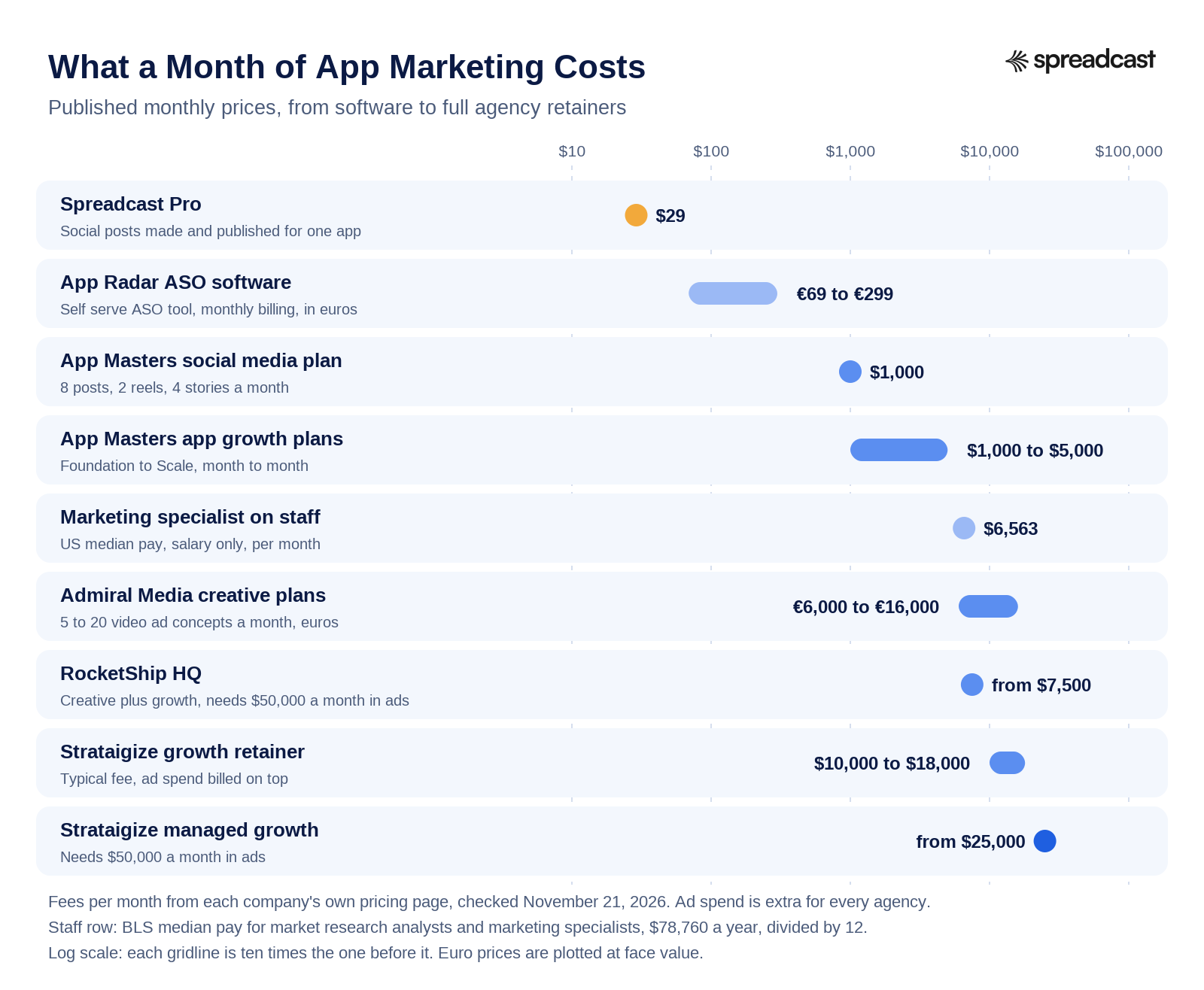
Look at the spread. The cheapest agency plan on the chart costs about 34 times a month of Spreadcast Pro, and the most expensive starting price is 25 times the cheapest agency plan. Those are different products, of course: a tool that runs one job, a small agency that does one or two jobs with a person on your account, and a senior team running ads, creative and measurement at scale. The point of the chart is to show where your budget sits before you start booking sales calls.
App Marketing Agency Pricing Models
Agencies charge in six main ways. Most proposals are one of these or a mix of two.
| Model | How the fee is set | Published numbers | Watch out for |
|---|---|---|---|
| Monthly retainer | A flat fee for an agreed scope of work | $3,000 to $25,000 a month (AppAgent); $5,000 to $25,000 (Admiral Media) | Scope that is vague, so the work shrinks while the fee stays |
| Share of ad spend | A percentage of the media the agency manages | 5% to 15% (AppAgent); 10% to 20% with a $1,500 to $2,500 monthly minimum (Admiral Media) | A reason to spend more, whether or not it pays back |
| Hybrid | A smaller base retainer plus bonuses for hitting targets | A base of $3,000 to $8,000 a month (AppAgent) | Targets that reward installs instead of paying users |
| Performance or pay per install | A fee per install, signup or purchase | Rare in pure form, according to AppAgent and Admiral Media | Sellers of cheap installs that break store rules |
| Project fee | A fixed price for an audit, a sprint or a launch | $5,000 to $25,000 per engagement (Admiral Media); $9,000 for a 30 day sprint (Strataigize) | A project that ends in a pitch for a retainer |
| Hourly | Hours worked, mostly freelancers and consultants | $25 to $49 an hour as the usual rate, $100 to $149 for US agencies (Clutch) | Open ended hours with no deliverable |
A good rule from Admiral Media's guide: keep the agency fee at no more than 15% to 20% of your total marketing money, meaning fee plus ad spend. Run that rule backwards and it tells you when an agency makes sense. A $5,000 monthly fee needs a total budget of at least $25,000 to $33,000, so about $20,000 to $28,000 in ads. A $3,000 fee needs a total of at least $15,000 to $20,000. If your whole budget is $5,000 a month, a fee that keeps to the rule is at most $750 to $1,000, which buys a freelancer for a few hours or a tool, not an agency team. That math is ours, built on Admiral's ratio.
Contract length is part of the price too. Admiral's guide says minimum commitments are typically three months, with six month initial contracts common. Moburst's ASO cost guide says most agencies require a 3 to 6 month minimum commitment. A six month term at $5,000 a month is a $30,000 decision, so treat it like one.
Mobile App Marketing Agency Pricing: Every Published Price We Found
This table holds every fee we found published by an app marketing agency on its own website, checked on November 21, 2026. Prices change, so open the linked page before you plan around a number.
| Agency and plan | Price | What is included | Terms and minimums |
|---|---|---|---|
| App Masters, Foundation | $1,000 a month | 2 ASO projects a month for one app on iOS and Google Play, in app events, an app audit, conversion analysis | Month to month, cancel anytime |
| App Masters, Elevate | $1,500 a month | Unlimited ASO for one app at one project a week, Apple Search Ads management, custom product pages, screenshot and icon design | Month to month |
| App Masters, Growth | $3,000 a month | Everything above at two projects a week, plus Google, Facebook and TikTok ads management (video ads not included) and push strategy | Month to month |
| App Masters, Starter | $3,000 a month | Unlimited ASO, retention and monetization work, paywall templates, onboarding screen design, push and in app messages, Apple Search Ads management | For ad budgets up to $100,000 a month; month to month |
| App Masters, Scale | $5,000 a month | Everything in Starter plus video creatives and Google, Meta and TikTok ads management | For ad budgets up to $100,000 a month; month to month |
| App Masters, Social Media | $1,000 a month | 8 posts, 2 reels or videos, 4 stories on 2 to 3 platforms, daily replies, monthly report | No long term commitment |
| Strataigize, 30 Day Growth Sprint | $9,000 fixed | One ASO overhaul or one creative testing rebuild | 30 days, you keep the work |
| Strataigize, Growth Retainer | From $10,000 a month, typically $10,000 to $18,000 | UA, ASO and creative testing as one program, weekly optimization | Month to month after the first 3 months |
| Strataigize, Managed Growth Operation | From $25,000 a month | Paid ads on two channels, the creative loop and measurement | Six months, then 30 days notice; needs $50,000 a month in ad spend |
| RocketShip HQ | From $7,500 a month | Creative strategy, production, testing, reporting and media buying | Floor of $50,000 a month in ad spend; ASO and paywalls priced separately |
| Admiral Media, AI creative | €6,000, €10,000 or €16,000 a month | 5, 10 or 20 video ad concepts, each in 3 variations and 3 sizes | Six month initial term |
| Webtonic | Not published | Paid media, static and video ads, weekly calls, dashboards | Takes clients with $500,000+ in yearly revenue or $15,000+ a month in ads; 3 month setup, then month to month |
Sources for each row: App Masters pricing, Strataigize pricing, RocketShip HQ's cost page, Admiral Media's engagement and pricing page and Webtonic pricing. RocketShip HQ is unusually direct about small budgets: it says its full service package is not recommended at $4,000 a month in ad spend, because the starting fee would be larger than the media budget. Strataigize offers a free 30 minute call with no minimum budget, and says you keep your own ad accounts.
ASO Agency Pricing
ASO is the cheapest agency job to buy and the easiest to test. Moburst's ASO cost guide gives the widest set of market ranges we found: a light audit from a freelancer or consultant at $500 to $3,000, an agency audit at $3,000 to $10,000, and monthly ASO at $1,500 to $5,000 from a solo consultant or small shop, $2,500 to $7,000 from a boutique to mid market agency, and $15,000 to $25,000+ for enterprise work. Self serve tools sit at the bottom: App Radar, an ASO tool, lists plans from €69 to €299 a month on monthly billing. At the agency end, Admiral Media's ASO programs start with a six month term, then run monthly with one month's notice, with no setup fee and the price set in a written proposal after a call.
For an indie app the real choice is between three things: a tool plus your own few hours a month, or App Masters' $1,000 Foundation plan with two ASO projects a month, or a full agency program in the thousands. The jump from a tool to an agency only pays when store search is a big share of your installs and you have many languages or many keywords to work on.
How Much Does It Cost to Promote an App?
The full cost to promote an app is the agency fee plus ad spend plus creative plus tools. Here are four worked examples using published prices, so you can see how the total behaves. The math is ours. What ad spend buys in installs depends on your country and category; our cost per install benchmarks page has the numbers, and how to advertise an app covers what each channel costs.
- An indie app with $2,000 a month for marketing. Any agency plan on our table takes half or all of it. The fee alone breaks Admiral's 15% to 20% rule, and RocketShip HQ says outright that its package does not fit budgets this small. Spend it on ads you can measure, a listing test and a tool that keeps your social accounts posting.
- A growing app with $10,000 a month in ads on App Masters' $3,000 Growth plan. The total is $13,000, and the fee is 23% of it, a little above Admiral's rule. Creative for Meta and TikTok video ads is not included on that plan, so add whatever new videos cost you.
- A funded app with $50,000 a month in ads at RocketShip HQ's $7,500 starting price. The total is $57,500 and the fee is 13% of it, with creative production included. ASO is priced separately.
- A bigger app on Strataigize's Managed Growth Operation: a $25,000 fee on top of the required $50,000 in ad spend is a $75,000 month, with the fee at 33% of the total. That buys a named senior team, two channels and measurement, on a six month term.
Agency fees fall as a share of the total as ad budgets grow, which is why the agencies that publish minimums set them at $15,000 a month in ads (Webtonic) or $25,000 to $50,000 (Strataigize and RocketShip HQ). Below those levels, you are paying for a team that is sized for someone else's budget. Our startup marketing budget page lays out budgets at $0, $500, $2,000 and $10,000 a month, line by line, if you want to plan the whole month rather than only the agency.
What We Found When We Checked 20 Agency Websites
The lists that rank for app marketing agency name many of the same firms. We took the 20 we saw named most often across them and opened each agency's own website on November 21, 2026. For each one we read the homepage and menu, checked the site's sitemap for any pricing page, and tried its /pricing address. We were looking for one thing: a fee for the agency's own work that a founder could read without booking a call.
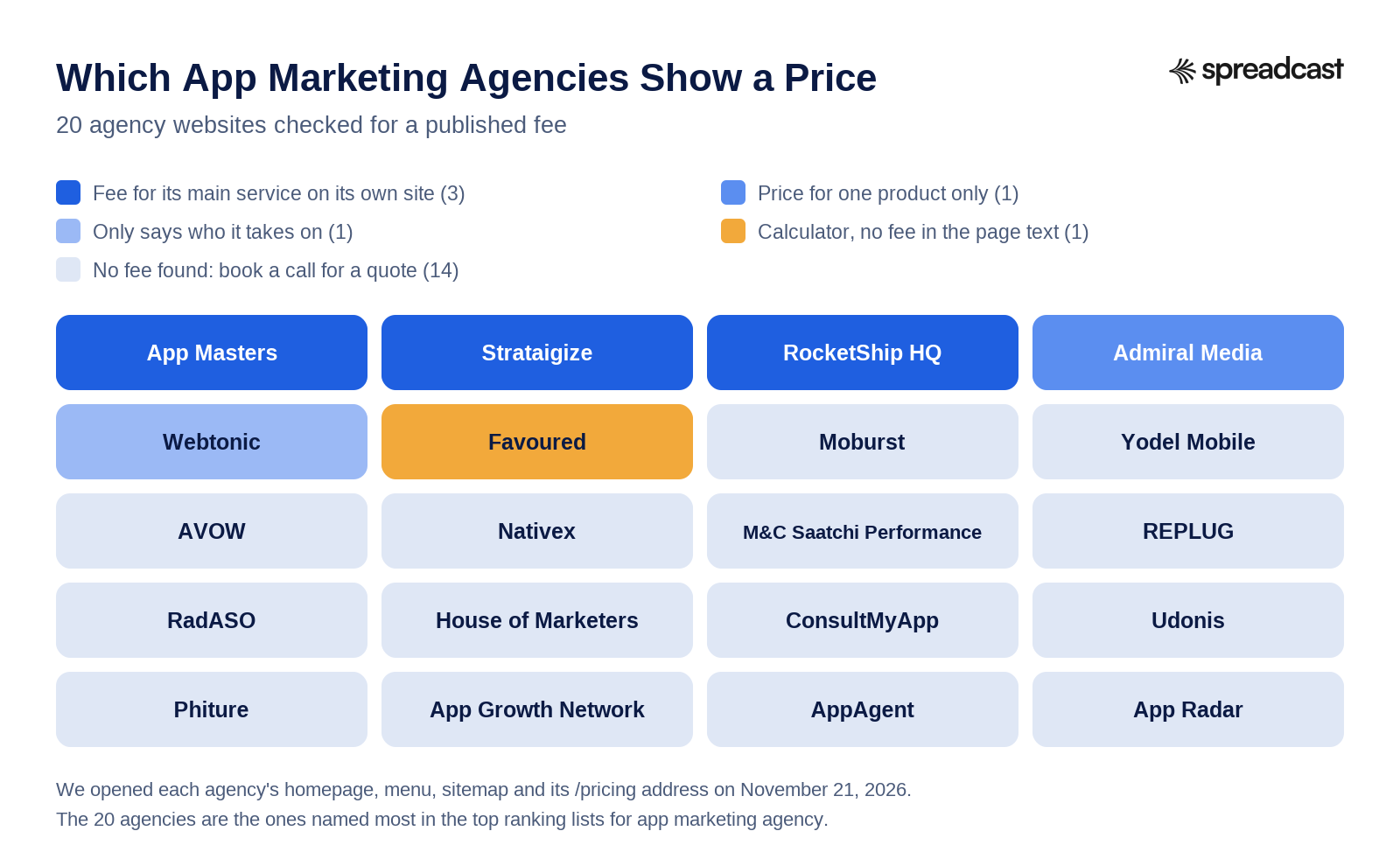
Five findings matter if you are about to shop for an agency.
- Most agencies do not publish a price. 14 of the 20 showed no fee anywhere we looked. The path is a form, a call and a proposal. That is normal for custom work, but it means you cannot compare agencies until you have spent time with several sales teams.
- The agencies that do publish are telling you who they serve. App Masters starts at $1,000 a month and lets you cancel any month. RocketShip HQ starts at $7,500 and wants $50,000 a month in ad spend. Strataigize's biggest program needs $50,000 a month in ads. A published price is a filter, and it saves both sides a call.
- Published minimums are high. Webtonic takes on businesses with at least $500,000 a year in revenue or $15,000 a month in ad spend. Strataigize starts managed media at $25,000 a month in ad spend. RocketShip HQ's floor is $50,000. If your app spends less, the agencies at the top of these lists were not built for you.
- First terms are long. Admiral Media's ASO and creative programs start with six months. Strataigize's retainer runs three months before it goes month to month, and its biggest program runs six. Webtonic has a three month setup phase. Of the agencies that publish their terms, only App Masters is month to month from the start.
- Directories do not fill the gap. MarketerHire's ranking lists each of its 10 agencies at custom pricing, and Clutch shows ranges across many agencies rather than one agency's price. To compare, you need the agencies' own numbers, which is why we built the table above.
Favoured, a UK agency, is a special case: it has a pricing calculator where you choose ad spend bands, channels and how many static, video and user generated style ads you want each month, but the fee did not appear in the page text we could read, so we did not count it as published. House of Marketers' /pricing address leads to its influencer services page, which says fees are tailored. App Radar's pricing page is for its ASO software, not for the agency services offered under its Enterprise plan.
What You Get at Each Budget Level
Budget decides more than taste does. The same app needs different help at $500 a month than at $50,000. The figure and table below turn the published prices and guides into four levels, so you can see where you are and what is realistic to buy there.
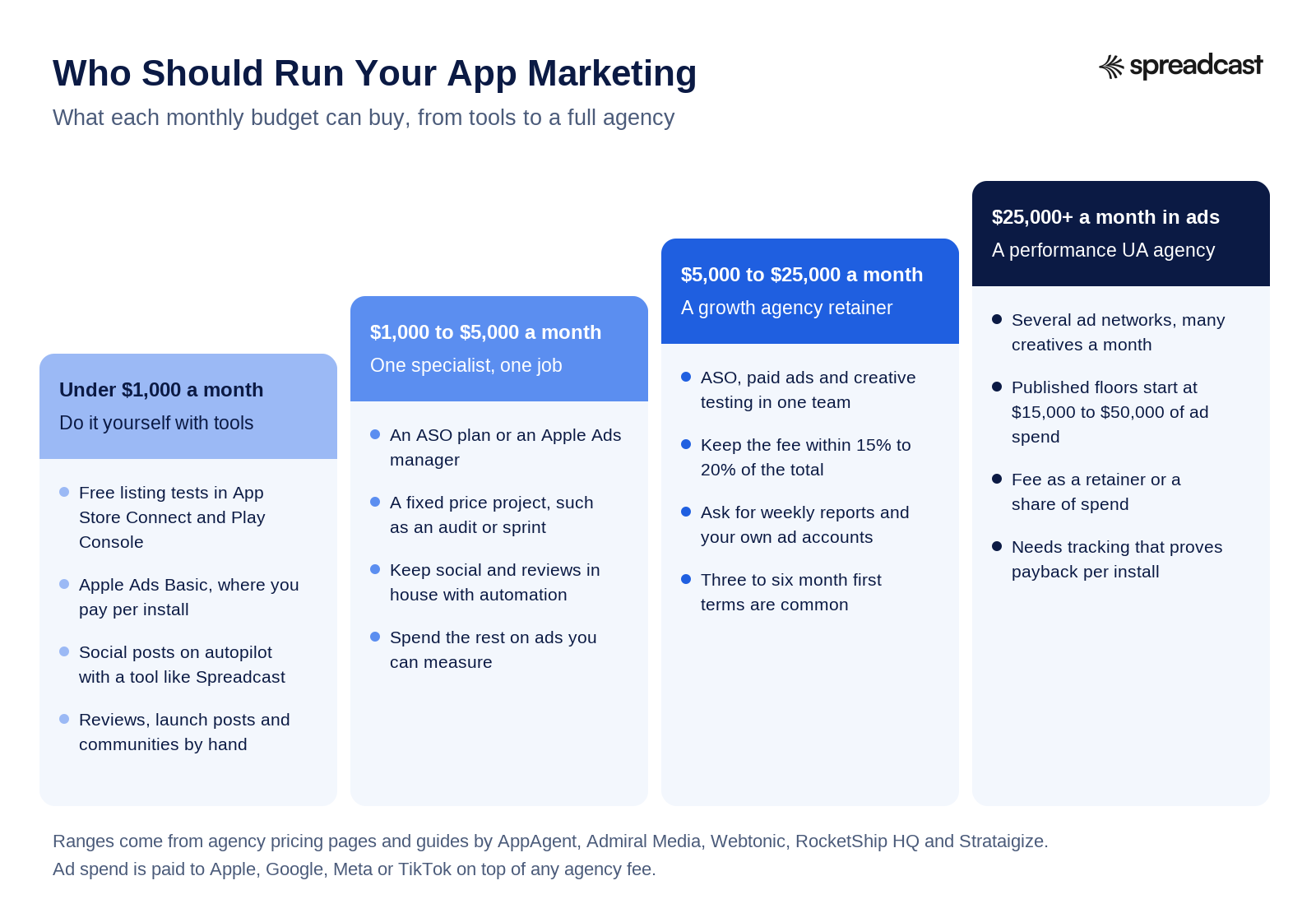
| Monthly budget | What it realistically buys | Who runs it | What to expect |
|---|---|---|---|
| Under $1,000 | Free listing tests, Apple Ads Basic, a few tools, your own time | You, with tools | Slow, steady gains if you keep at it every week |
| $1,000 to $5,000 | One specialist on one job: an ASO plan, an Apple Ads manager, a freelancer | A small agency plan or a freelancer, plus you | AppAgent's lowest tier, $3,000 to $7,000, covers one or two channels with creative limited or left out |
| $5,000 to $25,000 | A retainer that covers ASO, paid ads and creative testing | A growth agency | AppAgent's middle tier, $8,000 to $20,000, adds several platforms, structured creative tests and monthly strategy reviews |
| $25,000+ in ads | A performance agency across many ad networks | A UA agency or an in house team | Senior strategists, analysts, incrementality tests and a large creative pipeline |
The tier details in the last column come from AppAgent's guide, which describes $3,000 to $7,000 a month as account management for one or two channels with basic reporting, where creative production is typically limited or excluded; $8,000 to $20,000 as multi platform management with structured creative testing; and $20,000+ as senior strategy, analysts and incrementality testing. Notice what the lowest agency tier leaves out: the creative. For a small app, creative and steady organic content are the scarce things, and they are exactly what you can produce yourself with the right tools.
App Marketing Agency vs In House vs Doing It Yourself
An agency is one of four ways to get the work done. The others are hiring someone, hiring a freelancer, and doing it yourself with tools. Salary is the useful yardstick here. The US Bureau of Labor Statistics puts the median pay for market research analysts and marketing specialists at $78,760 a year, or $37.87 an hour, as of May 2025. Divided by 12, that is about $6,563 a month in salary alone, before taxes, benefits, tools and a manager's time. One hire is one person with one set of skills; an agency at the same price gives you parts of several people. That is the case for an agency, and it holds once your budget is big enough to buy more than a slice of one person.
| Option | Monthly cost | What you get | What stays with you |
|---|---|---|---|
| Full service agency | $5,000 to $25,000 plus ad spend | Several specialists: ASO, paid ads, creative, reporting | Product, pricing, approvals, a weekly check of the numbers |
| Specialist agency plan | $1,000 to $5,000 | One job done well, such as ASO or Apple Ads | Every other job |
| Freelancer | $25 to $150+ an hour, by market and skill | One person, flexible hours | Briefing, reviewing and managing them |
| Marketing hire | About $6,563 in median salary, plus costs | A full time person who learns your app | Hiring, management, tools and training |
| Do it yourself with tools | From $0 to a few hundred dollars | Store tests, ad platforms, social automation, analytics | Your hours, and the discipline to keep going |
Most apps end up in a mix. A founder keeps the product story, the reviews and the community, uses tools for the repeatable work, and buys a specialist for the one job that needs depth, often paid ads once there is money to spend. If you lean toward doing more yourself, our guide to founder led marketing shows how other founders split their week, and our breakdown of what social media management costs for an app puts freelancer, agency, staff and tool prices for the social job side by side.
How to Choose an App Marketing Agency
If the budget math says an agency makes sense, here is how to pick one without wasting a quarter. The steps run in order; skipping the first two is the most common and most expensive mistake.
- Know your own numbers first. Before any call, write down what a paying user is worth to you and what you can afford to pay for one. Our LTV CAC ratio guide shows the math, and how free apps make money has the revenue per install benchmarks. An agency cannot tell you whether paid installs pay back if you do not know what a user earns.
- Pick the one job you are buying. ASO, paid ads, creative, social or influencers. A clear job gets you a clear proposal and a clear way to judge it. "Grow our app" gets you a retainer with no finish line.
- Shortlist agencies that have done your kind of app. A games agency and a subscription app agency are different businesses. Ask for case studies in your category and on your platform, iOS, Google Play or both.
- Check their minimums against your budget. Use the published floors in this guide as a yardstick: if an agency wants $50,000 a month in ads and you spend $5,000, you will be their smallest client.
- Ask for a written plan for the first 90 days: what they will do in month one, what they will test, what they expect to learn and which number they will report every week.
- Settle ownership before signing. Ad accounts, tracking, creative files and listing assets should be yours. App Masters, for example, says clients get 100% ownership of the files, and Strataigize says you keep your own ad accounts.
- Agree on reporting. Weekly numbers on cost per install, cost per trial or paying user and spend, plus a monthly review, is a sensible default. Admiral Media's ASO program promises a written update every week and a results meeting every month.
- Start small. A fixed price audit or a 30 day sprint tells you more about an agency than any pitch. Strataigize sells a $9,000 sprint where you keep the deliverable whether or not a retainer follows; ask any agency you like for something similar.
Questions to Ask an App Marketing Agency Before You Hire
Use these on the first call. Good agencies answer them quickly and specifically. Vague answers to the first five are a reason to keep looking.
- Which apps like ours have you worked on, and what changed in their numbers? Can we speak to one of those clients?
- Who exactly will work on our account each week, and how senior are they? Is any of the work passed to freelancers or partners?
- Which number will you report every week, and how do you measure it on iOS and Android?
- What do you need from us, and how much of our time will that take each week?
- What is the full monthly cost: fee, ad spend, creative, tools and anything billed later?
- How long is the first term, what is the notice period, and what happens to our accounts and files if we leave?
- How many new ad concepts or listing tests will you run each month?
- What will you do in the first 30 days, and what would make you recommend stopping?
- Where do your installs come from? Do you ever use incentivized installs, review services or install campaigns from offer walls?
- How do you handle influencer disclosure and claims in ads?
- Who owns the ad accounts and the tracking setup?
- What did you get wrong for a past client, and what did you change?
The question on install sources is the one people skip, and it matters most. The next section explains why. MarketerHire's own vetting steps make a related point: an agency that reports installs alone, as a vanity metric, instead of what those users do after they install, is a red flag.
App Marketing Agency Red Flags
Some agency practices waste money. Others can get your app removed from the App Store or Google Play and your developer account closed. Here are the warning signs, with the rule each one runs into.
Guaranteed Rankings, Downloads or Chart Positions
Apple and Google decide search rankings and charts, and neither sells a guarantee. An agency that promises the top 10 for a keyword or a place on the charts is either guessing or planning to buy installs to get there. Apple's guideline 5.6.3 on discovery fraud says manipulating any element of the App Store customer experience such as charts, search, reviews, or referrals to your app is not permitted. A good agency promises a process and a number it will report, not an outcome only the store controls.
Paid, Incentivized or Fake Installs and Reviews
This is the big one, because the store holds you responsible even when an agency did it. The introduction to section 3 of Apple's App Review Guidelines says that if you try to manipulate reviews or inflate your chart rankings with paid, incentivized, filtered, or fake feedback, or engage with third party services to do so on your behalf, Apple may expel you from the Apple Developer Program. Guideline 3.2.2 also bars apps from forcing users to rate or review the app to get access to features. Google Play's policy on user ratings, reviews and installs opens with a plain rule: developers must not attempt to manipulate the placement of any apps on Google Play, which covers inflating ratings, reviews or install counts by illegitimate means. Its examples include offering an incentive for a rating and submitting ratings while posing as users.
Even where incentives are not banned outright, they rarely pay. When Google explained its policy on incentivized actions, it said its own research found incentivized users generally have lower retention rates and make fewer in app purchases than users from paid or organic channels, and advised against such actions as a general rule. Cheap installs that do nothing are worse than no installs: they spoil your conversion and retention data, so you make worse decisions afterwards.
Bought Followers, Views or Reviews on Social Media
In the US, the FTC's rule on fake reviews and testimonials, announced on August 14, 2024, bans buying or selling fake indicators of social media influence, such as followers or views made by bots or hijacked accounts, when the buyer knew or should have known they were fake and used them to look more influential for a commercial purpose. The same rule covers fake reviews that misrepresent who wrote them, such as AI generated fake reviews, and lets the FTC seek civil penalties from people who break it knowingly. An agency that offers a follower package is offering you legal risk.
Undisclosed Influencer Posts and Misleading Ads
Paid creator posts need a clear label, as the FTC's disclosure guide for influencers explains; it also tells creators to avoid vague tags such as "sp" or "collab" and not to bury the disclosure at the end of a post. Apple goes further for ads about your app: guideline 2.3.1(a) says marketing your app in a misleading way, such as promoting content or services it does not actually offer or a false price, inside or outside the App Store, is grounds for removal of the app and termination of your developer account. Ask to approve every ad and creator script before it runs.
Lock In, Rising Prices and Accounts You Do Not Own
Admiral Media's pricing guide names two contract red flags to keep in mind in any negotiation: lock in contracts longer than six months without performance based exit clauses, and a low introductory price that rises sharply after the first two or three months. Add a third: any setup where the agency owns the ad accounts, the tracking or the creative. If you cannot walk away with your data and your ads, you cannot really walk away.
- Reports that show installs, impressions or followers, but never cost per paying user.
- No named people on your account, or a senior team on the pitch and juniors on the work.
- A plan that is the same for every client, with your app's name swapped in.
- Pressure to raise ad spend before the first tests have shown anything.
- "Pay per install" offers with prices far below the benchmarks for your country and category.
Is an App Marketing Agency Worth It?
Sometimes, yes. An agency earns its fee when it buys you something you cannot get any other way at that price: several specialists at once, experience across many apps in your category, and a volume of creative and tests that one founder cannot produce. That value is real. It only shows up under certain conditions, though.
An agency is usually worth it when:
- Your app already keeps users and converts them to paying at a rate close to your category's median, so more traffic turns into more revenue.
- You know what a paying user is worth and can show that paid installs pay back, or you have the cash to find out properly.
- Your ad budget is at or above the minimums agencies publish, roughly $15,000 to $50,000 a month for performance work, so the fee can stay within 15% to 20% of the total.
- You need speed: a launch in new countries, a funding round to deploy, or a seasonal peak you cannot staff for.
- You need a skill you do not have and cannot hire quickly, such as video ad production at volume.
An agency is usually not worth it when:
- The app is still finding its audience. No agency can market its way out of weak retention.
- Your total budget is under about $5,000 a month. A fee that keeps to the 15% to 20% rule is under $1,000, which does not buy an agency team.
- Most of what you need is consistency: steady social posts, replies to reviews, listing updates after each release. That work is repeatable, which makes it a good fit for tools.
- You would be the agency's smallest client by a long way.
- You cannot spend an hour a week reviewing their work. An agency without a client who checks the numbers drifts.
Run the numbers on the stage most indie apps are in. Admiral Media's guide prices agencies for apps spending under $10,000 a month on ads at $3,000 to $7,500 a month. On a $10,000 ad budget, that fee is 23% to 43% of the total; on $5,000, it is 38% to 60%. That math is ours, and it shows the risk for a small app: the fee eats the budget that would have bought the installs.
How to Market an App Without an Agency
Here is the plan we would follow for an app below the agency line, job by job. It covers the same ground as an agency, scaled to one person with tools. Our longer guides on how to market an app and how to promote an app for free go deeper on every channel.
Run Your Own ASO With the Stores' Free Tools
Start with the listing, because every other channel sends people to it. Rewrite the title, subtitle and keyword field around the words your users search for, then test new screenshots with Apple's product page optimization and Google Play's store listing experiments. Test one change at a time. Apple's own session on product page optimization and custom product pages, below, explains what you can test and which assets to prepare. To make new screenshots without a designer, our App Store screenshot generator puts your screens in a device frame with a headline.

On Google Play, the store listing experiments tool works the same way, with up to two variants against your current listing. The Android Developers session below walks through experiments and how to show your latest offers and content on the listing.

Start Paid Ads Small and Measure One Number
If you want to try paid installs, Apple Ads Basic is the simplest start for an iPhone app: you set a monthly budget and the most you will pay per install, and you pay only for installs. On Android, a Google App campaign with a small daily budget does the same job across Search, Play and YouTube. Watch one number, cost per paying user, not cost per install. Our Apple Search Ads guide walks through the first campaign.
Ask for Reviews the Right Way
Ratings move both store search and conversion, and you can earn them without breaking a rule: ask with the system prompt at a happy moment, answer every review, and fix what people complain about. Our guide on how to get App Store reviews shows when to ask and what to say in replies.
Put Social Media on Autopilot
Social media is where most indie apps start strong and then go quiet. The posts that bring users are not hard to think of: a feature shown on a real screen, a new version, a five star review, a tip, a seasonal angle. They are just hard to keep making every week while you also build the app. This is the job agencies sell as a social plan, and it is the one that automation now does well, because the raw material already sits in your store listing. Our guides on promoting an app on TikTok and Instagram cover each network's habits, and the next section shows how Spreadcast runs the whole job for you.
Use Launches and Communities for Spikes
Launch days, Reddit threads, newsletters and podcasts give you spikes of installs. Plan two or three a year around real news, such as a big release or a new platform. Our list of app promotion ideas has 48 of them, with the main ones rated by effort and payoff, and how to get app downloads explains where downloads come from and what moves each source.
| Job | Do it yourself with | How often | Cost |
|---|---|---|---|
| Store listing | App Store Connect and Play Console tests | One test at a time, a new one when it ends | Free |
| Paid installs | Apple Ads Basic, Google App campaigns | Check weekly | Your ad budget |
| Ratings and reviews | The system rating prompt and replies | Reply weekly | Free |
| Social media | Spreadcast, posts made from your listing | Every week, on its own | Free plan to start; Pro is $29 a month |
| Launches and communities | A checklist and your own story | Two or three times a year | Mostly your time |
How We Researched This
On November 21, 2026 we collected Google Autocomplete suggestions for app marketing agency and related phrases, read the pages that rank for them, and listed the agencies those pages name most often. We took the 20 named most often and opened each agency's own website: homepage, menu, sitemap and its /pricing address. We recorded a fee only when the agency stated it for its own work in the page text. Calculators, budget dropdowns in contact forms and prices quoted for clients' ad results did not count. Market ranges came from the guides agencies publish about pricing, which we label by agency, and from the Clutch and DesignRush pricing pages.
Store rules come from Apple's App Review Guidelines, its product page optimization page and its Apple Ads comparison page; from Google's Play Console Help pages on user ratings, reviews and installs and on store listing experiments, its Google Ads help page on App campaigns and its 2017 Android Developers post on incentivized actions. US rules and pay come from the FTC's fake reviews rule announcement and its disclosure guide for influencers, and from the Bureau of Labor Statistics. All were opened on November 21, 2026.
The limits: an agency may publish prices somewhere we did not look, such as a PDF or a page reached only after a form; prices change; and published ranges from agencies are their view of the market, not audited data. The fee shares, per post costs and worked examples are our own calculations from the published numbers and are labeled as ours. We did not hire any of the agencies named. Claims about Spreadcast were checked against its plans and product on the same day.
Frequently Asked Questions
How much does an app marketing agency cost?
Most charge about $3,000 to $25,000 a month for small and mid sized apps, plus ad spend paid to the ad platforms. Specialist plans start lower: App Masters lists plans from $1,000 a month. Performance agencies that publish a minimum set it at $15,000 to $50,000 a month in ad spend.
What does an app marketing agency do?
It works on getting your app more installs and paying users: App Store Optimization, paid install ads on Apple, Google, Meta and TikTok, ad creative, and often social media, influencer campaigns, launch PR and retention work. Most agencies are strongest at one or two of these.
How much does ASO cost?
ASO tools cost from about €69 a month. Freelance audits run about $500 to $3,000 and agency audits $3,000 to $10,000, according to Moburst's guide. Monthly ASO from a small shop is about $1,500 to $5,000, and from a mid market agency $2,500 to $7,000.
Do app marketing agencies charge a percentage of ad spend?
Many do. AppAgent's guide puts the usual share at 5% to 15% of managed spend, and Admiral Media's at 10% to 20% with a monthly minimum of $1,500 to $2,500. Others charge a flat retainer or a base fee plus bonuses.
Is an app marketing agency worth it for a small app?
Usually not below about $5,000 a month in total budget, because the fee would take most of it. Small apps get more from free store tests, small ad tests, review replies and social posts run with tools, then hire a specialist once paid installs are shown to pay back.
Can an app marketing agency buy installs or reviews for my app?
Some sellers offer it, and you should refuse. Apple says developers who inflate rankings with paid, incentivized or fake feedback, or use third party services to do it, can be expelled from its developer program. Google Play bans manipulating ratings, reviews or install counts.
Where These Facts Come From
Every outside number, rule and price on this page links to the page it was taken from.
- PricingApp Masters
- PricingStrataigize
- How much does a user acquisition agency cost?RocketShip HQ
- Mobile growth agency pricingAdmiral Media
- Engagement and pricingAdmiral Media
- ASO agencyAdmiral Media
- User acquisition agency pricing: what mobile UA management costsAppAgent
- How much does ASO costMoburst
- PricingWebtonic
- Influencer marketing servicesHouse of Marketers
- Pricing calculatorFavoured
- PricingApp Radar
- Mobile app marketing pricing guideClutch
- Digital marketing agency pricingDesignRush
- Best app marketing agenciesMarketerHire
- App Review GuidelinesApple Developer
- Product page optimizationApple Developer
- Compare Apple Ads solutionsApple Ads
- User ratings, reviews, and installsPlay Console Help
- Google Play's policy on incentivized ratings, reviews and installsAndroid Developers Blog
- Run A/B tests on your store listingPlay Console Help
- About App campaignsGoogle Ads Help
- Federal Trade Commission announces final rule banning fake reviews and testimonialsFederal Trade Commission
- Disclosures 101 for social media influencersFederal Trade Commission
- Market research analysts and marketing specialistsUS Bureau of Labor Statistics
- Get ready to optimize your App Store product pageApple Developer on YouTube
- Maximize app discoverability with store listing experimentsAndroid Developers on YouTube
Researched and written by Mark Weizer. Last checked on November 21, 2026.
Keep Reading
- Growth
Social Media Marketing for Small Business: A Practical Guide With Real Numbers
Social media marketing for small business works when you pick one or two networks your customers use, post a few times a week without fail, and track the numbers that bring sales. Here is which networks fit which business, the time and money it takes, what to post, and a 30 day plan.
- Growth
How Do Free Apps Make Money? App Monetization Models With Real Numbers
How do free apps make money? Mostly through subscriptions, in app purchases and ads. We checked the 100 top grossing US iPhone apps: all 100 are free to download. Here is how each model works, what it really earns, what Apple and Google keep, and how to pick one for your app.
- Growth
How to Promote an Android App: The Complete Google Play Playbook for 2026
How to promote an Android app without a big budget: a Google Play listing that converts, testing tracks, pre registration, custom store listings, ratings, Android vitals, a launch week plan, social media, short video, communities, Google App Campaigns, the markets where Android wins, measurement, budgets and a weekly routine.